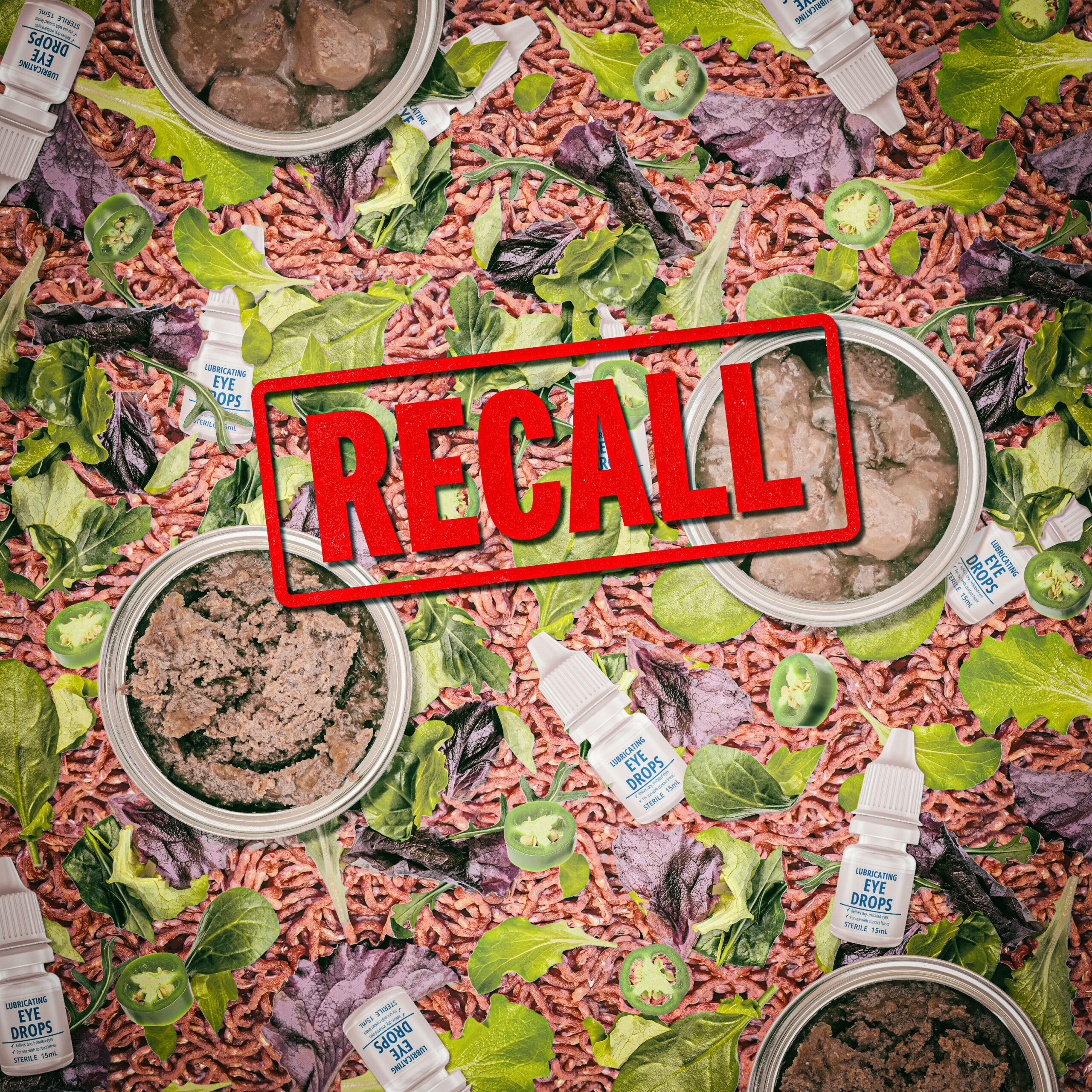

Salmonella in your jalapeños. Glass in your fruity popsicles. A “pallet nail was discovered in a loaf of Potato Sourdough Bread” earlier this month. And for a solid week now, Donald Trump has been cooking up some global scheme involving mystery meat. All in all, it really feels like a girl can’t simply kick back and enjoy “The Boys of Summer” at a late August cookout anymore without the whole party potentially devolving into that Final Destination: Bloodlines BBQ scene. (Out on the road today / I saw a RECALLED sticker on a salad pack …) So far, 2026 has been the year of food gone wrong—or at least, that sure is how it seems.
To go grocery shopping lately is to partake in a Squid Games challenge—one wrong flinch in the berry section and you could be toast, felled by the machinations of faceless enterprise and the Escherichia coli bacteria. To throw together a quick meal for the family is to briefly become that lady on Instagram who imitates a Claire Danes character crashing out, yelling things like, “What do you mean the Argentine beef was rejected by China??” and “I’m supposed to just know that Taylor Farms and Earthbound Farm are the same??” And this year’s issues stretch beyond consumables and into the pharmacy section. Few items are safe.
Picture this: You or someone you love is already experiencing a set of physical conditions that has placed you in the market for a bottle of Gas-X, a bar of “Boner Bears Sex Chocolate,” and some Clear Eyes eyedrops. (Not just any eyedrops—the Maximum Itchy Eye Relief formulation.) Now, go ahead and add a splash of factory-line coolant, a dash of “undeclared sildenafil,” and/or a “lack of assurance of sterility” to the equation, and you’ve got yourself whole new worlds of discomfort.
But there I go, babbling on about boner bears, as ever. You do probably have some questions about all of this mess. Lettuce attempt to find answers.
I ain’t reading all that. Is this about the explosive diarrhea lettuce?
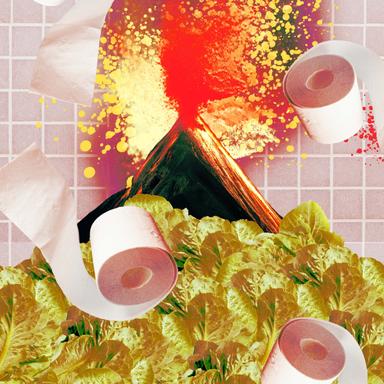
Yes—and beyond! By “explosive diarrhea lettuce,” I presume you mean the outbreaks of the microscopic parasite cyclospora that have sickened an estimated 17,000 people in the U.S. this year. Brought to consumers by produce that has been in the shit, literally, this gastrointestinal menace has wreaked havoc in the restrooms of at least 48 states, plus the District of Columbia. “You experience general discomfort and watery diarrhea like all get-out,” according to one Stanford infectious disease specialist. But that’s only the tip of the iceberg lettuce! The cyclospora situation is among some 160-plus recalls by the FDA and USDA so far in 2026.


What are some of the others?
How much time do you have? There are the usual suspects, like the 1.5 million cartons of eggs that might have salmonella, or the alfalfa sprouts with E. coli and salmonella. (Classic sprouts, tbh.) Then there are the more alarming headlines, like those Outshine fruit ice pops that possibly contain glass. (What’s the deal with all these shards?) Then there are the cult sensations: Ever heard of [checks notes] moringa leaf powder?
Who do I look like, RFK Jr.?
No, you’re more of a Gwyneth! But I hadn’t heard of it, either. Apparently it’s some superfood-y supplement, and since the start of the year, 131 people in 38 states have gotten ill with salmonella from the stuff, with 36 hospitalizations.
All this rot runs deep. Even good dogs are at risk for bad food; a brand named Oma’s Pride tested positive for salmonella. Which reminds me: All you human boy kibble enthusiasts out there need to watch out, too. Because there’s a new sick-to-your-stomach circus in town, with ringmaster President Trump performing some sudden meddling in the meat-grinder market.
Uh-oh, where’s the beef? (And also: Where did it come from?)
Last Friday, reacting to a recent surge in ground beef prices, Trump announced that the U.S. would allow 300,000 metric tons of foreign beef to enter the country tariff-free at prices he said would be up to 25 percent cheaper for consumers. But many found it odd when he declined to answer where he had sourced such a hot deal. Before long, an international meat of mystery conspiracy theory had developed, where online sleuths noted that a 22-ton shipment of Argentine beef had been rejected by China back in the spring (or should I say back in the fall?) on account of being spoiled by chloramphenicol. Could it be …?
Ha ha, very funny … right?
Well! Making matters more confusing, two weeks before Trump’s announcement, the USDA’s Food Safety and Inspection Service had quietly recalled a 30,000-pound shipment of meat from … Argentina … for having skipped import reinspection. (I appreciate that there’s a trade publication called Beef Magazine.) While this was ultimately found to be a shipment from a different Argentine company than the one China rejected, the timing was enough to raise more eyebrows at, and angst about, the White House’s cryptic quest for cheap beef.
Who is Trump doing this for?
If you ask the White House, it’s about cutting grocery prices for hardworking Americans. But if you ask the beef industry, you’ll hear that this new agenda mostly just harms American cattle ranchers. One letter to POTUS from the president of the American Farm Bureau Federation—whose name is Zippy Duvall—argued that Trump’s idea to import that much foreign beef “has created apprehension and chaos in the cattle market.”
Well, now I’m stressed! This is all way more recalls than usual, right?
Depending on how you define “this,” not necessarily. On August 21, the FDA sought to push back on the notion that this has been some Hot Recall Summer, posting on social media “Don’t believe the fake news” and attaching a chart arguing that recalls are at a decade low. According to a report by the U.S. Public Interest Research Group (PIRG) called “Food for Thought,” there were 320 food recalls announced in 2025 and 296 in 2024 (which you may remember as the Bad News Boar’s Head Era). So far this year, there have been something in the neighborhood of 162 food recalls, according to a KCRA investigation—meaning we may actually be on track to have fewer than last year.
Yet. As Bill Marler, a litigator who specializes in foodborne illness, wrote on his firm’s website, the FDA’s figures didn’t tell the whole story about food-specific recalls, instead lumping in drugs, medical devices, and tobacco recalls as well. (According to Marler and former FDA food safety director Susan Mayne, the food recall numbers are closer to an eight-year high.) What’s more, recall counts capture only the times someone figured out where the problem even came from. PIRG found that in 2025, 17 of 28 foodborne illness outbreaks did not lead to any specific recall. (In the vast majority of those cases, investigators never even identified the food.)
And even if recall numbers may be broadly in line with history, the number of people who have actively fallen ill in 2026 is notable. For example, last year a recorded 1,180 people got cyclospora between May and August, the high season. This year? It’s been something like 14 times that. It’s no wonder that this year feels so different, since it has caused a lot of Americans—more than 17,000 of ’em!—to feel really, really bad.
Is DOGE to blame?
Not entirely. For example, the probable source of the cyclospora outbreak, Taylor Farms de Mexico, hadn’t been inspected by the FDA in seven years, a lapse that stretches across multiple administrations. But the governmental cuts certainly haven’t helped matters (as Senator Richard Blumenthal recently argued in a strongly worded letter to the FDA). In Walter Isaacson’s biography of Elon Musk, the Tesla leader shared his “algorithm” for efficiency: “Delete any part or process you can—you may have to add them back later,” one part went. “In fact, if you do not end up adding back at least 10% of them, then you didn't delete enough.” Musk’s DOGE reign had a similar ethos. And it resulted in the loss of close to 4,000 FDA employees and another several thousand between the CDC and the USDA’s Food Safety and Inspection Service. And according to Wired, a CDC lab specifically meant to respond to cyclospora was whittled down from 11 people to three during DOGE-directed layoffs last year.
So what’s the biggest takeaway here? Is it mostly just: Steer clear of Taylor Farms?
On the one hand, good idea; on the other hand, good luck. This timeline, from Marler, shows a long and harrowing history of the company being at the center of food contamination events. These recent outbreaks have definitely called renewed attention to the way our consolidated food supply chains can take a contamination event and distribute the heck out of it. Last year, Taylor Farms, for example, made 40 percent of all U.S. salad kits—even if that isn’t always clear on the label. Products from Taylor Farms are sold not only under the Taylor Farms brand but also as things like Good & Gather and GreenWise. They’re found at Trader Joe’s, Kroger, Walmart, Whole Foods, and Target. The lettuce from Taylor Farms winds up at Taco Bell. The jalapeños make their way into the food at Chipotle and Qdoba. It’s guacamole whack-a-mole, all the way down.
Has this caused you, personally, to stop eating at Taco Bell, Chipotle, or Qdoba?
[Speaking too closely into the mic] Next question.
Hey, I’d probably rather get a parasite from fast food than lose a gallbladder to supposed healthful fare like “Daily Harvest lentils and leek crumbles,” you know?
The fast food world is definitely having some big problems that make me not want to visit certain places. But in many of those cases, it isn’t actually food contamination that’s the issue. Wendy’s, for example—
Wendy’s? The /r/WallStreetBets meme stock?
The one and only! So Wendy’s—which, quick backstory, is a downward-spiraling business that just might be taken private by Brooklyn Beckham’s father-in-law, Nelson Peltz—recently seconded the public perception that its food had gotten worse than mid. CEO Bob Wright, who joined the company after running Potbelly, admitted to The Wall Street Journal that Wendy’s had “prioritized cost savings over ingredient quality.” (The general reaction to this news on social media was: duh.) Not to be outdone, just this week Burger King acknowledged that customers found its chicken nuggets “rubbery” and vowed to change the formula. On the bright side, I hear the new Chick-fil-A waffle chicken sandwich is good? At least it has no lettuce or Maximum Itchy Eye Relief drops in it, that I’m aware of.
All the fast food stuff might be a separate category from food recalls, but I do think it all has the same cumulative effect on me, which is to create a constant layer of suspicion that really slimes up all the little daily moments of consumption. It’s like I’m always narrowing my eyes at a wall of food, trying to remember which brands are the ones that might land me in the hospital and which brands are the ones that private equity changed all the recipes of.
There’s the old joke that’s like, “The food there is terrible—and the portions are way too small!” The updated version these days would be “These frozen blueberries gave my entire family E. coli—and holy shrinkflation, can you believe how much of this bag is just air?” Meanwhile, the dog food has salmonella, and the tomato bisque potentially has listeria (and both of them probably claim to deliver 13g of protein, which is a whole ’nother matter for another day). If it’s not one thing, it’s another. As my mother-in-law likes to say: Problem solved! Next problem?
… I guess all that was more of a statement than a question.
I completely agree. Wait—do we have the same mother-in-law?
Final question: Given all of the above horrors, what are we having for dinner?
I hope you like a liquid diet.