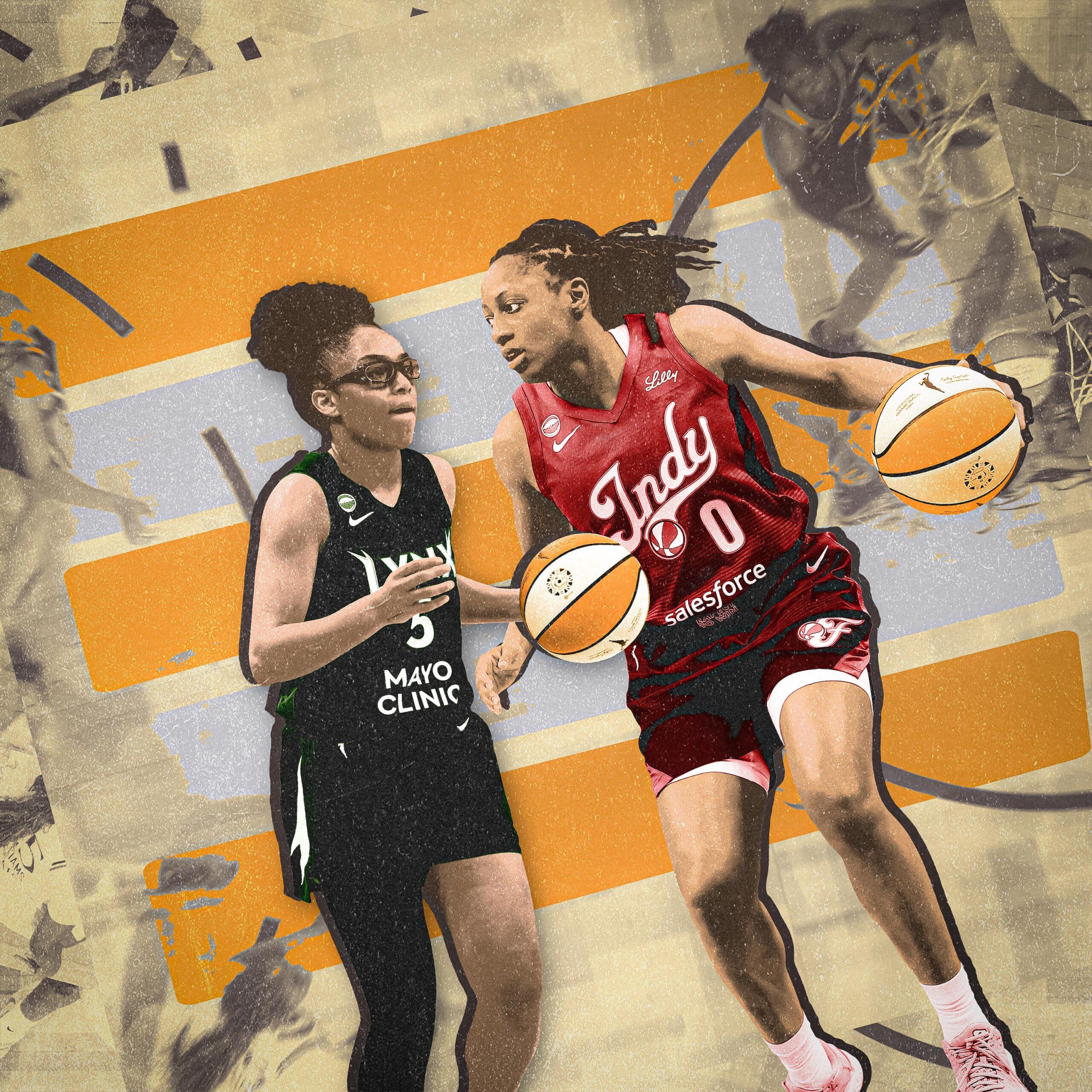

During a rare break in Sunday’s high-octane tilt between the Indiana Fever and the Minnesota Lynx, Olivia Miles caught her breath and used the brief respite to offer Kelsey Mitchell a compliment. “You so tough, man,” she said. “Oh my God.”
If you mistook a tightly contested WNBA game for a mutual admiration society of star guards, I don’t blame you. A league long defined by defense, physicality, and post play is now being overtaken by a golden generation of guards. Caitlin Clark bends defenses from 30 feet. Mitchell scores from anywhere. And Paige Bueckers and Miles are redefining what young lead guards can do. Every night, another backcourt with unguardable moves and unthinkable efficiency seems to take center stage.
In Sunday’s marquee clash, Indiana and Minnesota tied the WNBA record for total points in a first quarter (69), and each hit the 100-point mark by the end of the game. For so much of this clash, which the Lynx won 108-100, the only answer they had for each other was going back and forth.
This wasn’t an outlier performance from two offensive juggernauts, either. It was a window into the WNBA’s future.
Offenses as a whole are averaging a historic 87.3 points per game, obliterating the 83-point average the league had hovered under for the past five years. Teams are making triples, getting to the line, and scoring at rates the league has never seen. This season features five of the 10 best offenses of all time. Indiana and Minnesota, currently ranked no. 1 and no. 2 on offense, respectively, are pushing at the edges of a new frontier. The 2026 season also features the three worst defenses of all time, the Tempo, Sparks, and Fire. The Valkyries, the WNBA’s best defensive team right now, would rank 243rd of all time.
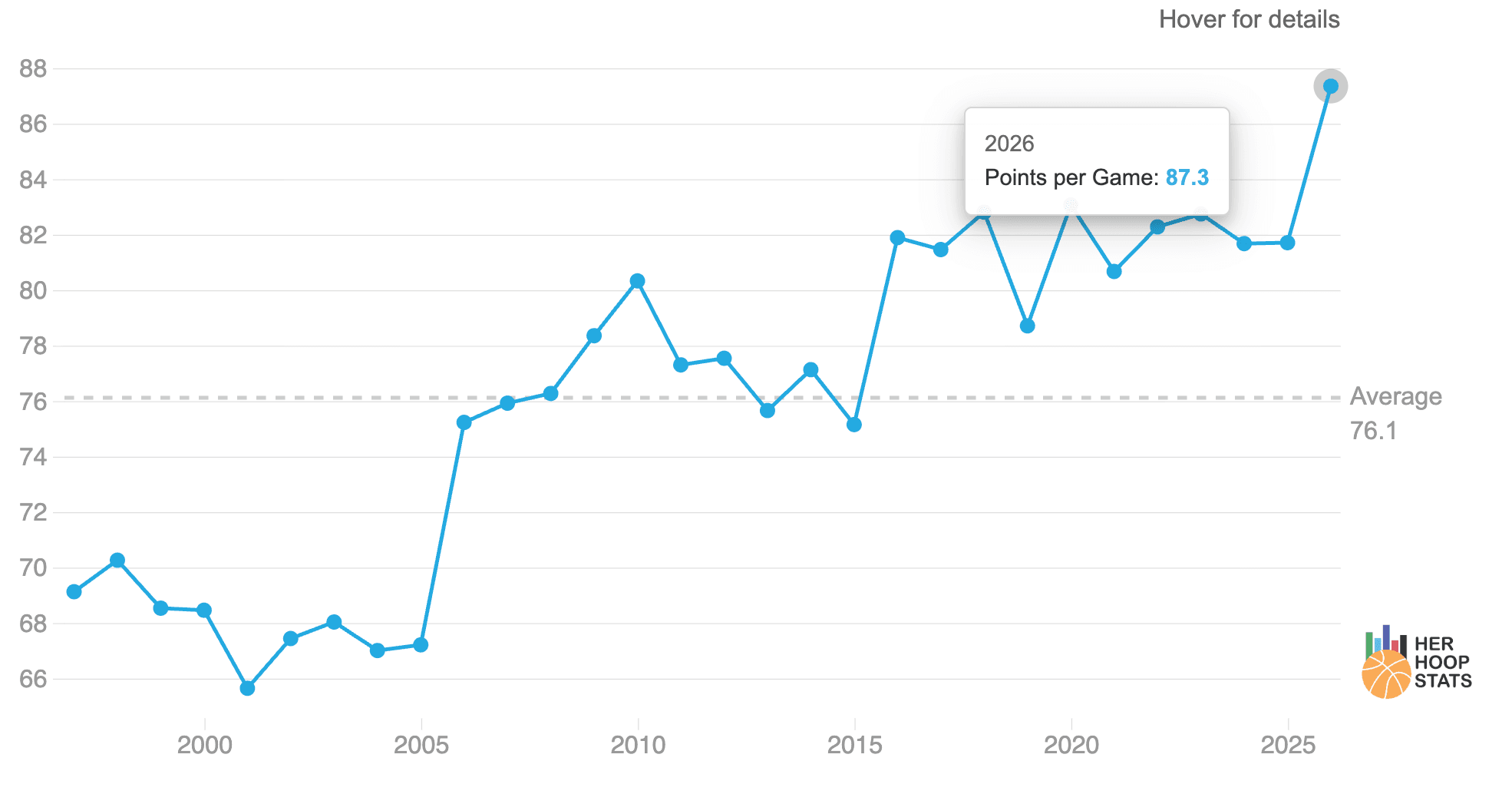
There are many culprits for this spike, from increased skill development around the league to more offseason rest to the proliferation of analytics. But no single factor has been as important as the WNBA’s emphasis on freedom of movement, a result of the new refereeing committee created after widespread discontent among players, coaches, and fans about the consistency of refereeing and the overphysicality of the game.
The results, which were immediate and game-changing when this WNBA season began, jumped off the screen in the Minnesota-Indiana clash.
To create more opportunities for guard play, teams are trading their tried-and-true post-ups for spread pick-and-rolls and isolations, and it’s had a downstream impact on every position.
Consider the fact that freedom of movement rewards speed, and it should come as no surprise that Mitchell, who finished with 37 points on Sunday, is averaging career highs in points, free throw attempts, field goal percentage, and 3-point percentage.
Courtney Williams, who finished with 27 points on 20 shots, has never gotten more separation on her midrange jumper.
Clark, who had 19 points on 10 assists, is tied for fifth in the WNBA in made free throws, after ranking 71st last season.
And then there’s Miles, who is in the midst of the best rookie offensive season of all time. It’s impossible to know how the 23-year-old would have fared in the old WNBA, but it likely wouldn’t have looked like the perpetual layup line we’re seeing now. Miles, who is leading all guards in made layups, got 16 of her 28 points against the Fever at the cup.
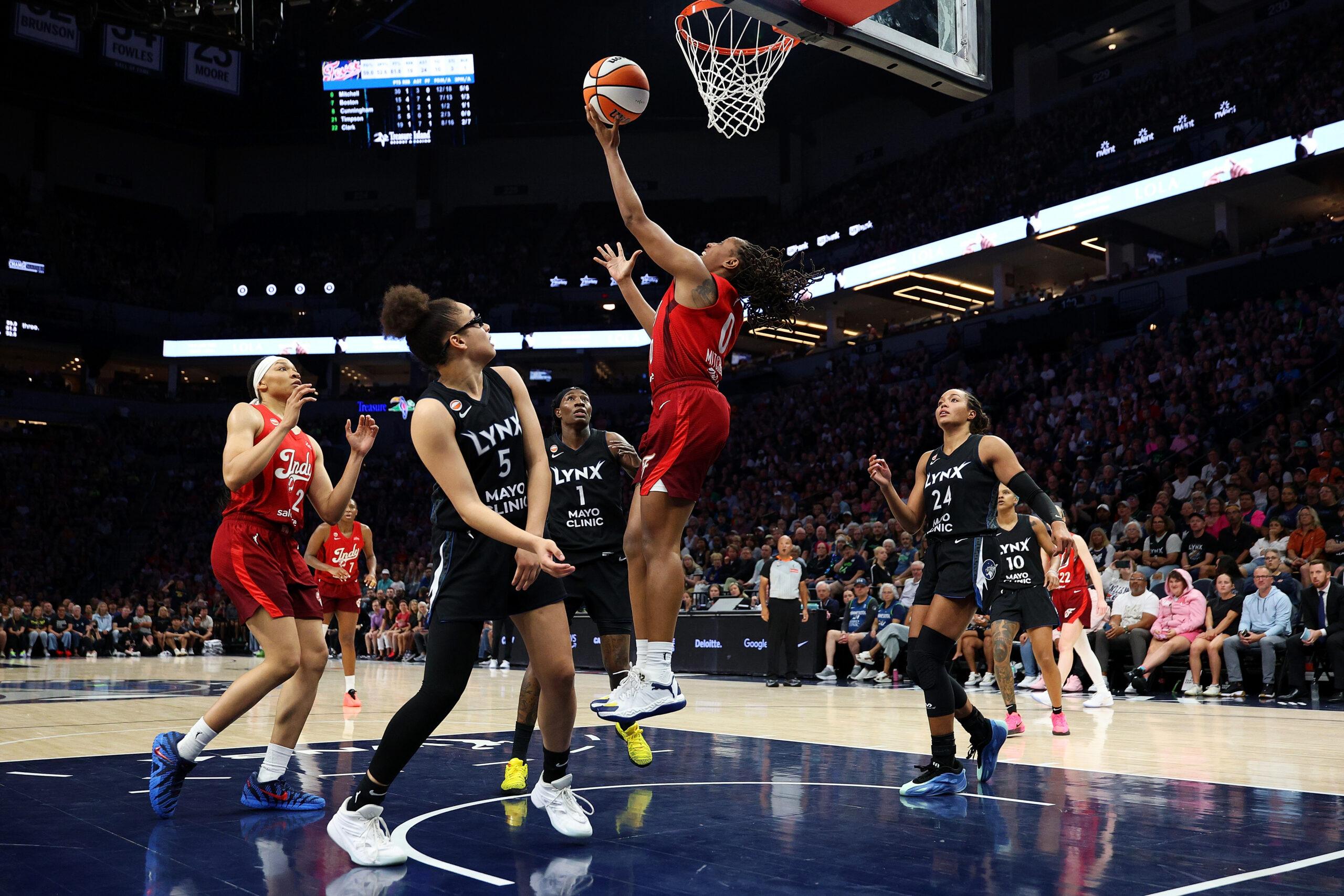
Kelsey Mitchell shoots against Olivia Miles
The vision of guards like Miles and Clark has turned WNBA defenders into employees in a panopticon, never quite sure when they’re being watched and when a lapse in attention will be punished by a cutter.
“Offenses are more complex,” Indiana Fever coach Stephanie White said after Sunday’s game. “In the older days, you guarded two or three people and you guarded two or three actions, and that was it.” Defenders, whose success often hinges on predictability, must now sift through infinite possibilities.
Every 2026 offense that’s currently sitting in the top 10 of all time has similar features: generational playmaking guards who can also score and bigs who can function as primary or secondary offensive hubs.
Consider the case of Jessica Shepard, a burgeoning triple-double archetype who could not have flourished if Bueckers and Azzi Fudd didn’t create the space for her drives to the rim. Their relationship is symbiotic. Shepard, a 6-foot-4 point forward who has the second-most layup points this season, is benefiting not from her own spacing ability, which is relatively limited, but from her teammates’. Shepard, in turn, sets blistering screens and finds open cutters with her playmaking.
The WNBA itself has adapted to the importance of spacing, adding a stat that measures gravity, or how much attention an offensive player draws relative to what the spacing predicts.
Coaches who’d spent their careers preaching “defense wins titles” are slowly acquiescing to new realities. What else are they to do, in the face of a 7 percent jump in scoring across the league, years of tactical evolution being compressed into a single season?
Becky Hammon, the Aces’ championship-winning coach, and the Valkyries’ Natalie Nakase, the most impressive branch from her coaching tree, are starting defensive specialists Stephanie Talbot and Kiah Stokes, respectively, but are increasingly finishing games without them because offensive possessions have become too valuable. (Golden State is also launching more 3s than any team in WNBA history.)



More on the WNBA
The Mercury, who have a bottom-five defense, just traded their best point-of-attack defender (Monique Akoa Makani) for Kelsey Plum, whose combination of output and accuracy on isolations and pick-and-rolls this season has never been seen before.
The Fever are remaking the game on offense and adjusting to it on the other end. White has tacitly lowered her defensive expectations, abandoning the early-season switch-heavy screens that often landed her offensive engines, Clark and Mitchell, in foul trouble. In a league where players are ruthlessly mismatch hunting, turning each possession into an interrogation, even defensive-minded coaches like White have to make concessions. It’s tantamount to losing the battle to win the war.
“I think you have to be solid [on defense],” White said after the game. “I think being middle of the pack is probably good because there are gonna be days you don’t make shots. You’ve gotta be able to at least force teams into the lower-percentage shots and force them to make those.”
This is coming from a coach who cut her teeth on the defensive end, who took the Fever job two years ago with a mandate of defensive improvement.
But the numbers don’t lie. In the past 15 games, the Fever’s historic offense has propelled them to the league's best net rating, despite their below-average defense.
It’s a good place to be in the context of the modern WNBA, where being able to score the ball is becoming the most important qualification for contention. Of course, thriving within that context still requires getting stops, which is why Minnesota eked out a victory on Sunday. When everyone can score, the few times you don’t will become decisive. Increasingly, the difference between a win and a loss is not whether you hold a team to under 80 points but whether you can shave five points off the score line of a team that’s regularly cracking triple digits.
For a team like Indiana, which has only one player—Makayla Timpson—with the athleticism and awareness to be in two places at once, defense is less about suffocating the opposition and more about surviving it.
It should be no surprise that Minnesota, with its spread pick-and-roll and floor-spacing bigs, finds itself at the top of this hierarchy.
“I'm excited for the fans,” Lynx coach Cheryl Reeve said at All-Star Weekend. “Really, all the players, but there's some really special guard play. We had Sue [Bird] and Diana [Taurasi]. This next era of guard play, Caitlin will be a big part of that. Olivia Miles will be a big part of that.”
What we are witnessing is likely just the beginning. Players like Miles, Bueckers, and Clark are laying the foundation for a host of on-ball creators at the top of the 2027 WNBA draft board, from JuJu Watkins to Madison Booker to Hannah Hidalgo. The league they’ll be entering has already crossed the strategic Rubicon that college basketball is approaching. Every level of the sport now rewards advantage creation, deception, and decision-making from its guards, who are learning to not only survive contact but also create it.
Pretty soon, the game will change again. Nothing stays the same for too long. Agile bigs like Awa Fam and Dominique Malonga, who can’t even legally drink yet, are already roaming, eating up the space that Clark’s logo bombs and Shepard’s crushing screens have created. They exist, and they are multiplying. Evolution bends toward necessity, after all. But until then, a game that has been dominated by giants has tilted, ever so slightly, toward its guards.