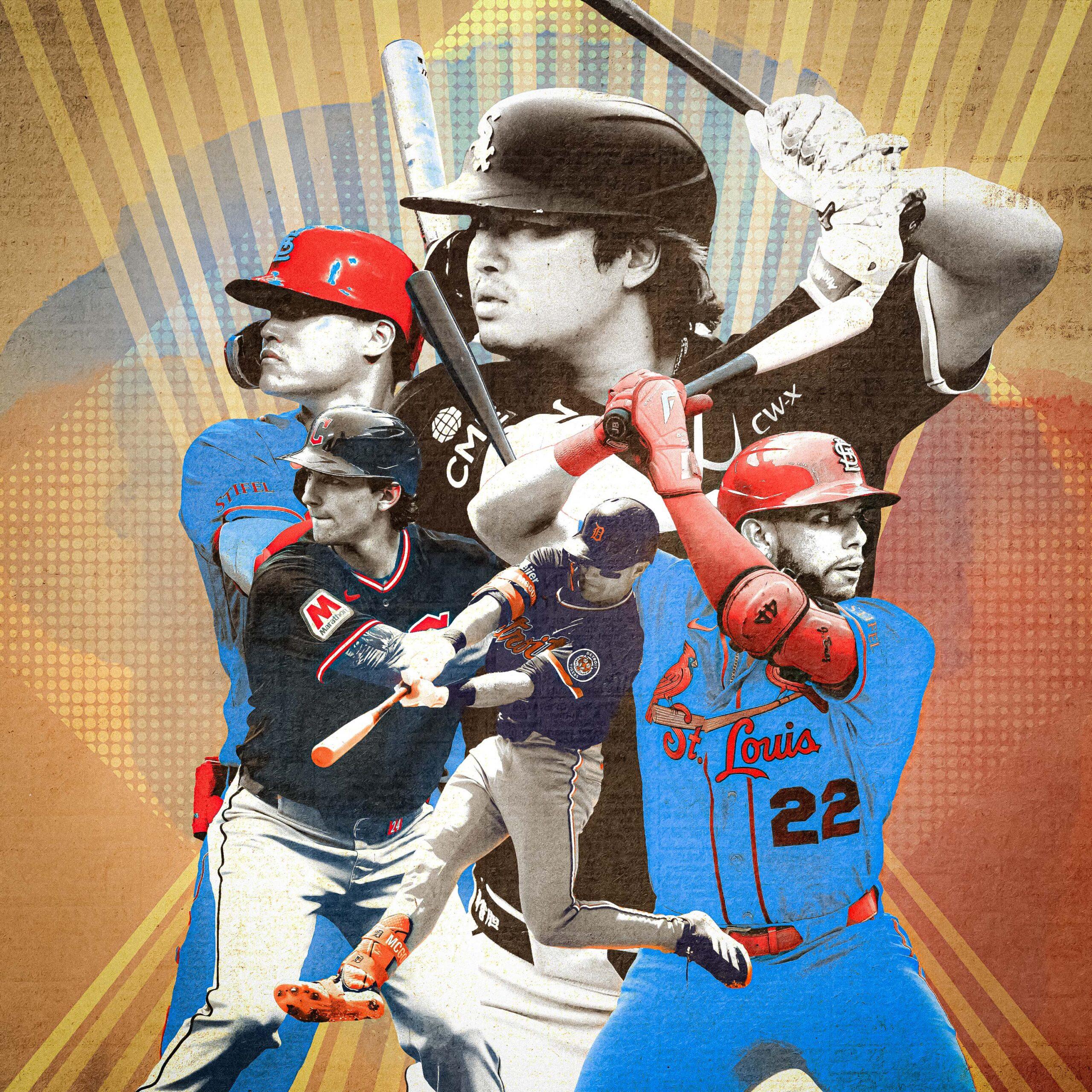

With one swing on Saturday, Joshua Báez sent fun facts flying. With a second swing, he rendered the first round of hype passé. And with a third swing, he set himself apart from every other player in major league history.
The Cardinals called up Báez, a 23-year-old, right-handed-hitting outfield prospect who was (and is) leading Triple-A in home runs, to make his major league debut in left field and the fifth spot in the order. The 2021 second-round draftee immediately demonstrated that his power would play in the majors. In the top of the first, Báez took Cubs starter Matthew Boyd deep—very deep—to center. With his 449-foot bomb, Báez became the first Cardinal to homer in his first at-bat since Lane Thomas in 2019, and the first Cardinal to homer on the first pitch of his first at-bat since Adam Wainwright in 2006. He also surpassed Aaron Judge for the longest homer hit by a player in his first at-bat in the Statcast era (since 2015).
Báez led off the top of the fourth with a blast to left that broke a 3-3 tie. That homer made him the third player ever to homer in his first two big league at-bats, after two previous St. Louis hitters: the Browns’ Bob Nieman, who did it in 1951, and the Cardinals’ Keith McDonald, who did it (over two games) in 2000. Then came the coup de grâce and pièce de résistance: In the sixth, Báez proved he has power to all fields by going oppo off Boyd for his third homer of the game. Báez—the 23,753rd player in major league history, by Baseball-Reference’s current accounting—is the first to go deep three times in his first game, in consecutive trips to the plate or otherwise. He’s also the first to record 12 total bases. Before Baéz, no player had gone yard three times in one game before his 10th major league contest. And few visiting Cardinals had elicited a standing ovation from Wrigley Field fans.
Three different pitch types, three different counts, three different batted-ball directions, same result. Báez had a four-homer game in June, but the Triple-A-to-MLB exchange rate makes three taters for St. Louis sweeter than four for Memphis, especially in light of the timing. “It’s just unreal,” he said. “For me to not only get a hit, but hit three home runs is just crazy.”
It was fitting that Báez would have arguably the best offensive first game in major league history because 2026 was already on track to be by far the best season ever for big league debutants. Never have hitters collectively made as positive a first impression as they have this year. In fact, they’ve never come close.
This season might be remembered for any number of feats. The Brewers’ Jacob Misiorowski hurled the fastest tracked pitch ever thrown by a starter. (Make that the fastest 90 pitches, and counting, thrown by a starter.) Padres closer Mason Miller could muster the most minuscule FIP on record. The Cubs’ Pete Crow-Armstrong may topple two-way star Shohei Ohtani in the NL MVP race by becoming a different type of two-way sensation: the first player since World War II to lead his league in both offensive and defensive value. (Snuffy Stirnweiss is the only other player ever to do so, in 1945.) The Astros’ Yordan Alvarez may win the first Triple Crown since 2012 and the second since 1967. (Relatedly, left-handed hitters are having their best year ever.) This season has stood out for exploits in mediocrity, too: One of the AL’s not-so-magnificent seven wild-card contenders could become the first team in a non-shortened season to make the playoffs without a winning record.
But the combined output of hitters in their first major league games might be the most mind-boggling performance of all. Players making their major league debuts have hit .325/.408/.613 in 285 plate appearances. If they had enough plate appearances to qualify for the batting title, they’d be in line to win one. Among individual players with at least that many PA, only Alvarez has bested—or even approached—the debutants’ 1.022 OPS, which has topped the MLB average (.719) by more than 300 points. It’s difficult to convey just how astounding that is, but I’ll try.
The table below shows the combined debut output of the 91 newly minted major league non-pitchers through Sunday’s games. Six of those players first appeared as defensive replacements or pinch runners and didn’t immediately make it to the plate, so the second row shows the collective stats for the same class of hitters in their first games with a plate appearance. Either way, they’ve absolutely raked, with non-park-adjusted OPS+ figures above 180—that is, more than 80 percent above league average—and better than average strikeout and walk rates. Maybe the majors are not that hard!
Offensive Performance by 2026 MLB Debutants Through August 16
To put this into perspective: Rookie hitters, as a group, always hit worse than the league as a whole. Relative to the average hitter, they’re inexperienced and immature, which makes them vulnerable prey for opposing pitchers. In their very first games, all of those trends are exacerbated by nerves, lack of sleep, and scant time to study scouting reports—plus, borderline talents who make major league cameos before washing out are weighted the same as top prospects who debut on Opening Day. Thus, hitters typically have particularly poor results in their very first taste of the Show. (Cue the “First time?” meme.) Entering this year, rookie hitters since World War II had posted a cumulative 88 OPS+, but hitters making their major league debuts had compiled only a 63 OPS+. MLB debutants hadn’t been better than league average in any single season since 1942.
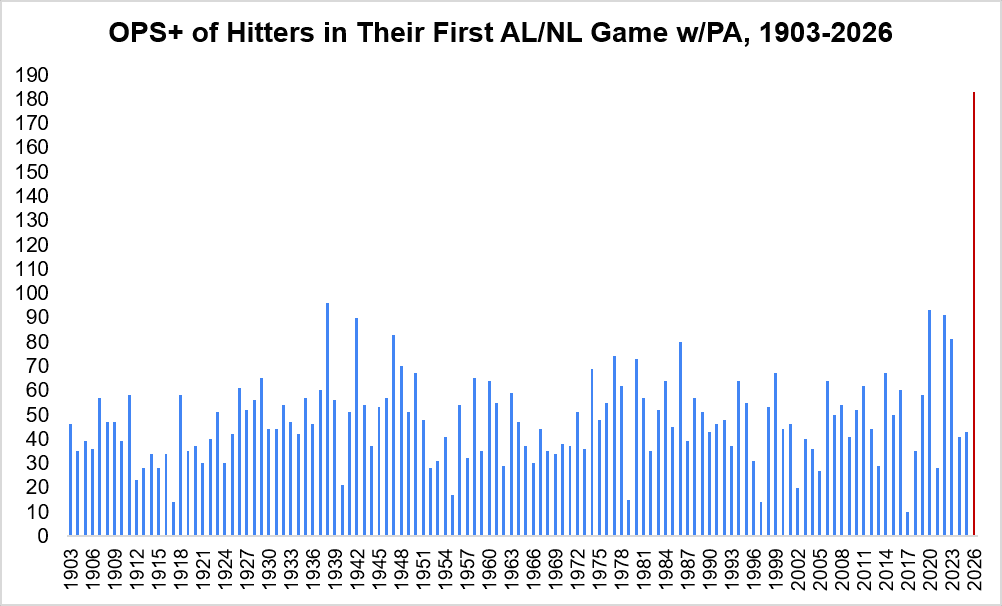
The graph below shows the yearly OPS+ by debut batters, dating back to 1903 (the year of the first modern World Series). The column for 2026 is displayed in red, not that a different color is really required to identify an outlier this extreme.
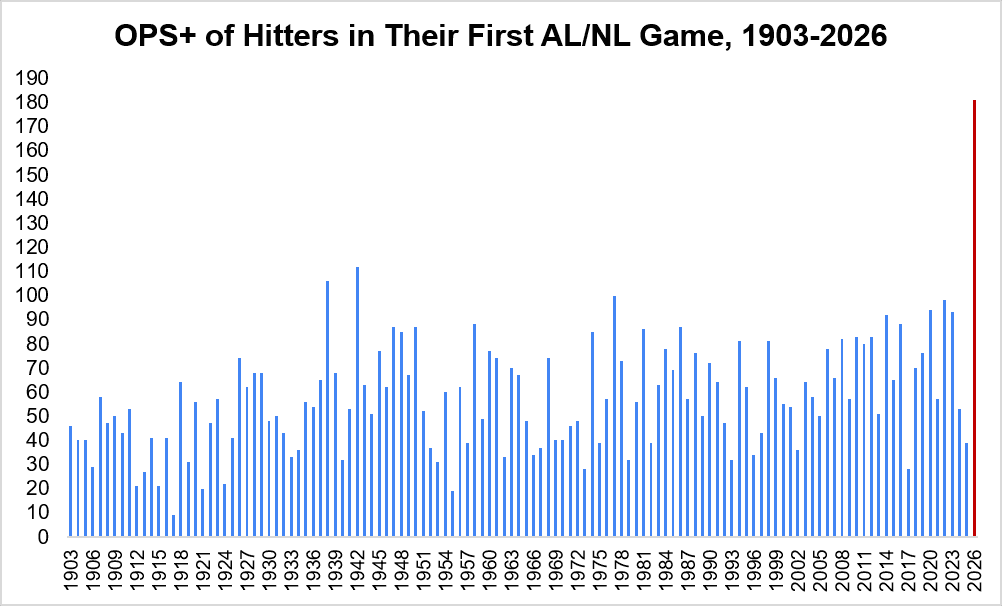
If we classify debuts not as first major league games, but as first major league games with a plate appearance, the post-WWII, pre-2026 baseline sinks even further (to an OPS+ of 50, instead of 63), probably because it encompasses more pitchers and other players who aren’t gifted enough at the plate to start or pinch-hit in their inaugural games. Yet this year’s debutant line only improves when viewed through that lens, thanks to solid first games at the plate by the Giants’ Daniel Susac (3-for-3 with a walk), the Padres’ Sung-mun Song (2-for-4 with a double), the Nationals’ Andrew Pinckney (1-for-2 with a homer), and the Angels’ Omar Martínez (a pinch-hit single), all of whom pinch-ran or subbed in on defense in their actual debuts. If we count first games with a plate appearance as batting debuts, MLB noobs had never equaled league average before this year.
Let’s display the annual debutant OPS+ totals by this method, too, to underscore even further that one of these things is not like the others.
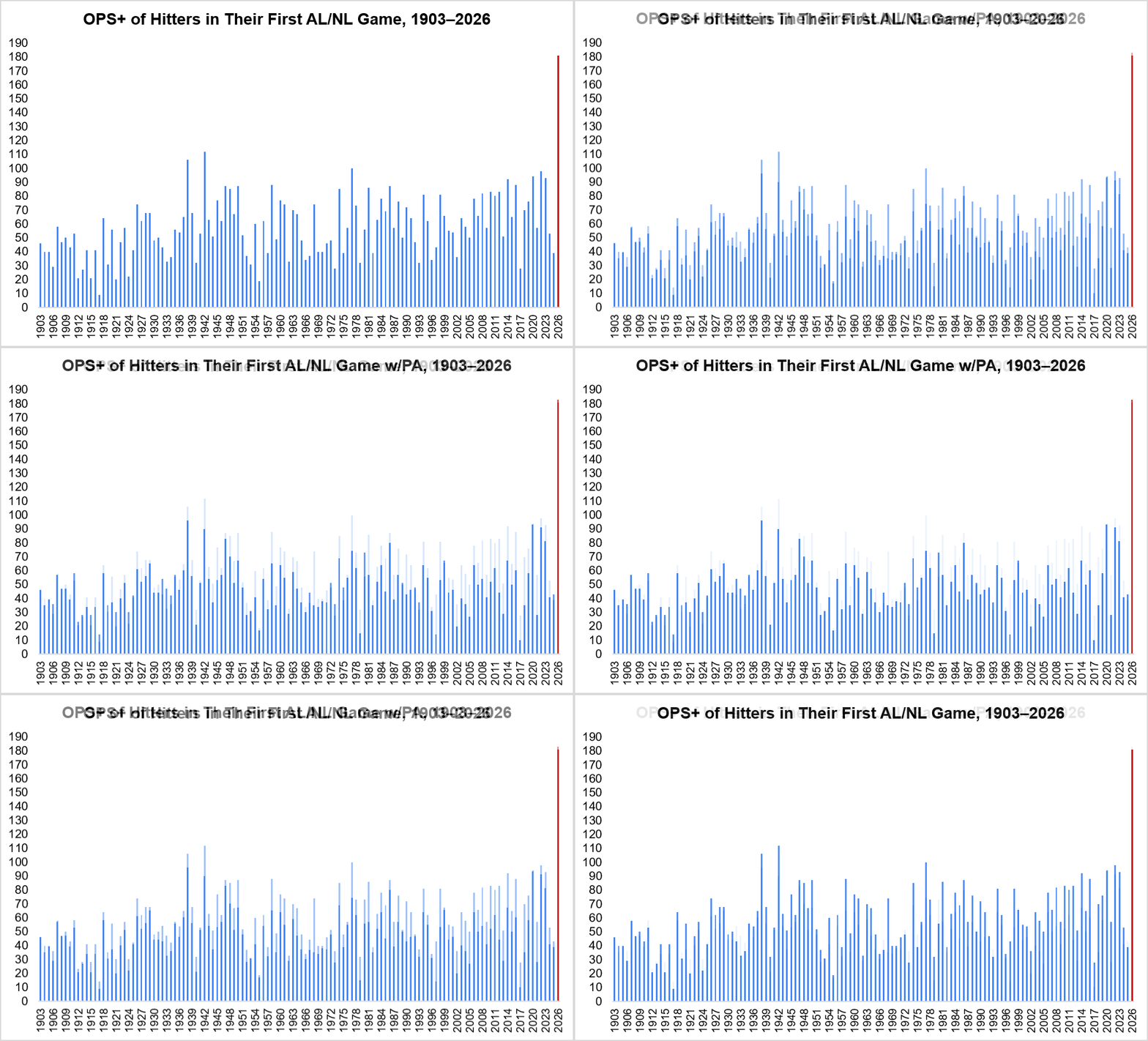
A GIF that alternates between those two charts might make the contrast more clear:
Obviously, we’re not talking about an enormous sample of playing time here, so some random fluctuation is to be expected. But no year has a huge sample of debut games. Given that the majority of major league seasons featured fewer teams and/or games than the 2026 schedule, this year’s count of approximately 300 debutant plate appearances is already larger than most past sums. (The mean and median PA totals from 1903 through 2025 were 219 and 204 PA, respectively, for all debuts, and 289 and 268 for batting debuts.)
Yet this season’s batters have hit the ground running to a degree that dwarfs any earlier cohort. And their early-season success has stubbornly resisted regression. I first spoke at length about this debutant outburst on a podcast published on May 27. At that point, the first-timers’ OPS+ stood at 162, which I thought couldn’t last. And it didn’t: Weirdly, it went up. I decided to write this piece on Saturday, after marveling at Báez’s banner day. On Sunday, Báez went 0-for-5, with three strikeouts. (After lining out in his fourth and final at-bat on Saturday, he’s now in an 0-for-6 slump. Might be time to demote him.) But the debutant stats got even better thanks to the latest entrant, Tigers outfielder Brett Callahan, who managed a two-run triple on his first MLB pitch in Sunday’s game against the White Sox.
Now, there’s one significant confounding factor we haven’t accounted for: pitchers’ performance at the plate. Pitchers used to hit generally pretty pitifully. Mercifully, they don’t anymore. That means we’ve been comparing debuts from the universal DH era (2020 and 2022-present) to debuts from the pre-DH era (before 1973) and the AL-only DH era (1973-2019, plus 2021). To make things more consistent, we can remove all pitcher debuts, which yields the following chart.
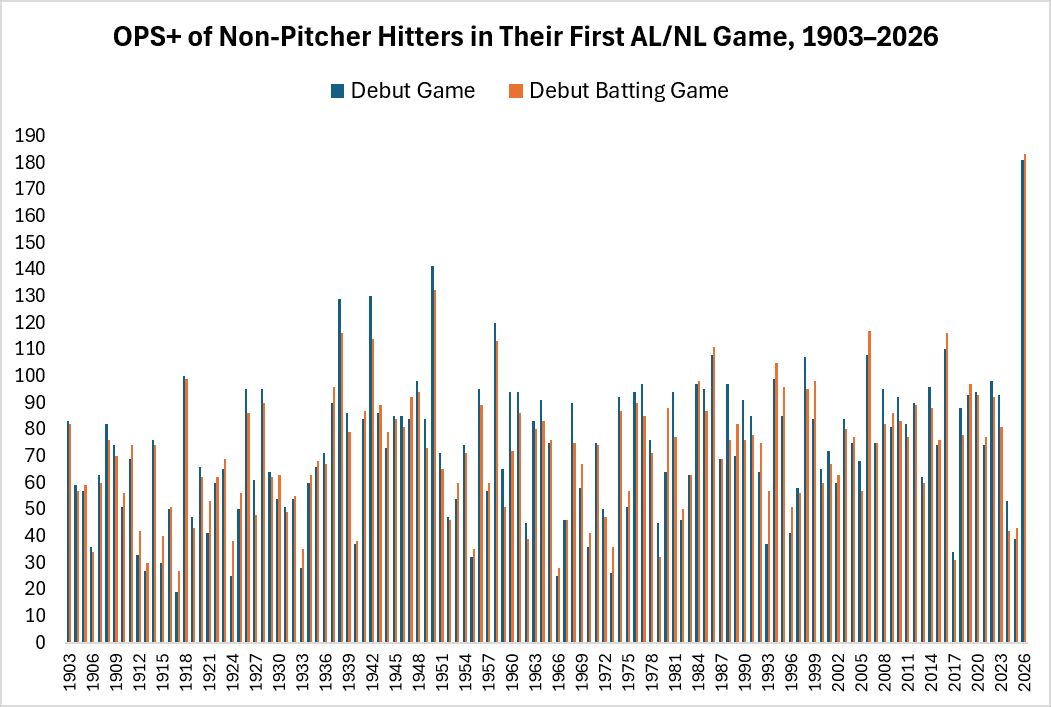
With pitcher hitters stripped from our sample, debut batters have been … well, still pretty terrible: Entering this year, they’d produced a 78 OPS+ in their debut games, and a 76 OPS+ in their debut batting games, since World War II. Even with the resulting smaller samples of playing times, no previous season’s numbers approach the peak of 2026. However, a few years (most recently 2016) poke just above the league-average OPS mark, which makes this season seem a little less extreme.
Only slightly, though. The genre of fun fact that followed Callahan’s triple—he’s the third position player since the start of pitch-by-pitch data in 1988 to hit an RBI triple on the first major league pitch he saw, and the first Tiger to triple in his first plate appearance since Ed Irwin in 1912—has become commonplace this season. Heck, Báez was the third Cardinal this year (after JJ Wetherholt in March and Bryan Torres in May) to homer in his first major league plate appearance, which ties an all-time team record. And on the debutant total bases leaderboard, two other 2026 regular-season arrivals, the Guardians’ Chase DeLauter (who admittedly made his postseason debut last year) and the Diamondbacks’ José Fernández, are tied for fourth at nine. DeLauter, Fernández, and Báez all homered multiple times in their inaugural regular-season games. No other season has boasted more than one such achievement. While we’re at it: Four big-name neophytes (Wetherholt, DeLauter, Munetaka Murakami, and Carson Benge) hit homers in their team’s first game of the season, doubling any other year’s total.
The early hits have kept coming, so we can keep listing highlights from the novices’ sizzle reel. AL Rookie of the Year favorite Kevin McGonigle started his season (and Detroit’s) with a four-hit, two-double day, making him the sixth debutant ever with a four-hit game on Opening Day. Another top Tigers prospect, Max Clark, chipped in a two-double day of his own (with three hits in total) on July 31. Joshua Kuroda-Grauer of the A’s had a three-hit debut on June 29, and the Guardians’ Angel Genao delivered the first four-hit debut in franchise history on August 5. On June 9, Braden Montgomery of the White Sox contributed the fifth walk-off homer ever hit in a big league debut, and the first since 2015. You get the point: Brand-new big leaguers raked at a historic rate right out of the gate, and they’ve hardly slowed down since. (Pitcher debutants, however, haven’t been anything special: In 258 1/3 innings pitched, they’ve posted a 4.56 ERA, a 4.59 FIP, and a 1.46 WHIP, with a 19.9 percent strikeout rate, a 12.7 percent walk rate, and 29 homers allowed.)
Before 2026, the latest day in any year with a debutant OPS+ as high as the present season’s 181 was April 20, 1938, when the newbies boasted a 183 OPS+ through 58 plate appearances. In the integration era (1947 on), it was April 16, 2004, when the first-timers owned a 184 OPS+ through 45 PA. If we exclude pitcher hitting, then the all-time and integration-era records, respectively, are May 15, 1938 (185 OPS+ in 64 PA), and May 12, 1971 (187 OPS+ in 22 PA). That this year’s newcomers have maintained that pace through mid-August, and several times as many plate appearances, is flabbergasting.
The 2026 rate stats are sure to decline between now and the end of the season (or so I keep saying), but the numbers to date are so gobsmacking that debutants could go 0-for-their-next-100 and still have a higher OPS than the league. Plus, as evidenced by Báez’s promotion, we’ve reached a point in the season when a bunch of blue-chippers tend to get the call. Historically, more players—and better players—have debuted early and late in the season than in the intervening months, although these days, September rosters max out at 28 players, instead of 40 as they did before this decade.
AL/NL Debutant Counts and OPS+ by Month, 1947-2025
The accomplishments of 2026’s MLB greenhorns have made for one of the season’s most exciting story lines. (Murakami alone has been extremely fun to follow: Dogged by doubts about his ability to hit high velocity, the precocious, personable Japanese slugger signed for a fraction of what he was expected to command but has handled high speeds just fine en route to a three-true-outcomes-heavy 150 wRC+.) But do these heroics by big league beginners mean something? Well, maybe. Buoyed in part by big debuts, rookie hitters have posted a 97 wRC+ this season, which would be an all-time high. (Technically, a handful of years have been better with pitcher hitting removed.) Rookie batters have accounted for 11.5 percent of non-pitching WAR, which trails the totals from only two other celebrated bumper-crop years, 2015 (13.3 percent) and 2023 (11.8 percent).
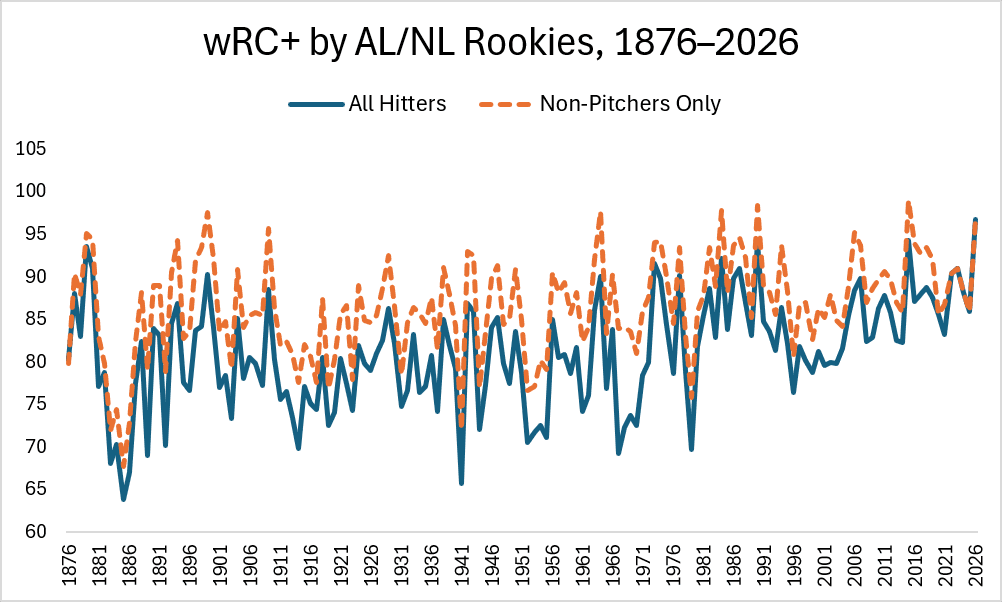
That much, at least, is in line with recent trends. As the batter aging curve comes to favor youth—whether because of increased pitch speeds, improved player development, or some other factor—big league hitters are getting younger by the year. Although there’s a perception that the difficulty gap between the minors and the majors is bigger than ever, that doesn’t seem to be true. Teams are promoting players from the minors more quickly and expecting the tenderfoots to flourish, or at least hold their own, from the get-go.
So far this season, they’ve done so, spectacularly. And yes, that makes some sense, considering that young batters are getting better. But let’s not mistake this debutant-batter outburst for the new normal. (After all, MLB greenhorns struggled last year and the year before.) We’re witnessing a singular, unsustainable, scintillating heater, so savor what we’ve seen. We normies never get a second chance to make a first impression. Neither do MLB batters, even if Jake Rogers’s recent team hopping has put that contention to the test. But this season’s fresh faces haven’t needed many mulligans. For them, the first time’s been the charm. And for Báez, the second and third times were pretty nifty, too.
Thanks to Michael Mountain and Preston Salisbury for research assistance.