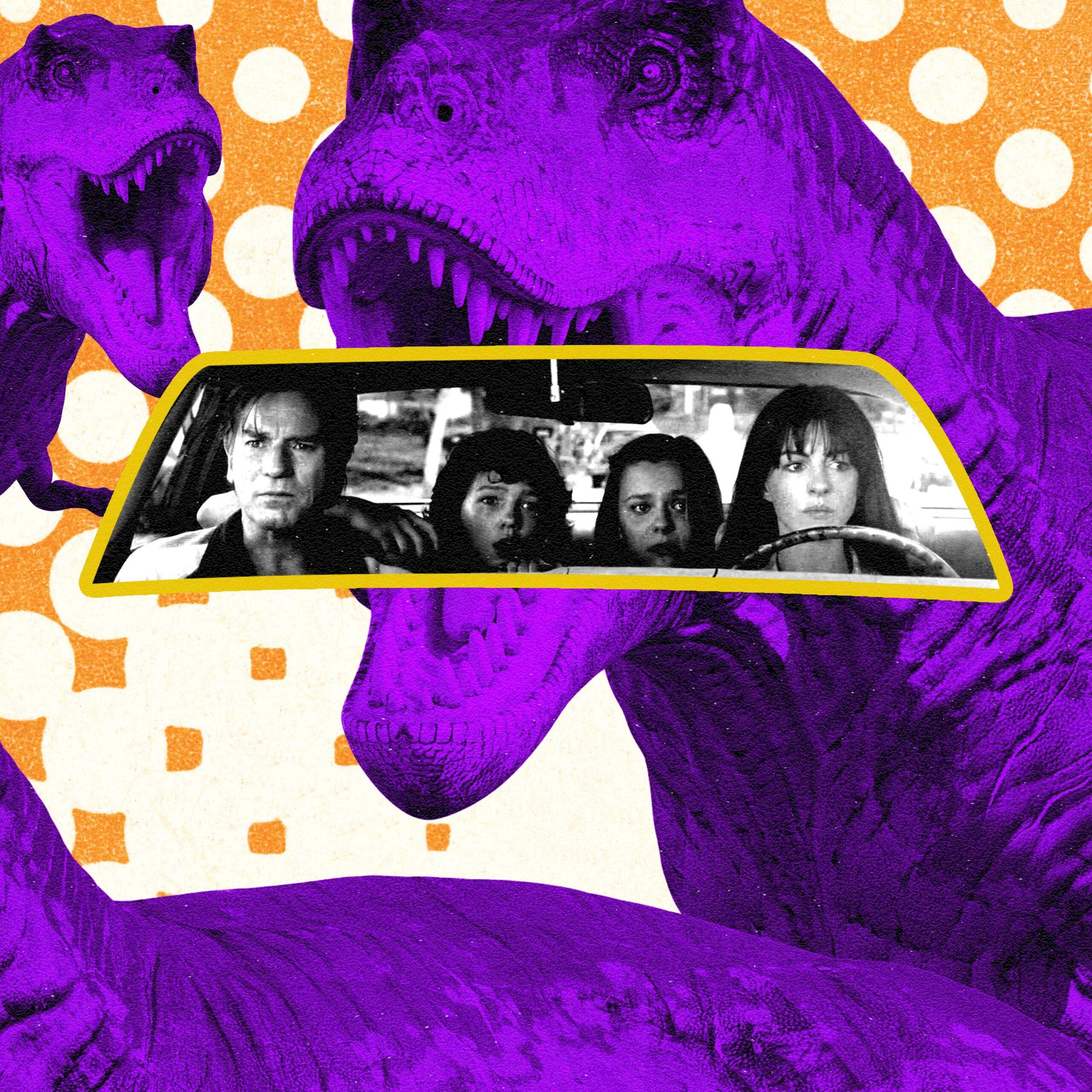

J.J. Abrams likes to call his movies mystery boxes. But The End of Oak Street, coproduced by Abrams, arrives unwrapped. The posters and trailers have already conveyed the premise of David Robert Mitchell’s refreshingly reckless sci-fi-thriller, in which an affluent suburban enclave gets scooped up out of time (the 1980s) and space (Michigan) and deposited into the Cretaceous period. There is thus no need to be coy about what’s going on here, and we can cut to the chase (and there are a lot of chases). The predators are dinosaurs, lithe and feathery-like vultures who are perpetually hungry. The prey are the people whose neighborhood has inexplicably been twilight re-zoned, and who now occupy the lowest rung on the food chain.
“Is this the end of the world?” asks a girl anxiously sheltering in place behind barricaded windows and doors. It’s a good question, although it seems that she and her family are trapped closer to the beginning. The classic time travel paradox involves characters trying their best not to alter the past lest it mess things up later on down the line. The End of Oak Street inverts the equation. There’s no Doc Brown and no DeLorean, and there’s no time for chin stroking, either. Kill or be killed, and let the cosmos sort it out. Late in the film, the main characters, who’ve spent 24 hours living by the skin of their teeth, are confronted with a metaphorical leap of faith. They discuss who should go first and why; ultimately, Mitchell gets a big, cathartic laugh by having one of them simply hurl themselves into the unknown, caution to the wind. Beats passing through a reptile’s digestive tract.
On one level, The End of Oak Street is nothing more—or less—than a swift, satisfying exercise in fight-or-flight suspense entertainment. It’s an escapist adventure with enjoyably ropy special effects and a nasty visceral kick. The film also gives the PG-13 rating what is surely its most limber workout since the glory days of Joe Dante: Limbs are unceremoniously severed, and skulls are duly chewed. There’s a second and more interesting movie contained inside, however—one waiting to shed its skin and reveal itself as a fairly morbid allegory about apocalyptic hinge points and our collective proximity to extinction. The first sign that things are out of whack in the featured cul-de-sac is that the weather has gotten unseasonably hot; eventually, the monsters slithering across the street take a back seat to a raging forest fire as the central source of threat.

“We’re like butterflies who flutter for a day and think it’s forever,” says teenaged Audrey Platt (Maisy Stella), harshing the vibe of an otherwise idyllic neighborhood block party. She’s quoting Carl Sagan, who’s not exactly a household name among her peer group. Given the kids'-eye vibe of Mitchell’s script, it’s fair to slot Audrey and her younger brother, Brian (Christian Convery), on the far side of the archetypal jock-nerd axis. Brian spends his time pedaling down side streets with his pals, dodging bullies and ogling girls; they could be auditioning for a remake of Stand by Me.
The grown-ups are similarly familiar. Denise (Anne Hathaway) is a would-be novelist working on a manuscript about a stifled housewife who’s ready to flee the coop; she types out chapters of her roman à clef in the basement while pretending to do the laundry. Husband Greg (Ewan McGregor) sees her subterfuge and raises it, sneaking out to the garage for a belt of whiskey. He’s hiding something worse than booze, though, and Denise knows it; he quickly changes the subject whenever his wife tries to talk to him—quietly—about D-I-V-O-R-C-E.
Suffice it to say Stranger Things have happened in recent American cinema than yet another wistful Reagan-era genre pastiche: Abrams has made such things his specialty. But Mitchell, who’s an idiosyncratic director a couple of generations removed from this milieu, is playing a different game than his producer. Despite its pile-up of lovingly detailed production design and scattered I-Love-the-’80s ephemera—vintage Froot Loops boxes and discarded Simon games, J. Geils Band posters on the walls and Playboy magazines stashed under covers—The End of Oak Street isn’t peddling nostalgia. Nor is it lamenting the good old days, for America or American movies. Rather, the period setting exists—if not in quotes, then in italics—as just one more trope tied to those underlying and melancholy themes of time and perception. Nothing lasts forever, for butterflies, or for human beings, or for Hollywood.
The analog backdrop is also a useful tool to keep modern technology out of the equation and isolate the characters from any sort of immediate understanding of their situation. Not a cellphone in sight, everybody just vibing (or running for their lives). Denise has to go to the library to cross-reference her Polaroid of the odd plant growing in the neighbors’ yard with images of Mesozoic foliage. Instead of drowning her sorrows in Spotify, Audrey sneaks into the garage—like father, like daughter—to listen to Steve Winwood on a dashboard tape deck (the song is “Valerie,” a lovely bit of shorthand for thwarted yearning). Meanwhile, Brian, who’s trying to reconcile himself to the new world order, flips studiously through a set of dinosaur-themed picture books, a bit lifted directly—and unmistakably—from Jaws.
Of course it does, and also from E.T. and Poltergeist and of course Jurassic Park. (There’s even a gag involving a miniature mountain of dinosaur shit.) In a year where Steven Spielberg has already made a movie that’s illegible as a meditation on the enduring power of his own filmography, Mitchell’s venture into stylistic cosplay is well timed. It’s also well executed. Freed from director jail nearly a decade after the failure of the underrated (and generally misunderstood) noir-tinged satire Under the Silver Lake—also a movie about the end of the world—he wears his vintage Amblin hand-me-downs with aplomb. There’s more dexterity per set piece in The End of Oak Street than in any other summer release so far, a gliding confidence that variably activates and booby-traps the widescreen frame.
That virtuosity should come as no surprise to acolytes of Mitchell’s It Follows. You can basically feel the director grinning behind the camera as he and his gifted cinematographer Michael Gioulakis restage that film’s slow-burning stalker iconography with a hungry—yet eerily quiet—Tyrannosaur that comes loping quietly into frame behind the protagonists’ backs like one of It Follows’ mournful ghosts.


The main problem with It Follows was the way that its originally taut visual and conceptual gimmick went slack from overuse. Something similar happens in Oak Street, which runs just over an hour and a half but feels weirdly distended anyway; when Brian sneaks out in the middle of the night to try to rescue his lost dog, Starbuck, it seems less like a decision made by a character under duress than a screenwriter looking for an excuse to put his protagonists further through the ringer. In the absence of any really significant human foils, the encounters between the Platts and the creatures going bump in the night can’t help but grow repetitive. What keeps things pressurized are the game, committed performances by the actors (Hathaway should spend more time splattered in blood and hacking away at CGI eels—she’s really good at it) and Mitchell’s refusal, at once obstinate and endearing, to try to rationalize anything that’s happening.
Where he does ultimately falter—and it’s unfortunate—is in bringing things to a conclusion. The startling lack of closure at the endings of both It Follows and Under the Silver Lake suggested a filmmaker who was willing to play with the rules of genre, for fun and for keeps. (Under the Silver Lake’s final anti–grace note, squawked out by a parrot, is especially clever.) The End of Oak Street, though, is on its best behavior in the homestretch. Mitchell isn’t the first filmmaker to smooth over his own work’s more jagged edges, and he’s obviously having fun showing off his skills as a crowd-pleaser: There’s one moment involving Starbuck that’s sure to bring the house down.
It’s nevertheless extremely frustrating that after setting up one of the more vivid no-win situations in recent memory—and bringing the hammer down hard with a genuinely startling mid-film twist—Mitchell gets antsy and sets about carving out a series of escape hatches, for his characters and also for himself. There’s a more ruthless version of The End of Oak Street that actually obeys its own brutal illogic all to the very end—one that honors Sagan’s awestruck fatalism. But Mitchell can’t quite bring himself to make it. (The dedication on the end credit offers a hint about why.) The climate change anxieties hovering in the margins of the film stay there; the final shot literalizes the idea that all Mitchell’s truly doing in the end is fucking around with some dinosaurs. Not that there’s anything wrong with that, exactly—but there’s only so much right about it as well.