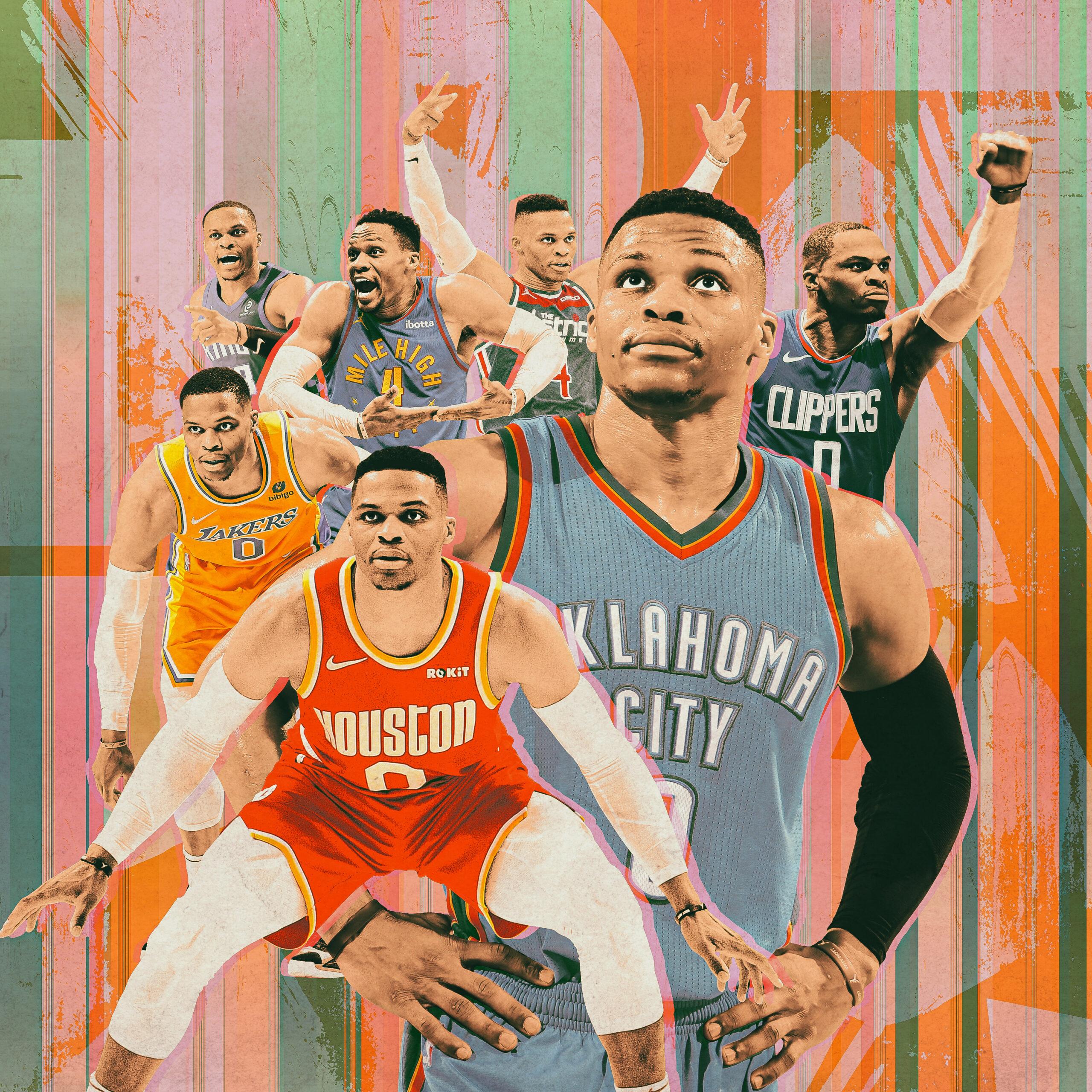

At the end of his singular 18-season career, it’s borderline impossible to fully capture just how wonderfully messy Russell Westbrook was: overwhelming, extraneous, unstoppable, self-destructive, essential, and irrelevant.
The 37-year-old announced his retirement on Wednesday. His list of accomplishments is loud and indisputable. Westbrook is a nine-time All-Star who made nine All-NBA teams. He led the league in assists three times, earned two scoring titles, and tallied an NBA-record 221 triple-doubles. After averaging 31.6 points, 10.7 rebounds, and 10.4 assists per game during the 2016-17 regular season, he was voted the NBA’s Most Valuable Player even though he played for a team that finished sixth in the standings.
Westbrook’s drive was insatiable, and he spent every minute of his career playing like he was starving, a quality that made him one of the NBA’s most endearing, vulnerable, and entirely uncompromising figures. His heart, grit, and competitive spirit couldn’t be taught or learned. Westbrook wasn’t jovial, didn’t care whether people liked him, and only thought to function in the fastest, most reckless gear imaginable. Why not?
His heart, grit, and competitive spirit couldn’t be taught or learned. Westbrook wasn’t jovial, didn’t care whether people liked him, and only thought to function in the fastest, most reckless gear imaginable. Why not?
The tragedy, then, of what came to pass is directly connected to everything that made him great. Any point guard who flaunts explosiveness and audacity as their two most appealing qualities probably won’t age very well. Doubly so if that player can’t shoot, is not efficient, and expects to dictate the outcome of every single possession with the ball in his hands. As the league’s priorities began to shift beneath Westbrook’s feet, so did his influence. According to counting stats, he was immortal. According to a combination of advanced analytics and the experience of watching him inundate possessions with his own flaws, he was toxic.
Regardless of what else you bring to the table, a broken jump shot tends to have the final say. Westbrook’s was an affliction that didn’t go away. His sensitive reaction to the “Westbrick” taunts always came off like someone in denial. Combined with the fact that he’s one of the 75 best players who ever lived, this all complicates a legacy that encompasses the sheer thrill of watching a 6-foot-4 guard hold the entire game in the palm of his hand—living at the rim with a first step that could spark a match—and the sheer disappointment of watching that same guard become a cautionary tale, one replete with hubris and a transparent unwillingness to accept his shortcomings or embrace the inevitable inroads cut by Father Time.
Amid various stages, incredible moments, and endless memes—so many goddamn memes—there’s a dividing line in Westbrook’s career. A before-and-after moment on the day his ever-complex relationship with Kevin Durant went from “reluctant costar” to “mortal enemy.” In publicly spurning the Oklahoma City Thunder on July 4, 2016, KD also rejected his All-NBA teammate’s insatiability. It was, indirectly, an indictment of Westbrook’s headstrong unwillingness to curb a game that could probably use some guardrails. In response, hilariously, Westbrook tripled down on who he was, through and through.
I don’t think I’ve ever seen a player commit himself to an all-consuming crusade quite like I did in Westbrook’s 2016-17 season. I didn’t have an MVP vote that year and thought James Harden and Kawhi Leonard were superior in just about every way, but Westbrook’s effort to prove everyone (i.e., Durant) wrong was breathtaking. His usage rate that year remains the highest in NBA history, and his true usage rate (which includes more playmaking attributes that better measure just how involved Westbrook was) vaulted to 78 percent. In BBall Index’s entire database, that mark is nearly 10 percentage points higher than any other player’s.


This isn’t to say Westbrook was subpar from that moment on, but his obsession with maximalism forever confirmed a penchant for self-indulgence that was hard to shake. He never seemed like someone who wanted to (or could) play any other way. Westbrook’s peak was the basketball equivalent of a pig in shit, but as the years passed by, words like “sacrifice” and “adjustment” failed to crack his vocabulary. Related: He’s retiring having won only one (1!) playoff series without Durant by his side. Eventually, after he played for six teams in seven years, Westbrook’s shtick grew tired. The lack of introspection that spurred him to history-making highs ultimately led to his undoing. It grated on teammates and coaches. Sometimes, in life, a filter can be beneficial.



More on Russell Westbrook’s Career
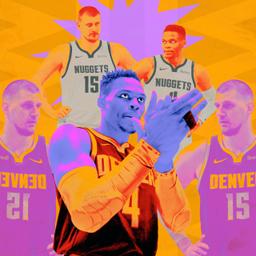
To his credit, Westbrook lasted longer than someone who clearly doesn’t impact winning should have. As late as the 2024-25 season, when he was seemingly a decent fit for the Denver Nuggets, Westbrook’s sheer willpower tantalized anyone who remembered his prime. How could you not respect someone with that résumé? Nikola Jokic did. Same with LeBron James, who, depending on how you look at it, might’ve cost himself another ring by hitching his wagon to Westbrook right after the Lakers won their bubble title. (The Lakers were outscored with Westbrook on the court, and his influence on the locker room was anonymously likened to that of a vampire. Good times.) Altogether, he was traded five times, was waived twice by the Utah Jazz, and ended his run on a rickety carnival ride called “the Sacramento Kings.” The only player in league history who’s committed more turnovers is LeBron; only six players, ever, have missed more shots.
But if he’s to be remembered for any one thing, it should probably be his unwavering dedication to doing things how he wanted to do them. In the context of playing a team sport, that can be read however you want. Westbrook was the Michael Jordan of self-assurance. His confidence was unshakable. He didn’t mince words or shy away from his own shortcomings. Integrity and pride were everything. And for 18 mesmerizing years, through many ups and even more downs, Westbrook didn’t lose either one. He performed each night in ways that were authentic to him. So many of us should be so lucky.