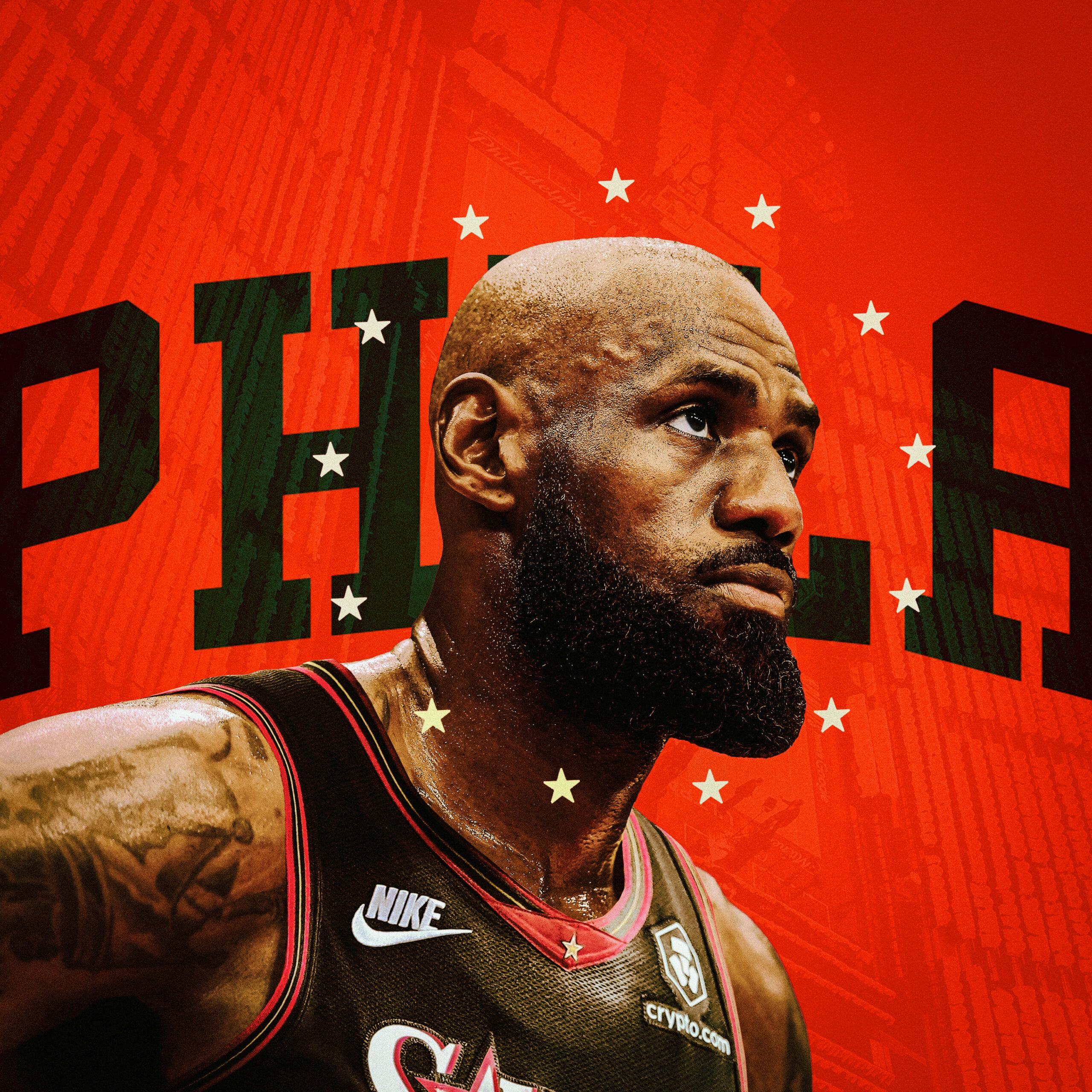

As LeBron James, at age 41, embarks on one final ring chase, with one final superteam, accompanied by one final cascade of predictable criticism, it’s helpful to remember where this journey began, more than two decades ago. It’s helpful to remember the church. The one where Bernie Mac served as the preacher and a choir literally sang LeBron’s praises as he zipped divine passes to an array of jubilant congregants.
The Chosen One was (as ever) surrounded by basketball legends—Jerry West, Dr. J, George Gervin, Moses Malone—all smiling and nodding in approval of his prodigious passing and vision. The “Book of Dimes” Nike commercial, filmed in 2003, told us everything we needed to know about basketball’s teenaged messiah: He was blessed with “crazy court vision.” He wanted “glory … for the team.” And yeah, given a choice, he’d prefer to be in the company of superstars.
So here we are in 2026—12,000 assists and approximately 100,000 passes later—and LeBron James just did the thing we all should have expected him to do. He chose the franchise with the most star power, and (among his official finalists) probably the best chance for a title. He chose Tyrese Maxey and Jaylen Brown, Joel Embiid and VJ Edgecombe. He chose the Philadelphia 76ers—a team with which he had no personal, emotional, or historic connections—over the sentimentality of Cleveland, the nostalgia of Miami, and the romantic appeal of Golden State.
“WTF,” texted an Eastern Conference coach. “Shocking.”
Shocking, because so many of us expected James, at this late stage, to opt for poetry over prose, to choose compelling narratives over competitive zeal. After all, the man is 41 (and a half), and his basketball legacy is firmly and indisputably set. Four championships, four MVPs, the all-time career scoring title, and an eternal seat in the interminable GOAT debate. He doesn’t need to chase rings or ghosts. He doesn’t need to move nearly 3,000 miles from his family, to play in a cold-weather city on the Eastern Seaboard, for a snake-bit franchise that holds zero personal resonance. And yet he’s going to.
But in retrospect, we should have seen it coming. This is, after all, what James has always done. When he determined the Cavaliers couldn’t win it all, he chose South Beach, to play with Dwyane Wade and Chris Bosh. When the Heat began to falter, he returned to Cleveland, to play with Kyrie Irving and Kevin Love. And when the Cavs faded, James chose the Lakers, where he quickly recruited Anthony Davis to join him. Why, we should have asked ourselves, would he operate any differently now? And why wouldn’t he want to move East, given the gauntlet of powerhouses atop the West? “I think Golden State was a better fit,” said an Eastern Conference executive, “but he wanted no part of the West.”
We can debate whether a fifth ring, with a fourth team, as a glorified role player surrounded by younger stars, would significantly alter James’s place in the basketball pantheon. But the debate is probably immaterial now. James wants another ring because it’s there, because chasing rings—in the non-pejorative sense—is what he’s always done.
“I still want to compete, to win and to have a chance at the feeling of winning another championship,” James said on Twitter.
He wants a title run, not a retirement tour—even if it means inviting the same old backlash. The barbs came quickly and predictably on Friday, from all the usual voices, along with some skepticism about Philly’s chances to win it all.
Executives and coaches across the NBA say the Sixers are indeed contenders, based on talent alone: Maxey and Brown are top-20 players; Embiid’s still a force when healthy; Edgecombe’s a budding star. There are, of course, plenty of reasonable doubts—about depth and chemistry and egos and age and health—but then, there always are when a new superteam forms.
“Good luck,” said a rival executive. “They do not have any role players on their team now. All those guys want and need the ball. I’m not sure any will want to sacrifice.”
“Somebody will have to check their ego at the door,” said another team executive, “and I don’t see Joel or Bron being the ones to do it.”
Good luck. They do not have any role players on their team now. All those guys want and need the ball. I’m not sure any will want to sacrifice.A rival NBA executive
And yet both execs declared the Sixers a legit contender anyway. And the shocked Eastern Conference coach nevertheless said James will fit well with Sixers’ younger stars: “He’s so smart he can make it work.”
Amid all the doubts, it’s that last part that’s worth remembering.
James might be guilty of occasional self-indulgence, but not selfish play. In his first Cleveland stint, he elevated the likes of Boobie Gibson and Donyell Marshall with his elite playmaking. In Miami, he struck the perfect balance between scoring and playmaking, empowered Wade and made Bosh a franchise legend. In his second Cleveland tour, he uplifted Irving and Love (and even J.R. Smith), all talents who’d gone nowhere without him. In Los Angeles, he lifted up Davis, and made champions of Kyle Kuzma, JaVale McGee, and Kentavious Caldwell-Pope.
Sure, James is guilty of choosing teams and teammates and leveraging every bit of his influence to surround himself with elite costars; but he’s consistently given those costars room to be stars—a virtue we saw once again last season, as he ceded control and shot attempts to Luka Doncic and Austin Reaves. Why would we think he can’t do the same with Maxey, Brown, and Embiid? James led a constellation of superstars to win Olympic gold in 2008 and 2012 and 2024. Is this really that much different?
Maxey and Edgecombe will surely benefit from James’s mentorship. The mercurial Brown could benefit from his PR savvy. Embiid could benefit from his work habits and attention to detail.
As he approaches his 24th season, James has lost some burst and has eroded as a defender. The basketball IQ and passing ability, however, remain intact. He can still control a game with his playmaking. He can still create easier shots for everyone in his orbit. Maxey and Brown can do the same for him. And at this age, he’d surely welcome a lighter offensive burden.
When James made his NBA debut in 2003, it was said he’d be “more Magic than Michael” (a phrase used by Magic himself). He ended up a blend of both—the greatest passer among the all-time scorers and the greatest scorer among the all-time passers.
The divine “court vision” invoked in that shoe commercial all those years ago is still James’s greatest gift.
“The Chosen One didn’t ask for hops! He didn’t ask for handles!” Bernie Mac exulted in the commercial. “Why did the Chosen One ask for court vision? I’m gonna tell you why—he wanted glory … for the team!”
“Pass! Pass! Pass! Pass!” sang the choir.
Even as he became the NBA’s most prolific scorer, James would insist again and again that he viewed himself as a playmaker first, forever valuing the smart play, the right play. At this late stage of his career, surrounding himself with younger stars and morphing back into his Magic persona makes all the sense in the world.
So if we’re looking for symmetry and poetry in the Book of LeBron’s final chapter, we won’t find it in the city he chose, or the team he chose, but more likely in the role he chose. Cue the choir.