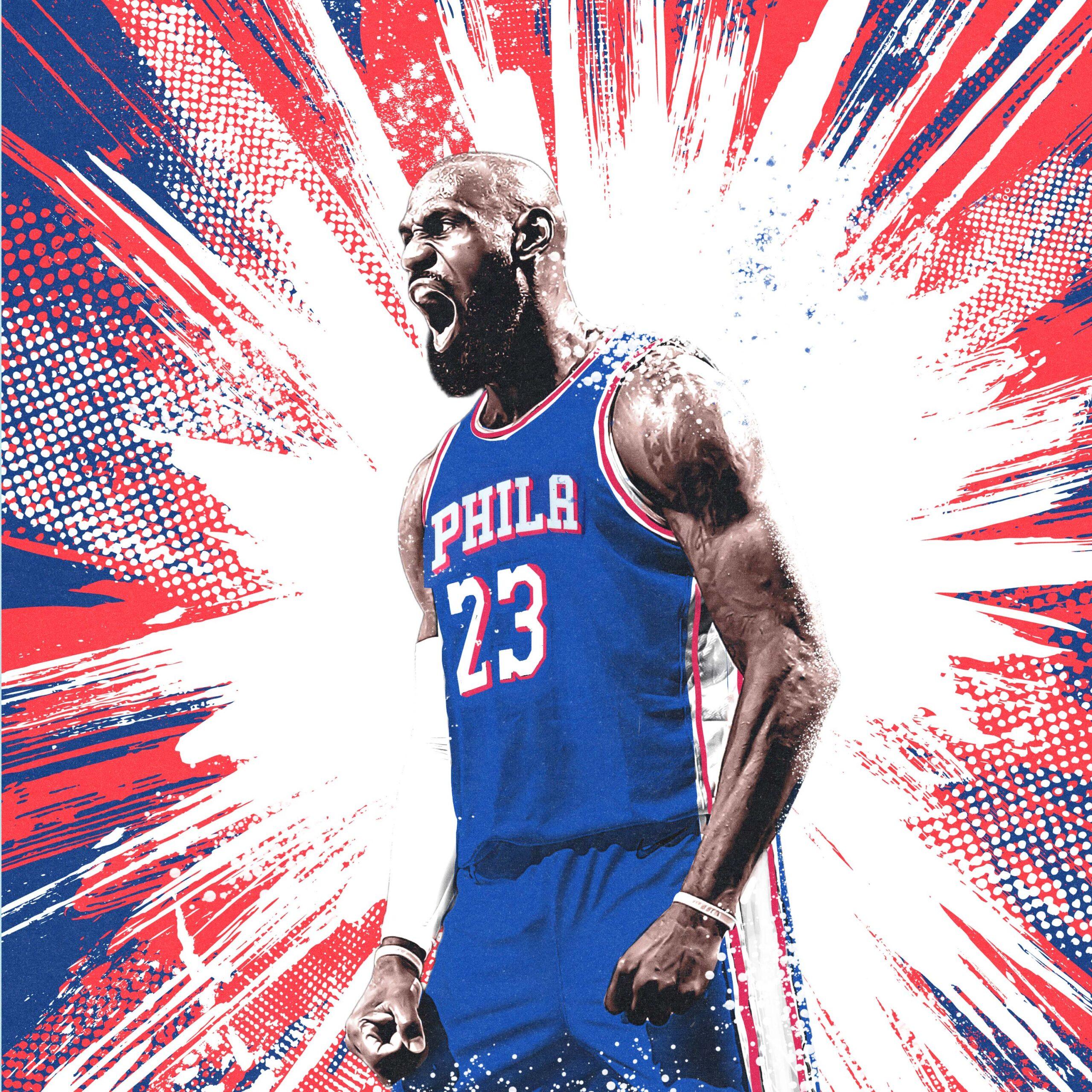

The last decision LeBron James will ever make as an NBA free agent is, without question, the strangest of his career. Instead of signing with the Cleveland Cavaliers, Miami Heat, Golden State Warriors, or Denver Nuggets, James has opted to conclude the greatest career in basketball history with an organization that’s spent the past decade personifying dysfunction: the Philadelphia 76ers. It is, without hyperbole, an utter shock.
The sight of Bob Myers pleading the Sixers’ case to Rich Paul on the Game Over podcast notwithstanding, Philly is way out of left field. The 76ers now have an über-talented, top-heavy, mind-blowingly fascinating roster that may or may not make any sense. Tyrese Maxey, VJ Edgecombe, Jaylen Brown, LeBron, and Joel Embiid provide, spacing issues aside, an egregious amount of skill, power, and athleticism. Good luck stopping that five-man unit if they can figure out how to meaningfully sacrifice their scoring opportunities, stay healthy, and make a resounding commitment to team defense.
“I believe I can help make the Philadelphia 76ers a championship team and I am so excited to energize a new fan base and start this incredible journey one last time,” James tweeted.
If you say so! If you strictly view this through a basketball prism, it’s almost like LeBron intentionally plugged himself into the most challenging situation on the board. The Eastern Conference is no longer the cakewalk it used to be. The Knicks, Celtics, Raptors, Pistons, Pacers, Heat, and Cavaliers all have top-tier star power that may top out above Philadelphia’s best punch, an established winning formula—featuring depth, style of play, chemistry, and so on—or both.

The bar here is not the Eastern Conference finals, either. It’s winning three rounds of playoff basketball and then defeating whichever colossus emerges out of the West. There was no easy choice for James, but this one seems like a particularly steep uphill climb. Instead of teaming up with Steph Curry, Draymond Green, and (eventually) Jimmy Butler; or Donovan Mitchell, Evan Mobley, and James Harden; or Giannis Antetokounmpo, Bam Adebayo, and Simone Fontecchio; or Nikola Jokic, Jamal Murray, and Aaron Gordon, James chose one of the most chaotic, unfamiliar situations available.
To be clear, LeBron can play with anyone. Adaptability is baked into his genius. He can function at any position, with or without the ball. He can shoot, set screens, run pick-and-rolls, dominate in transition, attack closeouts in his sleep, and always be in the right spot as a help defender. He can draw help in the post, find cutters from the elbow, and know who’s going to be open two seconds before he even gets the ball.
If you’re looking for a glass-half-full perspective, at 41 years old, James won’t be pressed to score or initiate offense in Philly. Maxey and Brown are two of the most reliable nightly performers in the league, a pair of offensive engines who can create a decent look for themselves whenever they want. James found ways to complement Luka Doncic and Austin Reaves in the back half of last season. There’s no reason to be skeptical about his ability to do the same with Brown and Maxey. Unlike Doncic, both have experience playing off the ball.
But the increasingly loud, ever-unavoidable Embiid questions portend disappointment. Even though he’s already teamed up with several Hall of Famers, Philly’s longest-tenured player has complained about various supporting casts throughout his career. Now, he has more pure talent on his side than just about anyone else in the league. Will it matter? Can he stay healthy? Will he sacrifice his shots and taper his role? Does Embiid have the wherewithal to understand that rebounding and rim protection are nonnegotiable, even if he goes 10 straight trips up the floor without touching the ball?


Is new Sixers president of basketball operations Mike Gansey already on a three-way call with Rich Paul and the Washington Wizards trying to swap Embiid for Anthony Davis? If Philly would be willing to offer AD an extension and attach draft compensation to Embiid’s contract, that’s the type of move that could make this team an overwhelming favorite. Until then, its best-case scenario is still a championship, but there are far more on-court questions in the way, and the margin for error is a lot slimmer.


There are larger depth and fit issues at play, too. Philadelphia’s starting five seems set in stone. Dean Wade, whom Philly signed this summer, is a pseudo-guru on defense who offers some size and semi-reliable outside shooting. Anfernee Simons, also signed earlier this month, could be the most lethal shooter on this entire roster and absolutely cooked in Boston last year when Brown wasn’t on the court.
But once you get past those two known commodities (who, by the way, have done nothing notable in the playoffs), Philly’s roster falls off a cliff. Justin Edwards? Dominick Barlow? Adem Bona? Ariel Hukporti? Rookie first-round pick Labaron Philon Jr.? Gansey still has a few first-round picks to trade and up to 13 second-rounders to play with, but any substantial change is unlikely. In a league that prioritizes depth and rewards versatility, the Sixers do not have those advantages.
What they do have is enough star power to stagger lineups and, ideally, give everyone enough minutes to be thrilled with their role. Crunch time either will be an opportunity for them to sledgehammer opponents to death or will turn into a constant search for answers. (I can’t wait for the first player’s-only meeting after Brown misses three shots in the final minute and then asks Embiid whether he knows how it feels to get out of the second round.)
For the past month, I’ve been of the mind that James’s decision wouldn’t move the league’s needle in a meaningful way; he’s debatably a top-20 player in a highly competitive playoff picture. While his decision is extremely surprising, undeniably a good thing for Philadelphia, and a bad thing for the Cavs, Heat, Warriors, and any other team that thought they were in the mix, I still feel that way. Sure, if everyone buys in, Embiid (or whoever they trade him for) stays healthy, and some bench pieces unexpectedly pop, the Sixers could absolutely win an NBA championship. It doesn’t seem likely that all those variables will coalesce at the right time, though.
James's final decision doesn’t dramatically alter the NBA landscape, let alone guarantee a top-six seed for Philadelphia. But it is a basketball experiment unlike anything we’ve ever seen before, and whether it deteriorates on sight or gleams with a twinkle the Sixers have never enjoyed in their franchise’s entire history, LeBron has made the upcoming season far more interesting than anyone expected it to be a couple of days ago.