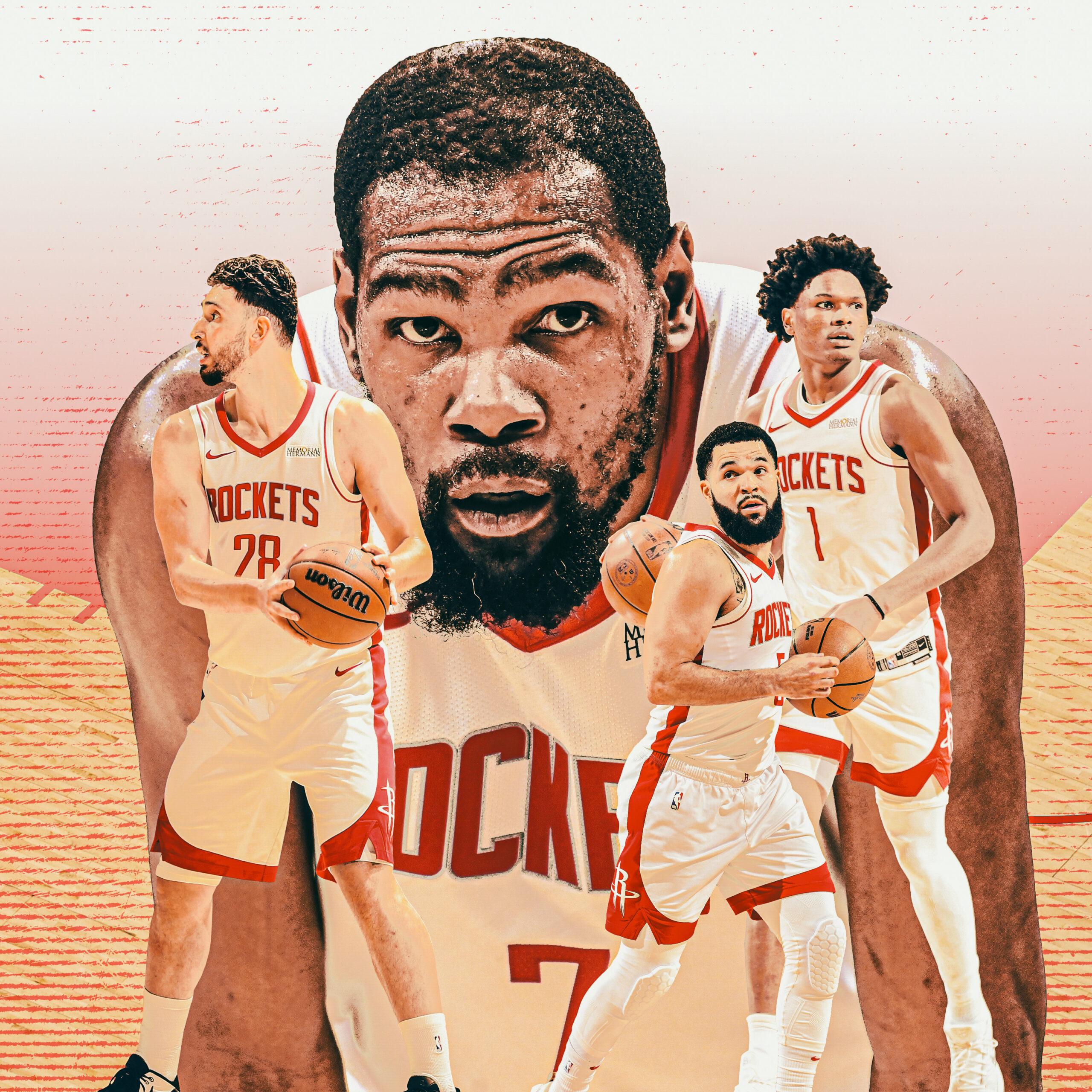

After they traded for Kevin Durant and before Fred VanVleet tore his ACL, the Houston Rockets were a title contender. For basically an entire summer—when, you know, zero games were played—Houston had star power, youth, depth, size, and playoff experience. It was an exciting albeit sadly worthless stretch for an ambitious organization that’s mostly been out of sight and out of mind ever since it was bounced from the first round in humiliating fashion.
Even though they won 52 games, finished sixth in net rating, and defended their ass off all year, the Rockets’ 2025-26 regular season amounted to little more than a blurry reminder of what could have been. With no table-setting point guards on the roster who could replicate VanVleet’s poise, Houston was forced to shift the burden onto the other players, and when Steven Adams underwent season-ending ankle surgery in January, it altered the team’s identity and dramatically lowered its ceiling.
Chemistry fizzled. Development flatlined. Expectations eventually evaporated. In the regular season, Houston generated as many points per half-court play as the Memphis Grizzlies. The Rockets were disorganized and sloppy, and they finished 27th in turnover differential. By the time they fell to the Luka Doncic–less Los Angeles Lakers in Round 1, the Rockets were a gooey knot of indolence and predictability, held hostage by the second-slowest offense in the league. Durant played more minutes than he did in any season since he won MVP in 2014, and zero people were surprised when his body broke down in the playoffs.
The stank was strong. But the faults in Houston’s roster were not inherent or irreparable. We all know why this team couldn’t score (especially in the clutch) and understood, in real time, what was missing. Even the most talented basketball teams are like a carefully stitched shirt: Yank one loose thread, and the whole garment can fall apart. But now VanVleet is healthy, back on a team that decided not to overreact during a summer that saw nearly a third of the league’s organizations make a transformative decision. And when you look at where the Rockets are now, you see the same group that was constructed to win it all. Which raises a question that should be considered before next season begins: Why can’t they do it?
It’s been a quiet summer for a franchise that normally isn’t shy. With Amen Thompson and Alperen Sengun currently in place as ascending franchise tentpoles, the Rockets added veterans Marcus Smart and Bogdan Bogdanovic, re-signed Tari Eason for an absolute bargain, and let Josh Okogie, Aaron Holiday, Jeff Green, and Jae’Sean Tate walk in free agency. Thompson is extension eligible but likely to either sign at a number that’s well below the max or try his luck (not recommended) in restricted free agency next year. In other words, Houston is happy where it stands, in no rush to clog its cap sheet or deplete its draft capital with a blockbuster trade for Giannis Antetokounmpo/Jaylen Brown. Optionality!
If the Rockets do want to improve anytime between now and February’s trade deadline, they have several paths to do so. They recently used three second-round picks to dump Dorian Finney-Smith onto the Charlotte Hornets, a move that created a $13.3 million trade exception and helped them duck under the tax. Armed with six tradable future first-round picks and three pick swaps, the Rockets are still $2.3 million below the tax, with $10.9 million worth of wiggle room beneath the first apron. In other words, every single good team wishes it had Houston’s flexibility.
They aren’t necessarily desperate to act right now, but a marginal move could be in the cards. Related: Milwaukee Bucks guard AJ Green should be on Houston’s radar. He’s one of the best movement 3-point shooters alive and would fill a critical need for the Rockets; they should be willing to acquire him even if there’s $45 million left on a contract that doesn’t expire until 2030.
Anyway, here’s Houston’s starting five: VanVleet, Thompson, Jabari Smith Jr., Durant, and Sengun. Some spacing questions exist, but that’s still a unique collection of complementary and interchangeable talent that most teams won’t be able to score on or slow down. Thanks to Sengun’s playmaking ability, they can run stack pick-and-rolls with any position on the ball. They’ll pound the offensive glass and, with VanVleet at the helm, can run more than one action in a single possession.
Assuming Sengun’s 3-point shot doesn’t come around, the Rockets would be wise to up his efficiency by utilizing the 23-year-old more off the ball. That means cutting down isolations at the nail and seeing way fewer situations in which he’s backing down an opposing center, not drawing a double-team, and settling for a tough look outside the paint. The Rockets should have enough ball handlers to up the percentage of Sengun’s baskets that are assisted, and it’s imperative that they do. (Only 36 percent of his shots in the midrange were assisted last season. Two years ago, that number was 70 percent.)
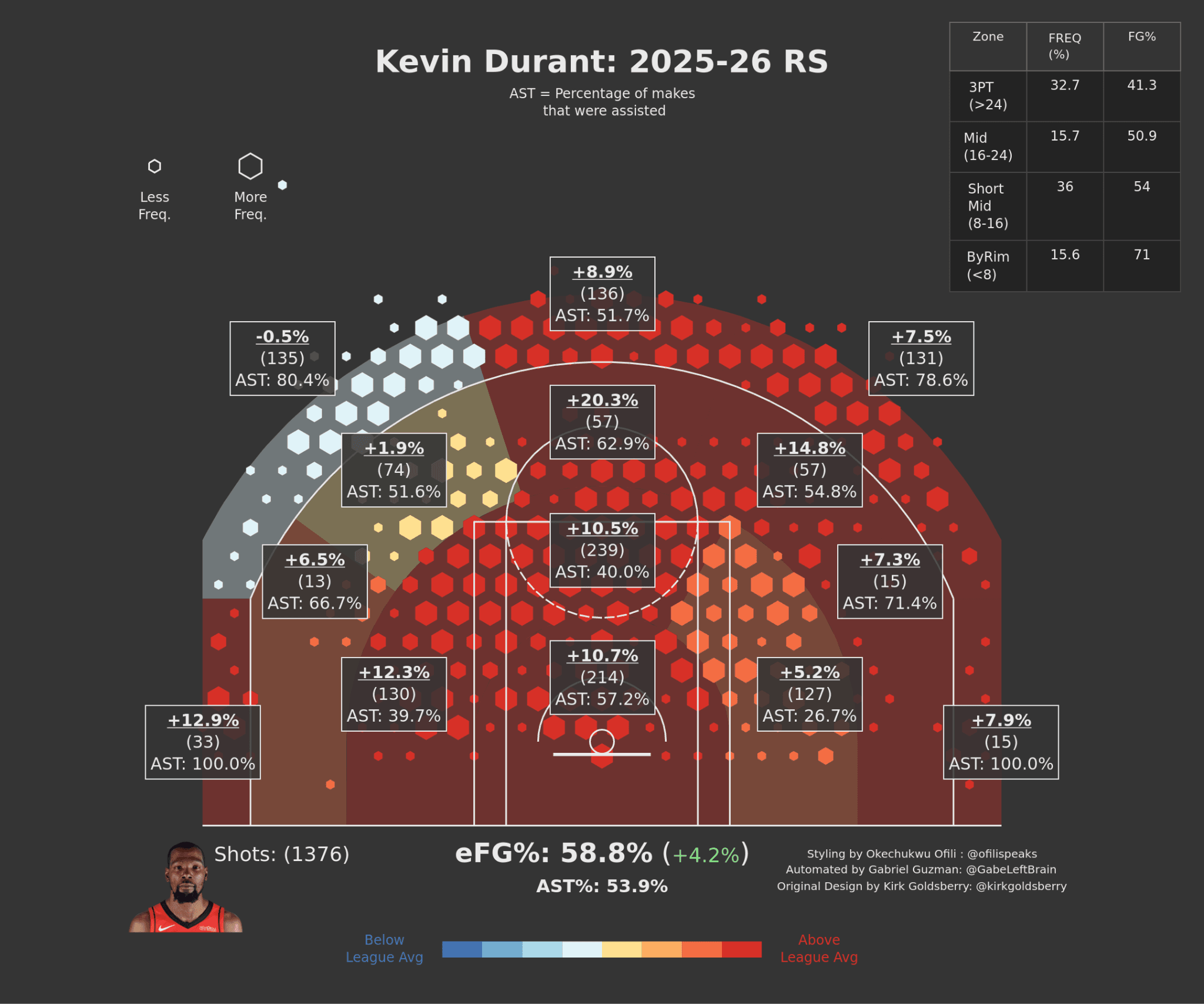
On a brighter note, if anyone needs a reminder of just how absurd Durant was in what’s already become a criminally underappreciated season—the 16-time All-Star nearly submitted the 16th 50/40/90 campaign in NBA history while averaging 26 points per game—here’s his shot chart. (Durant’s true shooting percentage was higher last year than it was in his second season with the Golden State Warriors, which makes absolutely no sense.)
Defensively, this starting unit will be a bear trap. They can either switch 1 through 5 or make opposing stars feel like they fell into the last 45 minutes of Obsession by siccing Amen on them. (Sengun took a slight step back on defense last season, but we now have a decent amount of evidence that suggests Houston can consistently get stops with him on the floor.)
Barring a move before opening night, Houston’s first four off the bench will likely be Adams, Reed Sheppard, Smart, and Eason. Hellacious. If he returns to form, Adams will play alongside Sengun in lineups that will rebound 95 percent of the shots Houston misses. Smart revitalized his career with the Lakers last season and is quite possibly the perfect player to spell Thompson without any tangible letup on the defensive end. Eason equals energy.
And then there’s Sheppard, maybe Houston’s biggest X factor, entering somewhat of a make-or-break third season. It’s true that he missed so many shots in his first playoff series—only two players in the playoffs had a bigger drop-off between their expected and actual field goal percentages—and, on both ends, didn’t look entirely ready for the expanded role VanVleet’s injury thrust him into. But circumstances were not ideal, especially against a Los Angeles defense that could switch screens and pack the paint. Just watch this clip, where Jake LaRavia passes Sengun off to Smart, who’s free to roam the paint once he abandons Thompson in the corner.
There’s still true franchise-altering upside here, though. Aside from Durant, who belongs in his own extraterrestrial tier, Sheppard was Houston’s best shooter last season. He made 39.4 percent of his 3s on seven attempts per game as a 21-year-old. That’s something! If opponents are motivated to take away his pull-up jumper with an aggressive pick-and-roll defense, it’ll open things up for everybody else. An invaluable development.
(Quick aside: Bruce Thornton, whom Houston just took out of Ohio State in the second round, could be one of the draft’s bigger steals. There are models that pegged him as one of the most impactful players in college basketball last season, and at summer league, Thornton looked like someone who may be able to carve out a spot in Ime Udoka’s rotation. He’s old—for a rookie—and small, but he can shoot, live in the paint, and take care of the ball. Why do players like this always fall on draft night?)
Now, does any of this mean that the Rockets should be favored to beat the Oklahoma City Thunder or San Antonio Spurs in a playoff series? No. But the NBA is full of surprises. This time last year, nobody thought the Detroit Pistons would finish with the 1-seed, or that the Jayson Tatum–less Boston Celtics would win 56 games, or that the Spurs would steamroll through the Western Conference, or that the Knicks would win their first title in 53 years.
This will once again be the largest, most intimidating team in the league. Their defense will be even more stout than it was last year, and their offense—with VanVleet (and Smart) on board to handle the ball—can reclassify itself with a broader playbook that highlights the skill already in place.
This won’t be a team that struggles to walk and chew gum at the same time. Durant, Sengun, and Thompson won’t be saddled by the playmaking responsibilities that are normally held by a point guard. They’ll dodge the avoidable turnovers that kept Houston from building significant leads and bound them to so many taxing late-game duels. (Houston led the NBA in high-leverage minutes last season.) Durant, presumably, won’t attract more attention—on and off the ball—than literally everyone else in the league.
There’s no guarantee that Houston’s system will accelerate out of the rush-hour-traffic-jam state it was mired in a year ago. VanVleet must adjust in an offense that has plenty of mouths to feed, Sengun needs touches inside the arc, Thompson is a guard whose shot profile mirrors Domantas Sabonis’s and Ivica Zubac’s, and Smith would presumably, at some point, like to dribble the ball.
But the recipe for success is pretty easy to follow: Defense, rebounding, and way fewer turnovers can be enough to dominate the regular season without seeing much falloff in the playoffs. Tough shotmaking is critical, sure. But simply letting Durant stand on the weak side will do wonders for a team that can finally leverage his gravity without tiring him out—to say nothing of the actions they’ll now run for him off-ball that aren’t (a) telegraphed and then (b) disrupted. His usage will go down, and his legs will stay fresh.
In a world where we’ve seen eight different NBA champions in eight years, I think the Rockets are good enough to be the ninth if they catch the lucky breaks that ultimately benefit pretty much every team that wins the title. But I also recognize and understand the main reasons people will ignore Houston as a credible contender. Spacing matters. Durant is old. VanVleet shot 37.8 percent from the field before he suffered a major leg injury. All true. There’s also something undeniably unfinished about the entire Rafael Stone era. The Rockets still feel like they’re stuck in a holding pattern, waiting for the perfect opportunity to come along and put them over the top. They passed on Antetokounmpo and Brown to keep that very door open, allergic to the type of all-in move so many organizations can’t resist.
The Rockets will eventually need to pivot away from KD, who will turn 38 in September, toward a more final form that’s ideally led by a bona fide MVP candidate. Competing annually against OKC, San Antonio, Denver, Los Angeles, or Minnesota without their own Shai, Wemby, Joker, Luka, or Ant isn’t necessarily impossible, but it doesn’t sound fun.
In the long term, maybe that superstar is already on the roster. Or maybe, with all those draft picks, the Rockets are able to extend their runway by pouncing on a bloated competitor who’s suddenly forced to cut costs. (Durant and a first-round pick for Franz Wagner? Anybody?) Or they get aggressive, prioritize the present, and make the type of offer that can’t be refused. (VanVleet, Clint Capela, and two first-rounders—including Dallas’s own pick in 2029—for Kyrie Irving?)
The front office’s patience can be frustrating, but credit the Rockets for operating with more foresight than just about anybody else. The way they’ve negotiated down contracts, refusing to capitulate to their own young core, is admirable. It’s kept every door open and allowed more room for optimism than they get credit for. (The ceiling on this year’s team is a banner. If, for whatever reason, things don’t appear to be coming together, they should be able to trade any one of their best players for a decent haul that fortifies the future.)
The leap from very good to great is arduous, and most organizations can’t afford multiple attempts in the same life cycle. But Houston—under the radar, seemingly biding its time, hardly in need of some dramatic alchemy—is currently the rare team that was meticulously constructed to have its cake and eat it, too.