
Look, I get it’s not the best time for petty complaints, what with the wars, the dingy, beige haze of wildfire smoke hanging over much of the country, and people in Michigan looking askance at their romaine. We’ve got real problems and it doesn’t help to pile on. Summer movies should be a welcome balm. And yet, there’s something I feel must be addressed:
The Odyssey’s Trojan horse popcorn bucket is all fucked up.
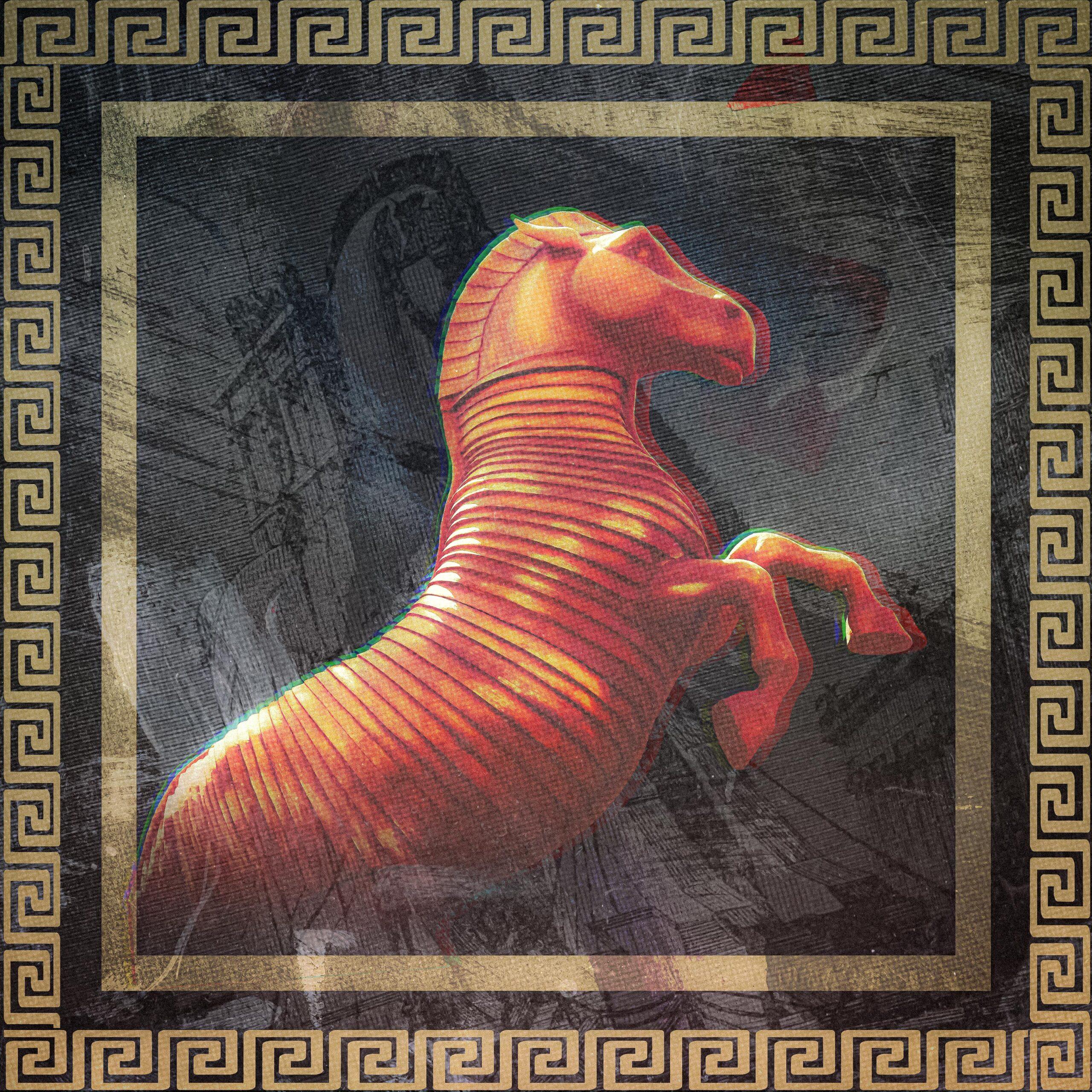
Phew, good to get that off my chest. Christopher Nolan’s adaptation of Homer’s epic poem was released in theaters July 17, along with two different novelty popcorn buckets, which have become a prerequisite of big-tent theatrical releases ever since Dune: Part Two’s sandworm receptacle for pervs. One Odyssey bucket is based on the IMAX 15/65mm camera, a favorite tool of Nolan’s. AMC says this bucket “celebrates the innovation and artistry behind modern filmmaking.” I think it holds popcorn, but sure, fine, whatever. The second bucket is the horse. And this thing is a mess.
It looks like it’s made out of chocolate but isn’t, which is fucked up. But that’s not anywhere near the main problem with this thing. Namely, this horse is the by-product of a complete and utter bastardization of historical and literary accuracy.
It’s a weird choice of avatar for The Odyssey movie in the first place, since the story of the Trojan horse is actually told by Virgil in The Aeneid. The horse is only mentioned in passing in Homer’s text, which takes place a decade after the fall of Troy. Sure, the horse is the most broadly legible symbol of the classical epic poems and the studio is trying to get butts in seats here, but that’s no excuse for mangling the source material! You see a collector’s item, I see a cowardly capitulation to those who don’t know their Circe from their Cyclops.
But even if we accept the Trojan horse as a symbol for this story, the issue of its positioning, rearing up on its hind legs, remains. To me, this is the most critical failure of the object. Obviously—and I really thought we all knew this—the Trojan horse was canonically standing on all fours.
On a logical basis alone, it’s ridiculous to stand the horse on its hind legs. If you were building a horselike structure designed to hide and transport a group of people, of course you would build it standing on all fours, to accommodate a relatively flat compartment in the stomach area. Build the horse rearing up and you’ve got Menelaus and Diomedes falling all over each other back toward the rump. Not to mention, half the trick of the horse was convincing the Trojan citizens that it really was a peace offering. Would you build that structure in an inherently aggressive rearing position or in a more docile one? A rearing horse would have sunk the entire plan, and Troy might still be standing today if Odysseus had sent one!



More on ‘The Odyssey’
There is also hard evidence to support the horse in a four-hooves-down position. The earliest known artistic depiction of the Trojan horse is thought to be the Mykonos vase, a large storage vessel called a pithos that was unearthed by archaeologists on the island of Mykonos in 1961. It dates to around 675 BC, making it roughly the same age as The Odyssey. Carved in relief on the neck of the vase are scenes related to the fall of Troy. And there’s the horse, on all fours. Other historical depictions share the same posture.
Then there’s the text.
Again, there are only passing references to the Trojan horse in The Odyssey itself. But one of them, in Book VIII, refers to “the horse which once Odysseus led up into the citadel as a thing of guile.” Imagine a man leading a horse. Is the horse rearing back? No, it is on all fours, enabling itself to be led. This feels essential before you even get to the part where 30 men needed to be transported inside.
Now, there is a risk of being too literal here. The Odyssey is, of course, a myth. Many scholars believe that the Trojan horse story is more likely a metaphor for, or creative embellishment of, events that led to Troy being destroyed by war in the Late Bronze Age. University of Oxford classicist Armand D’Angour has posited that the “horse” could have been based on a type of battering ram covered in horse hides. Other classic scholars have proposed that it could have stood in for a critical battleship, as Poseidon was both the Greek god of the sea and of horses, and there are passing references to ships as “sea-horses” in The Odyssey itself.
In Book II of The Aeneid, when the Trojan priest Laocoön tries to warn the citizens that the horse could be a trap, Virgil’s text uses language that could support either theory. Using Robert Fagles’s translation, Laocoön’s warning goes like this:
“Poor doomed fools, have you gone mad, you Trojans? You really believe the enemy’s sailed away? Or any gift of the Greeks is free of guile? Is that how well you know Ulysses? Trust me, either the Greeks are hiding, shut inside those beams, or the horse is a battle-engine geared to breach our walls, spy on our homes, come down on our city, overwhelm us—or some other deception’s lurking deep inside it. Trojans, never trust that horse. Whatever it is, I fear the Greeks, especially bearing gifts.”
His suspicion that the Greeks have not actually sailed away could nod at the ship theory.
Then there is the much more literal description of the horse as a battering ram. If you believe the Trojan horse is not a story to be taken literally, whether the horse was on four hooves or two isn’t a big deal. But I’d also like to point out that both ships and battering rams are oriented perpendicular to the ground and ballasted at the center.
Anyway, this seems like a good movie people should go see, but the fact remains that this horse, if it even was a real horse, was absolutely not on its hind legs and the entire plan would have fallen apart if it had been! Instead of resembling its supposed canonical inspiration, what this horse actually recalls is Blucifer, the equine statue outside Denver International Airport that fell on top of its creator and killed him during its making, a different case of equo ne credite. Now that is a fucked-up horse.
I’d say don’t look a gift horse in the mouth but actually, no, that too is a problem with this entire bucket saga! They’re charging $64.95.