
For a long time, isolation was the last thing I associated with Paige Bueckers.
The famously unselfish it girl of women’s basketball has always seen herself—and her game—in relation to others. You could map the entire league via six degrees of Paige Bueckers’s friendships.
When Dallas Wings coach Jose Fernandez tells her she’s the best player in the world, she looks completely unmoved. I have never seen such a precise scorer be so perfectly in tune with her teammates' needs. Even in the midst of a sophomore season that’s among the best in WNBA history, she has deflected credit back to her teammates.
Selflessness has long been considered her greatest strength and the greatest knock against her. She is, as Mirin Fader once put it, a giver. Watching Bueckers dominate, you’d ask yourself: Why isn’t the pick-and-roll maestro demanding more picks? Why does the most efficient isolation player in the league isolate so little?
But this year, those questions have dissipated. Isolation as a philosophy is at odds with who Bueckers is. Isolation as a style of play, however, is something she’s learning to embrace. Per Synergy, she’s going one-on-one on 10.4 percent of her possessions this season, way up from 4 percent in her rookie season. In the past 10 games, that number has jumped even higher, to 14 percent. And while the rest of the league is obsessed with the 3-point revolution, Bueckers ranks no. 2 in midrange scoring, a zag that gives her elite maneuverability against opposing defenses.
Take this play against the Toronto Tempo last Friday, in a game where Bueckers scored 34 points and notched seven points and three assists in the fourth quarter:
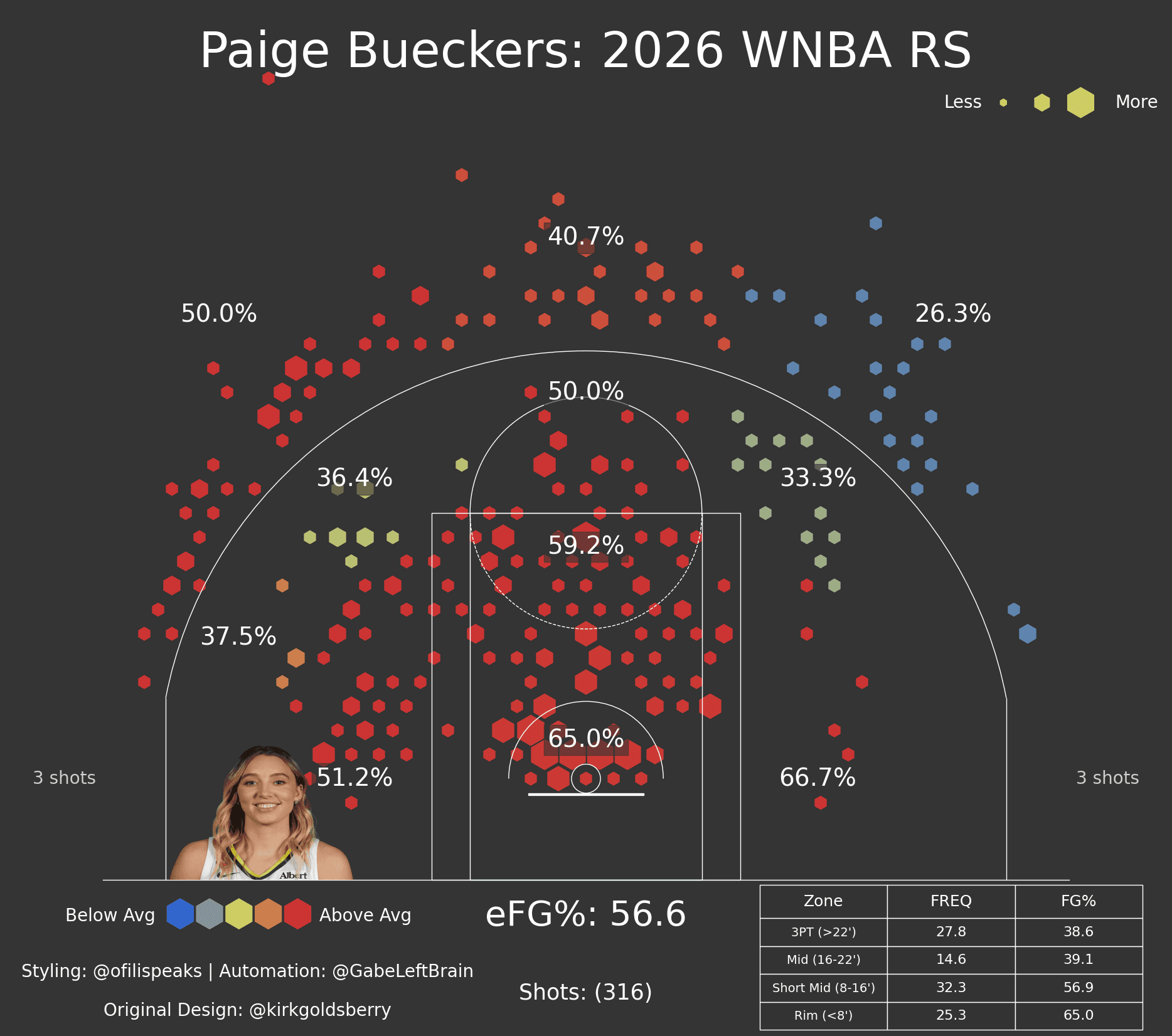
Last season, she likely would have responded to the double-team by immediately looking for an open teammate. But this year, she’s hunting her shot. The Tempo send help to the left in the clip above, cutting off her driving angle, so Bueckers dribbles to the right, steps back, and pump-fakes her defender before hitting a contested midrange shot, from an area of the floor where she’s shooting an extraterrestrial 58 percent.
The increased production hasn’t put even the tiniest dent in her accuracy, either, which is still tops in the league. As a whole, she’s shooting above league average this year from nearly everywhere on the court.
This is why fans, coaches, and analysts have always clamored for her to shoot more, dating back to her days at UConn. Bueckers’s surgical analysis, midrange mastery, deft touch, and ballhandling sorcery give her one-on-one game limitless scalability that peaks in crunch time. She will begin the game by cutting, screening, passing, and assessing the opponents’ weaknesses. And right when the defense has forgotten about her and shifted its attention to tracking Azzi Fudd’s movements or Jessica Shepard’s drives, Bueckers strikes. She leads the WNBA in fourth-quarter scoring, and she’s fifth in clutch scoring.
“She's such a competitor and a winner, and she just refuses to lose,” says Fernandez. “Certain guys don't want the ball in their hands at the end or don't want to take the big shot, and she never shies away from the big moment.”
Paige Bueckers’s Production by Quarter
In the fourth quarter, she has become downright relentless about getting open, using her skill as an off-ball mover as a counter. Against the Chicago Sky this week, during the Wings’ sixth double-digit comeback victory of the year, she thwarted Natasha Cloud’s ball denial by cutting hard to the rim and then cutting back, before using the threat of running a dribble handoff to spin back and score at the rim:
Even with her increased isolation dominance, Bueckers hasn’t lost the patience and clock awareness that have always been a hallmark of her greatness.
More than anyone else I’ve watched, save for maybe Chris Paul, Bueckers plays like she has an internal metronome dictating her pace. She plays fast, but she’s never rushed. Take this play against the Seattle Storm, which ends with Bueckers coming off a handoff and hitting a contested 3. But it starts with her giving up the ball, setting a screen, and passing to another big:
Or look at her eventual game-tying middy. A lot of young players would have taken the first opportunity Bueckers was presented with: an uncomfortable, heavily contested jumper. Last year, she might have faded into the background of the play after kicking the ball out. But here, she gets it back, drives, fades away, and hits a similar shot from a similar place against the same defender—just with a lot more space and rhythm.
Simply put, Bueckers is having the opposite of a sophomore slump. In fact, she might be having one of the best second years the WNBA has ever seen, at least on offense. She is eighth in points and fourth in assists of all time at this juncture of a sophomore season. Skylar Diggins is the only other player in WNBA history to be in the top 10 in both points and assists 23 games into their second season. This season, Bueckers is also the most efficient shooter among the top 20 scorers and has the best assist-to-turnover ratio of the top 20 passers.



More on Paige Bueckers
Bueckers is operating on a unique plane right now, where comfort, skill, and resolve have given rise to experimentation and innovation. Nothing exemplifies that, or the way she’s leveraged her reputation as an unselfish player to create scoring opportunities, more than this moment against Toronto from a few weeks ago.
As she’s coming off a dribble handoff with Shepard, two opponents are ready to impede Bueckers’s path to the rim. The simple, plus-EV basketball decision, the decision she’s been making her whole life, would be to kick the ball to Shepard. Everyone knows it, and she knows everyone knows it. So she takes the pass fake to an entirely new level, bouncing the ball in Shepard’s direction, but with so much spin that it boomerangs right back into Bueckers’s hands. The defense falls for it, and Bueckers takes the ball to the rim for a layup:
Pardon my French, but the English she put on that thing was fucking mind-boggling.
“She does things every single day that, you know, now you're not surprised anymore, right? How many times did she win the half-court shot? Eight or nine times out of whatever,” says Fernandez. “I should just come in every day with $100 for the day of the game and just give it to her.”
Bueckers has always seen basketball as a collective problem—one she is now realizing she often has the best answer to. At 24 years old, she’s just scratching the surface of her potential. Every contested jumper that falls through the hoop is an affirmation that the greatest service Bueckers can do for her teammates is to continue exploring the limits of her own individual ability.