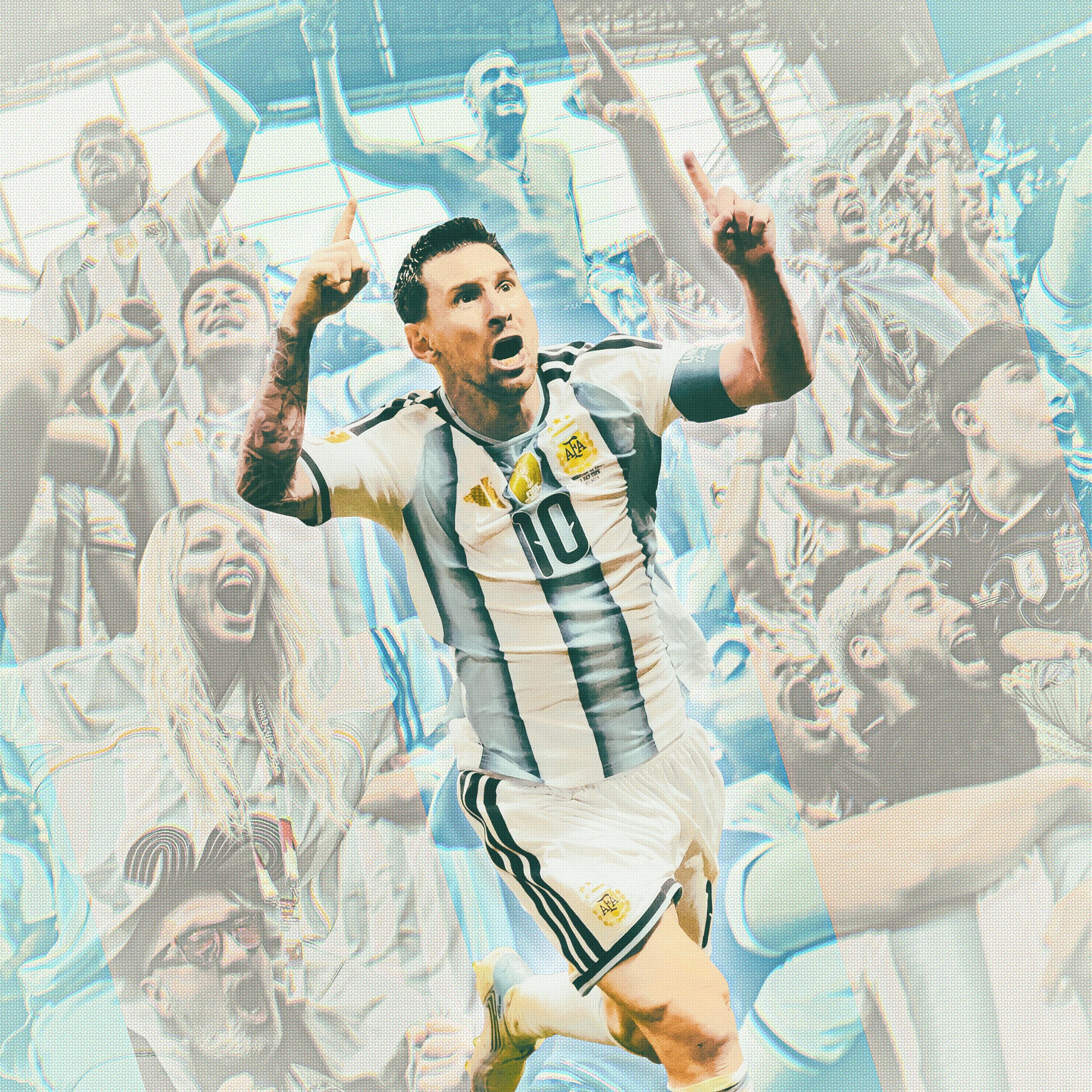

God is dead.
This seems clear. We feel it, sitting high up in Section 231 in Atlanta, winding our way toward the 80th minute of the Argentina-Egypt match on Tuesday afternoon. The end has arrived for Lionel Messi, soccer deity, he of the most gifted left foot to ever walk this planet. His World Cup career will die here, in Atlanta, Georgia, United States of America, such a strange place for a funeral, footsteps from the World of Coca-Cola and the College Football Hall of Fame, before tens of thousands of his countrymen and thousands more who’ve traveled from across the world just to spend 90 minutes in his presence. It will die like this: Messi denied, time and again, by an Egyptian goalkeeper who’s spent nearly 80 minutes standing squarely on his head; sucker punched, not once but twice, by a ruthlessly opportunistic Pharaohs attack; failed, critically and spectacularly, by that divine left foot’s tepid attempt at a first-half penalty kick; watched, in shared disbelief, by men in pharaoh hats and SEC polos, women in face paint and hijabs.
In pockets across the stadium, Egyptian fans chant and drum, jubilant. In the row before me, an Argentine boy named Felipe, 14 years old, sits next to his father, their heads in their hands. Just to my left, a little girl wearing Messi’s jersey begins to sob. Her mother stares blankly at the field below. She reaches out a hand, and she places it on her daughter’s head, but she offers no more comfort. She does not dare tell her child that everything will be OK.
I’m not quite sure how to describe what happens next. That’s because my view is obstructed, partly by flailing limbs and leaping bodies and partly by beer, which rains down from above and fills my eyes. I know there is singing, frantic and desperate at first, picking up energy, verse by verse, all in Spanish.
En Argentina nací, tierra de Diego y Lionel
De los pibes de Malvinas, que jamás olvidaré
No te lo puedo explicar, porque no vas a entender
Las finales que perdimos, cuántos años las lloré
And I know that then there is Messi, lofting a gorgeous cross into the box, off the head of Cristian Romero, and into the back of the net. 2-1. The singing subsides, giving way to cautious joy. Maybe this game is not over. Maybe this is not a funeral. Romero sprints back to midfield, waving for his teammates to join him. All around me, despair begins to crack, allowing room for hope. In front of me, Felipe puts his arms around his father, leans against his chest. Over my left shoulder, a man with neck tats and a four-drink buzz begins shouting prayers to the sky.
Three minutes later, the ball finds its way into the box yet again, this time with no clarity of purpose, bouncing off legs and heads on its way to nowhere, until suddenly he is there, Messi, having jogged into the perfect position, and 82 minutes and 58 seconds into what has looked like perhaps his final game wearing the blue and white of his native Argentina, the ball finds its way to his left foot.
Next: a half-volley rocket, over the keeper and right at the crossbar, bouncing emphatically down and goalward, across the line. Messi running, arms to the sky and full of wonder, as if even he can’t believe it, this gift of talent and luck and preparation, and now he looks less like a god than a child, one who’s just been told he gets to play for a while more.
I’d shown up in downtown Atlanta on Tuesday morning not planning to attend this game. I was there to interview fans outside the stadium, with an eye toward a future piece trying to make sense of this politically contentious, culturally complicated, wildly spectacular tournament being played mostly on American soil. I met plenty of Argentina and Egypt fans, some who’d never seen their team play in person, others who’d been following them all over the world for many years. But I also met people from South Carolina and Seoul, Houston and Bengaluru, all of them in Messi jerseys, not so much fans but pilgrims, here on a hot day in the American South to watch a man from Argentina play in the world’s greatest sporting event for perhaps the very last time.
“Yes, Messi,” said an enthusiastic young man from Korea whose name I didn’t catch and who spoke very little English. “I am happy to see Messi.”
I got jealous. I called a friend, asked him the price he would pay to watch Messi play in his final World Cup. He answered with a number much higher than the last-minute get-in price. “Forty years from now, you’re gonna want to be able to say you were there,” he told me. He had a point. Here was the man who’d won eight Ballon d’Or trophies, more than any player in history. Who held the record for most total goals in a calendar year, most goals in the history of the World Cup, most club and country trophies of any player who’d ever played the game. A man who was considered the possible GOAT before he ever won a major trophy for Argentina but had now, deep into his 30s, won them two Copa Américas and a World Cup.
More on the World Cup
So I bought a ticket. It was a bit jarring, entering a stadium most known for hosting SEC title games and NFC South slopfests, to find Argentines and Egyptians chanting and drumming their way through the concourse, TV reporters from across the world doing live hits around the rim of the lower bowl. When I arrived to my seat, I met Felipe.
“From 1 to 10, how do you rate my English?” he asked me, several minutes into a conversation he’d translated between me and his father, Riqui.
I gave him a 10 and meant it. He told me a bit of their family’s story. They’re from a small town in Tucumán Province, up in the north of Argentina. They planned this trip months ago, always intending to arrive after Argentina reached the knockout rounds. No need to waste time coming for the group stage when you know that’s just the preseason for your team. Now that they’re here, they plan to stay, following la Albiceleste through the tournament for the next couple of weeks. So far, they’ve been to Miami and Orlando. “I like the USA,” Felipe said. “It’s a very nice country.” His dad, wearing a bucket hat and a kind smile, took a vape hit while Felipe beamed.
We didn’t talk during the game. For a long time, barely anyone did. The Argentines sang, and the Egyptians chanted and drummed, and when Egypt’s Yasser Ibrahim headed in a lofted cross from Marwan Attia to give the Pharaohs a 1-0 lead, the singing grew a bit more urgent and the chanting and drumming a bit more emphatic, but for the most part, the mood in the building stayed the same. When Egypt appeared to score a second goal, the Argentine despair around me set in, though it lifted after an extremely controversial VAR process nullified the goal, citing a foul in the buildup. It was only later, in the second half, when Mostafa Zico scored on a ball from Haissem Hassan, giving Egypt a 2-0 lead in the 68th minute, that the mood fully turned.
“I started to cry then,” Felipe would tell me later. “I was very sad to watch my country lose.”
Of course, he didn’t have to. The Romero goal comes 11 minutes later, the Messi goal three minutes after that, and what will happen next begins to feel inevitable, like the only way this Tuesday afternoon in SEC country could possibly end. Lautaro Martínez takes the ball down the right flank in transition, lofts it perfectly to the head of Enzo Fernández, who places it, cleanly and softly, in the back right corner of the net. The cheers this time are enthusiastic but comparatively muted, as if the Argentines in my section are too drained by celebrating the last goal and too excited to celebrate the final whistle, too certain that once Messi had brought them all the way back, there would no longer be any suspense about the way the game would finish.
By the time the final whistle blows, half the men around me are no longer wearing shirts. Jerseys have turned to helicopter rotors, high fives to bear hugs, middle-aged men to tear-spewing faucets. Popcorn has landed in my hair, beer in my eyes. The guy with the neck tats, sitting behind me, will soon introduce himself to me as Dany. He will tell me he grew up in Argentina but now lives in Minnesota, that he loves his new home but aches for his old one, that he’s traveled all across the continent to every Albiceleste game in this tournament and plans to travel for three more. “I can’t believe I got to see this,” he would soon tell me. “I can’t believe I got to be here in this place with you and with everyone else and watch this game.” But now, when I turn around, he is sitting on the ground, holding his friend, whose name I don’t catch, and both are weeping. Before me, Felipe and Riqui are both shirtless and embracing, son resting his head on his father’s chest.
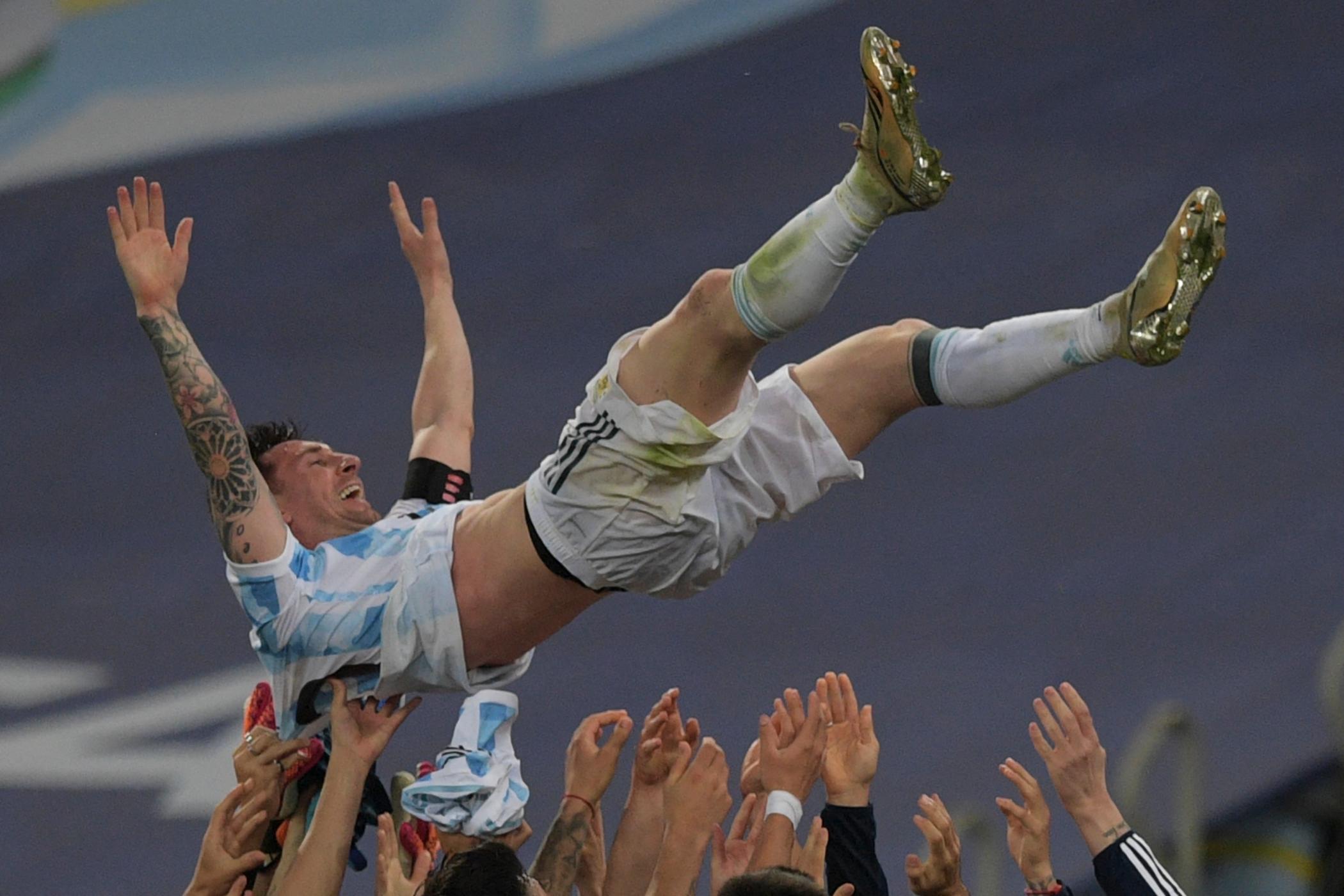
On the field, the team celebrates, embracing each other, clapping to the crowd. They gather around and lift up Messi, tossing his tiny body up to the sky. They leave the pitch, and the fans go nowhere, for 15 minutes, 20, 25, longer, no one quite knowing where to go now, all choosing just to sit here and stare at empty grass. An American in a Messi jersey starts talking to Argentines around him, and one of them, a heavily muscled bald man, pulls the American into an aggressive bro hug. “Thank you, my friend,” he says. “Thank you for supporting my country.”
The defending World Cup champions have survived a while longer, long enough to meet Switzerland in the quarterfinals in Kansas City, long enough to give Felipe and his father another game together, to give Dany another chance to stand in a stadium smack-dab in the middle of his new country and feel briefly like he’s back in the nation of his birth. Long enough for another American city to get the chance to see up close the greatest player to ever lace up cleats, long enough for Messi to continue to astound us, to leave one more stadium in shock and jubilation and wonder at whatever it is that he might do next.