What America’s 250th Birthday Extravaganza Is Really About
On July 4, the United States will ring in a milestone Independence Day. The capital is celebrating with a party that seeks to rewrite the nation’s history.What America’s 250th Birthday Extravaganza Is Really About
On July 4, the United States will ring in a milestone Independence Day. The capital is celebrating with a party that seeks to rewrite the nation’s history.
’Murica hats, ’Murica flags, ’Murica cutoffs, ’Murica backpacks, ’Murica walking sticks, ’Murica shoes, ’Murica umbrellas—each plentifully amassed. It’s late May on a muggy, overrun National Mall. I am perspiring from 360 different angles. A man with crumbs in his beard prepares to blow a Viking horn. Fifty yards behind him, an attendee fails to wrangle a 10-foot wooden cross from out of a wheelbarrow. “If everybody loves Jesus,” an exhorter with a plastic bullhorn bellows to the crowd, “make some noise!”
The MAGA migration hoots and undulates. They’ve come to bring these United States back into the light of the Lord. The White House, which organized the gathering, has dubbed it Rededicate 250, “a national jubilee of prayer, praise and thanksgiving” in honor of the 250th anniversary of America’s founding. In the pews, righteous graphic tees are the common garb. The messages vary: “One Nation Under God” in bold white lettering; “He’s got your six,” with a cross as punctuation; a Star Wars–coded “May the Lord be with you”; a lonesome “Overdose on the Holy Ghost.”
Someone a few yards behind me debates whether the earth is flat. A man who says he’s on a “missionary” rues transgender bathroom access. “I’ve been here many times, but I feel like I [always] have a lot of weight on my chest with the animus,” a retiree from Ohio drawls nearby. “I just don’t feel like that today.” At one point, a portly 60-something man clothed in a Revolutionary War–era uniform exchanges pleasantries with a young father sporting a yellow “Don’t Tread on Me” hat, who’d tapped on his shoulder and said buoyantly, “I love your outfit.”
On this 250th Independence Day, the arms of the state have not just conspired to erode the occasion into a farce; they have infused that mockery with so many aims that the endeavor can’t help but collapse under its own weight.
The entire scene is part of a series of events planned by the White House–partnered nonprofit Freedom 250—a MAGA-backed branch of the (ostensibly) nonpartisan National Park Foundation. Its mission, at face value, is to mark the national semiquincentennial, but its ultimate aims are far more sweeping. Four weeks after the Rededicate event, Freedom 250 hosts a hodgepodge of MMA fighters on the White House Lawn as they beat one another to a pulp on live television. Eleven days later, its Great American State Fair begins on the National Mall; it’s greeted by paltry attendance numbers and garish agitprop clips. In mid-June, a Freedom-coordinated concert series falls apart after a number of artists, including the Commodores and Bret Michaels, drop out. President Donald Trump responds by announcing his plans to turn the concert set for July 4 on the National Mall into a rally.
While the last leg of this multi-month semiquincentennial bash may have come together rather hastily, the larger celebration has been years in the making. Particularly in recent weeks, it’s taken on an ideological air. Since returning to office, the Trump administration has reconstituted the festivities to benefit a particular constituency and uplift a particular American narrative: its own. The country’s 250th birthday has become at once a fundraising vehicle, political transaction, vanity project, outlet of social backlash, and prolonged attempt to shout a stagnant movement into cultural supremacy. In the hands of this White House, the impetus for the celebration is ever shifting.
Whether Freedom 250 will succeed in its diffuse programming remains unclear. What’s certain is that the whole undertaking has much less to do with the past 250 years of actual American history—in all of its muddled depths—and everything to do with the present and how that present might be conquered. On this 250th Independence Day, the arms of the state have not just conspired to erode the occasion into a farce; they have infused that mockery with so many aims that the endeavor can’t help but collapse under its own weight. Beneath the pervading bluster, Trump’s semiquincentennial has stumbled and stampeded its way into the rare feat of meaning both everything and nothing at all.
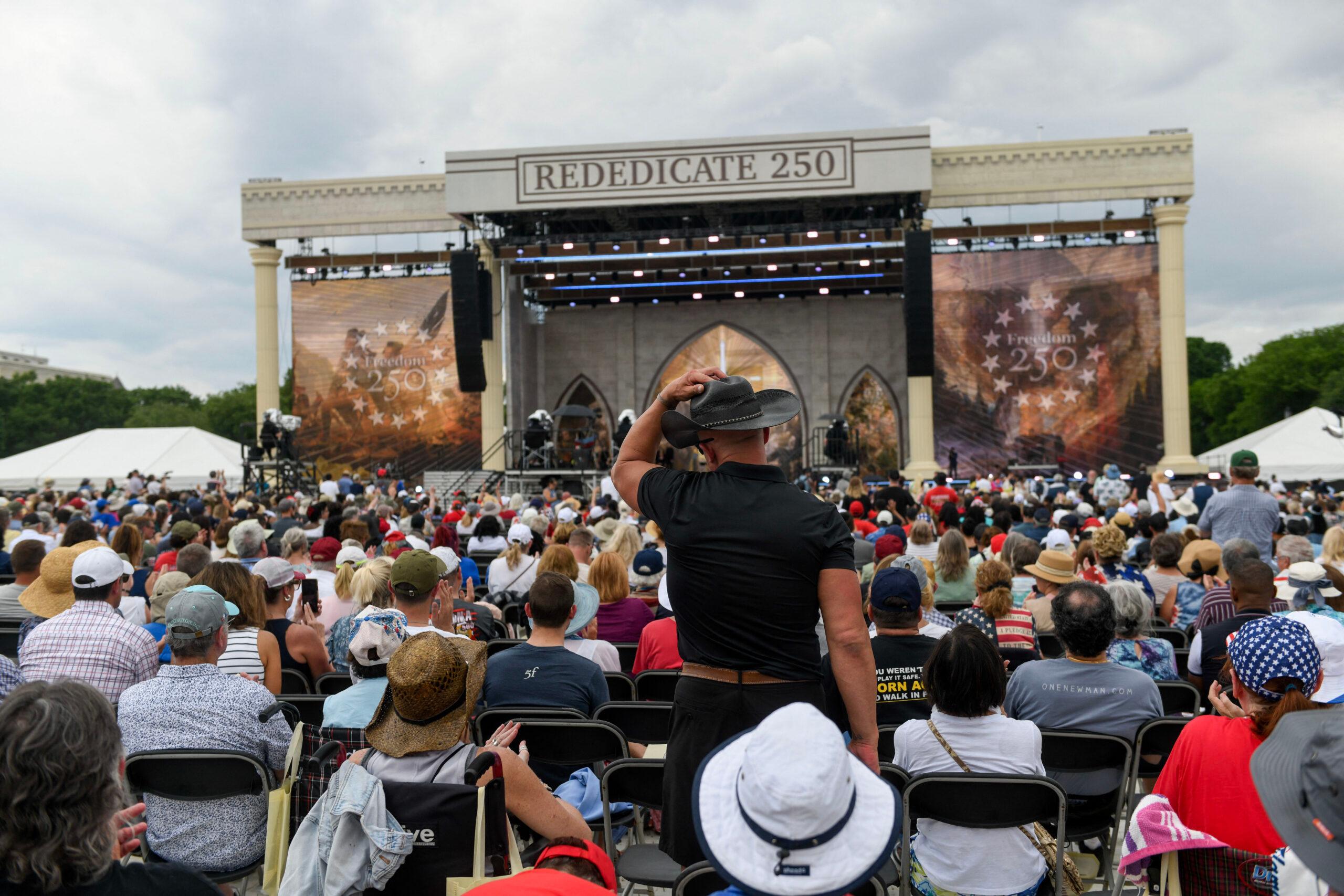
Attendees at Rededicate 250
The past few months of historical grandstanding are no quick fling: Trump’s infatuation with the semiquincentennial predates his return to office. In 2023, Politico reported that Trump was “proposing a blowout, 12-month-long ‘Salute to America 250’ celebration.” Around that time, he began to publicly broach the idea of a yearlong American State Fair.
Since his reelection, the president has undertaken a number of maneuvers to dominate the American anniversary landscape. In January 2025, he issued an executive order dictating a “grand celebration” to “honor the history of our great Nation” and establishing a task force to implement these plans. Until that point, the group in charge of organizing all federal actions related to the 250th had been the U.S. Semiquincentennial Commission—known publicly as America250. Trump moved to reshape the commission and guide its priorities from the early moments of his second term, stacking the board with loyalists.
When America250 partnered with the “Great American Farmers Market” in Washington, D.C., in 2025, the bazaar offered a “MAHA Monday” theme day featuring speakers including Health Secretary Robert F. Kennedy Jr. Historical societies that had previously partnered with the group began to distance themselves. One association went so far as to publish a report noting that America250’s programming had become “heavy on spectacle and with no clear lasting public benefit.” Eventually, the Trump administration moved to sideline the organization—which, by law, is constrained in how it can raise and spend funds—in favor of the independent fundraising instrument Freedom 250.
In April 2026, Mother Jones reported that Freedom 250 “seemed to have taken charge of the most visible anniversary celebrations” and that internal National Park Service memos told “employees to replace ‘America250’ references and logos displayed online and in public with Freedom 250 insignias.” According to a similarly timed report from NOTUS, America250 had received only a quarter of its congressionally appropriated funds as of April, while the Park Foundation—under which Freedom 250 exists—had “received nearly $80 million in federal government grants related to the 250th celebration. Before the creation of Freedom 250, the National Park Foundation had received less than $8 million in total grant funding from the federal government going back to 2009.” Because it’s an LLC that falls under the jurisdiction of the nonprofit National Park Foundation, Freedom 250 requires far less fundraising oversight than America250 and has courted potential donors with benefits including $1 million bids for presidential photo ops and $2.5 million bids for potential July 4 speaking slots.
Rededicate 250 and many of the other events that have made up the Freedom 250 lineup fit cleanly within Trump’s wider crusade against what he’s termed “improper ideology.” Trump has spent much of his second term policing what history is enshrined by the U.S. government and taught in the public education system. Perhaps the defining speech-related action of his second presidency is his executive order Restoring Truth and Sanity to American History. It instructs the secretary of the interior to ensure “all public monuments, memorials, statues, markers, or similar properties within [its] jurisdiction do not … disparage Americans past or living (including persons living in colonial times)” and “instead focus on the greatness … and progress.” This effort is a continuation of Trump’s first term, when he not only promised to counter educational narratives that he said portrayed America as “a wicked and racist nation” but also pledged to ensure that “our youth will be taught to love America.”
Complexity and depth do not tend to sit well with a man who responded to a question about his favorite Bible verse with “The Bible means a lot to me, but I don’t want to get into specifics.”
Trump has ordered his administration to stop racial sensitivity programs that he regards as “divisive” and “un-American.” In the past two years, his administration has reinstalled on federal property multiple memorials featuring slave owners that had previously been taken down after the racial justice protests of 2020, and it has spuriously reinstituted a number of Confederate fort names in the armed services. Freedom 250 events like Rededicate and the group’s roving “Freedom Trucks” often explicitly center and uplift the administration’s preferred founding narrative, a romantic account devoid of historical nuance, formulated for explicitly ideological aims.
A critical part of the motivation is to please one of his core constituencies: Christian nationalists. Dating back to Trump’s first election, Christian nationalists—and to a wider degree, evangelicals generally—have formed a bedrock of his base, particularly in moments of crisis. Trump’s current approval ratings are below 40 percent with the general public, per the latest New York Times/Siena poll, but as of this spring, his numbers with white evangelicals were still hovering around 64 percent. One needn’t attend Rededicate 250 to understand the extent to which these groups and the administration support each other. During his second reelection campaign, Trump often painted himself as the lone figure capable of defending Christian values. “They want to tear down crosses where they can, and cover them up with social justice flags,” he said at the 2024 National Religious Broadcasters International Christian Media Convention. “No one will be touching the cross of Christ under the Trump administration, I swear to you.”
In February 2025, Trump issued Executive Order 14202, Eradicating Anti-Christian Bias—with the explicit purpose of combating what he claimed was the “anti-Christian weaponization of government” under his predecessor. Months later, that July, he ordered the IRS to retain tax-exempt status for pastors who endorse political candidates, upending decades of tax policy. Trump also pardoned a number of antiabortion activists who had been charged with illegally blockading clinics under the Biden administration.
Freedom 250 is likewise tied directly to this push. It has repeatedly partnered with both the right-wing advocacy group PragerU, which advances “Judeo-Christian values,” and the “nonsectarian Christian university” Hillsdale College, which promotes a conservative-leaning “1776 Curriculum” for public schools. Other groups affiliated with Freedom 250 include the nonprofit America Prays (whose aims include returning the country “to its spiritual foundations” and “rededicat[ing] ourselves to one nation under God”), the National Religious Broadcasters, a school library book-banning group, and the evangelical film production company Angel Studios. It is nearly impossible to scan this as anything other than an attempt to fashion the semiquincentennial on fundamentalist ground.
Yet the contentions at the core of anniversary events like Rededicate 250 are fundamentally ahistorical. The founding of the United States was never explicitly Christian in nature, despite the deeply held religious beliefs of the founders. The phrase “One nation under God” was added to the Pledge of Allegiance during the Red Scare, and the Constitution rarely references religion outright. “In God We Trust” was adopted as our national motto only after the founders’ intended message, “E Pluribus Unum”—Latin for “From many, one”—was cast aside during the height of McCarthyism.
The ideology behind the 250th anniversary push similarly attempts to flatten and sanitize a history that is doggedly nuanced. Asking Americans to consider that some of our country’s founding fathers trafficked human beings, impregnated their enslaved teenage sisters-in-law, or attempted to eradicate Native American populations does not require people to only consider those acts when accounting for the founders’ impact on our present. It asks only that we consider the acts at all. Doing so does not deprive our national narrative of heroism. It merely exists in more varied and tangled forms.
Of course, complexity and depth do not tend to sit well with a man who responded to a question about his favorite Bible verse with “The Bible means a lot to me, but I don’t want to get into specifics”; who sells $60 copies of the good book for his own profit; who recently assailed the pope as “weak on crime” and proceeded to post blasphemous AI memes of himself as Jesus. What qualifies a man who invented a Civil War battle so that he could put up a placard at one of his golf courses—who bragged that he’d trounce both George Washington and Abraham Lincoln in a hypothetical election—to define our national historic narrative?
The only answer is power. And despite what the president may suppose, that, too, has its limits.
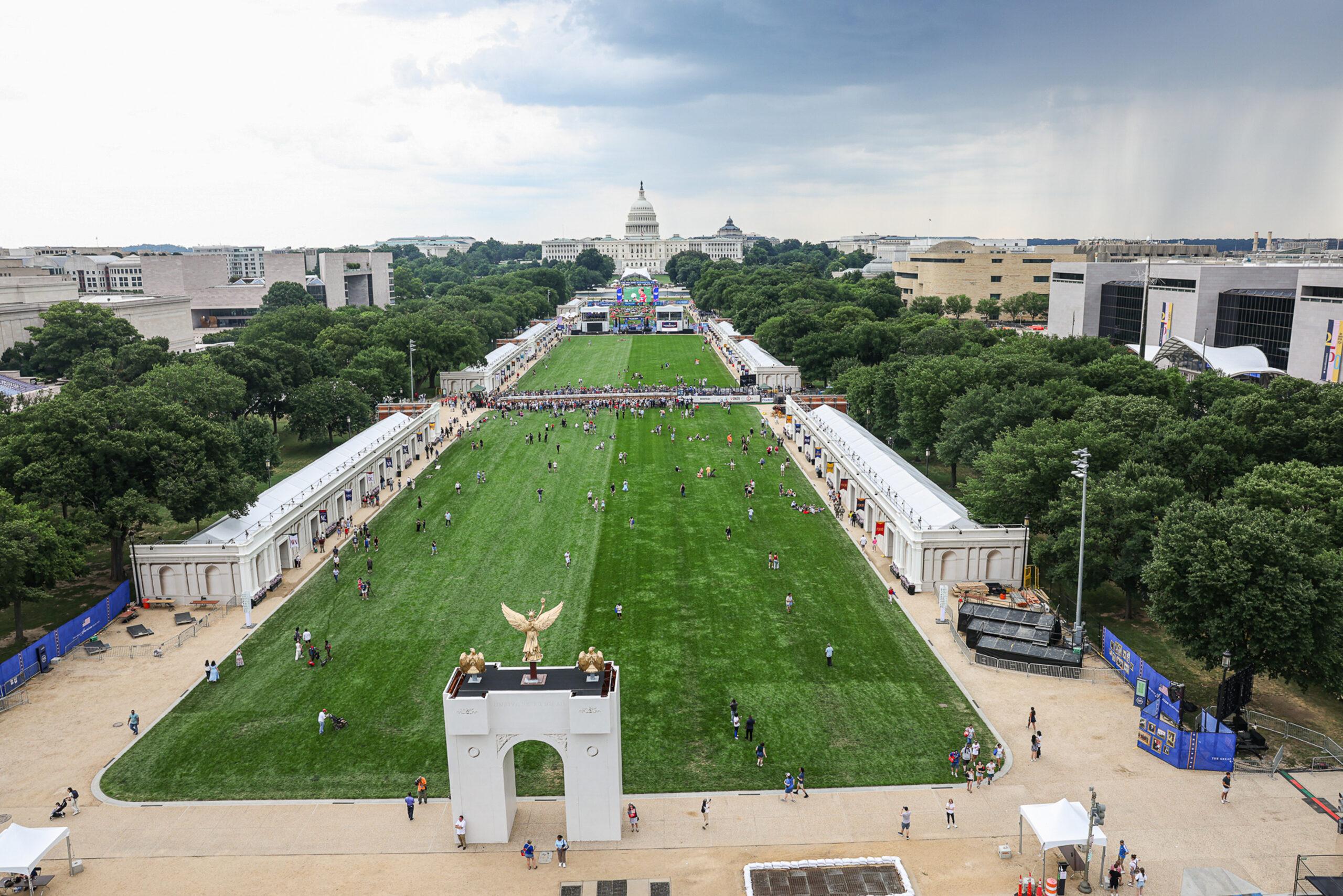
The U.S. Capitol and a replica of President Trump’s planned Triumphal Arch at the Great American State Fair
Back in May, my limit was six hours. The temperature at Rededicate was 85 degrees, but the humidity was plainly subtropical. I had waited in line for most of the morning. At the security gate, someone played a recording of the national anthem from a remote device, and it sounded like a chipmunk slowly dying. One of my neighbors in line turned to me and blamed it on “an antagonist” trying to counterprogram the event. Inside, the stage was backed by giant screens depicting fake stained glass and moving portraits of the founding fathers. Most of the in-person speakers were priests or religious scholars—only a few members of the administration bothered showing up. At one point I started counting piles of actual horseshit on the grounds.
In a prerecorded video, Defense Secretary Pete Hegseth—dressed like he had to convince a Nantucket beach crowd the waters were safe—urged the assemblage to “follow George Washington’s example” and pray. “Let us pray as he did,” the man reportedly responsible for ordering the executions of wounded boat-strike survivors said to the group. “Let us pray without ceasing. Let us pray for our nation on bended knee. And let us ask our Lord and Savior, Jesus Christ, as Washington did on that momentous day, so help us God.” Vice President JD Vance, also in a prerecorded clip, gave thanks that “we’ve always been and still are a nation of prayer.” Speaker of the House Mike Johnson spoke in person about “insidious ideologies,” “godless Soviet tyranny,” and having “the freest, most successful, most benevolent nation in the history of the world.” South Carolina Senator Tim Scott came onstage and started hollering like a swaggerless Oprah about “the Lord of Lords … the King of Kings … the Alpha and the Omega.”
President Trump appeared on-screen in a Bible reading he’d already used for a previous event. He was out golfing.