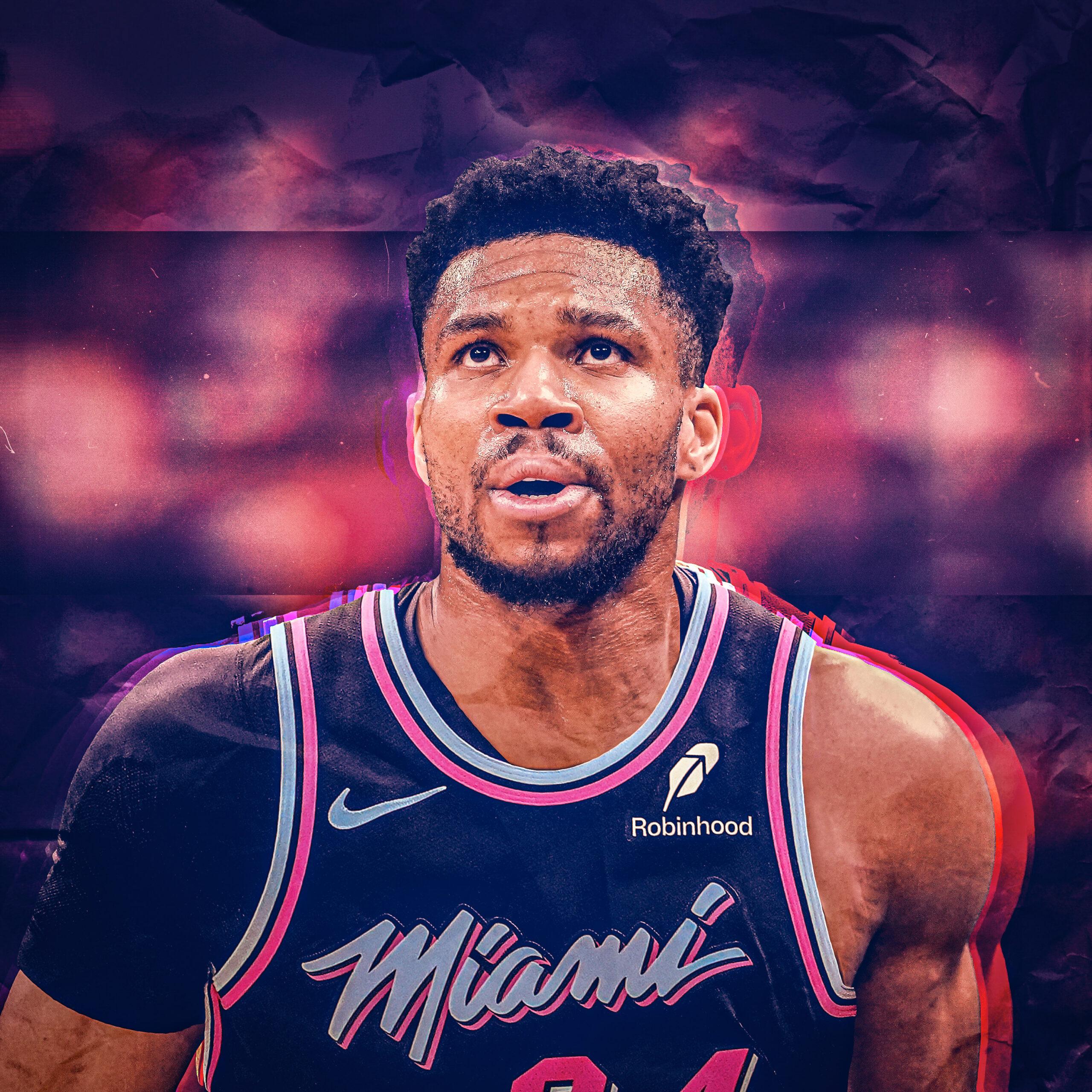

The Miami Heat just made the kind of blockbuster trade that wins a press conference, but can it win a championship? Giannis Antetokounmpo, a two-time MVP, Defensive Player of the Year, Finals MVP, and the most physically dominant interior force the league has seen since prime Shaq, is on his way to Miami. And just like the trade for Shaq, who went to Miami in 2004, acquiring Antetokounmpo is classic Pat Riley. The longtime Heat president has built a reputation as one of the shrewdest executives in the league in large part by luring top talent like O’Neal, LeBron James, Chris Bosh, and Jimmy Butler to South Beach.
But this isn’t the 2010s anymore. The game has changed. The CBA has, too. And Miami’s grand Antetokounmpo experiment will be a fascinating test of Riley’s star-first team-building approach in the age of the second apron.
The Heat just went all in on a soon-to-be 32-year-old superstar with a lengthy history of lower-body soft-tissue injuries. Miami gave up Tyler Herro, Kel’el Ware, Jaime Jaquez Jr., Kasparas Jakucionis, three first-round picks, one pick swap, and one second-rounder for Antetokounmpo and Bobby Portis. It’s a bounty befitting a player of Giannis’s stature, but there’s a tension between what the Heat are giving up and what they can expect to receive over the course of Antetokounmpo’s tenure in South Beach. Giannis may already be past his prime on the floor, and he’s nowhere near past his prime on the cap sheet.
In the era of parity, depth, and the second apron, overpaying players has become a cardinal sin. And because of the way NBA contracts escalate as superstars advance through their careers, many of the most damaging deals belong to older players. That’s not to say those players haven’t earned or don’t deserve the paydays they’ve received, but under the current economic structure of the league, many forward-thinking front offices are prioritizing younger, cheaper talent. The risk in South Florida is that the Heat just signed up for a massive overpay that will cost them the exact kind of team-building flexibility that is required to compete with younger and deeper contenders across the NBA right now.
Consider this: Among the 25 players who played the most minutes in the 2026 NBA playoffs, only two of them were 32 or older: Tobias Harris and James Harden.
If you expand that list to include the top 50 most active postseason players, you still see only five in their age-32 season or older: Harris and Harden, plus LeBron James, Paul George, and Rudy Gobert.
The most successful playoff teams this past season were all built around youth: OKC and San Antonio constructed two of the youngest juggernauts in NBA history, while the Knicks’ entire starting five is 28 to 31, smack-dab in the middle of their primes. Among the four conference finalists, players aged 32 or older accounted for just 7.7 percent of those teams’ total playoff minutes—and Harden accounted for nearly half of those, with 672. The other most active older players on the NBA’s final four teams were Dennis Schroder (271 total playoff minutes), Jordan Clarkson (195), and Harrison Barnes (183).



More on the Giannis Trade
This is more than just trivia. Antetokounmpo will turn 32 in December, and Miami has now become ground zero for a question I can't stop asking about the modern NBA: Is it even possible to build a championship roster around an aging superstar anymore?
Make no mistake; players in their mid-30s can still play at a high level, and Giannis is no exception. He remains the league’s most ferocious paint scorer, and when he’s healthy, his blend of strength, determination, and driving skill makes him unguardable near the cup. And let’s not forget: In this decade alone, Stephen Curry won a Finals MVP at 34. LeBron did it at 35. But here’s another fact. Both of those titles happened in a completely different CBA context, and once you look at the harsh interplay between aging curves, max-contract rules, and the dreaded “apron restrictions” that are specifically engineered to spread top talent evenly around the NBA, you start to see why the best teams in the current NBA are led by men younger than Giannis.
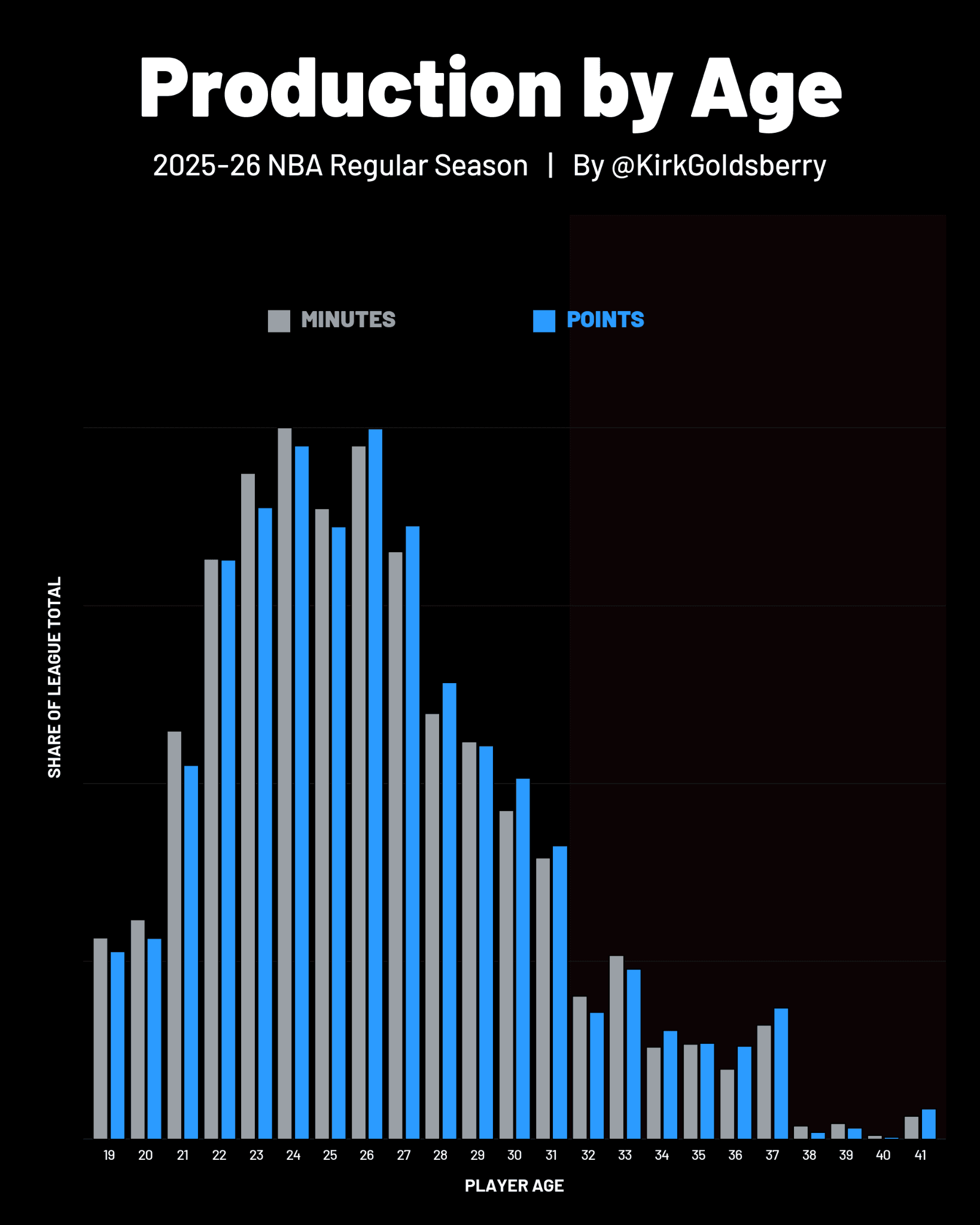
Let’s tackle the aging curves first. No matter how you slice it, the NBA is a young man’s game. The league is dominated by dudes under 30. Look at this chart: 24- and 26-year-olds play more minutes and score more points than any other age.
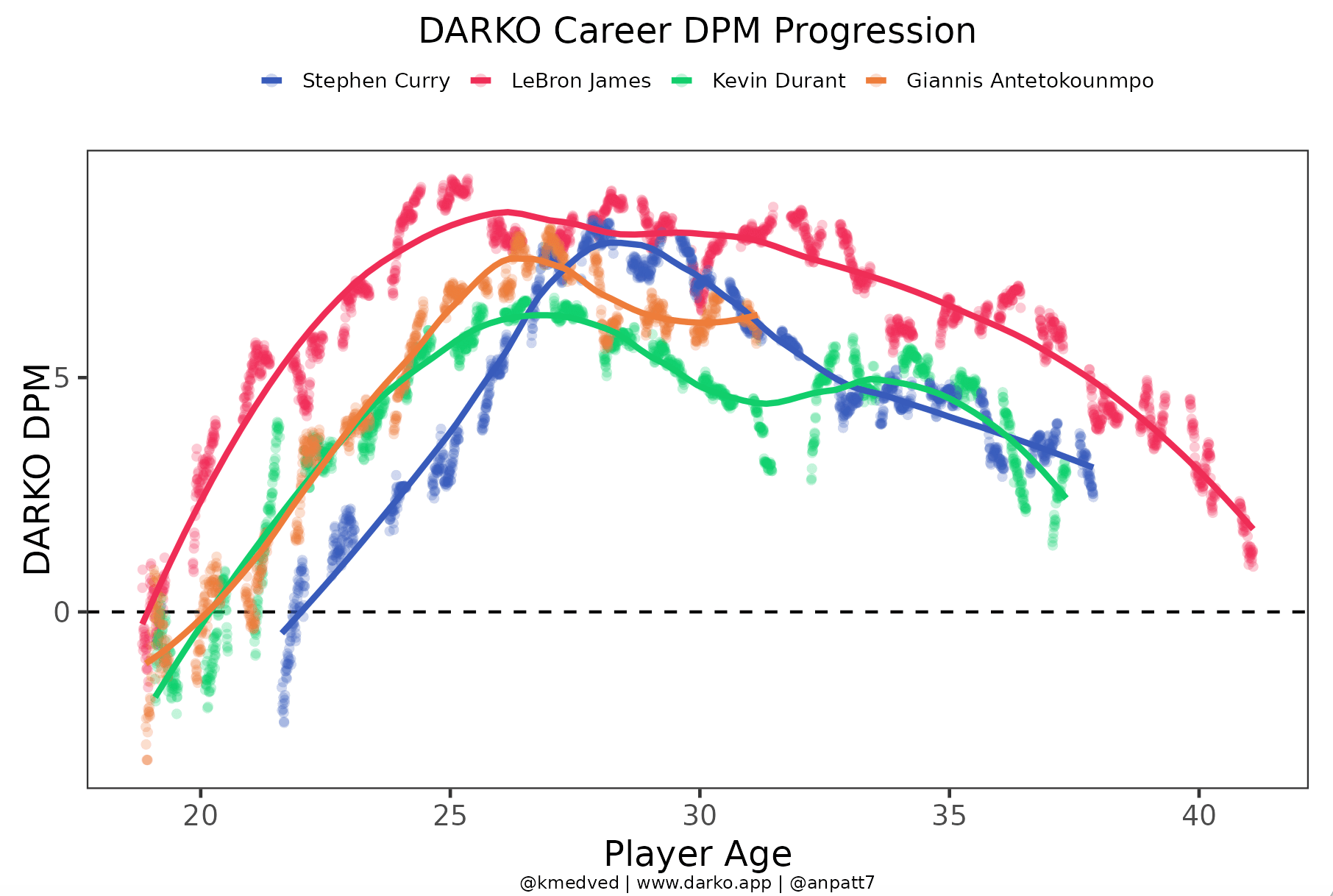
That’s because NBA stars peak in their late 20s. Don’t take my word for it; just look at the aging curves for Curry, James, Antetokounmpo, and Kevin Durant. As you can see, each star’s apex mountain came in their 20s.
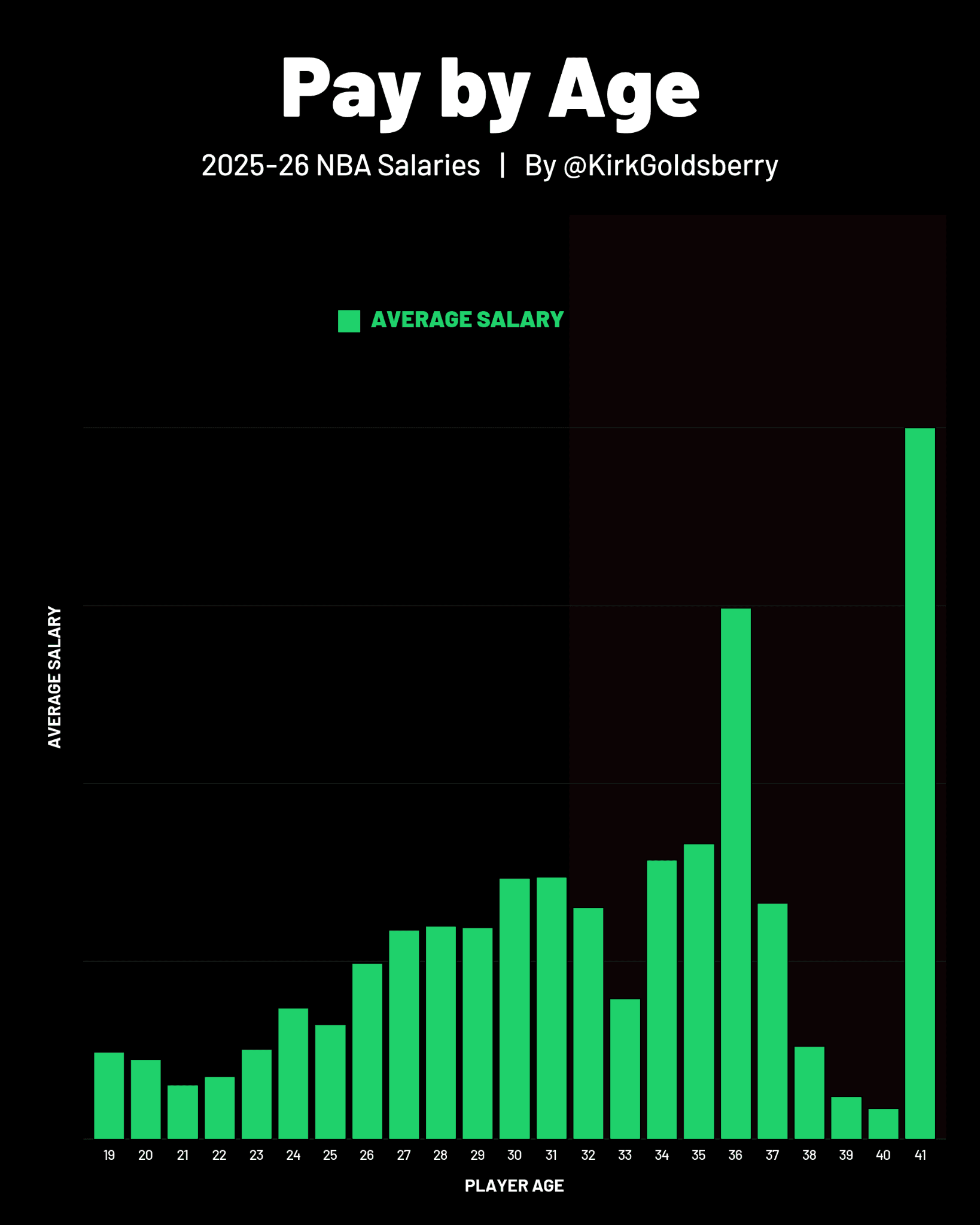
Now let’s layer in the key fact that the league also reserves its biggest max deals for players who have accrued the best résumés, and you start to see why many of the league’s best players earn their biggest paychecks once they’re past their prime years. Those résumés take years of All-NBA-caliber play to build, so the contract that rewards them almost always kicks in after the seasons that earned it—a player qualifies for the richest deal in the sport at the exact moment that their production begins to slip. So any team that has an aging superstar on its cap sheet under the current CBA is, to borrow a phrase from baseball, paying for past performance more than future production.
Finally, the apron system means that overpaying All-Star players has never been as catastrophic as it is right now. Although the league still doesn’t technically have a “hard cap,” in practice it kind of does. Only one team, the Cavs, dared to exceed the second apron last year. All 29 of the other teams stayed below it, and for good reason: The team-building penalties associated with exceeding it are downright draconian. The best rosters in the league now not only require great players but also include few wasted dollars.
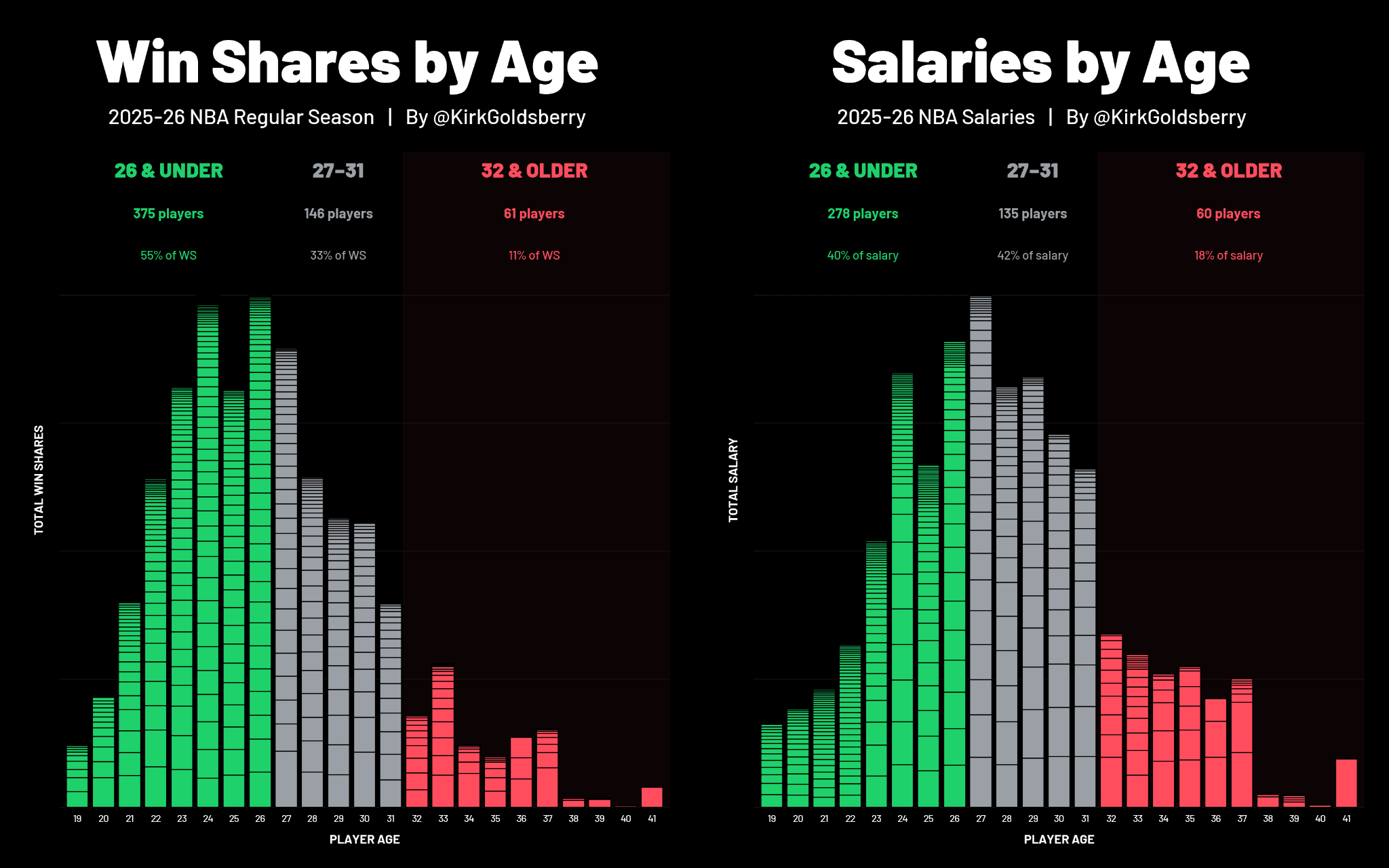
The four highest-paid players this past season were Curry, Durant, Nikola Jokic, and Joel Embiid. All of them are over 30. None of them made it to the conference finals. To varying degrees, all of their teams are entering this offseason looking for creative ways to upgrade their depth while doing cap gymnastics around their stars’ massive deals. Antetokounmpo and the Heat are in danger of falling into the same boat: He’s bound to make the most money of his career long after his on-court peak, which means that massive team-building challenges are taking their talents to South Beach, too.
Antetokounmpo will become extension eligible with Miami in the middle of the upcoming season, and he can sign one of two deals: a four-year, $275 million extension if he declines his 2027-28 player option, or a three-year, $214 million extension if he opts in. (The opt-in carries the higher annual value, ~$71.3 million vs. ~$68.75 million.) Either way, the extension will run through 2030-31, his age-36 season, and either way, his career earnings chart will look a lot different than his aging curve.
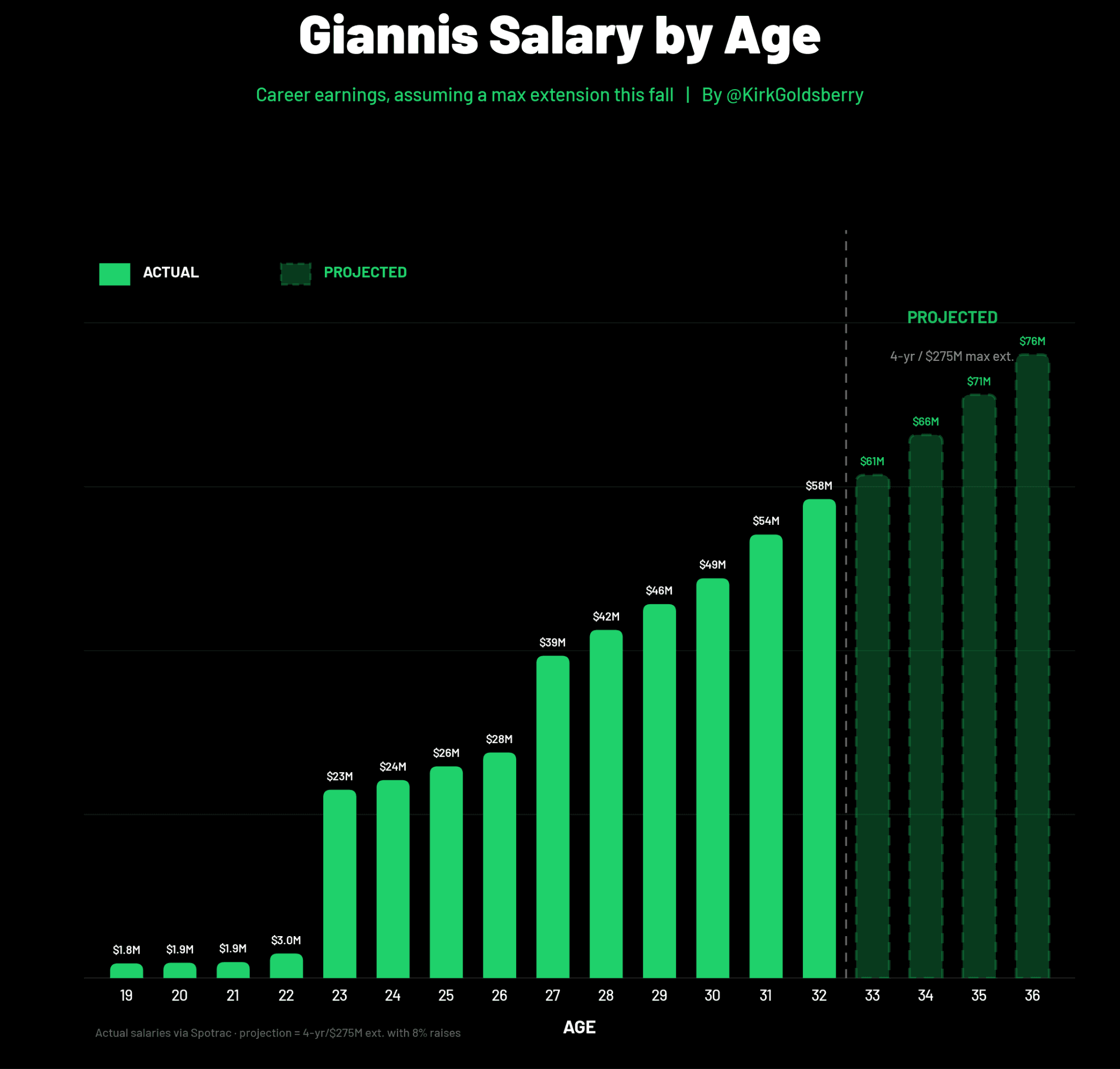
Almost everyone around the league expects him to sign one of those two extensions. The key question for Miami is whether he will be worth 35 percent of the entire cap when he’s on the wrong side of 32 years old, especially considering all the young players and draft capital the Heat gave up to get him. I’m skeptical, especially considering his recent struggles to stay healthy, which brings us to one final tension.
League rules dictate paying older players past their prime, but given the speed and space of the modern game, the ridiculous 82-game length of the regular season, the playoff grind, and the realities of aging bodies, it seems like it will be harder than ever for the league’s most famous faces—the superstars a bit past their primes—to live up to these massive deals. Maybe that’s by design. Maybe it’s an unintended consequence of the recent CBA. Regardless, under this set of rules and realities, it’s hard to envision how a team built around an aging star will ever find the depth (and health) required to compete with teams built around dudes almost a decade younger.
Riley built his brand in Miami by paying the league’s most famous players the most money possible. It was glitzy and glamorous, and it worked. But as Riley enters the late stages of his incredible run as an executive, it’s beginning to seem like the league has moved on from that strategy, and today’s best teams are built through the draft. The patterns are just starting to emerge, but things aren’t looking great for max players on the wrong side of 32—maybe Miami and Antetokounmpo can buck these trends.