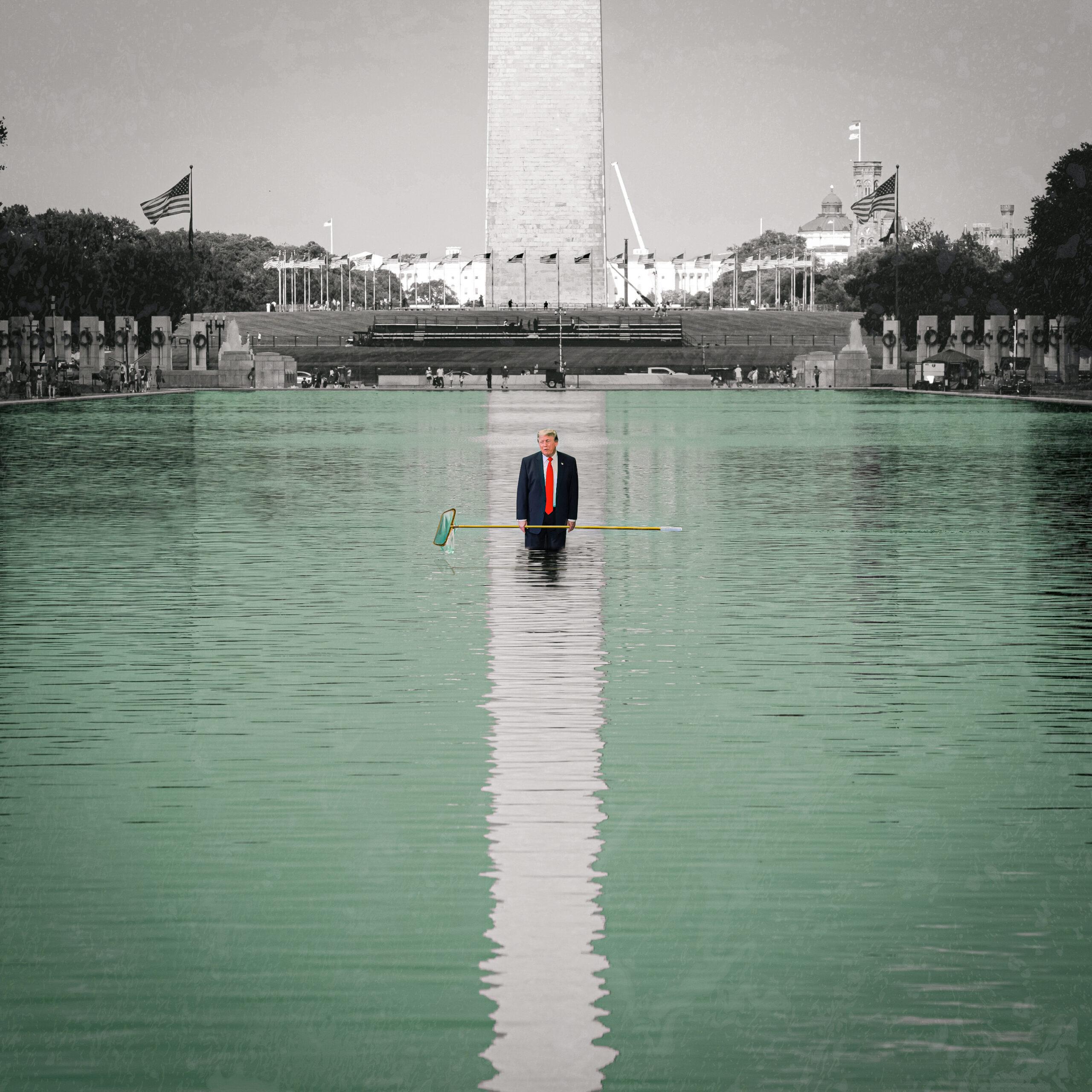
America Is Trapped in the Grossest Pool Party of All Time
The nation’s 250th birthday was supposed to be a celebration of all things red, white, and blue. Then the Reflecting Pool turned green.America Is Trapped in the Grossest Pool Party of All Time
The nation’s 250th birthday was supposed to be a celebration of all things red, white, and blue. Then the Reflecting Pool turned green.
I’m told that it stinks. I can’t confirm this myself—I’ve only seen photos—but people who’ve visited the Lincoln Memorial Reflecting Pool in the aftermath of Donald Trump’s $16.4 million renovation have spoken of an unsettling odor wafting off the surface, like the aroma of something decaying. The water, which was supposed to be a vibrant blue, is instead a deep, putrid green, the queasy artichoke of airsick cartoon characters and five-day-old bruises and pizza boxes left out in the rain. The polyurethane coating, which was not supposed to peel off, is peeling off. The algae are having an incredible time. To judge by the nonstop coverage they’ve gotten—The New York Times is treating the pool fiasco like Watergate—the algae, despite being insensate, soulless, slimy, insatiable, and repellent, may be the only organisms in the U.S. with a better media strategy than the Republican Party. Add in the stench, and you have a perfect emblem for Trump’s America: You can close your eyes, but you can’t escape.
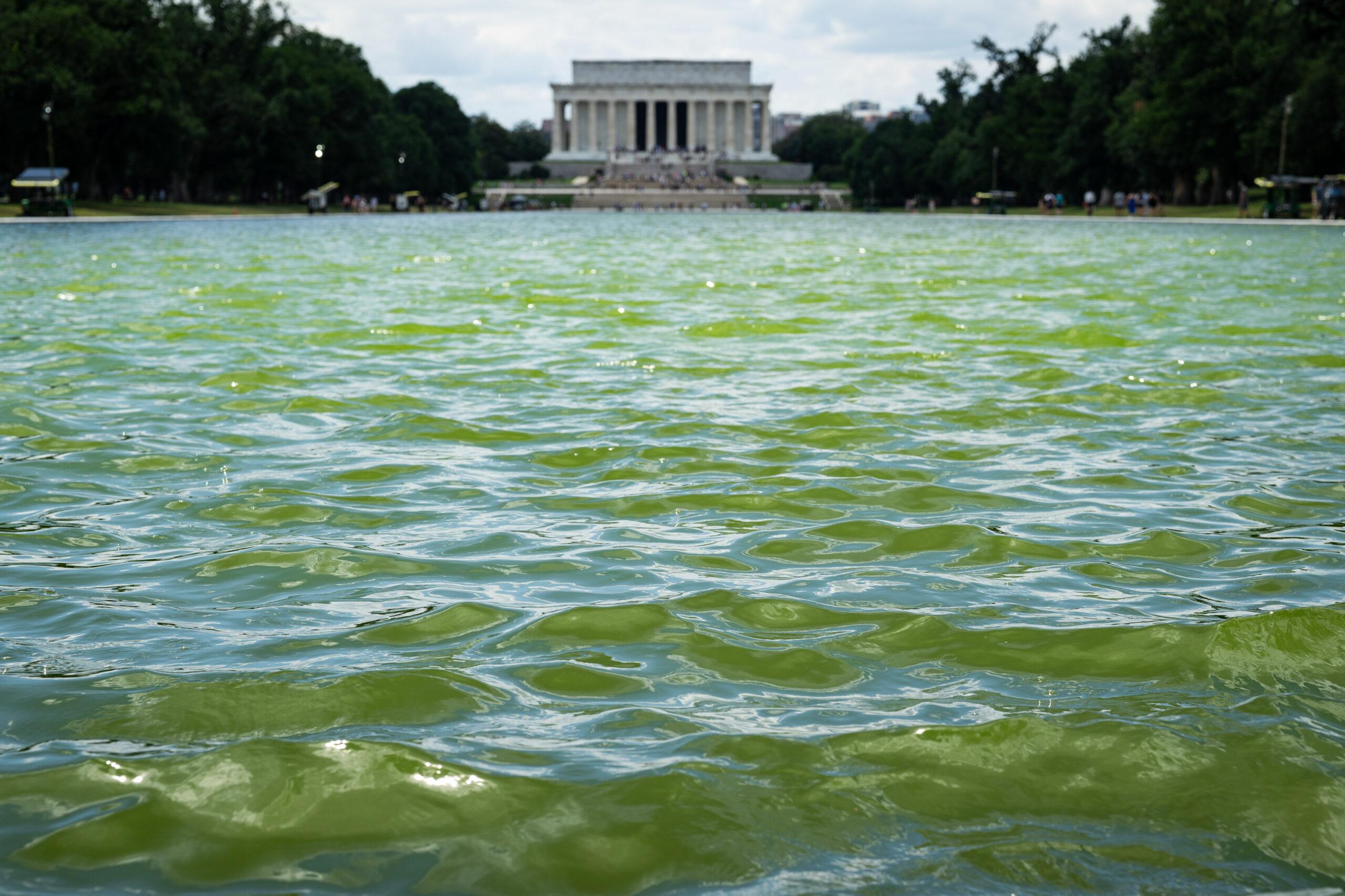
It wasn’t supposed to be like this. When the president closes his eyes and pictures a beautiful pool, he sees something turquoise and glimmering. He sees a sapphire rectangle on a hotel rooftop, the sort of pool his former associate Spuds MacKenzie might have jumped into in a 1987 Bud Light commercial. He does not see a dark, tranquil body of water designed to mirror the sky above, which was the purpose of the Reflecting Pool when it was built more than a century ago. The pool, which stretches for 2,030 feet on the National Mall, between the Lincoln Memorial and the Washington Monument, was meant to create a solemn atmosphere suited to its location among some of the most powerful symbols of American democracy. But for Trump, a solemn atmosphere is one where everything is covered with gold, and since it’s impossible to gold-plate water—someone should figure out how, it might end the MAGA war on science—he decided to upgrade the pool to the next best color.
Trump’s plans are always so easy, so perfect, until anyone tries to execute them. His wars can all be won in a couple of days, as long as we aren’t actually fighting them. (Although note that his wars, too, tend to founder around narrow bodies of water.) His concert bills are immaculate, as long as no one informs the artists. The idea for the pool was to turn the water blue by painting the bottom blue, although Trump doesn’t like calling the renovation a paint job. “This was not a paint job,” he posted on Truth Social earlier this month. “This was highly sophisticated material, industrial strength, that could last for 100 years, applied by very talented people, many of whom came from the Great State of Oklahoma, where I won 77 out of 77 Counties, THREE TIMES, the only President to ever do so. The material is thick, strong, flexible, and has a natural, beautiful color, the dark blue of the American Flag! President DONALD J. TRUMP.”
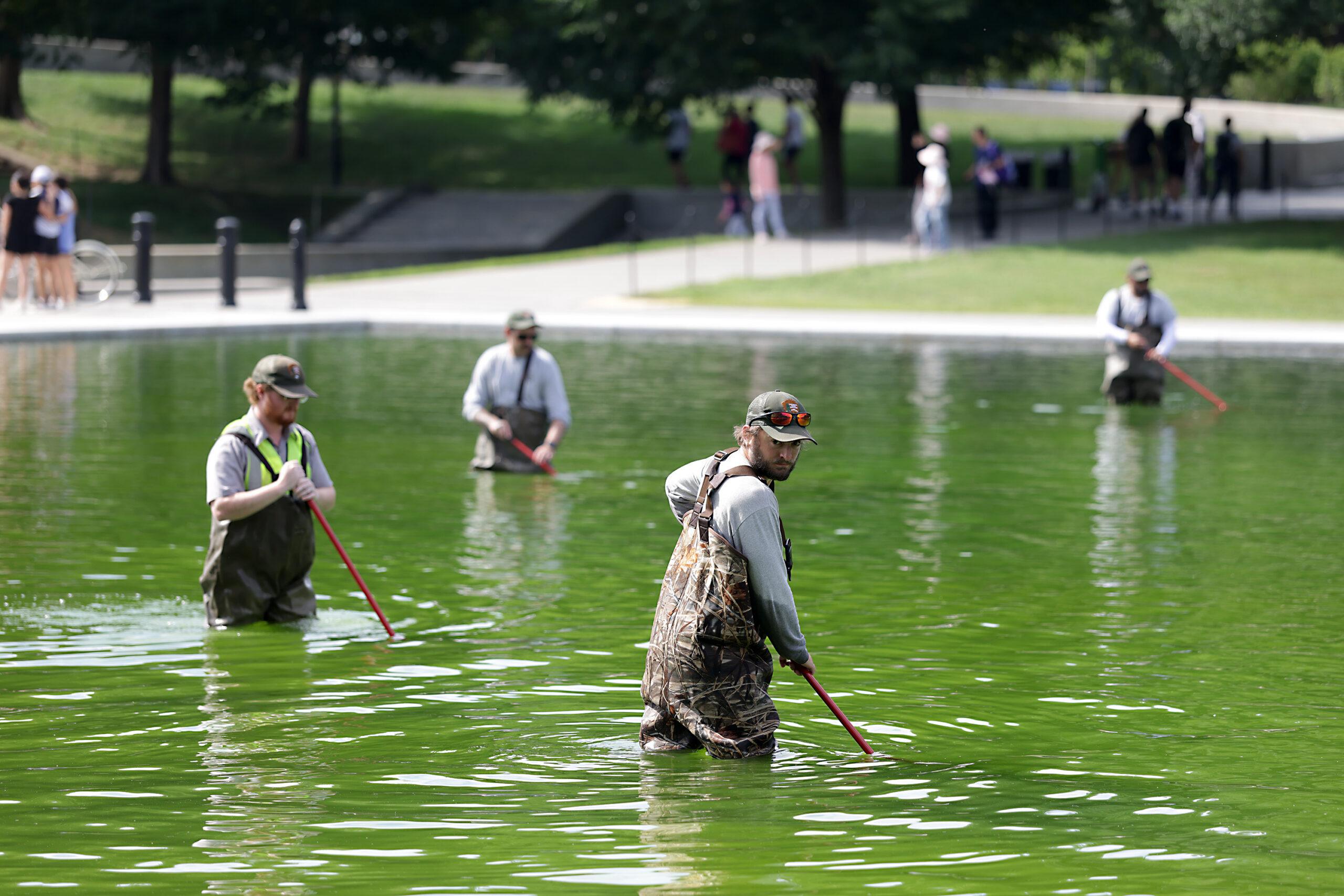
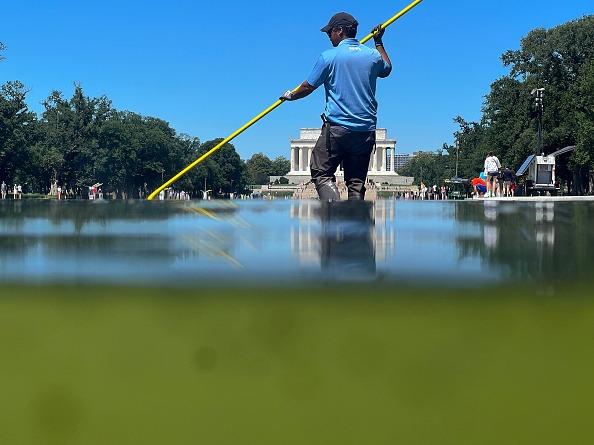
The pool was drained for work in April. It was refilled in early June. From this point on, things have followed an arc familiar from more or less everything Trump has tried to do in his life—apart from running for president, which he is, unfortunately, extremely good at. Algae returned within days. The thick, strong, flexible, industrial-strength coating instantly started flaking off. The pool filled up with park workers hopelessly trying to skim out the muck ahead of the celebration of America’s 250th birthday on July 4. Nothing worked, because nothing ever works, and Trump started blaming other people for the mess, because Trump always blames other people for the mess. In this case, he blamed unspecified saboteurs who, he claimed without evidence, had attacked the pool with box cutters. Blaming vandals didn’t fix the problem, but it did give Trump an excuse to put up fencing around the pool and send in National Guardsmen to patrol the perimeter, as Abraham Lincoln surely would have wanted.
What’s amazing about this story isn’t so much that it happened as that it’s gotten so much attention. Don’t get me wrong, it’s wild that it happened, but on the list of the administration’s most consequential fuckups of the past three months, it’s sitting in around 40 billionth place. Nevertheless, the Reflecting Pool saga and its adjacent algal discourse have become minor national obsessions. Feeds are full of them. News organs are breathlessly investigating who knew what and when. TikTok pool guys are weighing in. This week, in one of the most chilling verdicts of our lifetimes, a court in Texas sentenced a group of anti-ICE protestors to decades in prison, mostly for engaging in normal protest activities. Why would a decorative body of water, even a green and reeking one, attract more attention than that?
The answer probably has something to do with avoidance; while slimy water on the National Mall may not be delightful to think about, it beats contemplating the full scope of the immiseration and corruption currently marauding through this country. But I don’t think that’s the whole explanation. The Reflecting Pool fiasco is simply an irresistible metaphor for the effect of Trump’s power on everything it touches. More than the tariff debacle, more than the Iran disaster, even more than the ongoing horror of ICE raids and detention centers, it gives us a single, unforgettable image to represent what this administration is doing to the United States.
Here are five reasons why the Reflecting Pool story has captured our collective imagination.
1. It's a story on a human scale.
So many of the Trump administration’s crimes and failures have been vast, hidden, abstract, and hard to comprehend. This one is small and visible. It doesn’t force you to think in terms of billions or trillions. It doesn’t force you to keep a complex timeline in your head or remember a sprawling network of minor players. There’s just this dirty pool. If you want to, you can go and look at it.
When I try to think about, say, the destruction of USAID—the sudden disappearance of humanitarian programs around the world, the canceled shipments of food and medicine, the resulting increase in starvation and disease, the hundreds of thousands of needless deaths, with millions more likely to come—the sheer scale of the horror, spread out over lives, years, and continents, makes it hard to hold in my mind. I’m appalled, I’m furious, but the subject is too huge to be grasped in its entirety. In the same way, when I try to think about the global effects of Trump’s reckless, failed war in Iran, it’s too much. I know it’s awful, I can feel that it’s awful, but I can’t see it, at least not all at once.
The Reflecting Pool, though? It’s right there. It looks grungy as hell. It looks like a vat of frog cider. I can see the hunks of the liner floating in the water, and I can see the armed soldiers patrolling the area, keeping the president’s precious bog water safe from me and my fellow Americans. We live in the age of shortform video. It makes a huge difference that the Reflecting Pool’s grime can be taken in at a glance, with the Washington Monument looking embarrassed in the background.
2. It’s a crushing violation of the Dad Code of Pools.
From a certain angle, you could say that the Reflecting Pool screwup is one of the more relatable catastrophes Trump has engendered in his long career of malevolent self-owns. Most of us have never declared bankruptcy six times due largely to our gross mismanagement of our Atlantic City casino business. Many of us have tried to keep a pool clean. Whether dealing with a swimming pool, a Jacuzzi, or a fish pond, we know how very wrong a contained body of domestic fresh water can go. We’ve woken up to strange algae blooms, weird oozes, crumbling tile, and upsetting smells. We’ve battled these enemies, pH meters and telescoping net handles in hand. Sometimes we’ve won. Sometimes we’ve lost. We understand that true nobility lies not in victory, that fickle mistress, but in our undaunted continuation of the fight.
Perversely, however, a struggle that could have made Trump seem more accessible, maybe even slightly more likeable—his backyard problems are our backyard problems!—has instead made him seem more childish, spoiled, and out of touch. Because while plenty of us have taken an L to algae now and again, what we haven’t done is scream that it was someone else’s fault. We haven’t blamed mysterious pool vandals. We haven’t erected the world’s most palpably butthurt fencing around our koi enclosures. We haven’t tried to convince our neighbors that our hot tubs smell like that only because of a nefarious conspiracy against us.
No. We simply carry on the lonely struggle, honoring the terms of the Dad Code of Pools, which all dads know instinctively in their bones, having learned its sacred tenets from the generations of dads who preceded us. It is a lonely, humbling, and ultimately fulfilling existence, and Trump’s whole approach to the Reflecting Pool saga has dishonored it. For instance, this is the guy whose company the president handed a no-bid contract to handle algae mitigation:
I’m sorry, but what in the upside-down pineapple hell are we doing here? This is John J. Cafaro, whose company is called, I am not kidding, Greenwater Services; you can’t accuse the man of false advertising. He was paid $1.7 million to install a water purification system in the pool. Cafaro, a neighbor of Trump’s Mar-a-Lago residence, has donated hundreds of thousands of dollars to Trump’s various campaign-graft entities. No one who respected the Dad Code would let this man within 1,000 yards of a pool. Look at him, in his velvet-collared 1920s fat-cat overcoat. Look at his Les Miserables factory-boss hair. Look at this whole tragicomedy:
Did he go to the cigar store and say, “Make me look like I’m sucking on a thumb—not mine, but Thor’s”? Come on. This is not a man you hire for pool maintenance. This is a man you hire to tell Mayor McCheese bad news. Every dad knows that the guy you trust to care for your pool has a rat tail, owns a sleeveless denim jacket with an Appetite for Destruction patch on the back, and drives a $170,000 truck. Cafaro’s a convicted felon—arguably his most compelling credential as a pool guy—but he was convicted of bribing a congressman, which is all wrong. Are we looking for a guy who’s done time? Absolutely. But we want a guy who’s done seven nonconsecutive months for crimes committed at various Rite-Aids, not a guy who’s trying to slip U.S. representatives into his (presumably silk-lined) pocket. This man looks like he has his own table at a restaurant called Florian’s, where he sits nightly in an opera cape, eating squid ravioli and weeping. This is an affront to the Dad Code. Can we please be serious.
3. It cuts right to the heart of Trump’s favorite narrative about himself.
Trump wants you to see him as a builder. He wants to be seen as someone who makes things. Big things. Towering skyscrapers. Palatial gambling halls. Emerald golf courses so pristine and expansive that no one says anything when he puts “3” on his scorecard after shooting an 11. Anyone who’s followed Trump’s career for more than 30 seconds knows this image is bullshit, but it’s crucial to his brand.
It’s crucial for two reasons. The first is that a builder gets shit done. Others may wring their hands and cry over nuances of policy or the adjudication of fairness; a builder deals in the hard, tangible realities of girders, beams, and pylons. He occupies a more serious plane than the nonentities who merely talk about the best way to do things. He just does them, on his own terms, bulldozing through all difficulties. Right-wing authoritarianism depends on rulers who project an image of swift, physical action, of command over the material world. They erect monuments to their own greatness (which is also the nation’s greatness). They make the trains run on time.
The second reason the builder image is important to Trump is that, like many narcissists, he’s terrified of death and desperate for a way to beat it. I’m speculating here, but come on. It’s not subtle. He sticks his name on everything he can. This may be partly because he likes looking at his own name, but it’s probably also because seeing “TRUMP” on big, tall, sturdy buildings creates a reassuring illusion of permanence. Those gold letters aren’t going anywhere! Therefore, neither is the man they refer to.
Both of these obsessions come to a head in the Reflecting Pool project. Trump wants his construction projects in Washington, D.C., to seem grand and heroic: Look at the bizarre graphics the White House has pumped out demonstrating that the Reflecting Pool is longer than many skyscrapers are tall. And these grand, heroic projects are designed partly to demonstrate Trump’s prowess as a builder and a man of action, and partly to enable Trump to put his own stamp—even his name, courts permitting—on the physical iconography of American democracy. The White House will never be the same once he’s added his ballroom. The D.C. skyline will never be the same once he’s built his hideous triumphal arch. The Mall will never be the same once he’s turned the Reflecting Pool the color of a shopping-mall fountain. The symbols of the country will be marked by him forever; his rule will never end.
I think everyone senses this about him, even his own fans, and so it hits especially hard when he reveals himself as a bad and incompetent builder. It erodes the underpinning of the claim that he’s a strong leader whose bold, spontaneous actions are a better path to success than a lot of democratic committees and deliberations and planning. How useful are your bold actions if you can’t even clean out a pool successfully?
And on a deeper level, this visible incompetence erodes his symbolic push for immortality. It makes his late-life psychodrama look sad and pathetic. You can’t put your timeless stamp on the capital by allowing the capital to be overrun by aquatic muck. The whole fiasco might be the most Emperor’s New Clothes moment Trump’s specific persona could possibly invite: It makes him look like an old man who doesn’t know what he’s doing, which is both exactly what he is and the antithesis of what he’s trying to sell.


4. It reflects our sense of the broader assault on the nation’s capital.
Most Americans don’t live in Washington, D.C. Many Americans have never been to Washington, D.C. But the nation’s capital matters even to people who haven’t seen it. Symbolism plays a large part in constructing a national identity. The arrangement of the landmarks around the National Mall is meant to function as a sort of symbolism you can walk through; they’re meant to orient visitors in our guiding ideals, the lessons we’ve learned through 250 years of history. You can look at them and say, This is what we aspire to. This is who we’re trying to be. (Or you can not: One of the key factors that distinguishes a liberal democracy from the kind of country Trump apparently wants to build is that, in the former, you’re free to dissent from any symbolic display you dislike; the point is that they’re there if you need them.) We also have a deeply ingrained sense that the architecture of Washington, D.C., is part of a shared heritage. It belongs to all of us.
Because at any moment during the second Trump administration there are about 47,000 things to pay attention to, the story of how Trump is changing D.C.—on the level of architecture, I mean, not in terms of culture, though the two are of course linked—hasn’t gotten a lot of attention. At least not consistently or all at once, at least not in a way that’s fully broken through. But I think most of us have seen enough fragments of the larger story to have a deep, uneasy sense that Trump is altering our capital in a more fundamental and threatening way than we’re being told on a daily basis.
We’ve seen him rip out part of the White House to build an enormous, tacky ballroom hardly anyone seems to want. We’ve seen him build an MMA cage on the South Lawn of the White House. We’ve seen him put his own name, illegally, on the Kennedy Center; when a judge ordered him to take it down, we’ve seen him hide the building’s facade behind a shroud. We’ve seen his plans for a giant, self-glorifying arch. Each of these stories has kind of dribbled in separately and been discussed individually, as its own thing. But taken together, they represent a sustained assault on both the appearance and the meaning of the seat of American government.
Most worryingly—and this is probably the story that’s been talked about least—we’ve seen Trump fill the streets of D.C. with armed troops, many of them called up on bogus crime-fighting pretexts and drawn from National Guard units in faraway deep-red states. The atmosphere of a public space changes completely when there are armed soldiers surveying it: It ceases to be an open, welcoming environment that belongs to the people enjoying it and instead becomes something more sinister and dangerous, a place the public is permitted to visit on sufferance, and where putting a foot wrong could lead to violent consequences. This is catastrophically un-American, but it’s how things are always done in authoritarian states, where visible signs of the state’s power to harass, imprison, and/or kill you are as much a part of the symbolic landscape as the statues on the lawn. Personally, I am not comforted by the fact that a president who can’t admit when he’s lost an election is barracking a hand-picked military force in the capital city where transfers of power are supposed to take place; maybe that’s just me.
This may be a stretch, but I think the Reflecting Pool story captures all of these anxieties, albeit in a profoundly tawdry and ludicrous way. It’s all there in the photos: the architectural vainglory, the foreclosure of public space, the desecration of democratic symbolism. Trump is right that someone is vandalizing our national landmarks. The problem is that the vandal is Trump himself.
5. All these reasons coalesce to form a perfect metaphor for our current political sickness.
You really do have to hand it to algae. Through their relentless message discipline, they’ve done what seemed impossible: They’ve wrested the narrative away from Donald Trump. All they want to do is photosynthesize, form ever-longer tendrils, and maybe stink a little, and no Truth Social post is going to stop them from doing it. (In this, algae have more moral courage than the average Republican senator.) Their single-minded focus—not even single-minded, since they’re zero-minded—has given us a perfect metaphor for the state of the American government in this, the summer of its 250th year. There is a malodorous blight in the heart of our nation’s capital, and now there’s a literal one, too.
It’s an expensive failure, carried out with maximum bluster and minimum skill, to satisfy the ego of an elderly, megalomaniacal leader whose response to any setback is to blame someone else. It’s a small, pristine fable: A reflecting pool is meant to be a mirror, after all. Ours is rotten. When you look in it, what do you see?