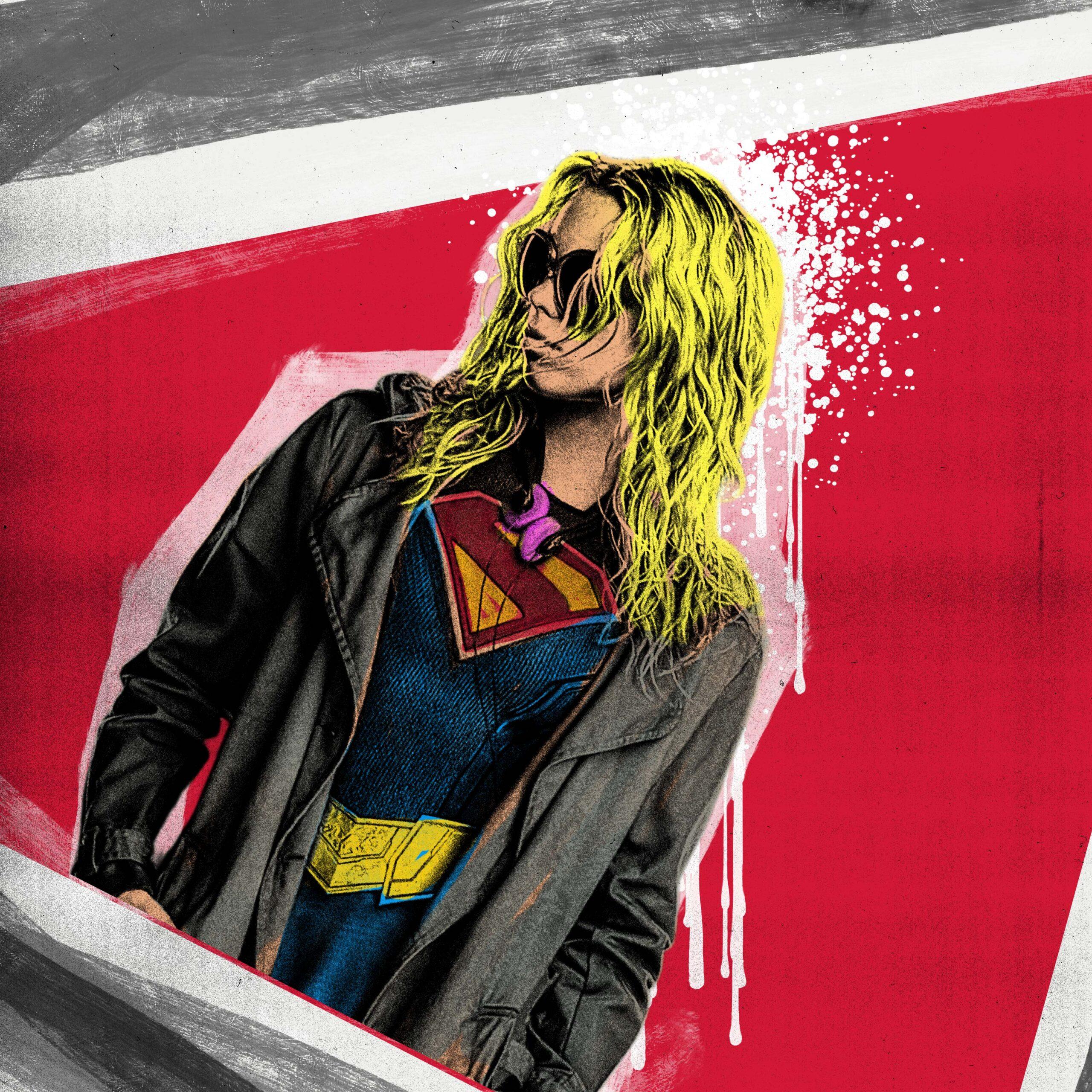

Almost a year after Superman became the first live-action film in James Gunn’s DCU, DC Studios is back with another entry in its fledgling cinematic universe: Supergirl.
Directed by Craig Gillespie and written by Ana Nogueira, Supergirl marks the return of Milly Alcock as the titular superhero and cousin of Superman, who made her brief debut at the end of Superman. Following the animated Creature Commandos, Peacemaker, and Superman, the film is also the first DCU project not to be written or directed by Gunn. As such, Supergirl stands as a significant test case for how the new DCU will operate when the DC Studios cochairman and co-CEO isn’t the one running the show. Although Gunn has previously stated that he wouldn’t be turning the DCU into a “Gunn-verse” and that the studio would empower other writers and directors to express their unique creative visions, it remains to be seen how much freedom other filmmakers will have to work within the confines of the DCU’s interconnected narrative.
More importantly, Supergirl provides a chance to see the beloved titular character on the big screen in her own film for just the second time since her DC Comics debut in the late 1950s, following Helen Slater’s portrayal of the Kryptonian in 1984’s Supergirl. Kara Zor-El has had her fair share of TV appearances over the years, including her own TV series with Melissa Benoist in the starring role, and she even had a brief life in the DCEU when Sasha Calle played the part in the ill-fated The Flash in 2023. But now the superhero will have the silver screen to herself once more. And with Alcock, who rose to fame as young Rhaenyra Targaryen in House of the Dragon, taking on the mantle, Supergirl could play a foundational role in the growing DCU.
Supergirl has received mixed first reactions from critics and is currently projected for a $50 million to $55 million opening at the domestic box office, well below Superman’s $125 million opening last summer, so the film is facing an uphill battle. But DC fans will be able to decide for themselves soon enough. Ahead of the film’s release on Thursday, here’s everything you need to know about Supergirl.
Superman and the Return of Supergirl
Before we focus on DC’s latest summer blockbuster bid, let’s look back at where the current incarnation of Kara made her first appearance: Superman.
Alcock’s cameo comes in the closing moments of the movie and functions like a stinger to set up Supergirl—but her presence still looms over the preceding events of the film through her adorable, chaotic superdog, Krypto. Although this isn’t revealed until Kara crashes into the Fortress of Solitude ahead of the film’s end credits, her cousin Superman had been tasked with dog-sitting Krypto while Kara was away from Earth. Before her arrival, it had been something of a mystery how Clark Kent—the ultimate paragon of virtue—could have raised a canine as unruly as Krypto. But it all clicks when the disheveled Kara stumbles in with stains all over her costume and calls for her furry friend, who promptly slams her into the ground with endearing, if not alarming, affection. And with no warning beyond Kara’s “Thanks for watching him, bitch,” Supergirl takes her leave once more.
“She likes to go and party on other planets,” Superman tells one of his robots, Gary, with considerable disapproval. “Planets with red suns. Because of our metabolism, we can’t get drunk on a planet with a yellow sun.”
This serves as a direct setup for Supergirl: We find Kara celebrating her 23rd birthday under the glow of a red sun before she’s thrust into the film’s central adventure. As trailers have already indicated, David Corenswet returns as the Man of Steel in Supergirl, albeit apparently in more of a cameo role, along the lines of Lex Luthor and the Justice Gang’s appearances during the second season of Peacemaker. The early offerings of the DCU have shown Gunn’s concerted effort to connect each DC story to the others in some fashion as the wider narrative of Chapter 1: Gods and Monsters takes shape. Whether through the film’s ties to Superman or in how it properly reintroduces his cousin to the fold, Supergirl seems primed to continue that trend.



More on ‘Superman’
Supergirl: Woman of Tomorrow
Created by Otto Binder and Al Plastino, Supergirl first appeared in Action Comics no. 252 in 1959. In the years since, Kara Zor-El has gone by several names (including Linda Lee Danvers) and has held a few different day jobs, from student adviser to TV camera operator. She’s died, and she’s been reborn again. Such is the life cycle of a long-running character in superhero comics.
But out of the many decades of Kara’s comic book life, there is one story that serves as the primary influence for the upcoming DCU movie: Supergirl: Woman of Tomorrow.
Woman of Tomorrow, written by Tom King and illustrated by Bilquis Evely, was an eight-part miniseries released from 2021 to 2022. The story reintroduces Kara from the perspective of a young alien girl named Ruthye, whose father is murdered by a man known as Krem of the Yellow Hills. Ruthye leaves behind her quiet life on the farm to seek justice for her father when she crosses paths with Kara—who happens to be soaking up the planet’s red sun for her 21st birthday—and recruits her to hunt down the fleeing villain. And although Kara declines at first, she soon finds a vengeful motive of her own to track Krem after he critically injures Krypto with a poison-tipped arrow. With Ruthye looking to avenge her father and Kara seeking the knowledge to cure her beloved dog, the duo chases Krem across the galaxy.
With Ruthye—an original character—serving as the story’s unlikely narrator, King repositions Kara as a tragic yet inspiring hero who had a very different childhood from that of her famous Kryptonian cousin. Woman of Tomorrow draws inspiration from Binder and Plastino’s 1959 origin story and retells how Kara escaped her world’s destruction. Unlike Kal-El, who was sent to Earth as an infant just before Krypton’s annihilation, Kara grew up on Krypton—and at the age of 14, she had to watch everyone around her perish. But as Ruthye says, “Krypton did not die in a day.”
Along with her parents and thousands of other Kryptonians, Kara survived on an asteroid of Krypton’s wreckage, a floating refuge that came to be known as Argo City. But soon those who remained, including Kara’s mother, started to die of radiation poisoning. Zor-El, Kara’s father and a scientist, kept devising solutions to save their people, but every fix was temporary. And so Zor-El finally chose to repurpose his brother’s plans to build an escape rocket, and he sent his only daughter away so that she could continue to live for all of Krypton.
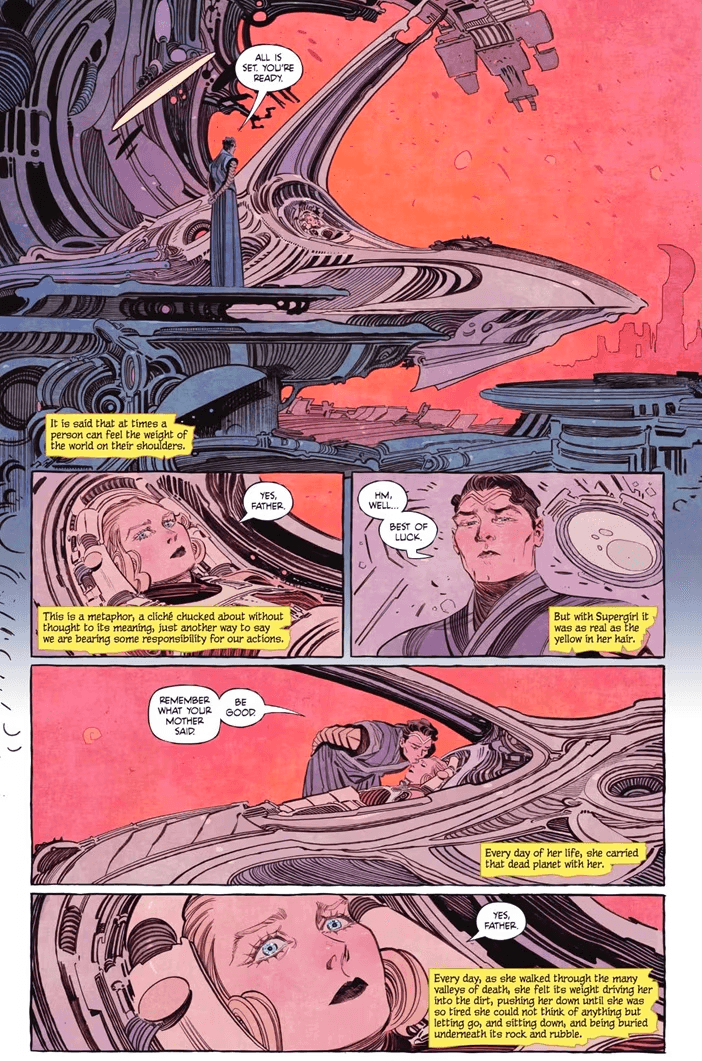
Woman of Tomorrow may be about Ruthye and Kara’s space adventures and quest for revenge, but it also captures the essence of Supergirl and what separates her from Superman. The story highlights the pain and loneliness Kara carries and the sense of responsibility that stems from her survivor’s guilt. It all makes for a fitting entry point into the character for the new DCU.
Supergirl is set to follow the narrative path laid out by King and Evely’s comic, and Gillespie and Nogueira appear to be staying broadly faithful to it. However, like most superhero stories, the film looks to be making plenty of tweaks to the source material. In addition to the presence of Superman, Supergirl will feature another DC Comics character in a more prominent supporting role …
Introducing: Lobo
Jason Momoa is making the jump from the DCEU to the DCU, but he won’t be reprising the role of Aquaman, the founding member of the Justice League and king of Atlantis. Instead, the 46-year-old actor is set to portray the ruthless interstellar bounty hunter known as Lobo.
Created by Roger Slifer and Keith Giffen, Lobo made his comics debut in Omega Men no. 3 in 1983. The character was initially conceived as little more than a spoof of several Marvel Comics heroes, but he quickly grew in popularity in his own right. “I have no idea why Lobo took off,” Giffen told Newsarama in 2006. “I came up with him as an indictment of the Punisher, Wolverine, badass-hero prototype and somehow he caught on as the high-violence poster boy. Go figure.”
Lobo began as a villain before transforming into more of an antihero, a rather classic trajectory for comic book baddies who gain a lot of popularity. But the alien bounty hunter is far from your average DC character. The space biker, who rides around on a rocket-fueled motorcycle he calls the “Spacehog,” is the sole survivor of Czarnia, which was once a utopian planet inhabited by near-immortal beings. In contrast to Kara and her cousin, though, Lobo’s lonely existence arose only after he decided to wipe out his home planet’s entire civilization. Yet despite his murderous tendencies, the guy has a deep love for space dolphins.
Although Lobo was featured in the short-lived Syfy series Krypton, which ran for just 20 episodes from 2018 to 2019, Supergirl will mark the character’s first big-screen appearance. And according to Gunn, it’s a role that Momoa has been lobbying for since the day that Gunn and Peter Safran were announced as the new heads of DC Studios in 2022. (I can’t decide what’s more impressive: that Momoa opened his campaign for the part with a text that read “fucking LOBO” or that it actually worked.) Lobo never appears in Woman of Tomorrow, but as King explained on the Word Balloon podcast in 2023, the antihero had a significant role in his original concept for the miniseries.
“That book began as me pitching a Lobo/Supergirl book,” King said. “And it was my editors, Brittany Holzer and Jamie Rich, who were like, ‘No, take Lobo out and make Supergirl the Rooster Cogburn character.’”
King had envisioned the story as a space Western in the style of True Grit, the 1969 revenge tale that starred John Wayne as U.S. Marshal Rooster Cogburn and Kim Darby as the young Mattie Ross. (The film was remade in 2010 with Jeff Bridges and Hailee Steinfeld, respectively, filling those roles.) After Ross’s father is murdered on their farm, Mattie hires the aging, one-eyed Cogburn to hunt down the outlaw who killed him. (Sounds familiar, doesn’t it?) And so instead of casting Lobo as the Cogburn to Supergirl’s Ross, King wisely followed his editors’ advice to elevate Supergirl into that weary hero role and remove Lobo from the story altogether. With the chaotic antihero now added back into the narrative in Supergirl, it’ll be interesting to see where Lobo fits in Ruthye and Kara’s revenge quest.
As Supergirl enters theaters around the world this week, we’ll learn more about what Gunn’s DCU will look like without his distinct filmmaking sensibilities all over a project. Nogueira, for one, seems to have quickly earned Gunn’s trust even though Supergirl serves as her feature screenwriting debut; Nogueira is now attached as the writer for the untitled Teen Titans and Wonder Woman films. And DC Studios will roll out two other non-Gunn projects later this year, with Lanterns premiering on HBO in August and Clayface premiering in theaters in October.
After some mixed critical and commercial results in its initial offerings, the DCU still has much to prove—and fans may not tolerate a long wait for the cinematic universe to find its footing after the dark days of the DCEU. Supergirl could end up playing a key role in shaping its future, one way or another.