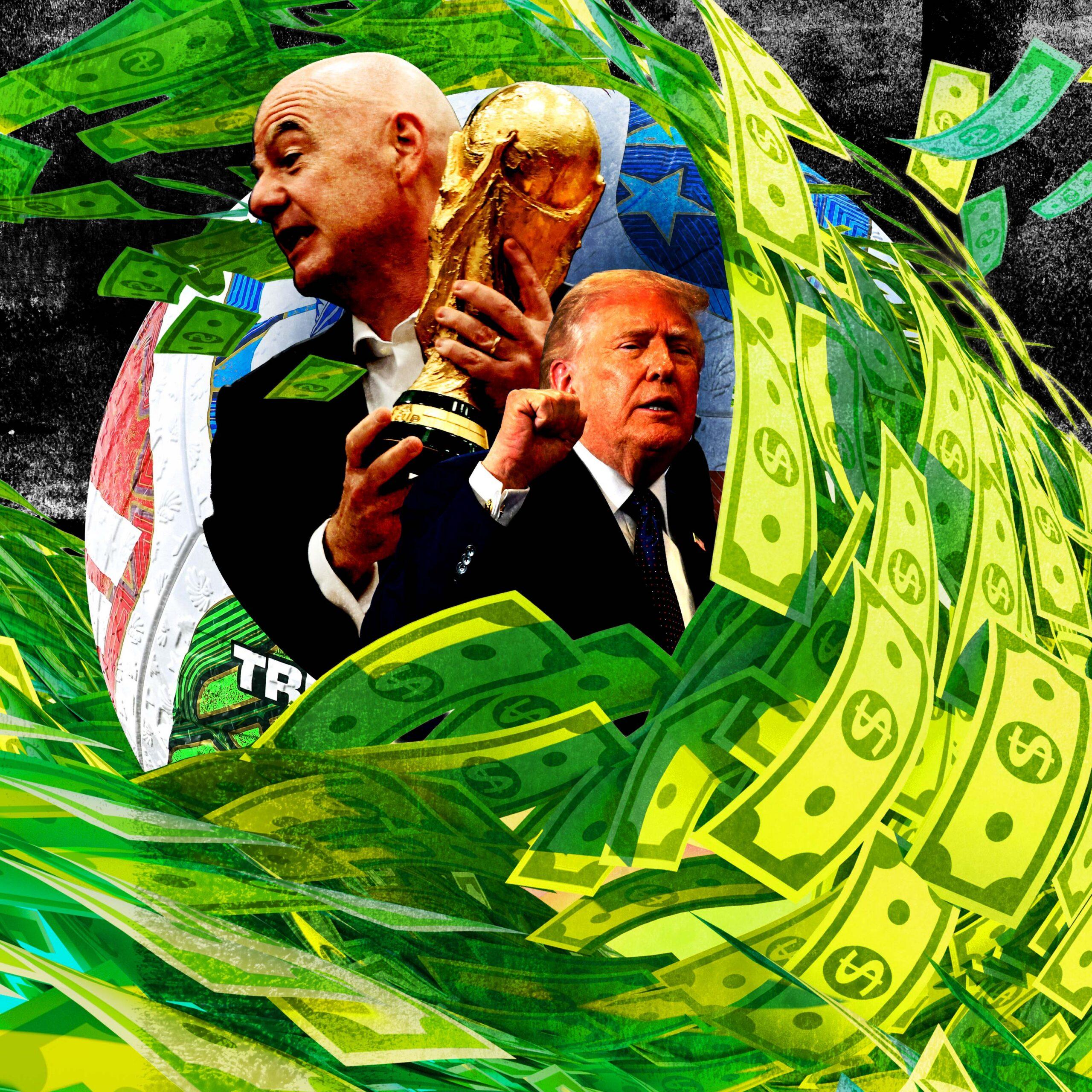

Mere days from kickoff, the quandary picking at the nape of the 2026 World Cup is a potent blend of big-time buyer’s remorse, capitalist bromance, and plain administrative tomfoolery. Given all the parties with demonstrable ties to the soon-to-be biggest spectacle in human history, we probably should’ve always expected as much. Calling the rollout for the impending gathering a certified shit show falls short, if only in that shit shows generally tend to be on the cheaper side.
According to the analysis site Ticketdata.com, as of early June, the average “get-in” price for the 23rd World Cup was nearly $600. That price point exists in part because tournament organizer FIFA adopted a dynamic listing model for the first time in its history, the basic function of which was to raise ticket prices as supply dwindled. Based on one recent report from The Athletic, between October and April FIFA increased prices for nearly 90 of the 104 total scheduled World Cup matches. Listings across the three most common ticket categories available to consumers increased by an average of 34 percent during that span. People noticed. And complained. The nickeling-and-diming continued apace, expanded into neighboring realms.
In December, a study of World Cup hotel rates found that nightly costs had, so far, increased by “more than 300 percent” in each of the 16 total North American host cities. And attendees were not only paying inflated lodging fees: FIFA, never one to leave a stream of income untapped, set the cost per parking space outside host stadiums in the hundreds. (At MetLife in New Jersey, it set the price at $300; in Los Angeles, $250; in Atlanta, $225). In April, the Massachusetts Bay Transportation Authority announced it would be boosting the pricing of round-trip trains from Boston to Gillette Stadium in Foxborough up from the usual $20 to $80 across World Cup play. Soon after, New Jersey Transit revealed it would list its typical $12.90 round-trip tickets from Manhattan to MetLife for $150 over the entire duration of the tournament.
This crude cacophony of moves appears to have capped consumer spending in the near term, though it hasn't stopped it completely. In mid-May resale prices for the tournament fell below list prices. The American Hotel and Lodging Association is now warning that a majority of hotels in the 11 U.S. host cities “are reporting underwhelming demand” during tournament play.
The primary stakeholders behind this fiasco have, in the meantime, occupied themselves by alternatively colluding with and undermining one another. In each case the effect on regular fans has remained deleterious. President Trump has, among other improprieties, spent the time leading up to when the U.S. will host 78 of the tournament’s 104 matches baselessly threatening to relocate outings from those localities that he most disfavors, actually banning the citizens of four participating nations from attending the event, and launching multiple armed incursions against some of those same nations. The leader of FIFA—a Swiss-born Italian striver named Gianni Infantino—has spent years cozying up to, publicly celebrating, and relentlessly lobbying Trump in what may or may not be an attempt to generate the largest possible financial windfall for his employer. The U.S. cities that have bought Infantino’s economic pitch have been forced to choose between foisting the bill for the festivities on their taxpayers or on incoming visitors, while the imagined benefits fail to materialize.
The World Cup itself is too big to fail. If there’s an unstoppable force of the sporting world, it's this tournament. But someone off the pitch will win and lose when a brand of politics like this coalesces around this kind of event and corporation, in this setting particularly. The ultimate answer on that front will say quite a bit about not just the current political moment in the U.S., or the abiding purpose of a 100-plus-year-old international soccer tournament today, but whether these kinds of economic endeavors in sports ever come without some form of equivalent cost.
In his downtime between tearing down the East Wing of the White House and clogging the Strait of Hormuz, President Trump has spent much of his recent months encircling the 2026 World Cup as a practical and political opportunity. In October, he threatened, without basis, to relocate Cup matches from the Boston metropolitan area after suggesting the host city had been “taken over” by uprisings. A few weeks later, at an Oval Office press conference during which he received a replica of the World Cup trophy, Trump boasted that he was open to launching “strikes” against 2026 World Cup cohost Mexico if its government did not take up his preferred drug-policing strategy.
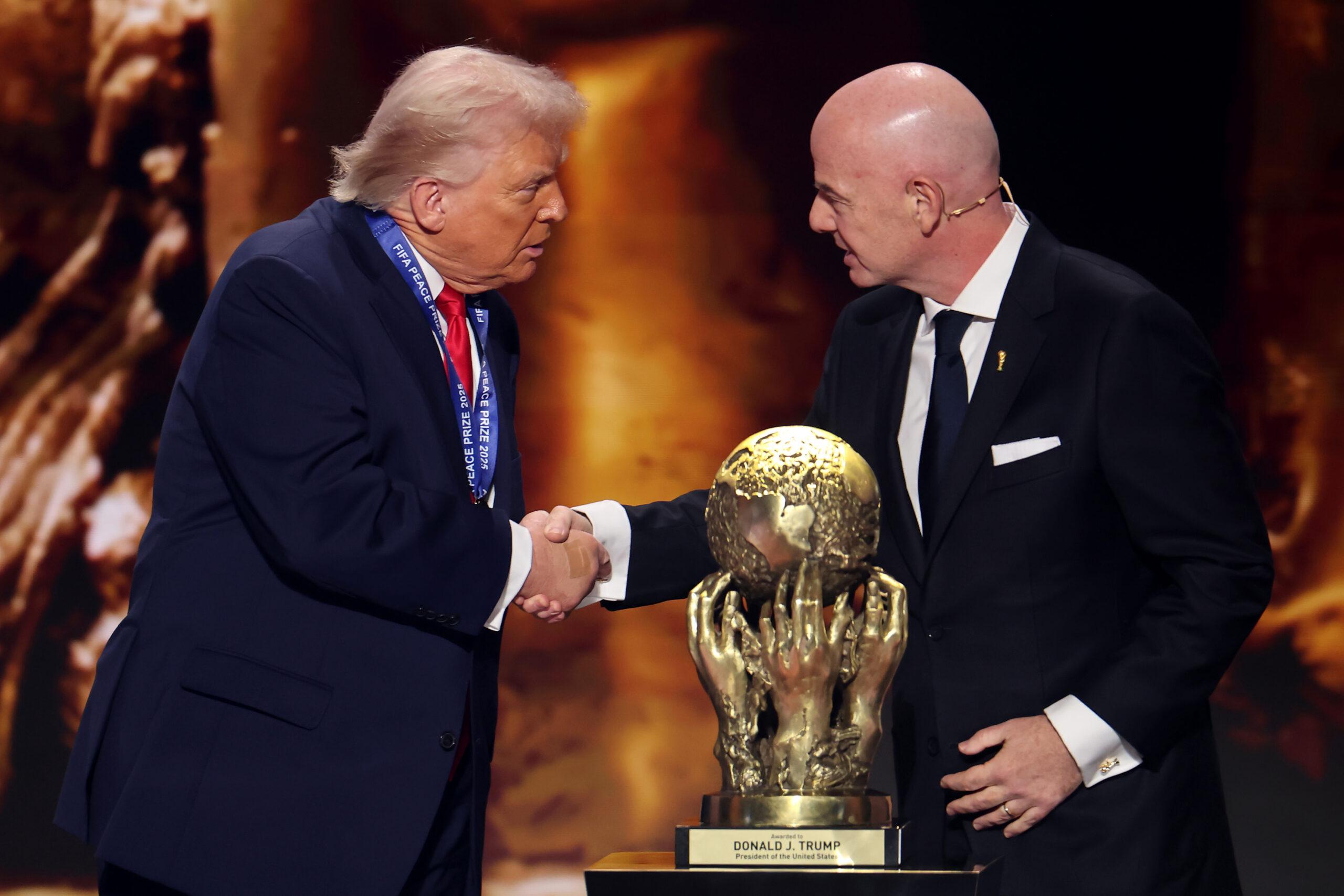
For his part, FIFA president Infantino has tended to enable Trump’s worst instincts, so long as they’ve augured continued profits. The athletic kingmaker has repeatedly referred to Trump as “a really close friend” and received nearly half a dozen invites to the Oval Office across Trump’s tenure. He’s also been spotted publicly wearing a red-MAGA core “45/47” hat, and he famously concocted a spurious “FIFA Peace Prize” soon after Trump failed to strong-arm the Nobel committee into giving him one of theirs. Since returning to office, Trump has issued numerous executive orders restricting immigration, a side effect of which has been banning fans from multiple participant countries from attending the 2026 World Cup.
Visa-less fans of Cup entrants Senegal, Ivory Coast, Haiti, and Iran—nations that are subject to Trump’s wider travel bans—will be prohibited from attending the festivities. (Until mid-May, even many eligible visitors were required to pay up to $15,000 in bonds just to enter the country.) Other than assuring FIFA’s congress last May—without any added detail—that the U.S. would welcome “everyone involved” and “definitely also all the fans,” Infantino has said little about the reinstalled regime’s nativist policies or about how the specter of their immigration enforcement tactics continues to loom over the tournament.
Ahead of last summer’s Club World Cup, U.S. Customs and Border Patrol posted to Facebook that it would have personnel “suited and booted” on-site “ready to provide security for the first round of games.” That plan was, reportedly, only removed after FIFA leadership raised objections to it. At one of the tournament matches, an asylum seeker who’d been flagged by local police for using a drone to take family photos was eventually detained by U.S. Immigration and Customs Enforcement and—after months spent in confinement—deported. In February, ICE acting director Todd Lyons refused to discount the possibility of ICE operations at the World Cup, stating instead that the group’s Homeland Security Investigations team would play a “key” role on the ground. (Around the same juncture, NBC reported that ICE may be present at matches.)
Host cities have been similarly impacted by the immigration agenda and general caprice of the second Trump White House. In March, Reuters reported that intelligence officers had “sounded alarms in recent weeks” after the administration “stalled $625 million in federal security grants” for World Cup sites. At the time, the Department of Homeland Security had taken to withholding hundreds of millions in funding from a collection of Democratic-led states in an attempt to force them to accede to the administration’s immigration enforcement priorities. Beyond federal meddling, these sites have also had to grapple with the increases in motor traffic, overtaxed transit systems, and other infrastructural headaches that are expected to come with the gathering. When the cost of doing so isn’t covered by FIFA or an executive branch outwardly in league with the sporting body, that price has most often tended to fall on residents or consumers. The bet originally made by each municipality was that the economic benefits would make that toll palatable. But through a combination of direct federal obstruction (see: an immigration agenda that has decimated international tourism in the U.S.) and indirect policy reverberations (see: Iran war–sparked fuel spiral), those returns have yet to materialize, and the bill’s due date is fast approaching.
Nearly the opposite can be said for FIFA’s financial windfall and the yield the organization has derived from its relationship with Trump. Dating back to the end of Trump’s first term, Infantino has publicly courted Trump as an erstwhile ally. At a Swiss ski resort in 2020, Infantino brandished Trump as a “sportsman” and “competitor.” After the U.S. won the bid process for the 2026 World Cup, Infantino dropped by the White House repeatedly, and would later golf and dine with the president. The FIFA executive was one of a select few sporting figures invited to Trump’s second inauguration. Since then he’s continued to regularly visit the White House and even accompanied Trump to a Middle East peace summit. (The president, for his part, has referred to Infantino as “my boy.”)
In July, under Infantino, FIFA opened an office in Trump Tower. According to reports, the workplace usually sits unused. Just five months later, the organization awarded Trump its slapshot “FIFA Peace Prize—Football Unites the World.” The stated purpose of the designation, in FIFA’s words, is to recognize “individuals who have taken exceptional and extraordinary actions for peace and by doing so have united people across the world.” No nominees for the prize were ever formally announced, nor was the criteria for the selection made public.
The organization’s relationship with the Trump administration has provided it with unfettered access to soccer’s largest untapped growth market and set it up to generate roughly $11 billion in total revenue for the upcoming tournament. It’s also put FIFA in a position of relative strength in negotiating with U.S. host cities. As part of its World Cup contract, the governing body maintains a full monopoly on not only broadcast and ticket rights but also concessions and sponsorships over the course of the tournament. The case FIFA made to host municipalities was, chiefly, that the residual economic benefits of accommodating the tournament—from tax revenue to increased business profits—would justify the costs attached to it. But this rationale was predicated on selling the World Cup to a full and open international marketplace—to say nothing of avoiding environmental pitfalls like economic slowdowns or widespread immigration enforcement–related fears. Now, with each of these one-time givens eroded, the arithmetic for host cities has been altered. Even more crucially, the math has been altered in ways that don’t apply to FIFA’s own accounting.
That the 122-year-old corporation’s profit motive might enable and coexist with its hosts’ worst tendencies is utterly predictable given the recent history of the tournament. During the lead-up to the 2018 World Cup in Russia, at least 21 workers died amid stadium construction, and many migrant North Korean workers were subjected to forced labor. (Infantino would eventually even admit that there had been human rights abuses.) Still the show prevailed: Online and broadcast ratings shattered previous records.
Four years later, the 2022 World Cup came to Qatar. The scale of carnage in the buildup to that tournament was unimaginable: A 2021 Guardian investigation found that at least 6,500 migrant laborers died during the building of World Cup facilities and infrastructure. One of FIFA’s own committees even admitted that “severe human rights impacts did ultimately occur” for a 12-year period. But just like earlier, the extravaganza continued unabated: The World Cup again shattered ratings records, and more than 3.4 million visitors made the desert pilgrimage.
Infantino continued to cultivate a productive relationship with both nations even after their respective tournaments. In 2019, he was awarded an “Order of Friendship” medal by Russian autocrat Vladimir Putin. For the Qatari competition, the FIFA president relocated his whole family to the region—enrolling his kids in local schools. In this light, those Trump White House visits and tee times aren’t exactly a bug, but a feature. That Infantino has been able to so seamlessly reinvent himself in such odious confines speaks as much to him and to the societies he’s partnered with for our viewing benefit as it does to the values of FIFA as an inescapably corporate entity.
It also suggests that no matter how many stumbling blocks or quandaries might appear in the lead-up to the North American tournament, the safe (and overwhelmingly large amount of promised) money is still on the 2026 World Cup being a financial windfall: just for a select few. In America, when an unstoppable force meets an immovable object, the one with the most cash riding on the outcome tends to win. The biggest show on earth has, for decades, been no different. This time, folks don’t even need to wait the few weeks to tune in and find out. That arithmetic is not kept quiet. At the cusp of this American World Cup, one need only look around.