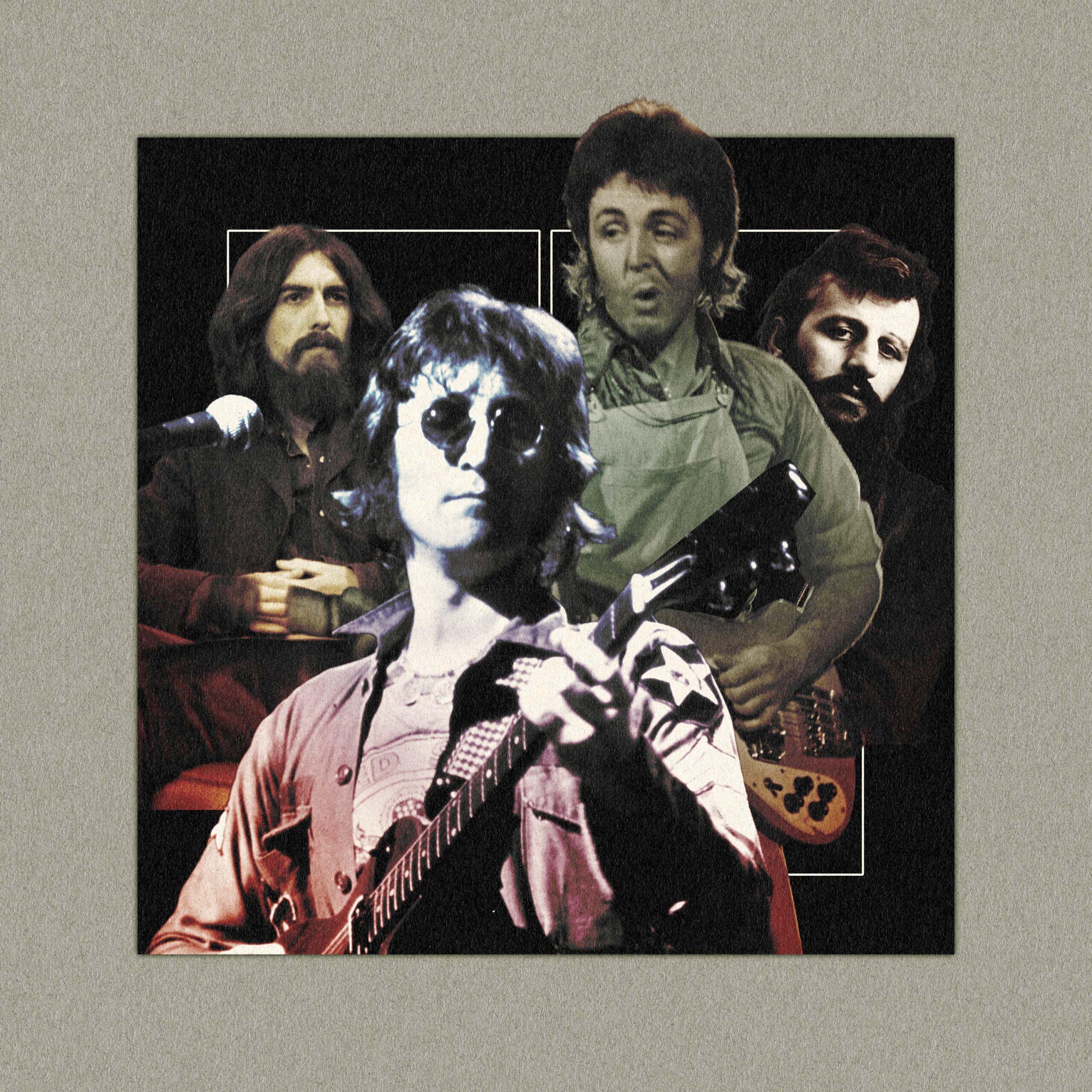
A Complete Ranking of Post-Breakup Beatles Collabs
All the times multiple Beatles teamed up in the studio, after the Beatles broke upA Complete Ranking of Post-Breakup Beatles Collabs
All the times multiple Beatles teamed up in the studio, after the Beatles broke up
The Beatles are underrated.
As individual artists, that is.
Now, it’s not as if the combined post-1960s output of John Lennon, Paul McCartney, George Harrison, and Ringo Starr is obscure. All four Beatles—yes, even Ringo—have been inducted into the Rock & Roll Hall of Fame as solo acts. But because the Beatles’ endlessly relistenable songs set such a high bar, many fans of the band don’t delve much deeper into the Fabs’ post-Beatles catalogs than “Imagine,” “Maybe I’m Amazed,” “My Sweet Lord,” and “It Don’t Come Easy”—all of which were released within a year and a half of Let it Be. John, Paul, George, and Ringo recorded as a quartet for only seven years and disbanded before they were 30. They made much more music thereafter than they had to that point. But the Beatles’ greatness together tends to overshadow their greatness apart.
In fact, some fans might be surprised by the degree to which they weren’t apart professionally. By the late ’60s, the Beatles regularly recorded together but rarely wrote together. And to an extent, that state of affairs among the bandmates—bonded by their upbringings and the crucible of Beatlemania—persisted even after the band broke up. Only mortality could keep the Beatles apart permanently. As Ringo told NME in 1972, “We’re together again. Not as a band. We’re not going to be a band again. But we’re together as people, and that’s more important really.”
On many occasions, they came (and continue to come) together on stage and in studio, too. On May 29, McCartney released his 20th rock album as a solo artist, The Boys of Dungeon Lane, which includes collaborations with Starr on two tracks. “Home to Us” and “As You Lie There” are the latest—and conceivably the last—in a long line of team-ups by members of the Beatles since the quartet uncoupled. All in all, the post-breakup Beatles collaboration library—excluding projects they simply signed off on, such as documentaries, archival releases, rhythm games, theatrical productions, “cinematic events,” and so on—now spans 57 years and approximately 80 tracks, encompassing some of the finest tunes John, Paul, George, and Ringo ever recorded. And in honor of the latest additions to this roughly 5.5-hour post-Beatles body of work, I decided to rank them all—mostly by musical quality, with helpings of historical significance, sentimentality, and teamwork.
A little more than half of the qualifying songs hail from the first five years after the breakup, when some relationships were frayed but the music was still as strong as ever. Admittedly, much—though far from all—of this corpus could be described as “[someone] with Ringo.” Any doubt about Ringo’s status as the Beatles’ glue guy—or about his bandmates’ respect for his skills on the skins—should be allayed by how often they all chose to work with him from 1970 on. As Ringo earnestly says to Paul and George at the end of a Beatles Anthology session in 1994, “I like hanging out with you two guys.” The feeling was mutual. Ringo was an O-negative and AB-positive member of the band—a universal recipient and donor of musical contributions. But post-breakup Beatles collabs didn’t require Ringo. Every Beatle produced recordings of some sort with every other Beatle after the foursome splintered.
Before we begin, a few clarifications about what will and won’t be included:
• I’m ranking only tracks on which two or more Beatles are audible. So, no “Stardust” (a strangely endearing standard from Ringo’s debut solo album, Sentimental Journey, that Paul arranged but didn’t perform on) or “I’ll Still Love You” (a George composition that Ringo recorded sans Harrison for the 1976 record Ringo’s Rotogravure).
• Since I’m focusing on post-Beatles releases, I’m excluding “Ski-ing,” a short groove from the first Beatle solo album—Harrison’s mostly instrumental, 1968 soundtrack Wonderwall Music—which is said to feature an uncredited Ringo (and Eric Clapton). Sorry, “Ski-ing” stans.
• I’m considering only studio recordings, so you’ll have to get your ranking of the tracks from the live triple album The Concert for Bangladesh (featuring George and Ringo) elsewhere. This asterisk also rules out 1969 John-plus-George renditions of “Cold Turkey” and “Don't Worry Kyoko (Mummy’s Only Looking for Her Hand in the Snow)” that appear on the Live Jams portion of Lennon’s 1972 album Sometime in New York City.
• I’m not double-counting songs that were released both as album tracks and as shortened singles (such as Paul’s “Take it Away”), extended bonus cuts (such as Ringo’s “Six O’Clock”), or hybrid medleys (such as Ringo’s “(It's All Down to) Goodnight Vienna”). Nor am I counting rerecorded self-covers, such as a ’90s version of George’s “This Guitar (Can’t Keep From Crying)” that Ringo overdubbed drums onto after Harrison’s 2001 death, or some of Paul and Ringo’s new takes on preexisting tracks for the 1984 soundtrack album Give My Regards to Broad Street. Speaking of Broad Street, I’m also excluding “Corridor Music,” a 19-second track on which both Paul and Ringo can be heard speaking in clips from the film. Apologies to “Corridor Music” heads; if you want to know where it would have ranked, if I’d ranked it, the answer is: last.
• I am including the three Lennon demos that the Threetles (Paul, George, and Ringo) turned into finished tracks. They’re billed as Beatles songs, but let’s be real (love): They don’t quite count as such.
• I’ve consulted numerous sources and tried to be both accurate and comprehensive, but this isn’t always easy. You’ll be shocked to learn that rock stars who were known to use and sometimes abuse mind-altering substances weren’t unfailingly diligent about documenting who played on what. When credits are unclear for George’s cast-of-thousands, Wall-of-Sound solo masterpiece All Things Must Pass, I’ve relied on the detailed, track-by-track recollections in ATMP powerhouse (and Derek and the Dominos member) Bobby Whitlock’s memoir—though as Whitlock concedes in that book, “Everyone was very high during those sessions.” For credits on Cloud Nine, I’ve deferred to Harrison chronicler Simon Leng’s drummer IDs.
In 1971, Lennon said, “If people need the Beatles so much, all they have to do is to buy each album and ... put it on tape, track by track—one of me, one of Paul, one of George, one of Ringo, if they really need it that much. Because otherwise, the music is just the same, only on separate albums. … And it’s far better music, because we’re not suppressed.” That’s not quite right. As incredible as compilations of the ex-Beatles’ solo songs can be, the band’s split cost its members the creative alchemy that came from their collaboration—but whenever they reunited, that magic came back. I’ve compiled a Spotify playlist of all 80 tracks that passed muster, arranged in chronological order of release. For the ranking, read on—and don’t miss the embedded playlists of each Beatle’s best 30 songs that don’t feature any other Beatle, plus the sidebars devoted to two top-10 lists: the best Beatles collabs on non-Beatles artists’ songs, and the missed connections that could have led to even more memorable collabs.
80
Goodnight Vienna, 1974
“Goodnight Vienna (Reprise)”
Beatles: Ringo and John
Well, something has to be at the bottom. The Lennon-penned “Goodnight Vienna” does double duty as the opener and closer of Ringo’s album by the same name, and the semi-Sgt. Pepper’s-esque reprise adds little to the full-length version of the song, other than Lennon’s leadoff invocation: “OK, with gusto, boys, with gusto!”
79
Give More Love, 2017
“Show Me the Way”
Beatles: Ringo and Paul
In the first few years after the breakup, Paul was semi-estranged from the other Beatles (particularly John and George), who’d grown to resent Paul’s self-appointed producer role in the studio and also supported manipulative manager Allen Klein in opposition to Paul’s preference. As a result, Paul got a late start on working with his former bandmates, who had recorded classic albums with each other in the early ’70s. As the longest-lived Beatles by far, he and Ringo have padded their relative team-up totals in the past quarter century. However, their late-career collabs aren’t exactly John Lennon/Plastic Ono Band- or All Things Must Pass-caliber bops. Paul plays bass on “Show Me the Way,” a schmaltzy, possibly Auto-Tuned tribute to Ringo’s wife, former Bond girl Barbara Bach. Ringo’s review: “Paul plays every note great.”
78
Single, 2020
“Here’s to the Nights”
Beatles: Ringo and Paul
Yeah, we’re in “celebrity sing-along single from a pandemic EP” territory. It could’ve been worse: After all, neither Paul nor Ringo guested on Gal Gadot’s “Imagine.”
77
Y Not, 2010
“Peace Dream”
Beatles: Ringo and Paul
Recording sessions for Y Not put Paul and Ringo in the studio together for the first time in 12 years (and the first time since the Threetles were reduced to two). “Peace Dream,” the lesser of the two tracks Paul played on, wasn’t especially worth the wait. For an added nostalgia boost, though, the lyrics alluded to Lennon. That reference prompted Starr to tell NPR that “he has no problem mentioning his old mates in his songs,” which was an understatement.
76
Give More Love, 2017
“We’re on the Road Again”
Beatles: Ringo and Paul
The title might trick you into expecting a Willie Nelson cover, but no such luck. Paul’s bass and screams are pretty rockin’, though.
75
Stop and Smell the Roses, 1981
“Private Property”
Beatles: Ringo and Paul
Amid his mourning for Lennon and the dissolution of Wings (which released its last album in 1979 and effectively dissolved in April 1981), Paul was still pumping out primo material, as evidenced by the best tracks on McCartney II and Tug of War. He just didn’t reserve any of the good stuff for Stop and Smell the Roses, which arrived between those two records. “Private Property,” the album’s second single, features Paul, Linda McCartney, Wings guitarist Laurence Juber, and so much saxophone. If for some reason you’ve always wished “Private Property” were longer, rejoice: An extended version with almost twice the running time surfaced in 1994.
74
Stop and Smell the Roses, 1981
“Attention”
Beatles: Ringo and Paul
“Give me your attention for a while,” Ringo implores on this song’s plaintive chorus, but Stop and Smell the Roses garnered very little. RCA dropped the drummer the following year. He’d release only one more album over the next decade, as his faltering recording career took a back seat to getting sober, forming the All-Starr Band, and acting on TV—which is why I knew him as the narrator of Thomas & Friends and Mr. Conductor from Shining Time Station before I caught up on his Beatles backstory.
73
Vertical Man, 1998
“What in the ... World”
Beatles: Ringo and Paul
After Ringo graced two tracks on Paul’s 1997 return to form, Flaming Pie, Paul did him one better by guesting on three tracks on Vertical Man, Ringo’s bid for a commercial comeback in the wake of Beatles Anthology. According to one account, when Paul heard the completed version of “What in the … World” (which was mixed by Beatles engineer Geoff Emerick), he exclaimed “Whoo ... Rich! Sounds kinda Beatle-ish!” and added, “You are a fucking Beatle!” Which I doubt Ringo had forgotten, but hey, if I’d ever been a Beatle, I wouldn’t mind regular reminders. As for the song: The “kinda” in Paul’s compliment is doing a lot of work, but it would be weird if the product of a Starr-McCartney-Emerick reunion weren’t at least a bit Beatle-ish. As in, replacement-level Beatle-ish, at best.
72
Vertical Man, 1998
“I’ll Be Fine Anywhere”
Beatles: Ringo and George
George was a Wilbury, but he didn’t live to see a solo sequel to his hit ’87 album Cloud Nine. (His career coda, the beautiful Brainwashed, was released almost a year after his death.) However, he got in on the Vertical Man action by dubbing his distinctive slide onto two songs—including this one, which lives up to its title. It’s definitely … fine.
71
Stop and Smell the Roses, 1981
“Sure to Fall (In Love With You)”
Beatles: Ringo and Paul
Paul produced and played on this Ringo cover of the 1950s Carl Perkins classic. It’s well-suited for Starr, who has an affinity for country-tinged tracks, but you might be better off listening to the Beatles play the same song live on the BBC in ’63.
70
Rewind Forward, 2023
“Feeling the Sunlight”
Beatles: Ringo and Paul
Have you had enough of the Ringo-Paul pairings yet? This cut comes from another recent Ringo EP, but don’t despair: Paul wrote it, which means it’s moderately cute. Here’s how Ringo explained the song’s origin story: “Paul and I were in England, having dinner together. I told him I was making an EP, and I said, ‘Why don’t you write me a song?’” Not only did Paul comply, but he recorded the entire track right down to the drums, which Ringo removed in order to put his own stamp on the song. It must be nice to possess the superpower of constantly convincing former Beatles to write songs for you. Not that Ringo doesn’t deserve it.
69
Pipes of Peace, 1983
“Average Person”
Beatles: Paul and Ringo
Pipes of Peace has its moments, but in my mind, it’s the album where Paul temporarily lost his touch. Largely composed of inferior leftovers from Tug of War, it marked the start of a (by his standards) dismal mid-’80s run. “Average Person” is one of Paul’s music-hall story songs—supposedly labeled by Lennon as “granny music shit”—and not even the combined Beatles-Wings energy supplied by Ringo, producer George Martin, Linda, and Denny Laine makes it one of the better examples.
68
Imagine, 1971
“I Don't Wanna Be a Soldier Mama I Don't Wanna Die”
Beatles: John and George
Finally, we come to a cut from a classic album—albeit said album’s most repetitive, skippable song. With apologies to the sterling cast composing Phil Spector’s Wall of Sound—including Harrison, Badfinger’s Tom Evans and Joey Molland, and constant ’70s studio satellites Jim Keltner, Klaus Voormann, and Nicky Hopkins—I can’t always stomach six minutes of this.
67
Vertical Man, 1998
“I Was Walkin’”
Beatles: Ringo and Paul
Paul’s backing vocals, which compete with Alanis Morissette’s and Steven Tyler’s for attention, don’t add that much to the mix here, but I like a steady, driving backbeat and a simple, catchy chorus as much as the next fella. “My occupation is syncopation,” Starr sings, and that about sums it up.
66
Vertical Man, 1998
“King of Broken Hearts”
Beatles: Ringo and George
The tempo borders on plodding—perhaps appropriate for a torch song—but it’s better than the previous Vertical Man entries (hence its higher ranking): a ballad with a hooky chorus, a Billy Joel bridge, and much more Harrison soloing in the vein of his soaring strains from the Beatles Anthology and Brainwashed.
65
Stop and Smell the Roses, 1981
“You Belong to Me”
Beatles: Ringo and George
It’s tough to screw up a cover of this song, and Ringo and George (who produced, sang, and played guitar) didn’t. Best of all, if you search for “You Belong to Me,” you might accidentally wind up playing “If You Belonged to Me” from The Traveling Wilburys, Vol. 3, which would be an even better choice.
64
Dark Horse, 1974
“Ding Dong, Ding Dong”
Beatles: George and Ringo
John has “Happy Xmas (War Is Over).” Paul has “Wonderful Christmastime.” Ringo has a whole Christmas album. Harrison has “Ding Dong, Ding Dong,” crafted for the much smaller musical market of New Year’s songs.
The simplistic track took him three minutes to write, after he focused on an aphorism inscribed on the wall of his Friar Park home by its eccentric original owner, Frank Crisp. For a variety of reasons, Harrison was happy to see the end of 1974: He’d cultivated and endured an almost comical amount of romantic drama, which would culminate in a divorce; he’d nearly lost his voice to laryngitis; he’d slogged through a brutal tour (which Paul and Linda attended in disguise) and weathered rough reviews for Dark Horse. But he’d also started a new record label, and—the same month “Ding Dong, Ding Dong” came out—signed the “Beatles Agreement” that finally paved the path to the band’s formal dissolution. So: Ring out the old, ring in the new. But he had no desire for Ringo the new. Ringo the old was still by Harrison’s side, drumming on “Ding Dong, Ding Dong.”
That unshakable bond is all the more remarkable in light of how it had been tested. I’m not counting romantic entanglements as “collaborations,” but in George’s case, I could. Harrison allegedly slept with and professed his love for Ringo’s first wife, Maureen, in late 1973. Ringo’s reported response: “Better you than someone we don’t know.” (See? Easygoing guy.) The somewhat incestuous love, uh … pentagon? … of Clapton, Harrison, Ronnie Wood, and George and Ronnie’s respective spouses makes Mike Kekich and Fritz Peterson seem tame. And somehow, the musicians’ friendships and musical collaborations barely missed a beat amid their many spouse swaps and affairs. The ’70s!
63
Flaming Pie, 1997
“Really Love You”
Beatles: Paul and Ringo
A hypnotic, improvisational, stripped-down jam: Just Paul, Jeff Lynne, and a metronomic Ringo holding down the beat. A song that exists because McCartney “wanted more fun” after recording his first Flaming Pie number with Ringo, it’s the first and only (released) song credited to “McCartney-Starr,” which was a surprise to Starr. “I wasn’t expecting anything,” he said. “It’s like, ‘You play on my albums through the years, and I’ll play on yours.’ I don’t get union rate! You know, we usually have dinner and send each other flowers and that’s it.”
62
Ringo’s Rotogravure, 1976
“Cookin' (In the Kitchen of Love)”
Beatles: Ringo and John
When Ringo comes calling for a song, nobody likes to let him down. Lennon knocked this out for his friend on pure muscle memory in the midst of his extended househusband phase. The only time John is known to have set foot in a studio between 1974 and 1980 was to play piano on “Cookin,’” which came out the same year as Paul and Linda’s “Cook of the House.” Perhaps because his horizons had shrunk to the size of his home, John was in his “I love lamp” era of inspiration; he wrote what he knew. “You know he’s really into that now—cooking,” Ringo explained.
61
B-side, 1973
“Down and Out”
Beatles: Ringo and George
Being the B-side to “Photograph” was a recipe for instant obscurity: The A-side was a smash, while “Down and Out” more or less lived up to its title. Nonetheless, it’s a solid little rocker that “yes, ands” Beatles B-side “I’m Down” with that all-important “out.”
60
Ringo’s Rotogravure, 1976
“Pure Gold”
Top 10 Recordings by Other Artists Featuring Multiple Beatles
John, Paul, and even George were generous songwriters whose high standards and prolific output led to lots of giveaways that became big hits for other artists—and not just Ringo, who often got by as a “solo” artist with a lot of help from his friends. But the Beatles didn’t just gift compositions they ran out of room for or felt weren’t a fit for themselves; they also stopped by the studio together sometimes to sing and/or play on other artists’ recordings, which is what I’m highlighting here. I’m playing by essentially the same ranking rules—to qualify, tracks must feature performances by multiple Beatles—so I can’t include the likes of 1972’s “Sweet Music” by Lon & Derrek Van Eaton (production by George, drums by Ringo) or 1974’s “Mucho Mungo/Mt. Elga” by Harry Nilsson (production by John, maracas by Ringo). But I will loosen my criteria enough to sneak in a few songs from before the breakup.
10. “Let It Be,” Dolly Parton, 2023 (Paul and Ringo)
Is it a spectacular cover? Not particularly. But any track that features a trio of legends like Parton and a pair of ex-Beatles belongs on this list.
9. “Shoot Out on the Plantation,” Leon Russell, 1970 (George and Ringo)
Russell’s eponymous LP is about as star-studded as debut albums come: Imagine embarking on a solo career backed by three Rolling Stones, two Beatles, half of Blind Faith and Derek and the Dominos, Delaney & Bonnie, Joe Cocker, and Merry Clayton. Ironically, the album’s most timeless track, “A Song for You,” features Russell alone. But this one—and “Hurtsome Body,” which unites George, Ringo, and Eric Clapton—hit a bluesy sweet spot.
8. “Daybreak,” Harry Nilsson, 1974 (George and Ringo)
The Beatles loved Nilsson. This single might not be the best illustration of how he earned their admiration, but the lone original on the soundtrack to misbegotten 1974 vampire movie Son of Dracula (which starred Nilsson and Starr) was catchy enough to become a minor hit. Harry and Ringo also coproduced the soundtrack and performed on this track, accompanied on cowbell by George.
7. “Don’t Worry Kyoko (Mummy’s Only Looking for a Hand in the Snow),” Yoko Ono, 1969 (John and Ringo)
Yoko’s vocals can be an acquired taste. If you don’t acquire that taste from listening to her wail while Lennon, Clapton, Starr, and Klaus Voormann bring the roof down behind her on this “Cold Turkey” B-side, you probably never will.
6. “All That I've Got (I'm Gonna Give It to You),” Billy Preston, 1970 (George and Ringo)
Amid the Beatles’ breakup, Harrison produced and played on three soul albums by Apple artists Billy Preston and Doris Troy, two of which costarred Starr. There may be better songs on those albums (which featured several Harrisongs) than “All That I’ve Got,” but because this single was cowritten by Preston and Troy, with a George-and-Ringo rhythm section on bass and drums, respectively, it stands in for the phase that preceded All Things Must Pass.
5. “I Am Missing You,” Ravi Shankar, 1974 (George and Ringo)
Shankar’s first attempt at Western pop, produced and arranged by George in Phil Spector’s style and sung by Ravi’s sister-in-law Lakshmi Shankar. The religious love song, which became the inaugural single on Harrison’s Dark Horse label, features not only two Beatles, but also several of their frequent musical partners: Preston, Nicky Hopkins, Voormann, and Jim Keltner.
4. “Dandelion,” The Rolling Stones, 1967 (John and Paul)
Lennon and McCartney wrote the Stones’ second single (and first hit), “I Wanna Be Your Man,” but they didn’t perform on a Stones track until the Summer of Love, during the Stones’ fleeting, underrated, Their Satanic Majesties Request psychedelic era. John and Paul’s vocal contributions to the next song on this list are somewhat widely known, but their presence on “Dandelion” might have been forgotten if Allen Ginsberg hadn’t written to Robert Creeley to describe the session: “everybody exhilarated with hashish—all of them drest [sic] in paisley and velvet and earnestly absorbed in heightening the harmonic sounds.” Sounds like quite a scene. In 2023, Keith Richards mentioned that the Beatles’ leading duo had sung on this song, and who could question Keef’s recall of the ’60s?
3. “We Love You,” The Rolling Stones, 1967 (John and Paul)
Short-lived supergroup The Dirty Mac notwithstanding, no Beatle would guest on another Stones song after this until Paul appeared on “Bite My Head Off” from the 2023 album Hackney Diamonds, and then again on “Covered in You” from the 2026 follow-up Foreign Tongues. Somehow, a Mick-Keith-Ron-Paul-Ringo quintet—The Bones?—still hasn’t happened.
2. “Carolina in My Mind,” James Taylor, 1968 (Paul and George)
The Beatles weren’t bad talent scouts. Taylor was the first non-Brit added to the Apple Records roster, and his homesickness as a North Carolinian in London sparked this song from his first album. The “holy host of others standing ’round me” referenced in the song are the Beatles, who were busy with the White Album while Taylor was working on his debut. But not too busy for Paul and George to lend their bass and uncredited voice, respectively, to Taylor’s classic, which would achieve greater commercial success when he rerecorded it for a 1976 Greatest Hits compilation. The Beatles benefited from Taylor’s creativity, too: His “Something in the Way She Moves,” from the same self-titled LP, inspired the opening line of Harrison’s “Something.”
1. “Sour Milk Sea,” Jackie Lomax, 1968 (George, Paul, and Ringo)
The Beatles did a demo of this song, but it didn’t make the cut for the White Album. (Hey, they had to leave room for “Revolution 9.”) I would’ve preferred it to “Piggies,” not to mention a few other non-Harrison songs, but the Beatles didn’t ask me. Two other songs Harrison wrote during or immediately after the Beatles’ visit to Rishikesh, “Not Guilty” and “Circles,” were shelved for more than a decade until he exhumed them for unsung solo albums. But “Sour Milk Sea” went to Lomax, a former Brian Epstein act whom the Beatles signed to Apple after Epstein’s death. “Sour Milk Sea” was his debut Apple single, and while it wasn’t a hit, it’s hard to imagine a Beatles studio version being much better than this one, which boasted a heck of a backing band: three-fourths of the Beatles plus Clapton and Hopkins.
Beatles: Ringo and Paul
Paul wrote “Pure Gold” for Ringo, and an apparently pretty tipsy Paul and Linda laid down backing vocals while on a break from the Wings Over the World tour. It’s a lovely little retro track with some swing to it, and considering Starr’s propensity for covers, it could easily be mistaken for a new take on a tune from the ’50s or early ’60s. Judging by its streaming stats, nobody knows this song. They should!
59
Dark Horse, 1974
“So Sad”
Beatles: George and Ringo
We just covered why Harrison was feeling so sad during this period, so we don’t have to rehash his “haven of adulterous intrigue.” But in this cri de coeur, which Harrison started in ’72, he channeled his pain and tumult into a song that was worthy of one of his stronger records.
58
Single, 1971
“Bangla Desh”
Beatles: George and Ringo
“Message” songs don’t always age well, but some of them aren’t intended to. If this single is less relevant today because the plight of Bangladesh is less dire than it was 55 years ago, well, that was what Harrison hoped for. He also aimed to raise awareness and money in the moment. Musically, Harrison was on such a heater—see the even better B-side to “Bangla Desh,” “Deep Blue”—that he couldn’t help but craft a quality single, even though he rush-wrote and rush-released it. But the lasting legacy of “Bangla Desh” wasn’t the song itself so much as the suffering it eased in the moment and, indirectly, for decades thereafter: As the first successful international charity single—long before Band Aid, Live Aid, and the like—“Bangla Desh” and the benefit that went with it established a powerful precedent that continues to pay dividends.
Commendably, at the peak of his creative powers and popularity, Harrison “got tired of people saying ‘But what can I do?,’” and did what he could. As Don Heckman wrote in his Village Voice review of the benefit, “I have no quarrel with John Lennon’s endless clattering around inside his psyche, or Paul McCartney’s search for sweetness and light, but at the moment I have to have stronger feelings about George Harrison’s active efforts to do something about the misery in the world around him.”
Also, though he never publicly performed “Bangla Desh” before or after Aug. 1, 1971, Harrison slayed on the day:
57
Pipes of Peace, 1983
“So Bad”
Beatles: Paul and Ringo
Speaking of Paul’s sweetness and light: I enter into evidence “So Bad,” which is not to be confused with “So Sad.” The cloying production (by George Martin), the falsetto singing, the bland lyrics, the low-effort video—none of this helped Paul beat the allegations of silly-love-song reliance. (Not that he cared to try at the time.) It’s extremely soft rock. But boy, can the man write a melody. The presence of Ringo just barely anchors this Pipes of Peace single to the palatable part of the sickly-sweet spectrum.
56
Ringo, 1973
“You’re Sixteen”
Beatles: Ringo and Paul
This one should arguably be either much higher or, like, last. Ringo’s cover of the 1960 original is an engaging earworm that went to no. 1. It’s also a romantic ode to a 16-year-old, sung by a then-33-year-old, which may explain why the always-on-the-road Ringo hasn’t played this song live since 2019. At least Carrie Fisher was 21 when she starred in the music video excerpted from the 1978 TV movie Ringo … though she was 16 when the song was recorded.
Oh, right, Beatles team-ups: Paul performs the solo, either with a kazoo or by doing a vocal kazoo impression. Wikipedia helpfully observes, “Starr’s version remains one of the few no. 1 singles to feature a ‘kazoo-sound’ solo.” So that’s something, I suppose.
55
What’s My Name, 2019
“Grow Old With Me”
Beatles: Ringo and Paul
Ah, the other end of the aging curve. The Threetles didn’t record “Grow Old With Me” for the Anthology, even though Lennon’s demo was one of the tapes Yoko delivered. Instead, Ringo and Paul covered it together 25 years later, after they had grown old together. Lennon wrote the song during the Double Fantasy sessions in 1980, and it appeared on the posthumous 1984 album Milk and Honey. Jack Douglas, who produced both of those records, also produced Ringo and Paul’s version, and he snuck a subtle “Here Comes the Sun” reference into the string arrangement to represent George. Harrison had reportedly rejected the song as an Anthology prospect because it made him so sad. As tragic as it is that Lennon (and Harrison himself) didn’t get to grow old, this cover accentuates the positive: Paul and Ringo did. The arrangement may be a bit mawkish, but—wait, why is my screen suddenly so blurry?
54
The Boys of Dungeon Lane, 2026
“Home to Us”
Beatles: Paul and Ringo
Paul sings sparingly on “Grow Old With Me.” To hear him and Ringo get equal time on the mic, we have to head for “Home to Us”—the only true duet Ringo has recorded with any other Beatle, if we get technical about the definition of “duet.” It’s a straightforward song that Paul and producer Andrew Watt constructed around a Ringo drum track. And though there’s not much nuance to the song’s sentiment, it’s a treat to hear Ringo and Paul trade lead vocals and belt out their affection for their childhood haunts as they approach ages 86 and 84, respectively.
53
All Things Must Pass, 1970
“I Dig Love”
Beatles: George and Ringo
Our first track from All Things Must Pass; keep scrolling, because there are going to be a bunch more. It’s no shame to be the lowest-ranked two-Beatle tune on an album so stacked. This one just lasts too long and lacks the profound spirituality that suffuses much of the rest of the record.
52
Goodnight Vienna, 1974
“Only You (And You Alone)”
Beatles: Ringo and John
The rare Ringo falsetto! “It was like, ‘Wow, it works!,’” Ringo remarked, expressing his own surprise at hearing himself sing in that register. And it does work, as does every other aspect of his well-executed ’50s cover, which Lennon had eyed for himself during his Rock 'n' Roll era before recommending it to Ringo. Starr sings and drums over John’s studio demo, with Voormann, Billy Preston, and Harry Nilsson sweetening the mix. Selected as the lead single from Goodnight Vienna, it hit no. 6 on the Hot 100.
51
Cloud Nine, 1987
“Wreck of the Hesperus”
Beatles: George and Ringo
Harrison’s commercial comeback album—which immediately preceded his transformation into Nelson Wilbury—is relentlessly upbeat, bright, and listenable all the way through. “Wreck of the Hesperus,” his ode to aging gracefully, is no exception. The nimbleness of Harrison’s voice lends credence to his claim that he’s still kicking, as does some of the musical muscle that surrounds him in the studio: Starr, Clapton, Lynne, and Elton John.
50
Stop and Smell the Roses, 1981
“Wrack My Brain”
Beatles: Ringo and George
Ringo couldn’t bring himself to record the tracks the late Lennon had earmarked for Stop and Smell the Roses, and the songs Paul supplied were mediocre Macca, but George’s cup wasn’t dried up. Harrison stepped up with an irresistible lead single that became Ringo’s last release to crack the U.S. Top 40. George also produced, played, and sang on the short-and-sweet hit, which debuted about five months after “All Those Years Ago”—another song that Harrison had written for Ringo, before deciding to rewrite it and release it himself following Lennon’s death.
49
Goodnight Vienna, 1974
“Goodnight Vienna”
Beatles: Ringo and John
This ranking began with a reprise of “Goodnight Vienna.” Now we’ve reached the real thing. Lennon’s tribute to his mid-’70s misadventures in Los Angeles with fellow carousers Keith Moon, Nilsson, and Starr makes for a fine, fast-paced title track to lead off Ringo’s follow-up to his self-titled LP. It’s as rollicking as a rock star’s social life, without the highs, hangovers, and crashes that Lennon would soon forsake in favor of family life. In other words, he’d soon stop being such a bad boy. Segue siren!
48
Give My Regards to Broad Street, 1984
“Not Such a Bad Boy”
Beatles: Paul and Ringo
The idea that anyone might have mistaken McCartney for a bad boy in 1984 was laughable enough to make this song seem silly, but it’s one of the highlights on a lowlight of McCartney’s catalog. “Shall we try ‘Not Such a Bad Boy?’” McCartney asks at the start of the video pulled from the film. “Do we have to?” Ringo replies. “Yeah,” Paul snaps with a smile. In reality, Ringo really liked the song. So do I! At the end of the scene, Ringo drops the act. Paul pats his own back—“That was great, that”—and Ringo replies, “Yeah, I know. It’s about time you noticed.”
47
Living in the Material World, 1973
“Living in the Material World”
Beatles: George and Ringo
The title track to Harrison’s much-anticipated sequel to All Things Must Pass is his St. Augustine’s Confessions song: the one (well, one of the ones) where he tries to reconcile his yearning for godliness with the decadent realities of rock-star life, and his affinity for Eastern music with his Western roots. (To match the melody, he also has to make “material” a three-syllable word.) From a Beatles collaboration standpoint, though, this verse stands out:
Met them all here in the material world
John and Paul here in the material world
Though we started out quite poor
We got Richie on a tour
Got caught up in the material world
I’ll never not be tickled by the pause for Ringo’s fills when he hears his “Richie” cue.
46
Ringo, 1973
“Sunshine Life for Me (Sail Away Raymond)”
Beatles: Ringo and George
OK, so the subject matter of “You’re Sixteen”’ hasn’t aged well. How about a less problematic palate cleanser from the same album? Ringo, Starr’s first and best rock record, may be the best hang in the post-breakup Beatles library. That’s largely because it barely concedes that the breakup has happened. It’s the only post-Beatles album to boast brand-new compositions and performances by all four former members of the band. And this song boasts performances by four members of the Band, as Robbie Robertson, Levon Helm, Garth Hudson, and Rick Danko join George and Voormann to back up Ringo on a Harrison-penned folk/country/shanty mashup that perfectly fits Starr’s homespun singing.
“Raymond,” by the way, was the lawyer Allen Klein hired to represent John, George, and Ringo in their legal squabbles with Paul. And in writing this song while vacationing in Ireland, Harrison hoped to banish Raymond—and the ex-Beatles’ business troubles—from his mind. I don’t know how well that worked for him, but I have a hard time holding on to my worries when I’m listening to Ringo.
45
Single, 2023
“Now and Then”
Beatles: John, Paul, George, and Ringo
By the time the final “Beatles” song surfaced, the Anthology sessions were as far in the rearview mirror as the Beatles’ heyday had been in the ’90s; George had joined John in death; Paul and Ringo no longer sounded like their youthful selves. In some respects, those starker contrasts between “now” and “then” served the song. In others, they required compromises. All in all, the third gussied-up demo from Lennon’s vaults is a satisfying signoff, but it’s not quite as effective or quite as collaborative as the two that preceded it. As I concluded in 2023: “‘Good one,’ Ringo mumbles at the end. Not great one, but we’ll take it.”
44
Ringo, 1973
“You and Me (Babe)”
Beatles: Ringo and George
More Ringo; more unbeatable vibes. On the album’s last track, written by Harrison and Beatles assistant Mal Evans, Ringo plays us out and bids us goodbye, à la the direct-address endings of Sgt. Pepper’s and the White Album. Along the way, he thanks his Beatles bandmates by name, as Harrison intersperses solos between spoken sections. It’s the musical equivalent of a hug and warm wave at the end of a convivial evening. And if you skipped straight from Let It Be and Abbey Road to Ringo, you might not know you weren’t listening to the same band. (Though you’d probably wonder why Ringo was suddenly singing so much.)
43
John Lennon/Plastic Ono Band, 1970
“I Found Out”
Beatles: John and Ringo
Harrison’s non-soundtrack solo debut is indisputably his best album. Lennon’s non-experimental solo debut is disputably his best album—but for my money, Imagine, Walls and Bridges, and Double Fantasy sit second through fourth, behind John Lennon/Plastic Ono Band. Know how I know? “I Found Out” is one of my least-favorite tracks on the record—and it’s this good. That crunchy, fuzzy, tremolo guitar tone; Ringo’s rat-a-tat-tat timekeeping; John’s snarling voice. It’s barebones and bluesy and great. And it gets so much better.
42
B-side, 1971
“Early 1970”
Beatles: Ringo and George
A rare Ringo-only composition—in the country style he explored on his second solo album, Beaucoups of Blues—the B-side to “It Don’t Come Easy” is a pleasant little ditty made much more significant by its subject. When “Early 1970” came out in April 1971, downcast Apple scruffs were still starved for insight into the state of the former Fabs’ friendships. “Early 1970” was a window into that world, cracked open by the one insider who seemed to miss the Beatles as much as the band’s fans did. In February 1970, Starr said, “I keep looking around and thinking where are they? What are they doing? When will they come back and talk to me?” In “Early 1970,” he set those questions to song, devoting one verse to each Beatle, from the rockiest relationship to the strongest (starting with Paul, whom he’d squabbled with about the release schedules for Let It Be and various solo albums). George came after Paul and John, because he was “always in town, playing for you with me”—including on this song. But Ringo wasn’t choosing sides; he was holding out olive branches. And “our representative on the Beatles,” as Robert Christgau dubbed him, spoke (or sang) for all the fans with his closing refrain: “I wanna see all three.”
41
Flaming Pie, 1997
“Beautiful Night”
Beatles: Paul and Ringo
In “Early 1970,” Ringo said of Paul, “I wonder if he’ll play with me.” On Flaming Pie, he did. As McCartney explained, “I’d been saying to Ringo for years that it’d be great to do something, because we’d never really done that much work together outside The Beatles. One night Jeff Lynne suggested, ‘Why don’t you get Ringo in?’ and I said, ‘OK!’ It just sort of happened.” McCartney dusted off “Beautiful Night,” an unreleased leftover from the ’80s. “Right away it was like the old days,” McCartney said. “I realised we hadn’t done this for so long, but it was really comfortable and it was still there.” That chemistry, coupled with George Martin’s orchestration, converted a stray song into a throwback, Beatlesque ballad and a well-received single.
40
Single, 1972
“Back Off Boogaloo”
Beatles: Ringo and George
“Back Off Boogaloo” is often interpreted as an anti-McCartney song, which Starr has denied. (Paul likes it.) It was certainly inspired by Marc Bolan, whom Starr had befriended and worked with while producing and directing the T. Rex concert film Born to Boogie. And it was polished and completed by Harrison, in the “Octopus’s Garden” tradition of tracks started by Ringo and elevated by an (initially) uncredited George. Harrison also produced and shredded on the rocking, energetic chant. It’s pretty repetitive, but Starr had an answer to that slight: “Play me a pop song that isn’t.” When you hear it, all you’ll wanna do is boogaloo.
39
Ringo, 1973
“Six O’Clock”
Beatles: Ringo and Paul
Not wanting to exclude any Beatles bandmate from the Ringo reunion, Ringo invited Paul to team up for the first time since the band’s split. The song Paul provided—and played on, along with Linda—oozes so much McCartney that it would have fit right in on the then-recently released Red Rose Speedway. (An extended version published as a bonus track in the ’90s includes a reprise that makes the McCartneys’ vocals even more prominent.) The ballad doesn’t suit Starr quite as well, but he still sells it.
Paul and Ringo’s recording sessions for the song (which, appropriately, wrapped up at 6 o’clock in the morning) further inflamed hopes for a group reunion; earlier in ’73, McCartney had said he saw “no real reason why we shouldn’t get together again” once the other three Beatles had deposed Allen Klein as manager, which happened shortly before “Six O’Clock” was cut. Although that didn’t happen, more success was in store for the “Six O’Clock” singers. When Ringo arrived, it established Starr as a reliable chart-topper, at a time when McCartney was still seen as something of an underachiever. A few weeks later, Band on the Run debuted, and Paul had the huge album that had eluded him since the Beatles’ breakup.
38
Imagine, 1971
“How Do You Sleep?”
Beatles: John and George
John’s McCartney diss track represents the public peak of the acrimony between the two halves of history’s most successful songwriting team. McCartney had sort of started the musical feud by obliquely alluding to Lennon’s political activism on Ram’s “Too Many People,” but Lennon made it much more personal. His dubious claim that “the only thing you done was ‘Yesterday’” may have hurt McCartney, but Harrison’s guitar all over the track must have twisted the knife, a tacit endorsement of the song’s sentiment by a second friend and former Beatle. The lyrics could have been even nastier: According to one eyewitness account, Starr visited the studio during the session and got Lennon to tone down the attacks with one mild rebuke: “That’s enough, John.” Ringo rules.
Lennon later said he regretted the Paul put-downs, both because they overshadowed the quality of the song and because (he claimed) he was really singing about himself. “How Do You Sleep?” is a good song. I just couldn’t rank it any higher because I hate to hear my Beatle friends fight. Fortunately, Paul took the high road in his response to “How Do You Sleep?,” the plaintive, conciliatory Wild Life gem “Dear Friend.”
37
Living in the Material World, 1973
“The Day the World Gets ’Round”
Beatles: George and Ringo
A quasi-counterpart to Lennon’s “Imagine,” “The Day the World Gets ’Round” was born from the clash between how heartened Harrison was by the idealism that delivered the Concert for Bangladesh and how disillusioned he was by both the need for the benefit and the protracted business woes that delayed the recording’s release. He started composing the song the day after the shows and recorded it the following year, using the same musicians who had supported him onstage (including Starr). The penultimate track on the follow-up to All Things Must Pass evinces some of the stately majesty of that album’s even more heavily produced pop hymns, but some cynicism had crept in: George leaves it unclear whether the dreamed-of day will ever come, because, he laments, “Lord, there are just a few who bow before you.”
36
The Boys of Dungeon Lane, 2026
“As You Lie There”
Beatles: Paul and Ringo
As a Beatles collab, “As You Lie There” leaves a lot to be desired: Ringo contributes tambourine, which would be easy not to notice. But what the track lacks in Starr, it more than makes up by being the best song on the album. As some writer who has a real way with words observed, it’s “a shape-shifting, tempo-changing rock collage that starts with a spoken-word address to a childhood secret crush and incorporates discordance and distortion. It’s the most musically restless, inventive track on the album, and it’s no insult to say that sonically speaking, it’s all downhill from there.” I guess we really have to hand it to that tambourine.
35
Cloud Nine, 1987
“Devil’s Radio”
Beatles: George and Ringo
Harrison decried the devil’s radio—gossip—but he had a hit on rock radio, as this infectious, rockabilly-style toe tapper reached no. 4 on the Billboard Album Rock (now Mainstream Rock) chart. Clapton’s lead guitar, Elton John’s piano, and Jeff Lynne’s backing vocals enliven a screed that helps explain why Harrison, stung by sometimes being the subject of gossip himself, had largely stayed out of the public eye during the five-year lull since his last album: “You wonder why I don’t hang out much / I wonder how you can’t see.”
34
Cloud Nine, 1987
“Fish on the Sand”
Beatles: George and Ringo
“Fish on the Sand” wasn’t a single, but only because Cloud Nine was so stuffed with up-tempo potential hits. Although it sounds as Electric Light Orchestral as anything else on the album, Harrison wrote it without any input from Lynne, the night before the sessions started. It’s an overlooked high point of a consistently strong record and a no-doubt top-two Harrison song in which he pronounces himself to be some sort of fish. Ringo wasn’t the only old friend from the Beatle days to make an appearance on the track; Harrison strummed the same jangly Rickenbacker 360/12 that produced the clanging chord that opens “A Hard Day’s Night.”
33
Cloud Nine, 1987
“When We Was Fab”
Beatles: George and Ringo
It’s clever, catchy, Beatles pastiche, but Beatles pastiche is permissible when it’s made not just by Jeff Lynne in full fanboy mode, but by multiple Beatles. Only two of them, though; contrary to rumor, Paul wasn’t the walrus.
32
Y Not, 2010
“Walk With You”
Beatles: Ringo and Paul
A personal sentimental favorite, “Walk With You” strikes me as a Ringo-and-Paul companion to “Two of Us”—which wasn’t actually intended to be about John and Paul, but nonetheless works as a tribute to their partnership. “Walk With You,” which Ringo cowrote with Van Dyke Parks, wasn’t conceived as a collab, but Paul spontaneously suggested that he try trailing Ringo’s vocals in the chorus, which worked to great effect. “Walk With You,” “Grow Old With Me,” and “Home to Us” constitute a sort of Beatles old-timer trilogy. This is the best of the bunch.
31
All Things Must Pass, 1970
“Isn't It a Pity (Version 2)”
Beatles: George and Ringo
A classic that suffers by comparison to the longer, livelier, Spector-ized take of the same song from the same album. This one was more closely aligned with the Beatles’ approach to the tune, which might help explain why the group never gave it the green light.
30
All Things Must Pass, 1970
“Hear Me Lord”
Beatles: George and Ringo
The ever-religious Harrison wrote a lot of “Lord”-related songs in this period, including “Sing One for the Lord” and “The Lord Loves the One (That Loves the Lord).” “Hear Me Lord” is easily the less-famous “Lord”-titled track from All Things Must Pass, but it’s an ideal album closer (not counting Live Jam). Majestic, somber, and uplifting all at once, it fades out as Harrison continues to plead with his higher power.
Harrison’s entreaties to his former bandmates had often gone unheeded. As they’d done with so many of the bangers on Harrison’s solo rock debut, the Beatles passed on putting this song on Let It Be. So be it: The result was a backlog that led to the best album of Harrison’s career, and probably the best by any Beatle after the band broke up.
29
Single, 1995
“Real Love”
Beatles: John, Paul, George, and Ringo
“Real Love” is probably a better song than “Free as a Bird.” But “Free as a Bird” is a better Beatles song—or, at least, a better Beatles Anthology song—because John’s demo was further from a finished form, which left the Threetles more to do. On “Real Love,” they’re more of a backing band than active creators—and remember, we’re ranking collabs here.
28
Ringo, 1973
“I’m the Greatest”
Beatles: Ringo, John, and George
Shortly after the Beatles disbanded, when Paul was on the outs and on the farm, the other three bandmates joked about carrying on without him. They’d just need a new member and a new name. As Starr told NME in 1971, “I wouldn’t be interested in being The Beatles with someone else; it’s not The Beatles. I’ll be in a group with John and George and Klaus and call it The Ladders, but I don’t think it would be The Beatles.”
That hypothetical “Ladders” lineup (plus Preston, another “fifth Beatle”) would unite for only one recording: “I’m the Greatest,” the opening track from Ringo. Lennon wrote this tongue-in-cheek, Muhammad Ali–inspired bit of braggadocio in 1970 and later reworked it for Billy Shears Ringo, whose self-deprecating charm made it the ideal introduction to the album’s Sgt. Pepper’s–lite conceit. Harrison happened to be visiting L.A. when Lennon and Starr were due to record—Lennon later said that McCartney would’ve been invited too, had he been in town—and the three Beatles convened in studio for the first and only time post-breakup on March 13, 1973. Lennon laid down a guide vocal that was partly retained on the finished song, and Voormann (who also guested on “Six O’Clock”) played the part of Paul on bass. “We were like big girls again," Starr said in 1977. “We were all looking at each other smiling. We hadn’t played together in four years. We were just smiling while we were playing. It was nice.” The session led to louder rumors of a reunion, and even some desire among the participants for the Ladders to form for real. That wasn’t to be, but I’m glad we got “I’m the Greatest.”
27
Vertical Man, 1998
“La De Da”
Beatles: Ringo and Paul
There are several seriously underrated Ringo songs from after his decade as a solo hitmaker—“Weight of the World,” “Don’t Go Where the Road Don’t Go,” “Never Without You,” the aforementioned “Walk With You,” “Time on My Hands,” “Breathless”—but none of them tops the single from Vertical Man, “La De Da.” This song sounds like happiness. It’s the essence of Starr distilled into one sing-along, with support from Paul for good measure.
26
All Things Must Pass, 1970
“Awaiting on You All”
Beatles: George and Ringo
Another one of George’s religion jams—but not an organized-religion jam. An uplifting, gospel-inflected rocker with a Spector sound so big that Harrison’s vocals are a bit buried in the mix, “Awaiting on You All” is George’s plea for a direct relationship with God, rather than one that requires a hierarchy, intermediary, or movement. (Like Lennon and Ono’s Bagism and bed-in, which Harrison—who disagreed with Lennon’s somewhat performative approach to promoting peace—dismisses in the first two lines of the song.) At the time, George’s musical mind was firing on so many cylinders that this song popped into his head while he was brushing his teeth. I’m still awaiting on my mid–oral hygiene epiphany.
25
All Things Must Pass, 1970
“Let It Down”
Beatles: George and Ringo
The similarly named “Let It Be,” “Let It Down,” and “Don’t Bring Me Down” were all in contention for inclusion on the Beatles’ last-released album, which could have been confusing. But as usual, Harrison’s candidate didn’t stick. Instead, the lustful song wound up on Side 2 of his non-soundtrack solo debut, where it beat the Pixies to the punch with its loud-soft contrast between the titanic, Westeros-sized Wall of Sound that Spector employs on the chorus and the more restrained verses. “Let It Down” is very different as an acoustic demo, though every version gives me the great satisfaction of singing along to George’s Scouse-accented “Letcha HURR hang all around me.”
24
All Things Must Pass, 1970
“Behind That Locked Door”
Beatles: George and Ringo
Ho, hum—another entry on this ranking, another song from the album that made every other Beatle look bad. The first track on All Things Must Pass, “I’d Have You Anytime,” is a cowrite with Bob Dylan; “If Not for You,” from Side 2, is a Dylan cover; and the next tune, “Behind That Locked Door,” is a song Harrison wrote for Dylan as Harrison’s pal prepared to make his anticipated return to the stage at the Isle of Wight Festival in 1969. George recorded it shortly after taking part in a recording session for Dylan’s 1970 album New Morning, when he was eager to emulate the Band, and he procured the services of pedal steel guitarist Peter Drake, who had played on Dylan’s Nashville Skyline and produced Ringo’s Beaucoups of Blues. The unadorned, economical, melodic tribute to a friend and idol is a pleasing departure from most of the album’s lavish sound. George didn’t do a lot of country in general, but in and around 1970, he could do anything.
23
Single, 1995
“Free as a Bird”
Beatles: John, Paul, George, and Ringo
There will always be something anachronistic, noncanonical, and uncanny valley about the three new tracks that came out of the Anthology sessions: the lo-fi, sped-up Lennon vocals and the knowledge that he never intended his demos to be the basis of Beatles songs; the Jeff Lynne approach to production; the jumble of timbres, technologies, and guitar styles that don’t quite scan as “Beatles.” But the best-known and highest-ranked of the repurposed songs is a tender tearjerker that elicits a powerful feeling of nostalgia—or, for most listeners, anemoia—especially when it’s watched as well as listened to.
22
John Lennon/Plastic Ono Band, 1970
“Well Well Well”
Beatles: John and Ringo
That guitar tone! The lineup of Lennon, Starr, and Voormann, which sounds so mellow elsewhere on this album, transforms into a formidable power trio on this mildly disturbing six-minute musical assault, as Lennon’s guitar crunches and slashes beneath the pentatonic, Angine de Poitrine–sounding melody and Ringo bangs his bass drum and cuts loose along with Lennon’s howls. Ringo may have had blisters on his fingers after this one. As will I, when this ranking is complete.
21
All Things Must Pass, 1970
“Run of the Mill”
Beatles: George and Ringo
“Breakup albums” typically pertain to lost romantic love. But the solo artist who laments lost platonic love after a band’s breakup is a storied tradition, too. “Run of the Mill” is a Beatles breakup song that smacks more of bereavement than anger, along the lines of a later beauty, “Who Can See It.” Even though George no longer belonged in a band dominated by John and Paul, he’d been in one with them since he was 15 years old—which, at age 27, represented half his conscious life. He was ready to move on, but still sorry that he had to. “Run of the Mill,” which drastically dials down the bombast of preceding song “Let It Down,” captured that complex mixture of emotions at a transitional stage. George may have been a run-of-the-mill writer when the Beatles began, but at his exemplary peak, the learner was now the master.
20
Single, 1969
“Cold Turkey”
Top 10 Missed Connections Among Ex-Beatles After the Band Broke Up
10. George and Ringo’s “Sue Me, Sue You Blues” about “I’ll Still Love You”
“I’ll Still Love You,” a 1976 song from Ringo’s Rotogravure, started out as a nice story. The Harrison composition, formerly known as “Whenever” and “When Every Song Is Sung,” had been kicking around since 1970, but no one had been able to complete a recording—not even Harrison, who never got further than a half-finished demo. Still, the bones of the song seemed strong, and Starr said he’d “always loved” it, so he persuaded Harrison to let him lay it down.
In the process, however, he let it down—or so Harrison believed. Because of conflicts with his own recording schedule, Harrison couldn’t attend the “I’ll Still Love You” sessions. When he heard Ringo’s recording, George was reportedly so displeased by how his former bandmate and best Beatles bud had presented his song that he sued Starr, or at least threatened to. Ultimately, the matter was settled and the hatchet was buried—“I said sue me if you want, but I’ll always love you,” Starr recalled, in conversation with a bashful Harrison—but Ringo’s Rotogravure went without a George appearance, and “When Every Song Was Sung” remains a squandered would-be gem from Harrison’s period of peak creativity.
9. George on a Paul solo song
George never played on a solo song by Paul, but it could have happened. Although the friendship between Paul and George was the oldest among Beatles bandmates, their post-band bond was sometimes strained. In 1974, Harrison said, “I’d join a band with John Lennon any day, but I couldn’t join a band with Paul McCartney. But it’s nothing personal. It’s from a musical point of view.” Paul, he explained, was “a fine bass player, but he’s a bit overpowering at times.” Although they were friendly outside of the studio, George had little interest in recording with Paul, whom he’d found controlling and dismissive during the late ’60s, when George was stockpiling songs that he was blocked from including on albums.
The closest they came to collaborating on a Paul song was in early 1981, when Paul visited Harrison’s house with the goal of getting him to lay down a guitar track for “Wanderlust,” a ballad that would appear on Tug of War. When Paul arrived, however, Harrison had him sing harmonies for “All Those Years Ago,” and they never got around to recording for “Wanderlust,” an excellent song that might have been even better with a dash of George’s distinctive sound. Paul made overtures to George about writing together in the late ’80s, but George downplayed the idea. George’s reluctance is understandable, but disappointing nonetheless; one wonders what he and Paul would have produced had they managed to meet in the studio on a more equal footing than their age and experience gap permitted in the ’60s.
8. John songs on Stop and Smell the Roses
Of all the reasons to lament Lennon’s murder, the lost opportunity for another appearance on a Ringo album doesn’t rate very high. However, Stop and Smell the Roses was supposed to be the first record since Ringo to feature performances by all four Beatles. On November 26, 1980, Starr and Lennon met in New York City, and John handed Ringo demos for “Life Begins at 40” and “Nobody Told Me,” which they planned to record for Ringo’s album on January 14, 1981. About two weeks after their final rendezvous, John was killed. A distraught Ringo abandoned plans to tackle the two songs, and with that, any hope of a true Beatles reunion—either as the Beatles, or via separate appearances on the same solo album—was gone for good.
7. A public Threetles performance
Former Beatles have taken the stage together plenty of times—but no more than two ex-Beatles ever gave a public performance at once. That could have changed on a couple of occasions in the ’80s. George, Ringo, Eric Clapton, and Dave Edmunds played with Carl Perkins (an early Beatles idol) at a televised concert in 1985, which marked Harrison’s first concert in more than a decade. Perkins invited McCartney, too, but reportedly Paul “had to decline because he was recording an album.” I’m not sure Press to Play was worth it.
Less than two years later, in 1987, George and Ringo closed the Prince’s Trust Rock Gala with a surprise performance of “While My Guitar Gently Weeps.” Paul wasn’t there because he had closed the Gala in 1986. Once again, ships passed in the night.
6. Paul’s no-show at the Beatles’ Hall of Fame Induction
The following year, it happened again. The Beatles were inducted into the Rock & Roll Hall of Fame—and Paul wasn’t there, thanks to “longstanding business and legal problems involving the surviving Beatles and their former record company” that McCartney said would have made him “feel like a complete hypocrite waving and smiling with [Harrison and Starr] at a fake reunion.” Instead, the Quiet Beatle spoke for the band. “It’s hard to stand here, supposedly representing the Beatles,” Harrison said. “It’s what’s left, I’m afraid.”
Paul partly atoned for that absence by inducting John (in 1994) and Ringo (in 2015). But he couldn’t make up for missing an “I Saw Her Standing There” performance with his two living bandmates and an assortment of other rock royalty in ’88.
5. John’s absence from Eric Clapton’s wedding
Paul, George, and Ringo—rebranded as “The Dingalings”—did take the stage together after the Beatles’ breakup, for an impromptu jam sesh at the reception for Clapton’s wedding (to Harrison’s ex-wife, Pattie Boyd) in 1979. John didn’t make the trip to England, seemingly because he was left out of the loop. In Boyd’s book, Wonderful Tonight, she wrote, “for some reason John wasn’t invited, but he said he would have come if he’d been asked, which was sad because if he had, it would have been the first and last time the Beatles played together since the breakup.” With that, Boyd noted, “a great opportunity was lost for the Beatles to reform for one last performance.” The Threetles reprised their performance at the reception that followed Ringo’s wedding to Barbara Bach in 1981, but by then, John was gone.
4. The Concert for Bangladesh
It probably couldn’t have happened, considering how high tensions were less than two years after Lennon broke the seal on the Beatles’ breakup, but it was within the realm of possibility that the Beatles could have gotten back together in some fashion for a good cause at the benefit concerts George organized with Ravi Shankar. George invited all three of his former bandmates, but only Ringo showed. According to some accounts, Harrison (who had his differences with Lennon at times) stipulated that John perform without Yoko, which prompted an argument that led to Lennon’s withdrawal. (Lennon later blamed logistical hurdles.) Paul declined to attend because Allen Klein was involved in promoting and managing the shows.

3. John and Paul’s SNL cameo
In an alternate universe, John and Paul might have appeared in public post-Beatles and presented a unified front on live TV. On April 24, 1976, the reconciled duo were relaxing at Lennon’s apartment in New York City and decided to watch an episode of Saturday Night Live’s first season. When Lorne Michaels jokingly offered $3,000 for the Beatles to reunite on SNL and “sing three Beatles songs,” they almost played along with the bit. Lennon later recounted, “We were watching it and almost went down to the studio, just as a gag. We nearly got into a cab, but we were actually too tired. … He and I were just sitting there, watching the show, and we went, 'Ha-ha, wouldn't it be funny if we went down?' But we didn't.” McCartney corroborated, “He said, ‘We should go down there. We should go down now and just do it.’ It was one of those moments where we said, ‘Let’s not and say we did.’”
If they had, it would have been great TV, and who knows? Maybe the tongue-in-cheek reunion would have laid the groundwork for a real one. As it was, George pretended to try to collect the $3,000 when he appeared (and performed) on SNL later that year. As for John and Paul, they’re not known to have seen each other after that weekend (though some sources claim otherwise).
2. John’s plan to renew his partnership with Paul
By early 1975, John was enjoying a rapprochement with Paul, and was very open to the idea of writing with his former muse and inspirational rival. According to May Pang, Lennon’s girlfriend during his mid-’70s “Lost Weekend” estrangement from Yoko, John was seriously considering traveling to New Orleans, where Wings would be recording Venus and Mars, to formally reunite with the actual McCartney to his literal Lennon. Then he got back together with Yoko and devoted himself to a domestic existence instead—a little like McCartney had when he was recording Ram, except for longer, and with less music made. Venus and Mars is an excellent album, but we’ll always wonder what would have happened had John rejoined forces with Paul during the period when he was working with the likes of Harry Nilsson, Elton John, and David Bowie (the last of whom once toyed for a few hours with the notion of forming a group with Paul and John). Yoko didn’t really break up the Beatles, but for better or worse, she kind of kept two of them apart.
1. Paul and John’s jam
Of course, the Beatles’ lead duo did play together once beyond their Beatles days—and damn, was it a dud. On March 28, 1974, almost 17 years after the fabled first meeting at the Woolton fete, Paul and Linda McCartney sat in on a Los Angeles jam with John. The result was preserved on an infamous bootleg known as A Toot and a Snore in ’74, which captures the McCartneys, Lennon, Stevie Wonder, Nilsson, Bobby Keys, Beatles roadie Mal Evans, and others as they lurched through retro rock covers for almost half an hour. That description makes it sound like the audio equivalent of the Ark of the Covenant crossed with the Holy Grail—but uncovering precious relics can backfire. Unfortunately, the bootleg mostly is a snore—an almost unlistenable, boozy, druggy mess, marred further by problems with Lennon’s mic and the low-quality recording. Even so, I defy you not to get goosebumps when John says, “McCartney’s doing the harmony on the drums.” (An absent Ringo’s drums, no less.)
“There was 50 other people playing too, and they’re all just watching me and Paul,” Lennon later recalled of their first face-to-face meeting in years. I wish we could watch too, but we can imagine—and we do have afewphotos from the next day, which feature Macca’s regrettable mullet-and-mustache combo. All in all, the audio document is unforgettably forgettable—both a tantalizing taste of what might have been, and possibly a sign that what had been couldn’t be recaptured.
Beatles: John and Ringo
John informed the other Beatles that he was leaving the band on September 20, 1969. Ten days later, he recorded “Cold Turkey,” and less than three weeks after that, the first song credited to “Lennon” instead of “Lennon-McCartney” was distributed to the world. It’s a song about quitting heroin, yet John essentially quit the Beatles cold turkey, too. Well, almost. He still needed a drummer, so he couldn’t quit Ringo.
19
John Lennon/Plastic Ono Band, 1970
“Remember”
Beatles: John and Ringo
Recorded on Lennon’s 30th birthday—an eventful, emotional day that included both an acrimonious final meeting with his semi-estranged father and an affectionate in-studio hug with Harrison—“Remember” is a singular song about regret, growing up, and the scales that fall from our eyes. The melody’s atypical tonality fits in, um, well, with that of “Well Well Well,” and Lennon’s pounding piano, Starr’s staccato, driving drums, and Voormann’s beating bass propel the listener inexorably (and almost relentlessly, save for a couple of chorus reprieves) toward an explosion that abruptly blows up the past and cuts off the song. No one would guess that the seeds of this song were planted during a 1969 session for “Something”; you never know when inspiration will strike.
18
Living in the Material World, 1973
“Don’t Let Me Wait Too Long”
Beatles: George and Ringo
Written amid marital discord in the early ’70s, “Don’t Let Me Wait Too Long” could be addressed to almost anyone: Harrison’s future ex-wife, Pattie Boyd; another lover; or, as was often the answer with George, God. (The title and refrain echo “it takes so long” from “My Sweet Lord,” whose subject was specified.) Regardless, it’s a great, melodic, longing example of Harrison’s rock-solid songcraft, which bears some of the hallmarks of Spector’s production style without its excesses. “Don’t Let Me Wait Too Long” was scheduled to be the second single from Living in the Material World, after “Give Me Love (Give Me Peace on Earth)” went to no. 1 in the U.S. That plan was scrapped, which may have cost Harrison another huge hit—not that he had any shortage of them at that time.
17
Imagine, 1971
“Crippled Inside”
Beatles: John and George
By sequencing “Crippled Inside” immediately after Imagine’s utopian, piano-centric title track, Lennon sent a signal that his second solo album would employ a wider set of sounds than his first. Crucial to the sound of “Crippled Inside” is Harrison’s slick work on a resonator guitar (a.k.a. dobro), which, along with Voormann’s upright bass and Nicky Hopkins’s tack piano, lends a honky-tonk tone to John’s evergreen, blistering takedown of hypocrites. Few songs so seamlessly synthesize jauntiness and scorn.
16
Imagine, 1971
“Gimme Some Truth”
Beatles: John and George
After more than half a century, some of John’s protest songs seem ostentatious, simplistic, dated, or lacking in musicality. Not “Gimme Some Truth.” The particular “neurotic, psychotic, pig-headed politicians” plaguing the public today may be different—and in many ways worse than Tricky Dicky—but the desperate desire for truth hasn’t changed. Lennon’s clever wordplay (aided by McCartney during a Beatles-era run-through) and caustic delivery, George’s searing slide solo, and the song’s regrettably timeless sentiment make this rant recorded by musicians who are mostly no longer alive feel fresh and cathartic today.
15
All Things Must Pass, 1970
“Wah-Wah”
Beatles: George and Ringo
On January 10, 1969, Harrison walked out of the Beatles’ troubled recording of Let It Be at Twickenham Film Studios, frustrated by Lennon and Ono’s heroin-induced apathy, McCartney’s controlling behavior in the studio, and both of the senior songwriters’ disregard for the bangers he was bringing to the table. “See you ’round the clubs,” he famously said, by way of parting, but he didn’t go clubbing; he drove home and wrote “Wah-Wah,” a song that expressed how unfun it had become for him to be a Beatle. McCartney was the song’s primary target, but Harrison expressed equal-opportunity pique. Basically, he was over being the Lennon-McCartney duo’s third wheel.
Although the others talked him into returning, he was marking time until he could unveil the treasure trove of songs he was sitting on. “Wah-Wah” was the first song recorded for All Things Must Pass, and no other song sounded bigger: About a dozen musicians (including Starr, Clapton, Preston, Voormann, Whitlock, Bobby Keys, Gary Brooker, and all of Badfinger) played on the hard-rocking track, and Spector’s thunderous reverb made it sound like many more.
14
Imagine, 1971
“Oh My Love”
Beatles: John and George
“Oh My Love” was one of several songs—such as Paul’s “Junk,” George’s “Not Guilty” and “Circles,” and John’s “Jealous Guy”—that were demoed by the Beatles circa 1968 but not formally recorded by their writers until after the band broke up. In its finished form, it still sounds like it could be a hidden track from the White Album, not least because of Harrison’s guitar. It’s one of John’s gentlest, tenderest, most life-affirming love songs, and it’s one of Imagine’s underrated treasures.
13
Somewhere in England, 1981
“All Those Years Ago”
Beatles: George, Paul, and Ringo
On January 3, 1970, Paul, George, and Ringo met at EMI Studios for the final Beatles recording session, as they laid down tracks for Harrison’s first contribution to Let It Be, “I Me Mine.” Lennon wasn’t there, having quit the band months earlier. The next time that trio teamed up on a song, they were once again without Lennon, but he was very much on their minds.
The song that became “All Those Years Ago” was originally recorded by Harrison and Starr the month before Lennon’s death; George had written it for Ringo, but it didn’t suit his singing. After Lennon was murdered, Harrison rewrote the lyrics to pay tribute to John, removed Ringo’s vocals (while keeping his drums), and brought in Paul, Linda, and Denny Laine to overdub vocals as George Martin and Geoff Emerick observed in the studio. Only “Bette Davis Eyes” kept the resulting homage—which was followed the next year by Paul’s Lennon ode, “Here Today”—out of the top spot on the Hot 100. Paul never played on another Harrison solo song, and the Threetles wouldn’t perform on the same song again until “Free as a Bird,” when once again they gathered to try to do justice to their fallen friend.
12
Tug of War, 1982
“Take It Away”
Beatles: Paul and Ringo
The rare McCartney solo hit to feature another Beatle, “Take It Away” wastes no time in introducing Ringo, who kicks off the song with an off-kilter beat. The single started as a composition for Ringo to record, but, per Paul, “the way it went into the chorus” wasn’t “very Ringo,” so onto Tug of War it went, with electric piano accompaniment by producer George Martin. “Ebony and Ivory” became a bigger smash, but “Take It Away” is significantly less cheesy.
11
Give My Regards to Broad Street, 1984
“No Values”
Beatles: Paul and Ringo
I realize that this is an aggressive ranking. I don’t care. This track rules. The Stonesy number that Paul woke up with in his head doesn’t deserve to be buried on Broad Street; “No More Lonely Nights” isn’t the only classic lurking on this much-maligned record. And while “Yesterday” may be the most famous song that came to McCartney in his sleep, most of the time, I’d rather rock out to “No Values.”
10
John Lennon/Plastic Ono Band, 1970
“Hold On”
Beatles: John and Ringo
A sparse, concise song that lasts less than two minutes and features only three musicians—not counting the vocal cameo by Cookie Monster—“Hold On” is the eye of the sonic storm that Lennon summoned on his solo debut. John Lennon/Plastic Ono Band is a diaristic document made by a man who’s afraid of falling apart; “Hold On,” a bright breather between the cumulonimbus anvils of “Mother” and “I Found Out,” is the moment when the mental clouds part and he briefly convinces himself he can keep it together.
9
Single, 1970
“Instant Karma! (We All Shine On)”
Beatles: John and George
John composed “Instant Karma!” in an hour, recorded it the same day, and released it 10 days later—or, as he put it, he “wrote it for breakfast, recorded it for lunch, and we’re putting it out for dinner.” So whom did he recruit to play electric guitar? Someone who could come in on short notice: the other guitarist in the band he’d privately left but still officially belonged to. Harrison, Preston, Voormann, and other frequent Beatle backers joined John in the studio—as did Spector, for whom producing the first million seller by a solo (sort of) Beatle would be the audition that got him gigs on Let It Be and both John’s and George’s first full-length post-Beatles LPs.
8
Single, 1971
“It Don’t Come Easy”
Beatles: Ringo and George
This song didn’t come easy to Ringo, but he had help from George, in both writing and performing it. Even so, his first rock release as a solo artist went through a few incarnations (including a few with Stephen Stills on piano) before finding its final form as a top-five single worldwide and one of Starr’s signature anthems. More than any other tune, “It Don’t Come Easy” established that Starr would have a future beyond being a guy who had been in the Beatles—although that didn’t hurt.
7
Ringo, 1973
“Photograph”
Beatles: Ringo and George
The last, best, and most commercially successful installment of the trilogy of early-’70s Starr singles cowritten by Ringo and George, and the only one for which Harrison received formal credit. As Ringo put it in 1976, “I only know three chords and he’d stick four more in, and they’d all think I was a genius.” They started composing “Photograph” in the south of France in 1971, after Ringo attended Mick Jagger’s wedding, where he had a somewhat awkward reunion with Paul. The song concerns lost love, but its joyous refrain and quasi–Wall of Sound production say it’s better to have loved and lost. The no. 1 hit is almost all chorus, but with a hook this good, who cares? Ringo brought the house down and left no eye dry with his rendition at the Concert for George in 2003, where he, McCartney, and a long list of other luminaries joined “George’s Band” for a Harrison salute.
6
All Things Must Pass, 1970
“Isn’t It a Pity”
Beatles: George and Ringo
It’s a sign of what a wealth of songs the Beatles produced—and of how myopically Paul and John overlooked George’s burgeoning composition skills—that an all-timer like “Isn’t It a Pity” (which went to no. 1 as a double-A-side single with “My Sweet Lord”) was rejected for inclusion on Beatles albums beginning with either Revolver or Sgt. Pepper’s. That is a pity. Or maybe it isn’t: By the time Harrison had the freedom to release the song at will, he’d developed the slide technique to enhance it, and the Beatles’ breakup had given the song’s message a subtext that added extra resonance.
5
John Lennon/Plastic Ono Band, 1970
“God”
Beatles: John and Ringo
John and George had very different ideas about religion. In a 1971 dual review of All Things Must Pass and John Lennon/Plastic Ono Band, The New Yorker’s Ellen Willis wrote that Lennon’s record was “the metaphysical opposite of Harrison’s. It’s a collection of songs about Lennon’s feelings—personal rather than cosmic, emotional rather than meditative, cathartic rather than persuasive, and disillusioned with a catalogue of snares ranging from religion … to class-climbing. … Unlike single-minded George, John is always looking for a new and better revelation.” George’s lord was sweet; John’s god was a product of pain.
“God” was (primal) therapy—not just for Lennon, as he transitioned from walrus to John, but for Beatles fans who had trouble letting go of the dream that John was no longer weaving. “I don’t believe in Beatles,” John declared, only months after the release of Let It Be—a pronouncement so shocking it demanded a mid-song moment of silence. But as the sound of those steady sticks revealed, he still believed in Ringo, a dear friend who carried on this song.
4
All Things Must Pass, 1970
“My Sweet Lord”
Beatles: George and Ringo
It’s a tad overplayed. It’s a tad derivative. I’m always a little surprised by how long the outro runs. But it’s Harrison’s signature solo song, and among the best expressions of who he was as a man and as an artist. Also: that ethereal guitar. He didn’t lift that from the Chiffons.
I’m not religious like George. I don’t know if there’s a Lord that believers get to see or be with. I hope Harrison has gotten to know and go with his God. But selfishly, I wish he’d had to wait a little longer. Many millions of mortals and apostates liked having him around.
3
John Lennon/Plastic Ono Band, 1970
“Mother”
Beatles: John and Ringo
Paul, George, and Ringo opened their inaugural post-breakup albums with gentle ballads (“The Lovely Linda,” “I’d Have You Anytime,” and “Sentimental Journey,” respectively). John’s debut solo album began with “Mother,” a song that starts with a mournful tolling of bells, segues into soul-baring enumerations of Lennon’s deep-seated abandonment issues, and closes with raw screams. What a way to leave the Beatles behind.
2
All Things Must Pass, 1970
“All Things Must Pass”
Beatles: George and Ringo
Yet another classic unreasonably rejected by John and Paul, although at least in this case, the Beatles did more than 70 takes before abandoning plans to put the song on Let It Be. (Look, I like “Dig a Pony”—more than John did!—but I’m just saying … it’s slightly longer than “All Things Must Pass.”) Harrison wrote the song in late 1968, inspired by his sojourn in the Catskills with the Band and, in particular, his admiration for Robbie Robertson’s signature tune “The Weight.” As with “Isn’t It a Pity,” the opus assumed new metatextual well, weight, by the time it came out: Harrison’s mother and band both passed in 1970.
On The Beatles: Get Back, Harrison is seen proposing to a tentatively supportive Lennon that George make a solo album as a sort of pressure-release valve: That way, he could have an outlet beyond the band, which would help him attain creative fulfillment while “preserv[ing] the Beatle bit of it.” Lennon later suggested an arrangement that would give him, McCartney, and Harrison four songs per album apiece, with each of them handing off any numbers the other Beatles didn’t dig to other artists. Could those diplomatic measures have sustained the group’s partnership, or would their solo side projects have pulled them in different directions? And was Lennon right that by the ’70s, the Beatles were bound to be more productive apart? We’ll never know, but one thing is certain: All bands must pass. None of life’s strings can last.
1
John Lennon/Plastic Ono Band, 1970
“Isolation”
Beatles: John and Ringo
If I could bring only a single song with me to a desert island, it would probably be “Isolation.” Not only would it suit my milieu, but I’d never need a second song. Few recordings sound so intimate; few Lennon vocals convey such vulnerability. With no non-bass guitar on the minimalist track, which features only Lennon, Voormann, and Starr, Ringo’s restrained drumming is the steadying force that keeps the song spinning on its axis. And even as Lennon gave voice to his fear that the whole world was against him, he still had another Beatle by his side.