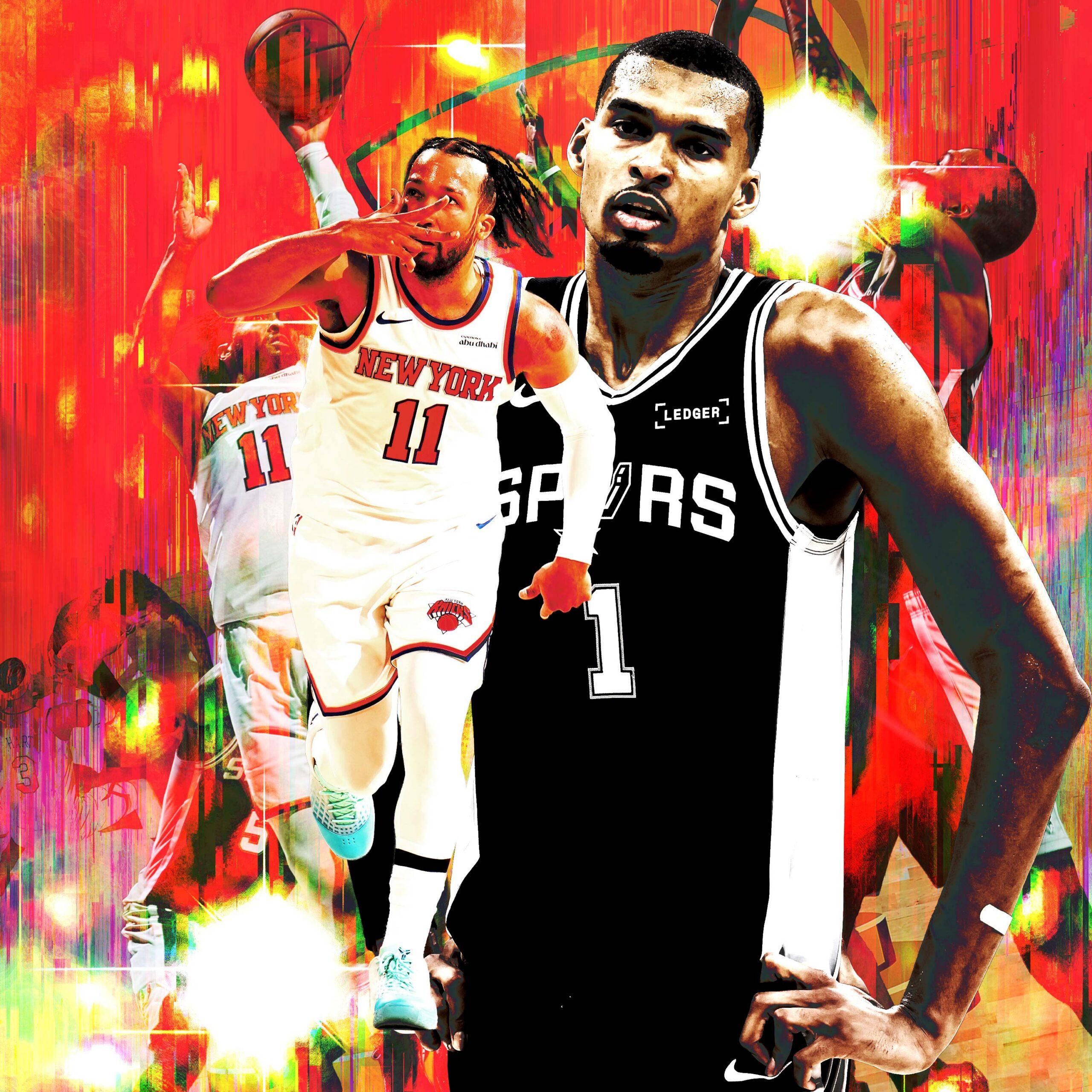

Sometimes, when you’re riding an 11-game winning streak with one of the most impressive point differentials in NBA playoff history, all you need is opportunism and a bit of luck.
In their 105-95 victory in Game 1 of the NBA Finals, the New York Knicks had what can fairly be described as a disappointing offensive performance. They generated only 105 points per 100 possessions—their lowest offensive rating of the postseason—and shot just 30.6 percent behind the 3-point line (3-for-23 above the break!). Jalen Brunson, who was generally marvelous under physical duress, needed 31 shots to score 30 points; as a team, New York finished 9-for-29 from the midrange.
But even when nothing is going right, the Knicks know how to make do with what they have. They’re resilient, relentless, and they refuse to stray from their game plan. On Wednesday night, New York was helped by San Antonio’s own ineptitude. The Knicks shot poorly, yes, but the Spurs were a dumpster fire, making just 25.6 percent of their 3s. Victor Wembanyama, who didn’t make any excuses for how poorly he played, was a putrid 6-for-21 from the field and committed six turnovers.
“I feel like some shots didn't go in for us,” Dylan Harper said. “Some shots went in for them.”
Still, San Antonio appeared to have the game under control midway through the third quarter. The Stephon Castle–Wembanyama pick-and-roll was starting to create fortuitous looks and the Spurs’ defense had New York locked firmly in a vice. Wemby was roaming the paint, Devin Vassell was locking up Karl-Anthony Towns, and with 18 minutes left in the game, Harper (who should’ve played way more than four fourth-quarter minutes) muscled Mikal Bridges into the paint, drilled a leaner, and gave the Spurs a 14-point lead, their largest of the night.




New York’s response was tactical ingenuity and desperation by coach Mike Brown that speaks to how resourceful these Knicks are. In order to maximize the team’s spacing, at the next whistle Brown deployed a lineup that had logged a grand total of zero minutes during the regular season, and just three in the first three rounds of these playoffs: Brunson, Towns, Miles McBride, Landry Shamet, and Josh Hart.
It’s a small albeit tough group that’s loaded with excellent shooters who can zip off screens and through crevices. Effectively, Hart is almost like a small-ball 5 here, guarded by Wemby, setting ball screens for Brunson, and crashing the glass. No matter who has the ball, though, a flurry of quick decisions will eventually trigger a pretty good shot:
“When you are playing at San Antonio and you have a defensive anchor like Wembanyama, your spacing has to be right,” Brown said. “We know Wembanyama is in the paint. And when the ball gets sprayed, guys have to make plays. … Guys were great having a second drive and those are things you have to do against this team.”
That five-man unit shared the floor for the next four minutes. By the time Brown made his next substitution, the game was tied. They finished plus-11 with an offensive rating of 170.0, giving New York the CPR it needed to give Brunson his takeover opportunity at the end. Within that third-quarter stretch, though, a potentially existential problem for San Antonio began to materialize. It has a name: Karl-Anthony Towns.
Regardless of who guarded him, New York’s All-Star center had an answer. When it was Luke Kornet, KAT drove past him for an and-1 layup. When it was Keldon Johnson—with Wemby curiously rushing out to contest Hart’s late-clock 3—he ragdolled the Sixth Man of the Year and drew another foul putting back the miss. When it was freaking Wemby himself, Towns battled for position and created another second-chance opportunity.
“They are going to put a small guy on KAT quite a bit,” Brown said after the game. “And when they do that, we want KAT to hang out in the dunker. We don't want him around the 3-point line. We would rather have Josh there, and we know Wembanyama is still going to be down on the floor. So KAT is going to hopefully have an opportunity to get offensive rebounds.”
By the time Mitchell Robinson subbed Towns out of the game with just over a couple of minutes left in the third quarter, New York’s offense was starting to play with the type of pace that’s a prerequisite for success in this matchup. The quintessential sequence came with a few seconds on the clock, when a defensive miscommunication allowed Hart to put pressure on the rim and skip a pass to McBride as he faded toward the weakside corner:
Hart could’ve stayed put, waited for the ball, and fired up his own corner 3. But it’s usually a good idea not to do what the defense wants. “Josh has to shoot the ball if he's open, or he's got to make quick decisions with the basketball,” Brown said. “DHO here, DHO there, or touch off the paint, play a two and spray it. We are trying to keep it as simple for our guys as possible and they have to take advantage of where Wemby is because he's just so impactful defensively.”
Luck is a factor in every win and every loss. New York could’ve lost if half a dozen coin-flip variables went San Antonio’s way. But this team is rarely at fate’s mercy. Whether it was Towns repeatedly standing Wemby up on an island, the entire team tightening up its transition defense, a broad refusal to turn the ball over, or Brunson’s commitment to getting downhill against matchups he favored all night long, the Knicks found ways to control enough of what they could to prevail.
The Spurs have a few obvious adjustments to consider beyond “make 3s” and “stop driving into a crowd without a plan.” They can replace Harrison Barnes’s minutes with someone who isn’t so susceptible to a blow-by. They can start more defensive possessions with Vassell (instead of Wemby) on Towns, which allows Victor to roam off a relative non-shooter and lets Castle stay on Brunson. When Wembanyama guards KAT, his paint-protecting superpowers tend to be neutralized:
They can run more inverted pick-and-rolls with Wembanyama, and send him off wide pindowns when Towns or Robinson is guarding him. And, critically, they can treat the defensive glass like a first, second, and third priority. Allowing 23 second-chance points is a death sentence. “We know we’ve got to control the boards,” Vassell said. “They like to crash the glass. KAT, OG, all them. Can’t just be one half where we’re crashing the glass. We’ve got to help Vic. That’s going to be a huge part of this series.”
Every game is its own story that transpires on its own terrain. The Spurs understand this. But so do the Knicks. Having a collectively level-headed mindset, now only three wins away from a championship, is almost more important than something as meaningful as 3-point variance.
“You have to come out with that same energy, intensity, and desperation, like it's Game 1 of any playoff series,” Towns said about Game 2. “You know, we've got 48 hours to rest up and do it all over again. And even at a higher level.”