
The Death of the Texas Political Machine That Bush Built
Ken Paxton routed John Cornyn in this week’s Texas GOP Senate primary runoff. The result is a stunning rejection of a political lifer—and the final blow to George W. Bush’s hold over his home state.The Death of the Texas Political Machine That Bush Built
Ken Paxton routed John Cornyn in this week’s Texas GOP Senate primary runoff. The result is a stunning rejection of a political lifer—and the final blow to George W. Bush’s hold over his home state.
A decade ago, former president George W. Bush emerged from the relative obscurity of political retirement—which mostly seemed to involve oil painting in his Dallas home—to join his brother Jeb on the campaign trail in South Carolina.
Jeb Bush, the former Florida governor, was then in the middle of a disastrous campaign for the 2016 Republican presidential nomination. The hope was that his older brother, who had left the White House in 2009 with low approval ratings but had since enjoyed a resurgence of popularity, could offer a boost to the floundering campaign.
The former president’s old political allies eagerly awaited his return. “The Bush name is golden in my state,” said South Carolina Senator Lindsey Graham, who had dropped out of the race two months earlier and threw his support behind Jeb in January 2016. He contrasted Jeb with Donald Trump, whom he called reckless and dangerous. The alliance of Jeb and Graham seemed to be one of the few encouraging signs in a campaign desperately in search of a spark.
Instead, things immediately fizzled. A week later, Jeb—who’d been touted as the front-runner early in the primary cycle—finished fourth in South Carolina, with less than 8 percent of the vote. He ended his presidential bid and has avoided the spotlight ever since.
Trump, the winner of that primary, took immense pleasure in sending home the establishment’s preferred candidate. He had spent much of the primary season insulting Jeb, calling him “clueless,” a “total stiff,” a “sad sack,” and an “embarrassment to his family.” Reminded a couple of months later that Jeb was still withholding his endorsement, Trump said, “No, Jeb hasn’t done it yet. He will get a burst of energy, and he will do it, believe me. He needs a little more energy.”
I thought about that humiliating political theater on Tuesday, as the Trump-endorsed candidate Ken Paxton routed incumbent John Cornyn in their Texas GOP Senate primary runoff. The 74-year-old Cornyn had been a fixture of Texas politics for more than four decades, becoming the first Republican since Reconstruction to serve as attorney general and then winning a Senate seat in 2002 with the vigorous support of President Bush and his administration.
Together, Bush, Cornyn, and many others fueled a Republican revolution that changed Texas, the nation, and ultimately the world. Under Bush, Texas solidified as a one-party state that predicted the rightward shift that would happen on a much broader scale. Bush rammed through tax cuts that benefited the wealthy, normalized the privatization of government services, brushed aside climate change concerns at the behest of his friends in the petroleum industry, and aggressively moved to nominate conservative judges to vacancies in an effort to remake the judiciary.
Beneath the veneer of Bush’s self-described “compassionate conservatism” was a folksy ideologue who presided over a record number of executions in Texas and whose preemptive attack on Iraq caused untold carnage and left at least a million people dead. His reign over Texas and the United States from 1995 to 2009 set the stage for an even more muscular brand of right-wing governance that morphed into the Tea Party and later MAGA.
But this week, Texas GOP voters dealt a final Trump-inspired blow to that once wildly successful movement, cutting ties with the last elected statewide official connected to the Bush camp. The political colossus that Bush and Cornyn built finally consumed them—and my home state. Texas now belongs to Trump, Paxton, and their far-right revanchist movement.
“It was a stunning rejection [of the Bush era],” political scientist Cal Jillson of Southern Methodist University in Dallas told me on Wednesday. “This is emotional, the idea that Trump and Paxton are fighters for the Republican cause and they’re going to take it to the Democrats. And they have a willingness not just to win on policy but to drive their opponent’s face into the dirt.
“Republican primary voters [in Texas] are drawn to that these days.”
Despite claiming to support Trump’s legislative priorities more than 99 percent of the time and trying to curry favor two weeks ago by introducing a bill to rename a stretch of Texas highway after the president, Cornyn found himself on the wrong side of the MAGA movement. In comparison to the embattled Paxton, Cornyn was perceived as too moderate to inspire fiercely partisan GOP voters in a deep-red state and too conventional to embrace Trump. Cornyn’s support was repeatedly called into question, particularly after he said that “President Trump’s time has passed him by” in a criticism of Trump’s bid for reelection in 2024.
“There’s no question that President Trump has some enthusiastic supporters as part of his base,” Cornyn said at the time. “That works well for him in a Republican primary, but not well when you need to expand your appeal in a general election.”
As Cornyn learned Tuesday, those primary voters remain loyal to Trump and his acolytes. In his victory speech Tuesday night, Paxton showed a flash of MAGA malice in bidding farewell to Cornyn.
“What people should really care about is back to my message: What have you done for the people of Texas when you have served them?” Paxton said. “And the answer for John is: ‘I’ve done nothing good for you. I listened to Mitch McConnell. I wasn’t there for you. I was not there for Trump.’”
During their bruising primary, Cornyn had a difficult time hiding his apparent disgust of Paxton, even going so far as to reference the scandalous dissolution of the attorney general’s marriage with state Senator Angela Paxton. “If his own family can’t trust him, you can’t trust him either,” Cornyn said in February. “I can’t trust him.” He added that Paxton was “going to be unelectable” after their runoff.
Yet there was Cornyn on Tuesday, standing before a stunned and somber gathering of supporters, being the dutiful Republican he’d always been.
“I’ve fought the good fight,” he told the room. “I’ve finished the race, and I’ve kept the faith.”
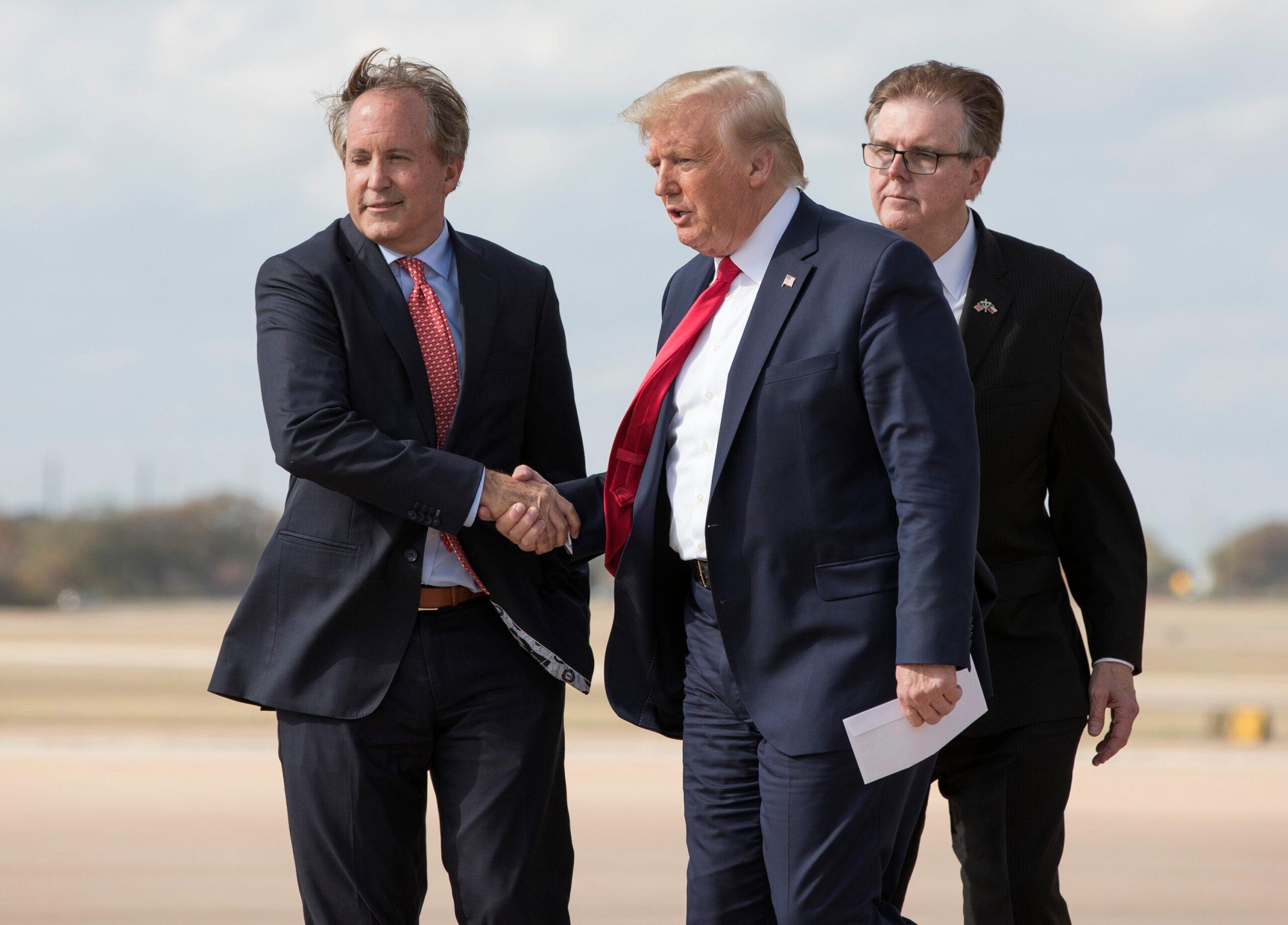
President Donald Trump is greeted by Texas Attorney General Ken Paxton, left, as he arrives at Austin-Bergstrom International Airport
“There’s no doubt in my mind that John Cornyn needs to be the next United States senator from Texas,” Bush said at a Cornyn campaign reception in Houston. “It’s important for Texas that he be elected. It’s important for America that he be elected. He’s the best man with whom I can work.”
This quote came from September 2002, back when Bush was America’s transformative conservative leader, bringing his practiced Texan folksiness and hard-line politics to the world stage. Texas’s sharp rightward shift was already underway but still in its adolescence.
As foreign as it seems today, prior to Bush’s ascendance, the Lone Star State was a dependable Democratic stronghold. In the Texas of my ’80s and ’90s childhood, Democrats controlled both houses of the state Legislature and most statewide positions. This was a different generation of Democrats and a more politically conservative party that was home to Phil Gramm and Rick Perry until the 1980s.
The Democratic star of the time was Ann Richards, a sharp-witted and proud liberal firebrand who came to national attention for her keynote address at the 1988 Democratic National Convention in Atlanta. Her cutting diss of then–vice president George H.W. Bush sent the room into hysterics: “Poor George, he can’t help it,” Richards said. “He was born with a silver foot in his mouth.”
Richards went on to win the governorship in 1991, becoming only the second woman in Texas history to hold the office. But there were strong headwinds forming during her tenure; in 1992, Bill Clinton became the first Democrat to win a presidential election without Texas’s electoral votes.
Two years later, George W. Bush challenged Richards for the state’s top office amid a Republican revolution that gave the party control of all three branches of government for the first time since 1952. Bolstered by his name and connections, his gift for retail politicking, and his notoriety as part owner of the Texas Rangers, Bush defeated the incumbent Richards by almost 8 points. “Texas is ready for a new generation of leadership, and I will provide it,” Bush said in his victory speech in November 1994.


Once in the White House, Bush enacted rounds of massive tax cuts, launched a war against Iraq based on intelligence that was later debunked, moved against Roe v. Wade by banning late-term abortions, approved a U.S.-Mexico border fence to stem the tide of illegal immigration, and pushed for the kind of wide-scale government deregulation that many believe led to the Great Recession. He also nominated John Roberts and Samuel Alito to the Supreme Court, which upheld a 5-4 conservative majority.
Through it all, Cornyn was a consistent supporter of Bush’s political priorities and remained a Republican in good standing back home in Texas. Cornyn was rewarded with electoral security, winning elections four times by margins of no fewer than 10 points.
In Bush’s Texas, Republicans amassed more power and turned formerly competitive political races into laughers. The same 2002 election cycle that sent Cornyn to the U.S. Senate also gave the Texas GOP control of the state House for the first time since Reconstruction.
Republicans moved quickly to lock in their political advantage and establish an enduring majority. That set the stage for a 2003 redistricting battle, during which Democrats twice fled the state to block the GOP-led plan. It didn’t work; Republicans finally passed the bill in a third special legislative session. In 2004, the Republicans also won their first majority in Texas’s U.S. House delegation since Reconstruction.
“I think Texas is on the cutting edge in a lot of reform of the conservative agenda,” Republican political consultant Reggie Bashur told PBS in 2005. “From a conservative perspective, it’s quite an achievement.”
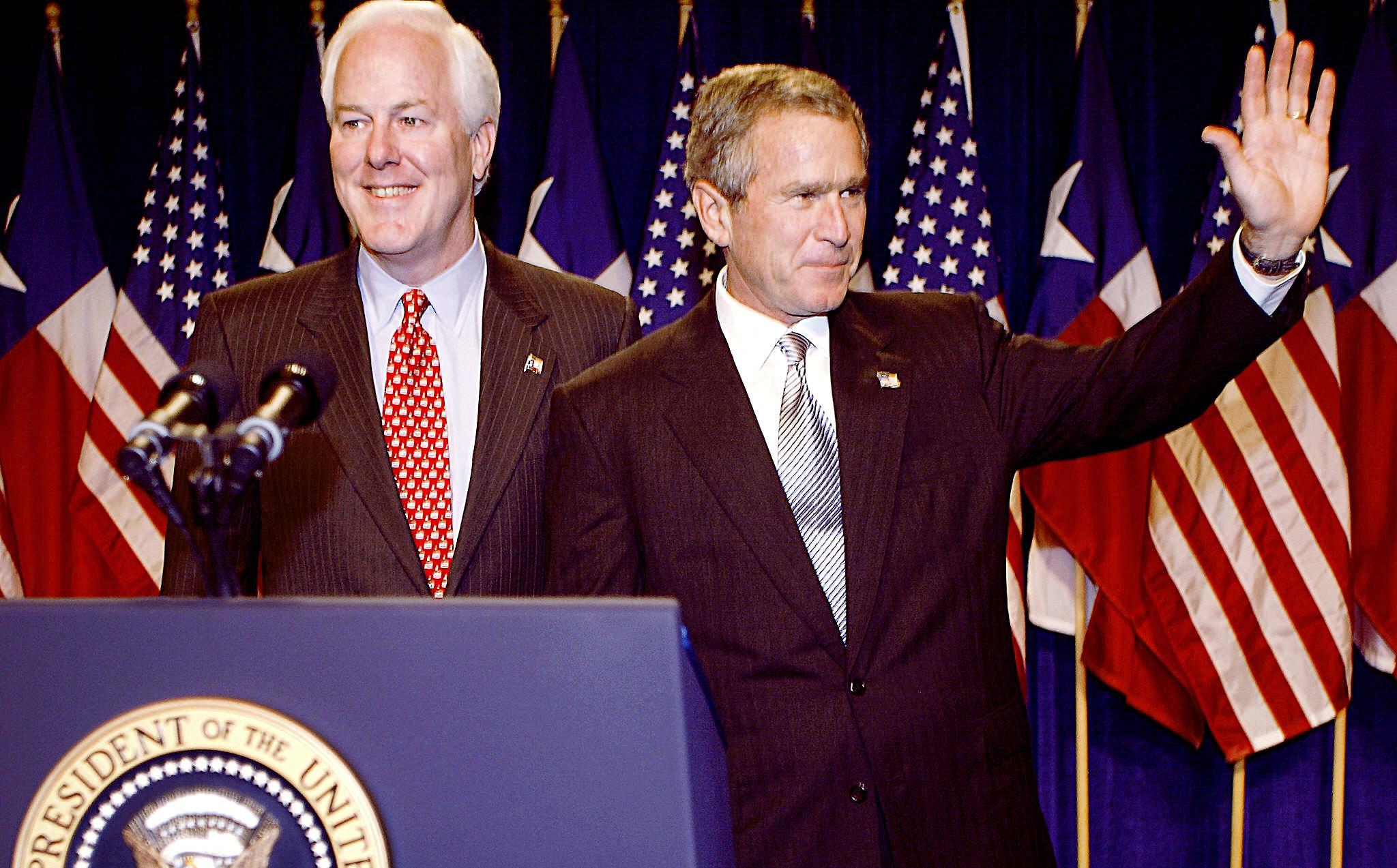
George W. Bush campaigns for John Cornyn in September 2002
Things started to change in Texas around 2014, when a more activist and aggressive crop of Republicans led by gubernatorial candidate Greg Abbott seized control of the state government. Paxton and Dan Patrick handily won their races for attorney general and lieutenant governor, respectively, bolstered by their support of the then-surging Tea Party movement.
The Tea Party was no fan of Cornyn and tried to boost primary challenger Steve Stockman that year. Although Cornyn prevailed by 40 points, that was the first sign of simmering discontent with the soft-spoken incumbent. “The beginning of the end,” Jillson said.
According to Jillson, the second big inflection point came in 2023, when the Republican-led Texas House of Representatives voted to impeach Paxton on charges of corruption and bribery. Later that year, the Texas Senate acquitted Paxton in a trial that could have banned him from office permanently. That victory gave Paxton new political life and, more significantly, endeared him to Trump. “Ken has been a great A.G., and now he can go back to work for the wonderful people of Texas,” Trump wrote in a Truth Social post two days after Paxton’s acquittal. “It was my honor to have helped correct this injustice!”
“[Paxton’s] lawyer said over and over again that his impeachment and trial was the last gasp of the old guard,” Jillson said.
That split within the Republican Party was illuminated during this primary season: Bush donated $5,000 in March to Cornyn’s reelection campaign; he made no public pronouncements and never showed up on the campaign trail as he did for his brother 10 years ago. Trump, meanwhile, loudly waded into the intraparty battle, backing Paxton in a race that was seen as tightly contested through last week.
“I know Ken well, have seen him tested at the highest and most difficult levels, and he is a winner!” Trump wrote on Truth Social. “John Cornyn is a good man, and I worked well with him, but he was not supportive of me when times were tough.”
There were other signs of how far Texas Republicans are willing to go to hold the MAGA line as Tuesday’s results poured in: Former Tarrant County GOP chair Bo French prevailed in the railroad commissioner primary runoff. French is one of the most transparently extremist candidates to advance this far in recent memory; he has made headlines for using anti-gay and ableist slurs in social media posts and encouraged Republicans to embrace Islamophobia. In March, Abbott expressed his support for these efforts. That’s “something that we’ve been fighting for well over a decade,” he said.
This is the party Bush helped to build—yet it’s something far uglier. And Cornyn, who was a few votes shy of becoming the Senate Republican leader in November 2024, no longer has a place in this increasingly hostile GOP, not even in his backyard.
During his concession speech Tuesday, Cornyn somberly confirmed that he’d support Paxton in the general election against Democratic nominee James Talarico. It was a demeaning denouement for a man who has been about as loyal a Republican soldier as he could be in his 42 years in public office.
“I think it’s style as much as anything else—Cornyn still has the embarrassment gene,” Jillson said. “Whereas Paxton can do anything that needs to be done, no matter how discreditable to himself it might be.”
Paxton’s victory has many political observers discussing whether Talarico and the Democrats have a chance to win statewide office for the first time since 1990. But if Paxton does what Republicans have done to Texas Democrats without fail for 32 consecutive years, and the state continues its lurch toward the furthest reaches of the right wing, Cornyn can console himself with the knowledge that he helped lay the party’s foundation.
And then it sent him home.