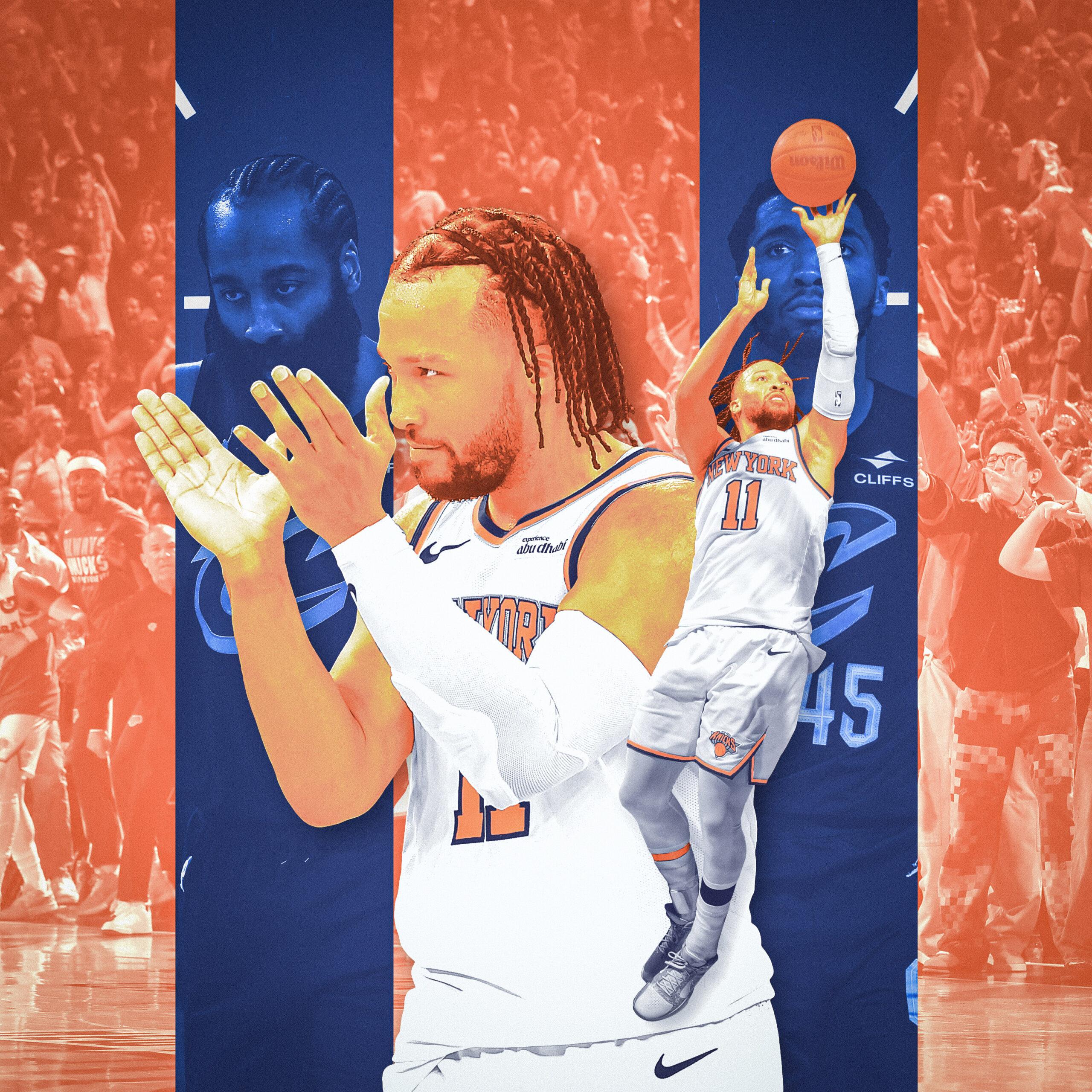

Three hundred sixty-three days later, the only events missing from Game 1 of the Eastern Conference finals were a fireworks display by Aaron Nesmith and a buzzer-beating moon bounce lofted from Tyrese Haliburton’s fingertips. Otherwise, after another truly insane comeback at Madison Square Garden, it was functionally déjà vu.
Tuesday night’s final score was unremarkable: New York Knicks 115, Cleveland Cavaliers 104. How we got there, though, was unforgettable and unprecedented. The overtime win was the largest comeback in Knicks postseason history. The Cavaliers led by 22 points with just over seven minutes left in the fourth quarter—good enough for a 99.9 percent win probability, if you believe in that sort of thing—and then promptly forgot how to pass the ball or make a simple defensive rotation.
In his walk-off interview with ESPN’s Lisa Salters, Jalen Brunson, who scored a game-high 38 points and single-handedly steered New York’s turnaround, could barely process his own feelings. “I don’t have an answer for you,” the three-time All-Star said before spewing a few clichés, hearing his voice crack, and then giggling in disbelief. “I really don’t have an answer.”
Sometimes the line between hero and scapegoat is drawn with invisible ink. In the third quarter, Brunson was cooked mercilessly by Cleveland’s offense. Every time he was brought up to defend a ball screen, it was a disaster, whether Brunson switched or blitzed. The Cavaliers generated 140 points per 100 possessions in that period, when they appeared, demonstrably, to be the superior team.
Minutes later, the evening shifted onto a different axis. Those who watched the fourth quarter live will best remember New York’s captain repeatedly hunting James Harden, getting a switch, and then proceeding to flame-broil him one-on-one:
It was vintage Brunson, a blend of smooth pull-ups and seemingly inconceivable floaters hoisted at crooked angles. He scored 13 points in the final seven minutes of regulation, which coincided with Mike Brown’s wise decision to replace Josh Hart with Landry Shamet. New York’s starting five was minus-13 in 18 minutes. New York’s lineup with Shamet instead of Hart was plus-36 in 12 minutes. (Yes, you read that correctly: plus-36 in 12 minutes.) Spacing matters, and Hart, who’s seen his 3-point percentage plummet during these playoffs, wasn’t providing any of it.
On the other bench, Kenny Atkinson decided against making any personnel changes down the stretch. After the game, Cleveland’s head coach was asked whether he considered pulling Harden in crunch time. “No,” he said. “Listen, he’s been one of our best defenders in these playoffs. I trust him. You know, smart, great hands. Didn’t think about that.”


Reminder: Max Strus, Dean Wade, and Dennis Schröder are also on this team. Jaylon Tyson has recently fallen out of the rotation, and Keon Ellis was terrible in his first and only stint. It would’ve been wild to put either one into a spot like that. At the same time, both were probably stronger options.
If you hold a process-over-results point of view on this sort of thing, it’s easy to see why Atkinson was willing to live with New York’s excellent shotmaking. The loss also hangs on other factors, including an offense that suddenly refused to move the ball, cut, set a screen, or even run a set. But in real time, it felt like a crime for the Cavs to let Brunson eviscerate Harden for as long as he did.
“We held [Brunson] in check most of the game,” Atkinson said afterward. “Basically the fourth quarter he got loose. We definitely tried to mix up some stuff, throw some stuff at him. We’ll have to keep looking at it. He hit a lot of tough floaters and a tough contested 3. I felt like they hit a lot of tough shots.”
Right. By the time Atkinson finally made an adjustment and sent two defenders Brunson’s way, New York’s deficit was already down to single digits, and the Garden was guilty of triggering a mild earthquake in midtown Manhattan. At that point, a team that entered this series on fire behind the 3-point line decided to make a bunch of 3s and complete one of the great in-game U-turns you’ll ever see. When asked about altering some of their defensive coverages involving Harden at the end of the game, Donovan Mitchell said, “Maybe we could have got to it a little bit earlier, you know, I think kind of getting [it] out of Brunson’s hands because I think that’s something we can adjust to. But ultimately, you know, this isn’t on [Harden]. … It’s on all of us.”

Some luck was on the Knicks’ side here. There was a late-clock prayer by Mikal Bridges over Evan Mobley’s outstretched hand. There was Shamet catching a friendly bounce—the type that’d make Kawhi Leonard smirk—after Harden took a poor angle on his closeout. And then, on the other end, there was Cavs guard Sam Merrill, muffling a Mike Breen BANG! on what would’ve been a game-winning dagger that went halfway in before popping out.
Any comeback of this magnitude requires its fair share of good fortune. But the weird thing about Atkinson’s blind commitment to Harden—who, it should be said, played a team-high 42 minutes—is that up until Cleveland’s fourth-quarter meltdown, the defending Coach of the Year actually made a slew of smart decisions and sensible adjustments. This team didn’t build an ostensibly insurmountable lead by accident, and its defense was incredible in some ways that could very well carry through the next two weeks.
Cleveland’s game plan was sound, leveraging its size and versatility to shrink the floor. Mobley continued to look like the most disruptive defender in the Eastern Conference and never let Karl-Anthony Towns find the type of rhythm he enjoyed during the first two rounds. Both he and Jarrett Allen did an excellent job of helping off Hart, mucking up the highly effective sets New York has run through Towns at the high post. When he was at the 5, Mobley did a fantastic job of roaming on the weak side while Harden guarded KAT:
New York had very few answers for most of the night; after unsuccessfully executing some drop coverage in the first quarter, the Cavs had a ton of success switching every screen for the next 30-ish minutes. It vaporized the Brunson-Towns two-man game and, to make Mitchell defend at the point of attack, persuaded New York to put the ball in Bridges’s hands a little more than it might’ve wanted:
For most of Game 1, I thought this was going to be the story: a philosophical difference between Atkinson and Brown, where the former had success trusting his individual defenders and the latter was scorched for constantly putting them in rotation. New York doesn’t want to leave Brunson on an island defensively, but its commitment to blitzing pick-and-roll ball handlers helped Cleveland generate 50 3-point attempts. Most were fantastic looks from very good shooters. If this team made 36 percent instead of 32 percent from behind the arc, that 22-point advantage might’ve eventually ballooned into the 30s:
Series openers can be weird. If anything can be gleaned from this one, it’s that pretty much anything is possible from here on out. The Cavaliers could win three in a row. The Knicks could sweep them. Through the first four quarters, both teams played with fire in their own designated way, and, in the end, Cleveland got roasted.