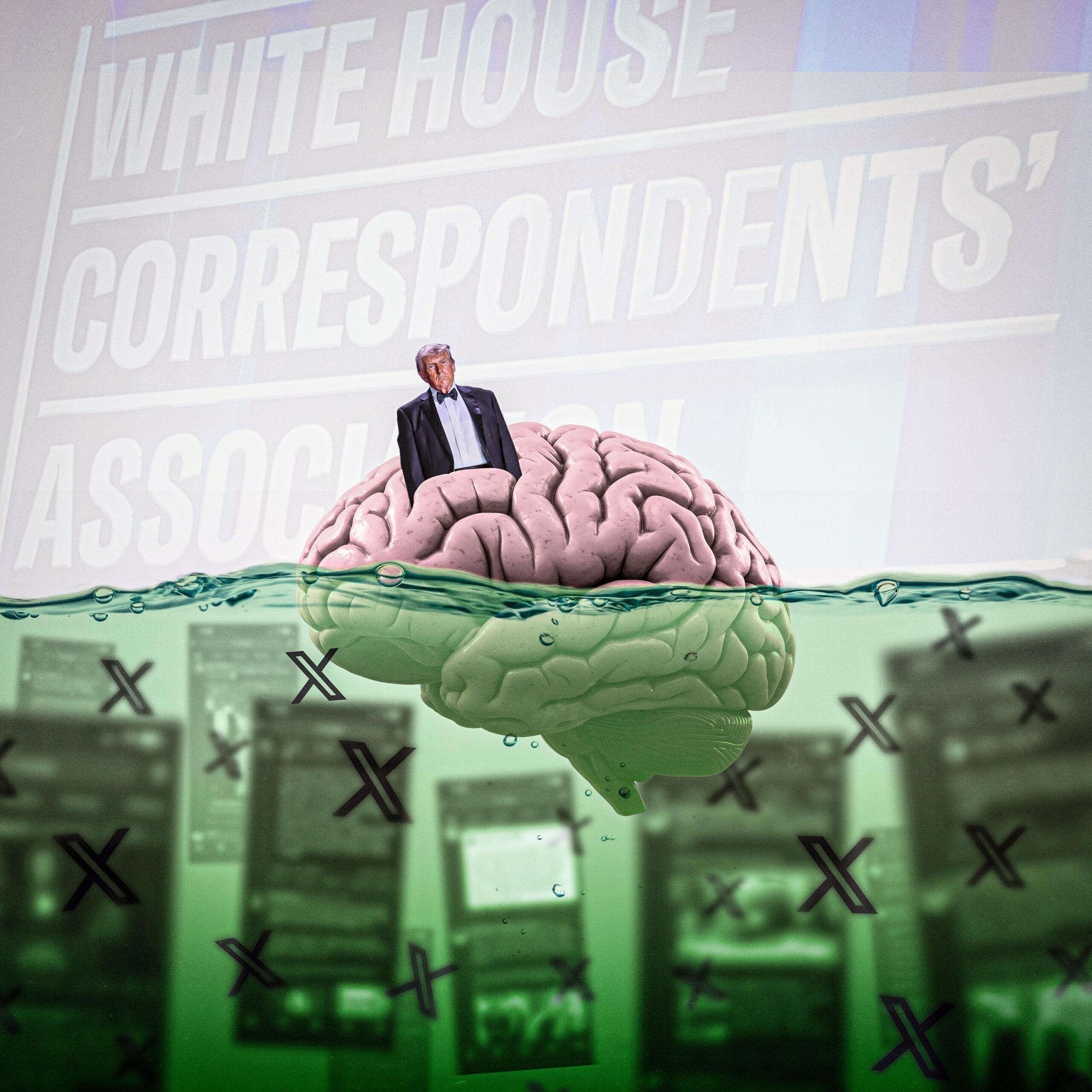
News Is Fleeting. Conspiracy Brain Is Forever.
What an assassination attempt at the White House Correspondents’ Dinner revealed about how our internet-poisoned minds make sense of the worldNews Is Fleeting. Conspiracy Brain Is Forever.
What an assassination attempt at the White House Correspondents’ Dinner revealed about how our internet-poisoned minds make sense of the world
When did you have your first irresponsible thought about the latest assassination attempt against Donald Trump? I mean the one on April 25, at the White House Correspondents’ Dinner. I had my first irresponsible thought about 0.2 seconds after glimpsing the news. In fact, I had a whole series of wildly irresponsible, reckless, and indefensible thoughts almost simultaneously. My complete Assassination Brain Timeline went something like this:
0 seconds: My brain registers the information that someone fired a gun at the White House Correspondents’ Dinner, which the president, along with the vice president and several senior administration officials, was attending.
0.015 seconds: Oh God, my brain thinks, here’s some more bullshit I’m going to have to know about.
0.1 seconds: Do I have to care about this? Am I a bad person if I don’t care about this? Goddamn it.
0.12 seconds: I hope the gunman was some MAGA guy and not someone on my side. Can’t let them have the moral high ground.
0.17 seconds: You know what? Trump’s poll numbers have been in absolute free fall. This will probably give him a boost. Convenient!
0.18 seconds: Maybe too convenient???
0.2 seconds: Man, if you wanted to fake an assassination attempt in a bid to win back public sympathy, the Correspondents’ Dinner would be the perfect venue for it. You’ve got a captive audience of reporters and media elites, and they’ll all be so enraptured by the dangerous and historic moment they’ve lived through that they’ll be sure to cover it breathlessly and give you lots of good PR.
0.22 seconds: Wait, are other people talking about this? Are they thinking the same thing? I better immerse myself in the conversation immediately—no time to read the details of what happened!
0.25 seconds: I’m so tired.
These were not, let me stress, considered, rational, or intentional thoughts. They were instinctive reactions, the droplets that splash across your mind right after it’s hit by a pebble of new information. That doesn’t make the thoughts better—someone planned to kill the president and my innermost self cried “can I ignore this?” and then “false flag??”—but it does help me understand the strange way in which this story has developed over the past few days. Because less than a week after a would-be assassin rushed the security perimeter outside a Washington gala in an apparent attempt to gun down the most powerful man in the world, the story seems to have fizzled into a weird combination of disbelief and indifference.
At first, the news cycle developed about as you’d expect. We learned more about what had happened: The alleged shooter, Cole Tomas Allen, had tried to get past officers at the security checkpoint outside the stairs leading to the event. The officers shot at him. He wasn’t hit, but was apprehended. One of the officers was hit—the shot struck his bulletproof vest—but it’s not clear by whom; it’s uncertain whether Allen ever fired his gun. We learned that Allen was never in the same room as Trump; he wasn’t even on the same floor of the hotel. We learned that Allen is a 31-year-old teacher from Torrance, California. We learned that he shared a strange manifesto, written in the tone of a LinkedIn status update, in which he attacked Trump’s policies and called himself a “Friendly Federal Assassin.” It was the first revolutionary document I’ve ever read that could easily have opened, “Some personal news.”
After that initial drip of information, though? The story didn’t exactly vanish, but it faded awfully fast. It’s largely (though not entirely) fallen off the front pages of the biggest news sites; on social media, it’s visible primarily as a tangle of competing conspiracy theories, each sillier and more implausible than the last. There are theories that Trump staged the attack to boost his approval ratings, or to garner support for his ballroom construction project, or to distract from his failures in Iran. These theories spread on the right, where people are “increasingly convinced” that Trump staged the assassination attempt against him in Butler, Pennsylvania, in 2024, and they spread on the left, where a smaller but equally vocal number of people still believe that Trump is motivated to appease Russia because Vladimir Putin has a tape of someone peeing on him. They seem to interest people far more than the actual details of what happened. (I should be extremely clear about this: There is zero reason to believe that any of these theories are true. My instinctive thoughts are idiotic. If you knew me, you would not need me to tell you this.)
Maybe your feed looks different from mine; I’m partly just reading the vibes. But it’s easy to look at this attempt against the president, an event that might have altered the course of world history, and conclude that we, the people, (1) kinda don’t believe it was real, and (2) don’t really care that much anyway.
I don’t think it’s a stretch to speculate that these two responses are intertwined. When you feel lied to by everyone in power, you’re likely to either search for alternative narratives or to opt out of the story completely. But these instincts are worth looking at individually, as each offers its own skewed window into our exceptionally skewed moment. Let’s take them one by one, and because we’re exhausted (always so exhausted), let’s do it in list form. We’ll start with indifference and then move on to paranoia.
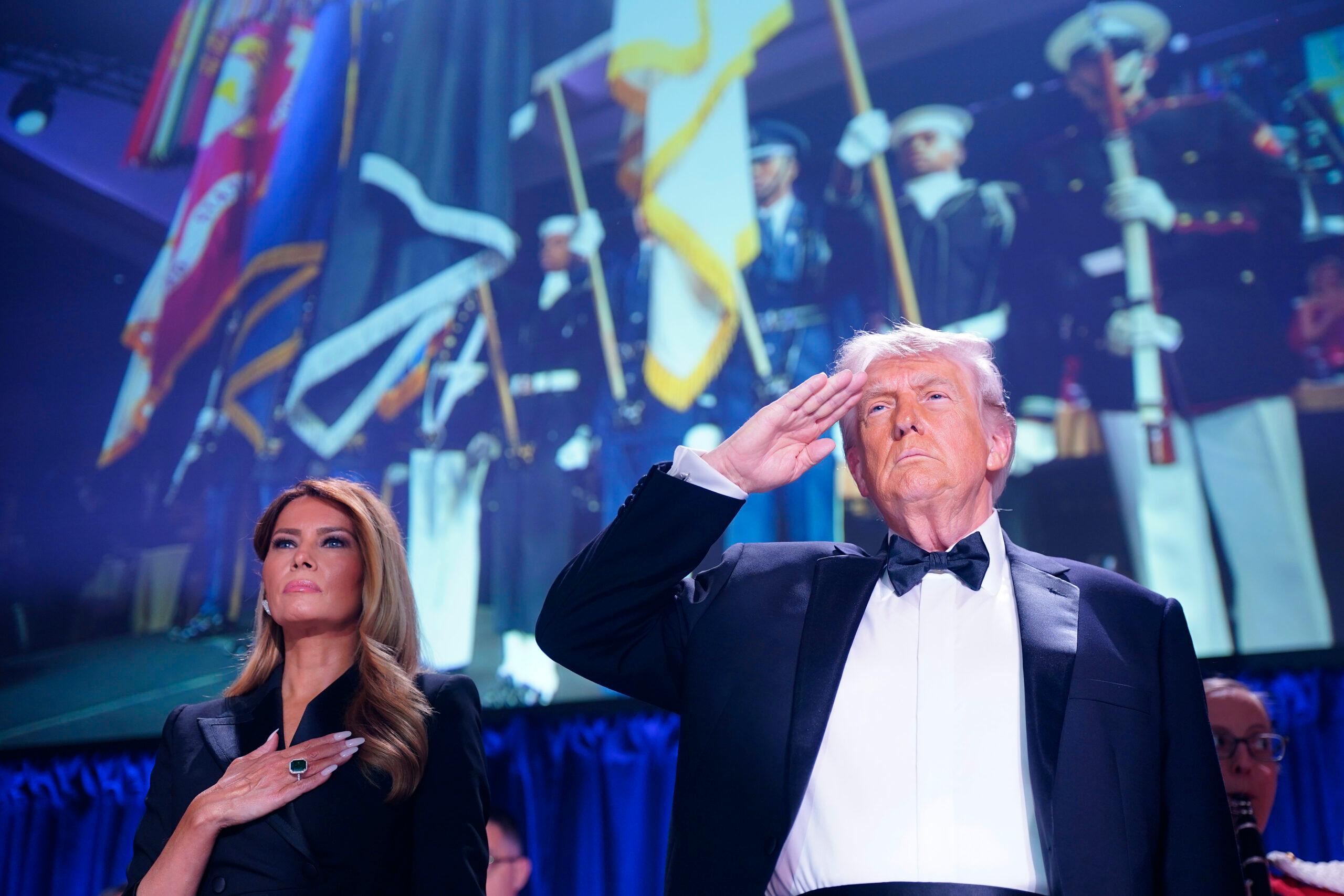
Melania and Donald Trump at the White House Correspondents’ Association Dinner
Five Reasons Americans Seem Kind of Meh About an Assasination Attempt Against the President
1. America has crisis fatigue.
A few months ago, I wrote about Evil Laser Pointer Theory, the idea that the Trump administration has used a constant barrage of scandals, atrocities, upheavals, and emergencies to keep us all so distracted that we can’t possibly keep up. ICE is assaulting Minnesota; Elon Musk is stripping the government for parts; suspiciously timed bets are being placed on Kalshi directly before military actions. Yesterday we were attacking Venezuela. Today we’re at war with Iran. (Are we? Seriously, I’m asking.) Remember when we were going to annex Greenland?
Gas prices are skyrocketing. Voting rights and the foundations of citizenship are under attack. Meanwhile, the Trump family is making billions from crypto schemes. You’re doomscrolling 24/7. You’re in a constant state of low-grade stress—maybe not so low-grade—and you feel powerless against the rapid-fire succession of maddening, scary, and grotesque events. We’re all living in an awful, sped-up version of “We Didn’t Start the Fire,” and we are burned right the hell out.
Keeping us in this state has made it easy for Trump and his cronies to get away with misdeeds they couldn’t have pulled off if our attention weren’t so overstrained. But when you plunge an entire nation into profound crisis fatigue, it’s hard to make them care when someone brings a gun to a dinner party. An assassination attempt is just one more crisis.
2. America has overwhelming Trump fatigue.
People are so tired of this guy. He’s been the black hole at the center of American culture for more than a decade, and even voters who once loved his shtick appear to be sick of him. His approval rating is stuck in a downward spiral. Republican political strategy is pivoting away from him. He’s elderly and enfeebled, and there are days when even he seems to realize he’s cooked.
When people have checked out of your overwhelming narcissism, they’re less likely to check back in just because someone fires a gun on a different floor of the hotel where you’re entertaining guests. Trump can literally be targeted by an assassin and Americans will be like, “Ugh, does everything always have to be about you?”
3. Right-wing rhetoric is already maxed out.
After the incident, right-wing influencers on X—a platform that algorithmically favors their content—leaned predictably hard into apocalyptic vengeance messaging. You know the sort I mean. This is a war, the radical left wants to destroy us, we cannot rest until we’ve eradicated their vile movement from the earth, etc.
The problem is that the same people already used this exact blood-and-thunder language for the Little Mermaid casting announcement, and it’s gotten hard to take seriously even when it’s being applied to something important. MAGA has one volume level—cranked so hard the knob is hanging on a spring—and they keep it there for absolutely everything. I doubt Dan Bongino can order a latte without threatening to salt the earth under the barista if the foam’s not glossy enough.
The right portrayed the Bad Bunny Super Bowl halftime show as a Hiroshima-level event, and now it has no way to escalate its rhetoric. Everything has a quality of fake catastrophe, even something—like the attempted murder of a president—that might normally seem like a real catastrophe. It’s like living next to a train; after a certain point, you just don’t hear it anymore.


4. It was just kind of a shitty assassination attempt?
I don’t mean to make light of a serious situation here. OK, I kind of mean to make light of it. What was this guy’s plan? “I will just … run past the security guys and it will probably work out.” The shooter literally approached the slaying of the commander in chief like:
- Jog past trained security officers with guns, while brandishing my gun, into a space crawling with Secret Service agents.
- ??????
- Success!
I’m pretty sure I’ve come closer to assassinating people purely by accident while going about my day. I was once randomly introduced to one of the most powerful politicians in India. I didn’t recognize him and had no desire to harm him, yet the pressure of my manly handshake represented a more grievous degree of bodily peril than anything Trump was subjected to on Saturday night.
It’s hard to get worked up about a murder plot that depended on someone being really good at evasive trotting. Americans follow winners, as Trump himself would say.
5. We’re cynical about how the news will be used.
In his press conference the night of the incident, Trump was already spinning it as proof that his inane White House ballroom project was a good and necessary idea. You don’t have to believe that the attack was staged to be turned off by this. If Trump’s mind had been on something else, he’d have used the shooting to drum up support for that. You’d expect someone to be more open and less calculating in the immediate aftermath of an attempt on their lives. That’s just not a gear that apparently exists in the president’s brain. Everything is either boasting or selling; usually, it’s a combination of the two.
After so many years of this, I think most people have grown wary. When your only mode is bad faith, even your genuine emergencies start to seem kind of shady. Trump may be the only person on the planet who could be almost killed in a way that seems insincere.
Now, let’s move on to the other side of the reaction: the Illuminati.
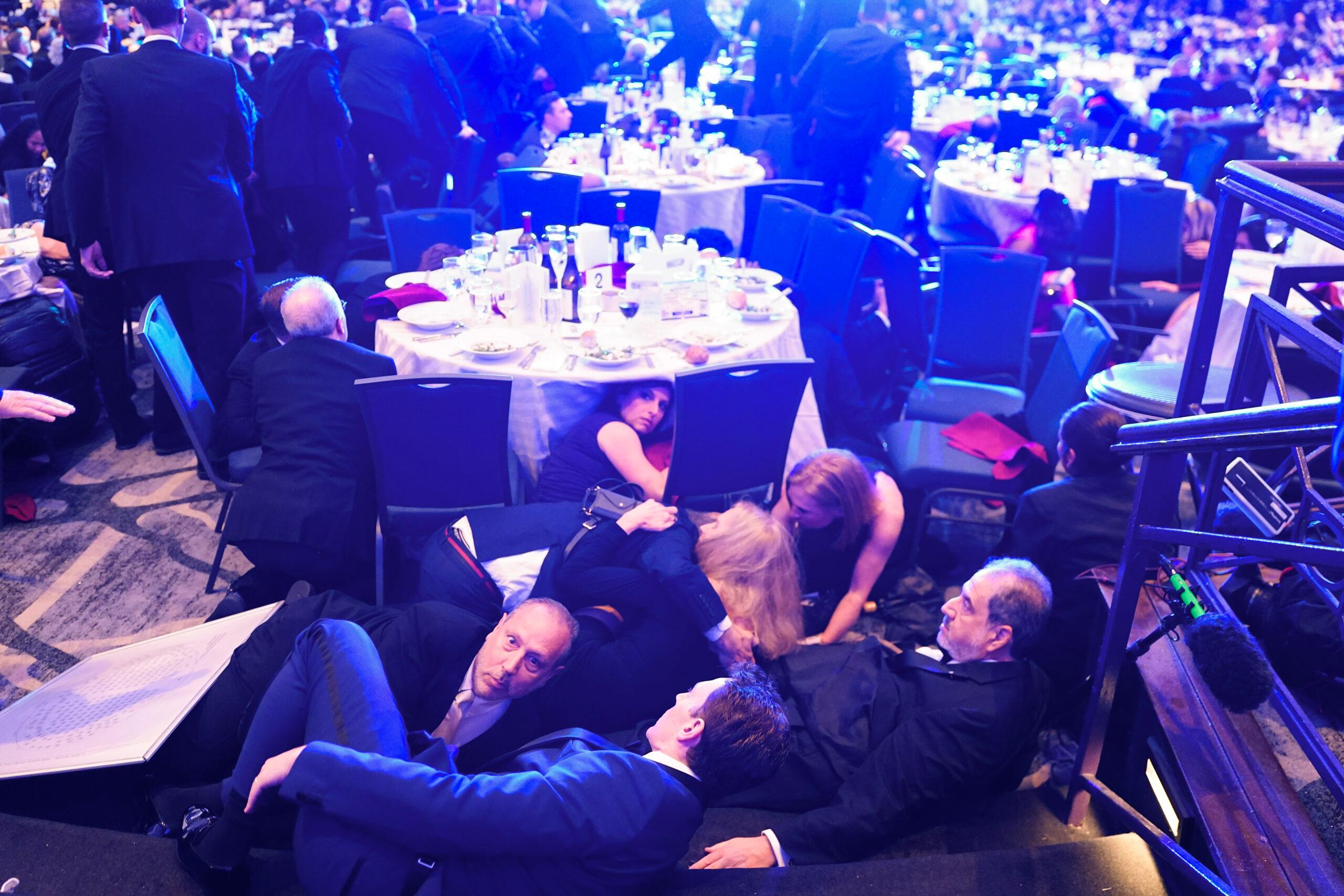
Attendees at the White House Correspondents’ Association Dinner hide under tables after hearing what sounded like gunfire
Five Reasons So Many Americans Yelled, “Staged!” the Moment They Learned About the Incident
1. We’ve been lied to so, so much (my God, so much).
“The administration,” the scholar Scott Radnitz, who studies conspiracy theories, told The Guardian this week, “does not have the best record of honesty and transparency when it comes to communicating with the public.” This is like saying locust plagues do not have the best record of nurturing crops. This is a president who once, for a televised weather announcement, showed America a doctored map that changed the path of a hurricane. How much are drug prices down? According to Trump, by a mathematically impossible amount. (In fact, they’re going up.) Outside the White House, the information environment is decaying at a terrifying rate. Social media companies and TV networks, bought up by billionaires, are tweaking their algorithms and content to make the news reflect their owners’ politics. AI, disastrously forced into web search and research applications for which it isn’t suited, is eroding our trust in the internet and our access to accurate information.
So many people feel cut off from the truth not because they’re morons, but because powerful people are, in fact, working to cut them off from the truth. (I’d say this was the real conspiracy theory, but I’m not sure it qualifies since it’s happening practically in the open.) And when you distrust both the media and the government, alternative accounts seem more credible, precisely because they’re not the official accounts. It’s flawed logic, of course. But there’s a twisted sense in thinking that whoever the liars accuse of lying is probably telling the truth.
2. Our brains have been marinating in poison for a long time at this point.
I don’t want to go too deep into a “social media has broken our brains” rant because you already know everything I’d say. On the other hand, wowww has social media ever broken our brains. There’s a reason it took me less than a second to go from learning of the assassination plot to wondering inanely whether it was staged. The reason is that I joined Twitter in the 2000s and have spent nearly two decades dissolving in a quicksand of competitive sensationalism, engagement-driven extremism, and algorithmic conditioning. It’s instant now; I jump to social media’s funhouse-mirror version of reality before I’ve even taken in the reality it’s meant to reflect. That I can still—mostly, for now—see this process happening and minimize its impact on what I believe doesn’t make it less unsettling.
Most of us are sick of the online conversation; many of our brains still lapse directly into its patterns the moment we begin to process an event. Sometimes, those patterns lead me to start drafting jokes about a big play in an NBA game before I’ve paused to appreciate it. Other times, they lead to sequences like, “Cole Allen is from Torrance … Bill Clinton’s half brother, Roger, was once sentenced in Torrance to two days in jail for DUI … what if Roger Clinton used the criminal connections he made behind bars to arrange a fake assassination attempt in an effort to distract from Bill Clinton’s involvement in the Epstein files?”
3. Reality is chaos; conspiracy theories offer an illusion of order.
This is the classic explanation for why people are drawn to conspiracy theories. We look at the world around us and see a whirlwind of events terrifyingly devoid of purpose or meaning. There’s a certain comfort in the idea that these events are in fact controlled and guided by a hidden intelligence, even if the intelligence is that of a malevolent cabal of oligarchs. At least there’s a plan!
It’s religion in reverse: Rather than being ordered by a loving but invisible God, the world is ordered by a tyrannical but invisible group of humans. And we, the elect, confirm our status not by trying to perceive God’s hidden plan and embrace it, but by trying to perceive the tyrannical group’s hidden plan and resist it.
This explanation probably applies more directly to, say, QAnon than to the conspiracy theories that proliferated after the Correspondents’ Dinner, most of which seemed too performative to lead anyone into real tinfoil-hat territory. On the other hand, if I put my mind to it, I can think of some reasons reality might seem especially chaotic and frightening at the moment.


4. It’s so fun to be on the right side! And so awful to be on the wrong one.
Political paranoia, the critic James Wood has written, is “the logic of pampered ignorance.” Ignorance, because paranoia reasons from what it doesn’t know while rejecting what it does—the facts of the case are lies, while the secrets concealed in unread files and unseen photos contain the truth—and pampered, because paranoia tells stories that flatter our existing views. We rarely believe in conspiracy theories that make our side look bad. (Many MAGA voices have recently embraced anti-Trump conspiracy theories; this is not a sign of intellectual honesty so much as a sign that these voices are turning on Trump.)
Political paranoia pretends to establish a more exacting standard of belief: We have to dig deeper, look harder, uncover the connections the sinister gray men are trying to keep under wraps. What it really does, more often than not, is free us to believe in whatever we want, as long as the fiction we devise can be propped up by a complex and ingenious explanation.
One of my first terrible thoughts after learning about Saturday’s incident was “I hope this was some MAGA guy and not someone on my side.” If it was someone on my side, I worried the attack would be used as evidence of the sinister intentions and violent nature of everyone opposed to Trump. It was bad optics, I feared; people who didn’t like Trump, but who also didn’t support the extrajudicial murder of elected politicians, might see it as the logical endpoint of opposition to the right-wing agenda and move closer to the MAGA fold. If the attack had been carried out by a betrayed MAGA enthusiast, though, all the bad optics would be on the other side. I could accuse them of all the stuff I didn’t want them to accuse me of! That’s so much better!
As it turns out, the suspect in this attack was someone on my political side. But if I follow the logic of pampered ignorance, I never have to acknowledge this. I can choose to believe that while the surface-level truth might make me look bad, the hidden truth actually makes me look phenomenal. You would like me, if only you knew the real facts. You truly would.
5. Actual dystopia is dull, grinding, and miserable. Conspiracyland is a more exciting place to be.
For those of us lucky enough not to be directly targeted by the administration, one of the worst aspects of life in Trump’s second term is the sheer passivity of daily existence. You can go to protests, organize, donate, attend anti-ICE training sessions, and volunteer to help refugees, but even if you do all those things, there’s still a lot of time every day when you’re not doing them, and there’s still so much happening that you’re basically unable to resist. And we’re all alone so much more than we used to be. Plus, the work of resistance, when it’s even possible, is often monotonous and annoying. Calling your representatives is important, but Matthew Phoning His Senator isn’t exactly Washington Crossing the Delaware.
Buy into a conspiracy theory, though, and suddenly the world has more color. You’re instantly thrown into a more glamorous position: You’ve pierced the veil! You’re one of the elite few who can see what’s really going on! And the narrative itself becomes far more fascinating as well. Reality has given us a bunch of lazy, bumbling gangsters trying to work an ACH transfer from Fort Knox directly into their checking accounts. A conspiracy theory gives us master plans and cover-ups and the whole X-Files bonus pack of TV tropes.
Of course, most conspiracy theories—although not all—are nonsense. But people, even well-intentioned people, will often choose exciting nonsense over dispiriting reality. Especially when all the ascendant forces in the culture are urging us to worry less about what’s real.
Looking back over these lists—which aren’t exhaustive; this is just what came to my mind within the first few days after those first 0.2 seconds—it’s clear that none of these points are really separate. Their edges fit together; they make up a sort of psychic jigsaw puzzle, self-protective withdrawal combining with self-destructive delusion to form an emotional state that I personally would like very much to escape. (What’s the picture on the jigsaw puzzle? It’s the HA HA HA … YES guy peeping through the window at the This Is Fine dog going up in flames.) The news itself fades almost before we’ve even processed it—seriously, do you remember the last assassination attempt against Trump before Saturday? It’s not the bloody ear one!—but the feelings of suspicion and grievance keep growing. Indifference about the facts we forget; paranoia about the feelings we remember.


I don’t want to overuse the “we” here because I can’t know what goes on in your mind. But I sure wish I could turn off the algorithm that keeps churning in my head even when I’m not online.