The State of the Union We Chose
What defines the past 400 days is not just the stories of those this administration has deemed to be insufficiently American. It’s what’s behind them.The State of the Union We Chose
What defines the past 400 days is not just the stories of those this administration has deemed to be insufficiently American. It’s what’s behind them.
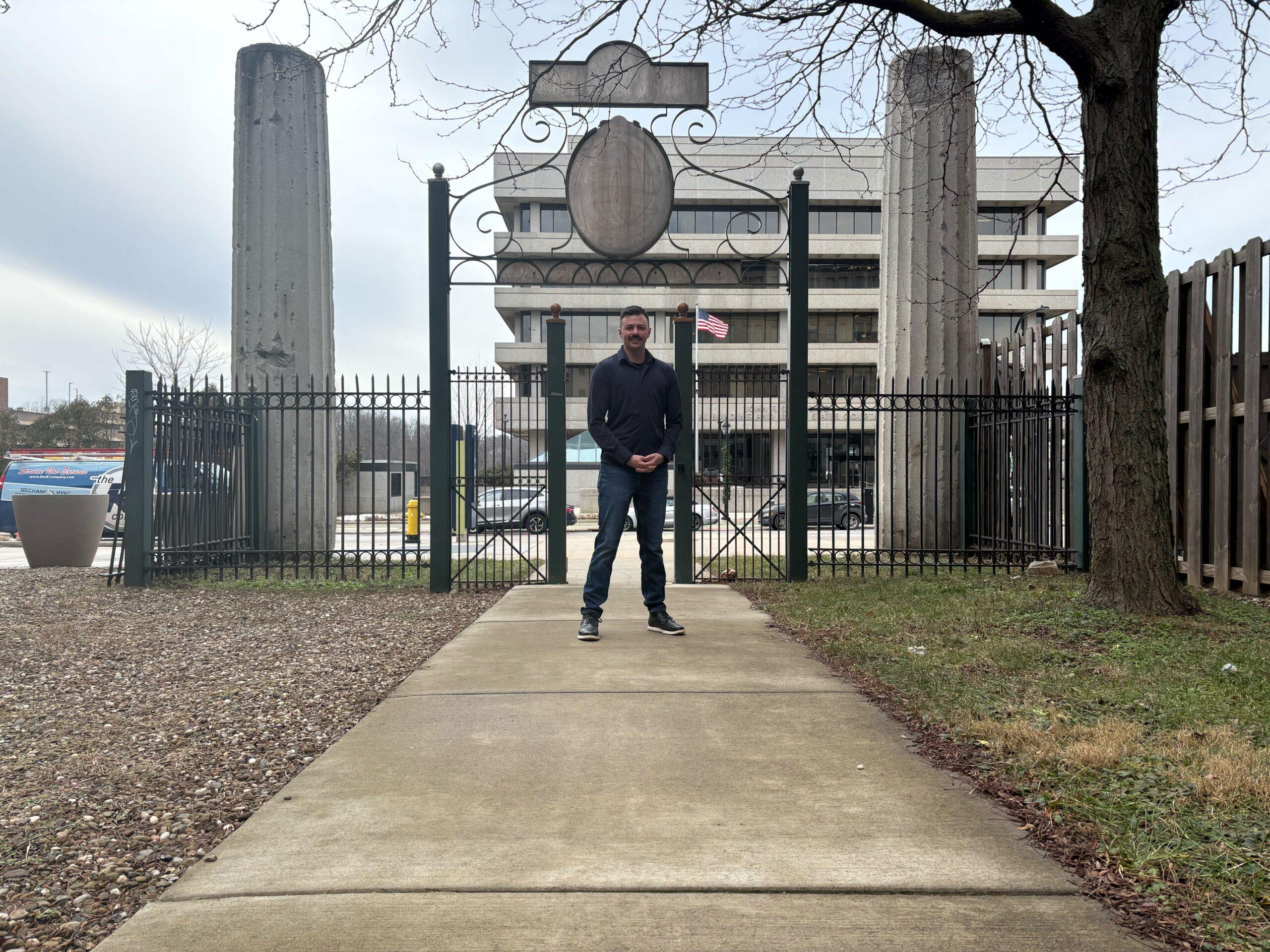
The soldier and I meet for coffee by an Akron overpass. Our drinks warm our hands against the bitter Ohio wind. We sit at a nearby picnic table while the sun hides behind dull cloud cover. A courthouse, gray and postmodern, looms across the street.
Though Nic Talbott is not the first in his family to catch the martial spirit—his grandfather and granduncles volunteered during the Vietnam War—he’s as earnest a recruit as the bloodline has yet produced. Nic had wanted to serve since he was crawling around the family farm, out on the rolling foothills of Columbiana County. He went to college at nearby Kent State and enrolled in the Reserve Officers’ Training Corps. Talbott, who is transgender, socially transitioned by the end of high school and began to medically transition in 2012. In the years that followed, he’d work odd jobs to pay the bills, return to school for his master’s, and lend a hand to his ailing grandmother. In March 2024, he finally took the leap and enlisted in the United States Army.
Talbott’s gender identity was well known among his peers. “The only thing anybody cared about was whether or not I could do the task at hand,” he says. “It was not a secret that I was transgender. It’s also not something that I ran around advertising, plastered across my forehead. But by the time we were a few weeks into basic training, everybody knew, and nobody treated me any differently. We spent more time talking about how I was the old guy in the platoon than that I was the trans guy.”
In July 2024, he began basic training; by January of the following year, he’d graduated from officer candidate school. A few weeks later, Talbott and at least 4,200 other transgender service members were banned from serving in the U.S. military.
Executive Order 14183, issued seven days after Donald Trump returned to the White House in January 2025, was one in a series of actions restricting trans rights in the opening stretch of the president’s second term. The directive, which reversed a decade of precedent in the armed services, charged that transgender soldiers could not “satisfy the rigorous standards necessary for military service” and violated “a soldier’s commitment to an honorable, truthful, and disciplined lifestyle.” On February 7, Defense Secretary Pete Hegseth paused all gender-affirming surgeries in the military; 12 weeks later, he penned a memo declaring that the presence of trans soldiers was no longer “in the best interest of the Military Services” or “national security.” Transgender troops, Hegseth wrote, could either “voluntarily” exit the military or submit to an “involuntary separation process.” (The “voluntary” route initially included retirement benefits for any soldiers who’d served at least 15 years, but eligibility was later amended to the standard 20-year minimum.)
The Supreme Court allowed the ban to take effect in May while a trial determining its legality played out in the lower courts. As of Tuesday, the circuit court arbitrating the dispute is still hearing arguments.
Talbott, 32, is the lead plaintiff in that case. He says for now his life remains “kind of in limbo.” Before the ban, he’d worked for a moving and delivery company. He left the gig a few months ago, hoping to ship off to his final training program, after which he’d be fully eligible to join the military police. Now, the closest thing he has to normalcy is when he’s buried in paperwork, fitness exams, and equipment inspections as his Army Reserve unit goes about its monthly drill session. (Talbott is still training with his platoon while the case is pending.)
The only thing anybody cared about was whether or not I could do the task at hand. ... We spent more time talking about how I was the old guy in the platoon than that I was the trans guy.Nic Talbott
He has many feelings about the past 13 months, an inescapable sense of exhaustion chief among them. Still, if he got a call telling him that he could resume his career tomorrow, Talbott says he’d be on the phone with HR instantly, saying, “Get me signed up.”
Whether he receives that chance is out of his hands. “I know I earned my uniform. If I didn’t deserve to wear my lieutenant rank, I wouldn’t have made it through officer candidate school,” he tells me. “I’m just going to keep showing up and proving that.”
Stories like Talbott’s are the cardinal through line of the first year of the second Trump presidency: individuals of varying backgrounds, cultures, professions, faiths, political slants, and social origins caught within the churning gears of a federal machine guided as much by partisan score settling as insatiable kleptocracy. Over the past 400 days, the glaring signature of our union has been the harm wrought by this administration upon a wide spectrum of figures it has deemed to be insufficiently American. It is not the propagation of pain that is novel across these episodes, but rather the explicit intention to cause it. It is the way that propagation of pain is glorified.
On Tuesday, the man whom 77 million Americans returned to office will spend many minutes rambling, crowing, and championing how he has contorted the country to his accord. It will not be wholly untrue. For the present State of the Union is defined by his havoc—our havoc.
Attempts to dissect what has unfolded over the past year strike familiar notes: the ego of the president, the greed of his sycophants, the failures of political parties, and the dissolving idea of fact. However enticing, these explanations are critically incomplete. We are here as a country for many reasons, but none more than that this is what we voted for. This is the vision we chose.
An honest accounting of our union today must reckon with the way it forever changes the lives of those who comprise it. Below are a few portraits of what this nation has delivered unto itself. Of the wreckage that now accrues in every corner and courthouse in America.
“Oh god,” the congresswoman remembers thinking. “Here I am on his list of people.”
It’s late January, so cold outside that my hands fail to defrost before shakes and pleasantries ensue. Representative LaMonica McIver is trying to recall the day eight months earlier when President Trump first fixed his eye on her. McIver, clad in a navy blue bubble vest with a House of Representatives insignia over her heart, sits on a rolling chair in a harshly lit conference room at her Newark offices. When she gets to talking, she waves her hand with aplomb.
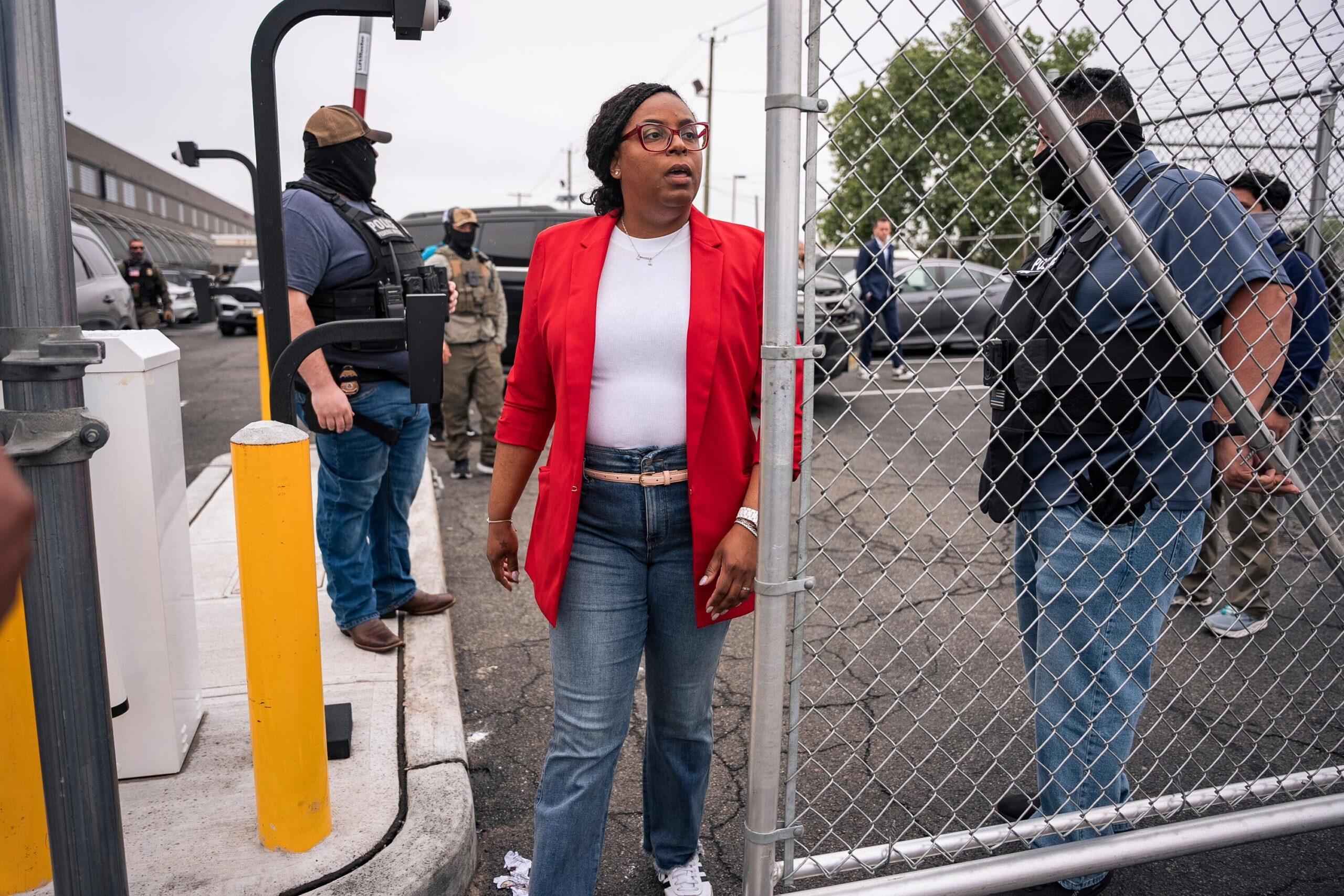
The conflict kicked off in a parking lot three and a half miles from where we’re meeting, on a Friday morning last spring. McIver had arrived at an immigration detention center called Delaney Hall to conduct an oversight tour. Three months had passed since the Department of Homeland Security had inked a $1 billion lease agreement on the property to facilitate the president’s mass deportation agenda; local officials, who opposed the complex, issued warnings that the building hadn’t been properly inspected. On May 9, McIver and two of her House colleagues—Bonnie Watson-Coleman and Rob Menendez Jr.—were granted entry into Delaney, but only after being delayed for hours by Immigration and Customs Enforcement officials.
Newark Mayor Ras Baraka, who also opposed the facility, had planned to hold a press conference with the representatives after they finished their review. At 1:42 p.m., he arrived at Delaney. A protest had broken out on the adjacent street. After initially permitting Baraka to enter the gated perimeter surrounding the property, ICE agents changed course and attempted to arrest the mayor. McIver and the 80-year-old Watson-Coleman managed to stand between Baraka and the approaching immigration officials and shepherd him out of the parking lot.
ICE agents on site later received a call from Deputy Attorney General Todd Blanche, who directed them to return to the nearby street and seize Baraka. McIver and her colleagues again attempted to shield the mayor, this time to no avail. Recordings of the dispute show the 39-year-old congresswoman pushing toward the perimeter as she was shoved from behind. Baraka was arrested, though the charges against him would later be dropped. McIver and the other representatives went home free.
Ten days later, DHS issued a criminal complaint against only McIver. The citation said she had attempted to “forcibly assault, resist, oppose, impede, intimidate, and interfere” with agents. McIver denies the charges. Her case remains ongoing.
I don’t even see myself getting fair anything, fair trial, fair judgment from a judge. ... I just find so much corruption with this president that I’m sometimes hopeless around the systems that exist.LaMonica McIver
“I didn’t go there to protest,” McIver tells me. “I went there to do my job—conduct oversight and find out what was going on in this place.”
Shortly after the indictments against McIver were issued, President Trump told reporters that she had been “out of control” and was “shoving federal agents.” Lambasting the New Jersey Democrat, he added: “The days of that crap are over in this country. We’re going to have law and order.”
McIver says that in the week before the indictments, former Trump personal attorney and acting U.S. attorney for the District of New Jersey Alina Habba attempted to negotiate a settlement with her. The plan, McIver says, was shifting constantly: First, all three representatives would be charged; next, any one of them; and finally, her. “[Habba] would call every day with a different scenario,” McIver tells me. “At least a week we were going through this.” (A representative from the U.S. attorney’s office for New Jersey declined to comment.) The congresswoman and her legal team say they found out about the charges—three counts of “assaulting, resisting, and impeding” federal officers—when Habba confirmed them on social media.
In the months that followed, McIver’s Republican colleagues tried and failed to formally censure her for the dispute. In November, the judge in the case allowed it to move to trial, with all three original counts. If convicted, McIver could serve up to 17 years in prison. The case is being heard by the Third Circuit Court of Appeals.
Even after all this time, she says the shock of the situation still hasn’t worn off. When I ask how often she thinks about what life would look like if she’s convicted, McIver doesn’t hesitate. “All the time,” she says. “Sometimes, it even brings tears to my eyes to think about it because at the end of the day, you really have to hope for the worst in this America under Trump. I don’t even see myself getting fair anything, fair trial, fair judgment from a judge. I don’t see it. I just find so much corruption with this president that I’m sometimes hopeless around the systems that exist.”
McIver’s case is perhaps the gravest in a line of attempts by this administration to persecute and punish its perceived enemies. In August, it brought specious mortgage fraud accusations against Lisa Cook in a bid to fire her from a governorship on the Federal Reserve Board. (No charges were filed.) In September, it charged former FBI director James Comey with making “false statements to Congress” and “obstructing congressional proceedings.” (The case was eventually dismissed by a federal judge.) In November, it pursued another mortgage fraud investigation into California Senator Adam Schiff. (He has denied any wrongdoing.) In October, it similarly charged New York Attorney General Letitia James with mortgage fraud. (Her case was dismissed.)
Across the first two months of 2026 alone, Trump’s Department of Justice has initiated an investigation into Federal Reserve Chair Jerome Powell and tried to indict two senators and four members of the House of Representatives for a video published in November telling members of the armed services that they can refuse to perform illegal orders. Not since the second Red Scare have arms of the state been so plainly deployed against its duly elected and appointed representatives.
For McIver, the trend is both intensely personal and constitutionally disturbing. “I have a 9-year-old daughter who’s like, ‘Are you going to jail?’ I have a husband, like, ‘What the hell is happening?’ My mother is like, ‘Oh my God, you’re going to be in jail for 17 years,’” she says. Still, her larger concern is that the machinery of American democracy has been fundamentally fragmented. “This isn’t just about a little Black girl from the city of Newark,” McIver says. “This executive branch can literally weaponize the DOJ against members of Congress. … Scaring them out of doing their job.”
She contends that in cases like hers, “the process is the punishment”—that the volume of these episodes is part of a larger strategic effort to wear down the structures and figures standing in the administration’s way. The consequences of that pattern will continue to be felt in both chambers of Congress and beyond.
“No one is safe with them,” McIver tells me. “No one.”
Born and raised 120 miles from each other, Joey and David built a life together and carried it across two continents. Their story began in Venezuela, unfurled in New York, and was abruptly rerouted by perhaps the defining maneuver of the second Trump presidency, the use of a little-known, 200-year-old wartime act. Because of their immigration history and other privacy and safety concerns, both Joey and David requested to have their real names withheld from print. Joey, one of four siblings, was raised just north of Caracas; David, one of three kids, was reared two and a half hours to the northwest.
“Going to the U.S. was not really part of my plans,” David says the first time we speak, in a video call, via a translator. “I knew that as a Venezuelan, I needed to jump through many hoops and do many things in order to be able to migrate.” He had neighbors and family members who’d made that jump as the Venezuelan economy turned the nation into a practical failed state, but he says if economics were his only priority he never would’ve left. When David met Joey though, the arithmetic began to shift.
“We are members of the LGBT community here in Venezuela, and we receive a lot of mistreatment,” Joey tells me. Having long dreamed “to see” and “to live in New York City,” he decided that America was the ideal “country where we can profess our love openly.” They departed for the States soon after, in 2023.
They were, without knowing it, grains of sand in a mass-migratory desert. Some 800,000 Venezuelans emigrated to the U.S. from 2020 to 2026, fleeing starvation, repression, and disease. The path was particularly perilous: After moving through nine South and Central American nations, Joey and David traversed the infamous Darién Gap. Because it still remained incredibly difficult for Venezuelans to acquire U.S. visas, Joey and David had to rely on smugglers to facilitate their arrival. Joey tells me the journey took at least nine months. “We had to ride on the train of la Bestia, and along that path we faced several coyotes, several moments where we were unprotected, vulnerable, and we were physically mistreated. We had to withstand hunger, abuse. And it was very difficult going through the jungle.” David says that a few traffickers “threatened to kill us.”
Later in 2023, Joey and David entered the U.S. through El Paso, Texas. They both filed asylum applications and were soon granted work permits and Social Security cards. Seven days later, they were bused up to New York, where they settled in Long Island. They were hired as dishwashers, busboys, car cleaners. For years, both men had dealt with chronic ailments; in New York, they could get medicine for a fraction of the cost they’d paid in Venezuela. They relished the chance to send money back to their families. They joined a local pride group.
Joey and David soon discovered that the peace they had clawed out was increasingly tenuous. Two months into his second term, President Trump invoked an obscure 18th-century statute called the Alien Enemies Act to facilitate the mass detention and expulsion of Venezuelan migrants. Of particular concern to the administration was the supposed proliferation of the Venezuelan prison gang Tren de Aragua.
During those five months [in detention], they didn’t hit us physically, but it was psychological torture. I wasn’t given my medication. The food was terrible. I thought I was going to die.David
When Joey and David heard the rhetoric of the Trump regime, they figured it needn’t concern them. “I personally wasn’t initially very scared because all the threats and everything [Trump] was saying pointed that he was going to go after people who had criminal records, who were real criminals,” David says. “I never thought that I would be included in there.”
Soon, though, they noticed a much wider net had been cast. “Immigration was the topic of everyday chats and conversation,” David says. “Everybody was constantly saying, ‘Oh, ICE is making a raid in this neighborhood,’ or, ‘ICE is arresting people here or there.’” Joey and David tell me they started to limit when they’d go out in public and for how long. They’d go straight to work and come straight back home. They tried to keep their heads down and ride it out. That’s when ICE burst through their front door.
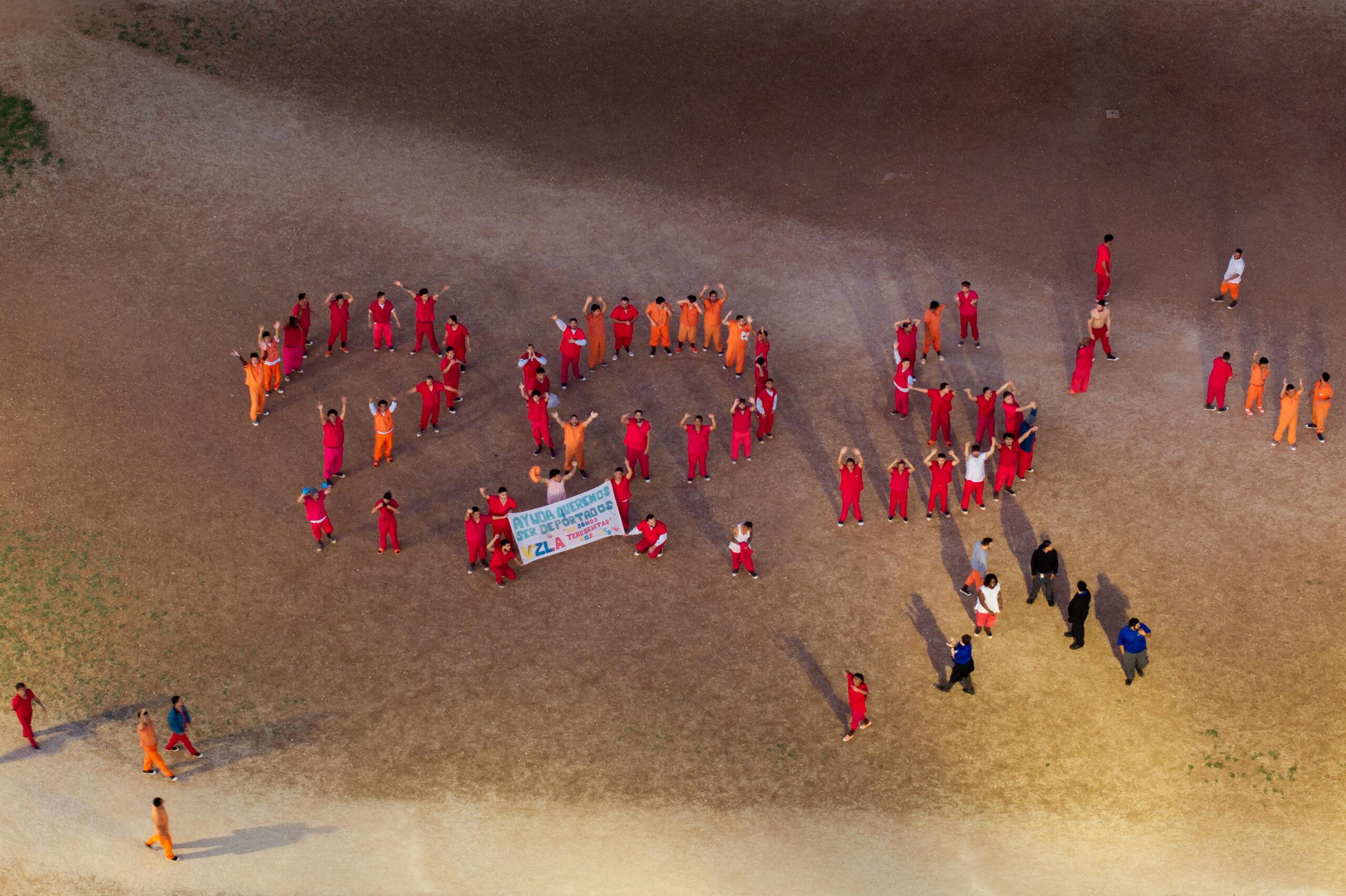
In March 2025, immigration agents entered their apartment and detained David. Within days, he and his legal representatives say he was relocated from a collection of federal buildings in New York City to a holding facility in Louisiana and finally to a detention center in Texas. After his capture, David tells me, authorities mistook his tattoos for signs of affiliation with Tren. At Bluebonnet Detention Center in Anson, Texas, he watched firsthand as countless Venezuelan migrants were rounded up and sent off to the Salvadoran maximum security prison known as CECOT. “We saw many people who were told that they were going to bring them to a clinic visit [at the infirmary] and in reality they would disappear,” David says of his memories at the center. “Even their family members didn’t know about them.”
In total, he was held for five months. The only person he was able to communicate with over that time was his lawyer. “During those five months, they didn’t hit us physically, but it was psychological torture,” David recalls. “I wasn’t given my medication. The food was terrible. I thought I was going to die.”
The administration ultimately backtracked on its claims that David was associated with Tren, and after a series of legal maneuvers it sent him back to Venezuela. Joey was also detained by ICE, after a routine immigration court appearance in New York. He, too, was sent to Louisiana and then to Texas. “You are cuffed at the hands and feet the entire time. You don’t eat, they simply move you. They tell you where to go,” he says. “You just follow instructions. You don’t know what’s going on or what’s going to happen to you.”
By the time he reached Bluebonnet Detention Center, Joey doubted he’d make it much longer. “I thought I was going to die,” he says. “I spent 15 days without my medication. I said to myself, ‘I’m going to die here.’” Like David, he was eventually sent to Venezuela, in his case after almost a month in detention.
Neither one of them has fully made peace with their incarcerations. When I ask Joey whether he’d do it all over again—come to the U.S. knowing how it would turn out—he says yes, unequivocally. David isn’t so sure. “When I was detained, I was with people who were in health situations that were even more delicate than mine, and they were treated like the worst kind of dog or animal that there can be,” he tells me.
“I would like to have the United States citizens understand the pain and suffering that the people who are being unfairly detained are going through.”
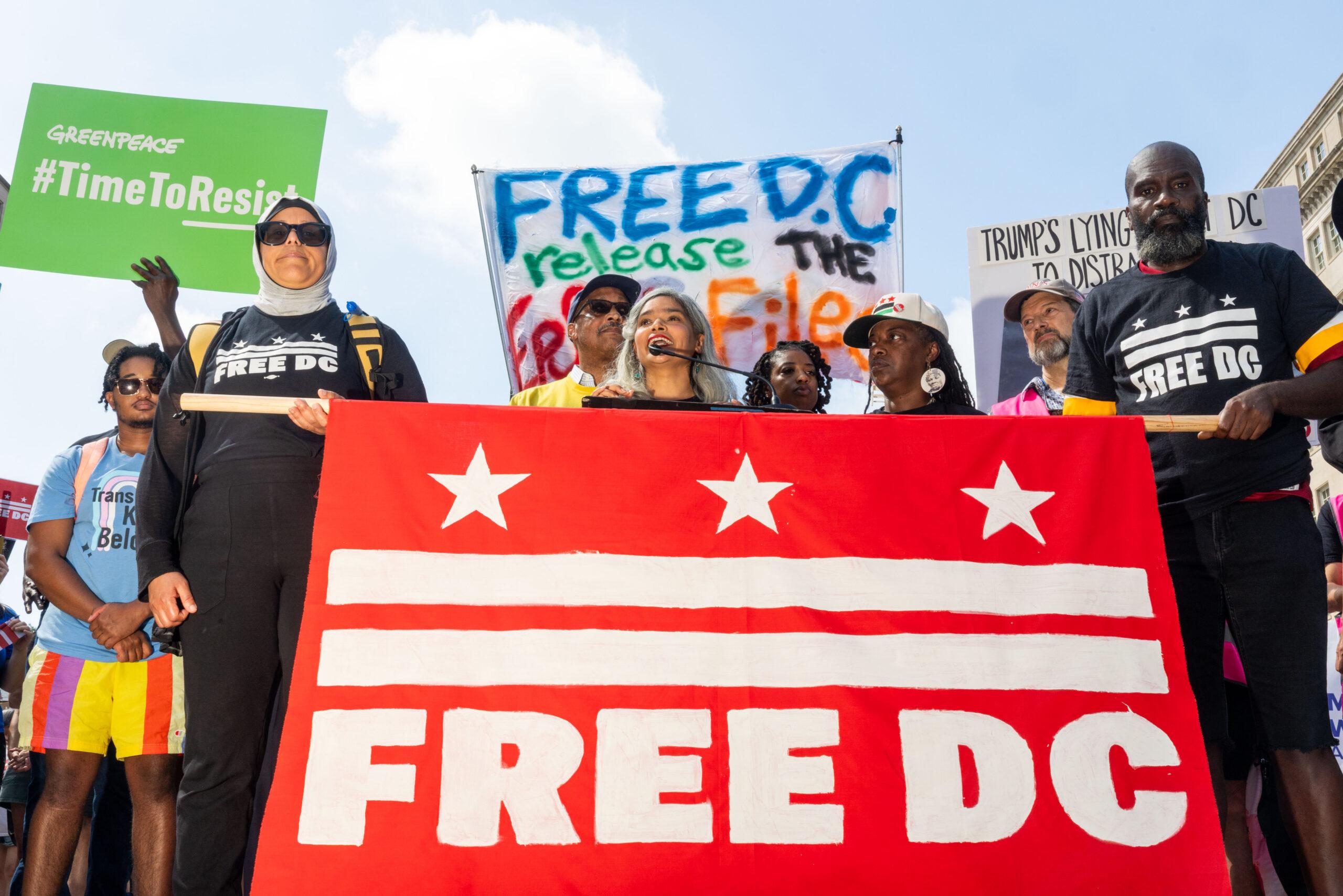
Our meeting point is a hole-in-the-wall coffee shop in the northwest sector of Washington, D.C. We sit in the back and keep the introductions brief. I ask Alex Dodds, cofounder of the nonprofit group Free DC, about her work, and she’s hesitant to divulge much, given the circumstances. “We’re in the sixth month now of military occupation,” Dodds says, sporting a black hoodie and hoop earrings. “There’s just no way that isn’t terrifying.”
Conceived in the wake of congressional interference with 2023 revisions to the city’s criminal code, Free DC advocates for local autonomy in Washington and is a central player in the grassroots campaign against the deployment of federal forces across the District. The group’s end goal is for D.C. to achieve statehood. For now, though, its priority is ensuring demilitarized communities. Dodds and her colleagues endeavor to educate, motivate, agitate. They view their work as a direct response to the present climate.
On August 11, 2025, after months of demagoguery about the supposed “criminal” conditions in D.C., President Trump ordered 800 National Guard members to patrol its streets. “Our capital city has been overtaken by violent gangs and bloodthirsty criminals,” he told reporters at the time. This surge was buttressed by increased activity in the area across various agencies, including the FBI, the IRS, and ICE. By the end of the year there would be more than 2,500 federal agents roaming the city. Because of Washington’s status as a federal district, its local government and citizenry had little to no recourse.
Dispatches from the city in the days since have painted an Orwellian portrait. In late August, the specter of ICE raids was so ever-present that restaurants reportedly began preemptively closing their doors. A few weeks later, a number of FBI officials quit rather than devote their time to routine shows of force citywide. After being thoroughly booed outside a Shake Shack, White House deputy chief of staff Stephen Miller promised that—having been “inspired by” his detractors—“we’re going to add thousands more” troops to the District “to get the criminals and the gang members out of here.” As of December 2025, according to The Washington Post, a third of all arrests in Washington still involved federal officers.
We don’t have the same protections that would allow us to even get out of a dangerous situation. It’s one thing for there to be a fire, but it’s another thing to realize there are no fire escapes on the building.Alex Dodds
In the time since the initial deployments, Dodds says Free DC has substantially increased its member count. “This administration has attacked D.C. so confrontationally, violently, and so extremely,” she tells me. “It has just brought more people onto our side than we ever really thought.” When I ask her to describe the general mood of the communities she works in—particularly among their most vulnerable members—she cites fear as the primary disposition. “People are afraid to take their kids to school,” she says. “Afraid to leave their homes, afraid to go to work … afraid to go to the grocery store.”
That feeling isn’t distinct to D.C., but its roots and ramifications are. “It feels particularly scary because we don’t have the same ability of our local government or a state government to protect us,” Dodds adds. “We don’t have the same protections that would allow us to even get out of a dangerous situation. It’s one thing for there to be a fire, but it’s another thing to realize there are no fire escapes on the building.”
One of the unifying threads of the second Trump agenda is the administration’s use of cities as political targets. Whether on North Main Street in Los Angeles, outside Broadview Detention Center in Chicago, or on the snowy byways of Minneapolis, MAGA governance has been predicated on an interventionist relationship with the places that serve as the movement’s foils. It is not enough for this regime to hold every mechanism of executive, judicial, and legislative power; no degree of political, social, and economic prosperity will satiate a desire for complete and unquestioned rule. Any outpost that stands in opposition is regarded not only as an affront but as an existential threat.
What has unfolded in D.C. fits firmly within this context. And the November shooting of two National Guard members only redoubled the administration’s commitment to a militarized presence in the capital. As of today, that force is best measured in thousands: 2,400 Guard members and hundreds of representatives from other agencies.
This sustained armed presence comes with even more antidemocratic implications. “Our worry,” Dodds explains, “is that having a large armed branch of the military stationed in the capital city during an election year poses some real problems for whether elections will happen fairly and freely.”
There is a tendency, she tells me, for outsiders to separate the fate of Washington from the currents guiding the rest of the country. That because D.C. is uniquely disempowered, its problems say less about the nation at large than they do about the District itself. Dodds believes that D.C.’s fate will ultimately be determined by whether a different understanding of its connection to its neighbors and the current administration can be forged. “If D.C. is a place where people cannot move freely, cannot protest, or exercise First Amendment rights, that type of city cannot be the capital of a healthy democracy,” she says. “That is a capital in an authoritarian state.”
Logan Ireland’s nightmare has unfolded in paradise. In late December, he calls me from his home a few miles off an Air Force base in Hawaii to talk about the day the U.S. military decided his service was prohibited. Ireland—who is transgender and enlisted in 2010—initially intended to combat the Trump administration’s January ban on trans service members, in hopes of preserving his 15-year Air Force tenure. “The military never taught me how to retreat,” he says. “So I thought, ‘Well, we’re going to fight to have our service.’”
Then he found out the depths of military leadership’s plans to root out trans troops. When word came down that this administration had offered to expand retirement eligibility to entice a wave of departures, he thought it over and decided it was his best course of action. In an August 7 memo, however, the Air Force suddenly announced that it was reversing its expansion of retirement offerings. Soldiers like Ireland, who had been promised standard benefits, would not receive the very compensation that had lured them into retirement in the first place. Even with four months’ worth of distance, Ireland tells me he still regards both the ban and the about-face as “an absolute betrayal.”
“You feel like everything about your service was ripped from beneath you,” he says. “You feel sadness, you feel anger, you’re questioning why. Why is your service now under scrutiny and under question when you’ve done everything right? You followed the guidelines, you’ve given yourself honorably. No veteran should be treated this way, and you can’t help but feel like a pawn in someone’s cruel game to kick us while we’re already down as service members.”
Ireland is one of more than a dozen Air Force members suing the government to recover the retirement benefits they were promised. The case is ongoing. In the absence of work, he’s searching for purpose. Over his 15-year career, he was deployed to Afghanistan, South Korea, and Qatar. Nothing, Ireland tells me, will replace it. “One day I was serving in uniform with my team,” he says. “Then the very next day, I’m told that, ‘Hey, your service is no longer needed.’ … You feel lost.”
Why is your service now under scrutiny and under question when you’ve done everything right? ... No veteran should be treated this way, and you can’t help but feel like a pawn in someone’s cruel game to kick us while we’re already down as service members.Logan Ireland
From the shade of an oak tree in a downtown Akron park, Nic Talbott echoes a similar sentiment. Given the ups and downs of his own case against the federal government, Talbott tells me he often feels like he’s trying to outmuscle despair. “I don’t want to sound like I’m complaining or that I can’t do it by any means. This is very much the path that I have chosen, and I realize my privilege and my honor to be where I am, but it definitely does take a toll,” he says. “This is always in the back of my mind: Is tomorrow going to be the day that I get fired from the Army?”
Talbott doubts that civilians truly understand the weight of the ban, particularly on members of the trans community who’ve served for most of their adult lives. “A lot of the folks in the military that are being forced out are people who have been in their [whole] career. This is all that they know,” he says. “They’ve spent 5, 10, 15, 20, 30 years in the service. They don’t know anything else.”
He shakes his head. The wind howls off the buildings behind us. The footsteps of pedestrians passing by echo off the concrete. The gears of the union keep churning.
“People tend to forget that we are real people,” Talbott tells me. “We’re not just a buzzword out there. It’s not just a very small handful. It’s veterans who are being fired simply for existing.”
We rise and head our separate ways. He pauses in the breeze. An American flag billows over the soldier’s shoulder, on the other side of the street.