
“Democracy is not convenient,” said the Honorable Yvonne Gonzalez Rogers on Monday in her federal courtroom in Oakland, California. She was addressing a pool of 40 prospective jurors, and she understood how they probably felt: Overwhelmed by the possibility of being called to serve for three weeks or more in a high-profile court case pitting tech industry billionaires. Elon Musk, et al. v. Sam Altman, et al., the civil trial that began this week, is indeed a lot to take in, even beyond the logistics.
The case revolves around the origin stories of cutting-edge, arms-racing research labs. It includes bandied-about concepts like “artificial general intelligence” and “AI-human symbiosis.” The plaintiff is Elon Musk, captain of industry and disruptor of stasis; the lead defendant is Sam Altman, the man at the helm of AI behemoth OpenAI. There are private bodyguards everywhere after you notice them. Yesterday, I looked out a fourth-floor window in the courthouse and saw a gaggle of paparazzi lenses looking back at me from the plaza below, hoping to catch a glimpse of Musk or Altman during a break in the action. (They did!)
Musk is accusing Altman and another OpenAI founder, Greg Brockman, of betraying the company’s decade-old nonprofit founding mission (to do leading AI research for the benefit of mankind, “unconstrained by the need to generate a financial return”) by focusing instead on growing the for-profit arm of the operation into the heading-toward-trillion-dollar business it is today. (Or, in Musk’s words Tuesday: “It’s not OK to steal a charity.”) In response, the defendants are arguing that there was never any specific agreement violated; that Musk is just frivolously tossing obstacles in their way for the benefit of his newer AI company, xAI; and that he’s too late anyway, procedurally speaking, to bring these claims. (His case, in their words Tuesday, is “a pageant of hypocrisy.”) Caught up in all this is OpenAI investor Microsoft, which Musk says knowingly aided and abetted its partner company in this unsanctioned evolution.
Regardless of the outcome, the trial has already brought a trove of inside information to light—in the form of emails, depositions, and even diary entries—about the inner workings of the world’s most rapidly ascending businesses. AI may be an industry of high-tech, bits-n-bytes innovation, but the people building it are still aggressively, painfully human. And so are the folks who will hear their respective arguments. In the jury questionnaire, potential members were asked the standard questions about scheduling conflicts—and also for their preexisting opinions of Musk, Altman, and AI.
On Monday, one prospective juror was asked by Judge Gonzalez Rogers whether she uses AI tools in her job as a nurse. She sighed at the thought. Sometimes, she said, but she doesn’t really trust the technology and winds up checking everything twice. In the end, “it just gives you more job to do,” she explained. Hey, just like democracy.
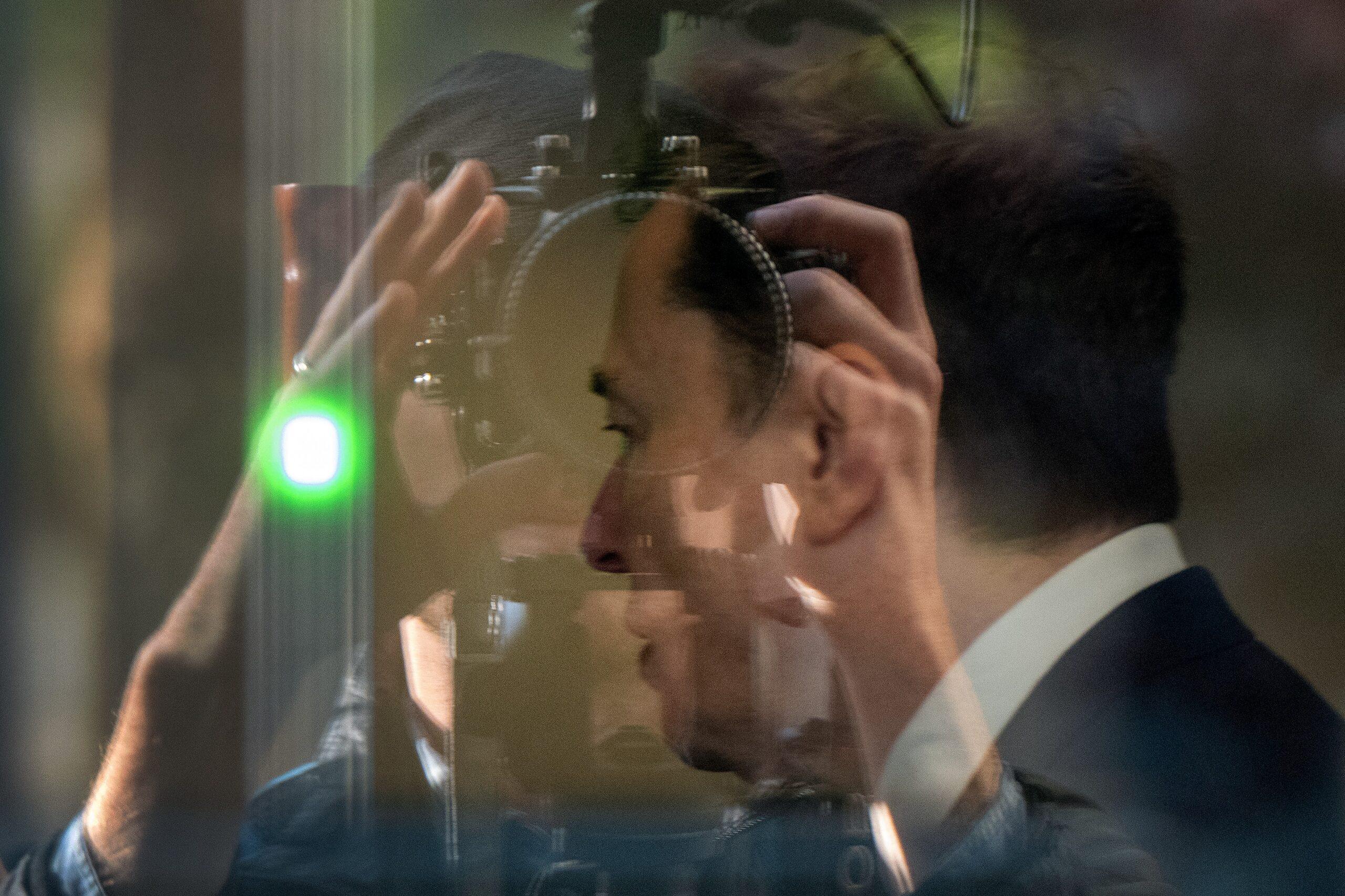
Elon Musk in the courthouse in Oakland
Picture, if you will, a museum, with a glorious, noble, and nonprofitable mission to grant the masses access to fine art in perpetuity. Maybe it has a museum store attached to it: a little for-profit operation whose income helps boost the museum’s bottom line. This is the analogy that Musk’s lawyer, Steven Molo, made in his opening remarks to the jury on Tuesday morning in an attempt to explain the two wolves living inside OpenAI.
Initially, Molo explained, OpenAI was created to be like the museum, there to deliver advances in artificial intelligence research to all of humanity like so many Picassos. But Musk contends that at some point, the leaders of the company began siphoning resources into the for-profit side of the business, seeking to better monetize OpenAI’s success. The result, Molo argued, was like if “the museum store sold the Picassos—and now they are locked where no one can see them.”
Ultimately, Molo asked the jurors to write down three questions to ask themselves day by day throughout the trial:
- Did OpenAI have a charitable mission to operate as a nonprofit and develop safe AI open-sourced for the good of humanity?
- Did Altman and Brockman violate that mission through what they’ve done with the for-profit business?
- Did Microsoft know about the charitable mission, and substantially assist Altman and Brockman in breaching it?
Following Molo with his argument was Will Savitt, representing his clients Altman, Brockman, and OpenAI. If rolling one’s eyes had a sound, it would be his introductory remarks. “We are here because Mr. Musk didn’t get his way at OpenAI,” he said. “My clients had the nerve to go on and succeed without him. Mr. Musk didn’t like that.”
Savitt coolly sought to dismantle the plaintiff’s narrative point by point, noting that Musk himself had suggested more than once that the company ought to beef up its for-profit operation, and that it wasn’t until Musk built a competing AI enterprise that he expressed any interest in bringing a lawsuit. He noted that Musk’s attempts to evade statute of limitations laws were transparent and pointless, because the defense had plenty of evidence that Musk became aware of OpenAI’s actions years earlier than he claims he did. He asked jurors to look for everything missing from Musk’s story, to ask why some dogs don’t bark.
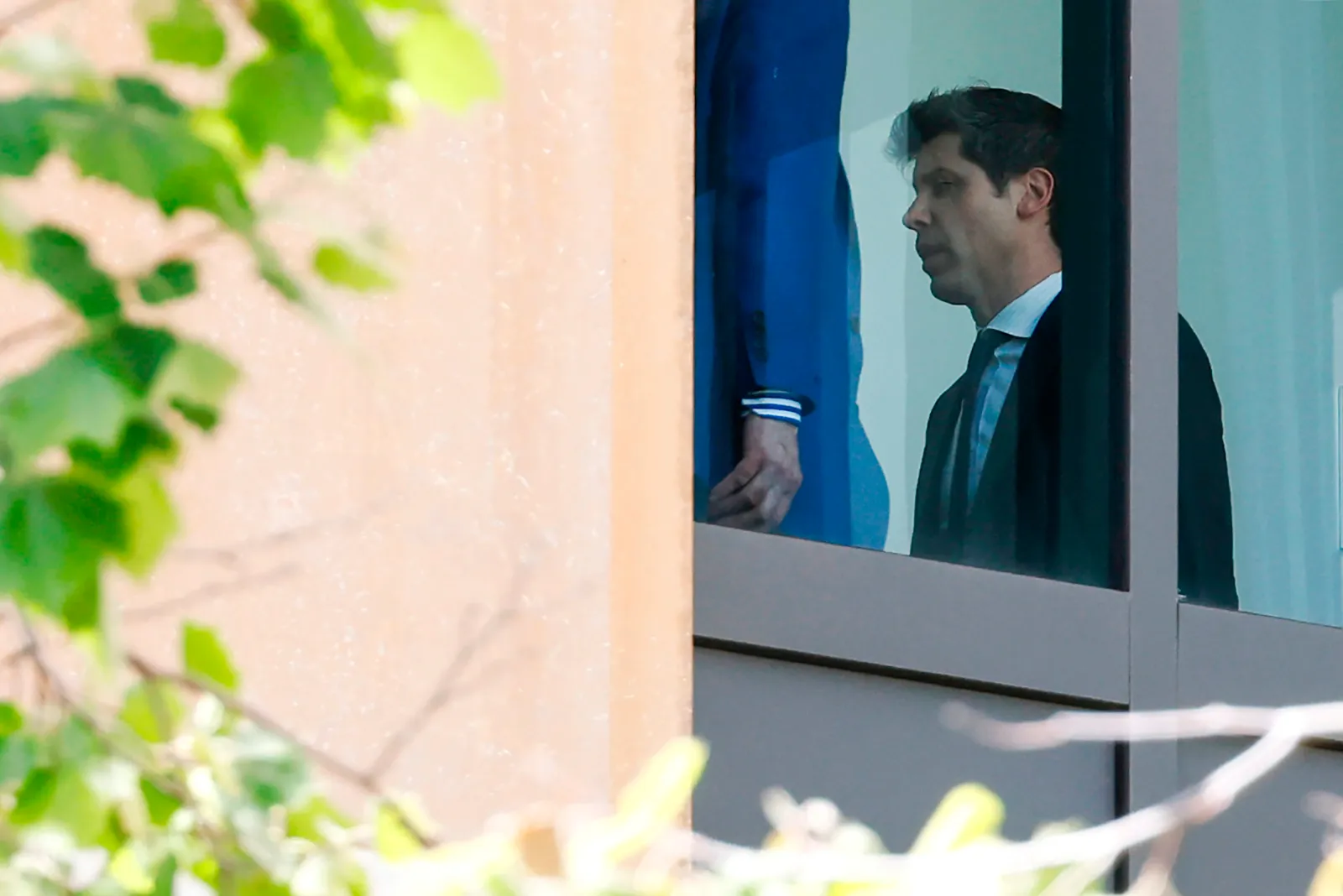
Musk was the first witness to be called to the stand in the trial on Tuesday. Earlier in the morning, before the jury was brought into the room, Gonzalez Rogers had admonished Musk and Altman for bickering on social media the day before. (Musk’s missive had included the monikers “Scam Altman” and “Greg Stockman,” the latter of which could maybe be workshopped.) On the stand, Musk angled himself toward the jury a few feet away. His demeanor ranged from subdued to disarmingly self-deprecating to kinda-mumbling to what I’d gauge as moderately animated, as assessed on a scale of his own historical levels of animation.
The start of his direct questioning was like a live reading of a Wikipedia page, with Musk and his lawyer Molo walking through his life and times. Elon was interested in technology at a very young age, it turns out. At 12, for example, he built and sold (for $500) a video game, and in college he had no need to major in computer science because he already knew the material. Born in South Africa, he moved to Canada and then the U.S., coming to the States in 1992.
That last part put him in good company among the jury of his peers. On Monday, during jury selection, my jotted notes included all the following locations referenced throughout the day: Australia, China, Eritrea, Guatemala, Hong Kong, India, Indonesia, Italy, Macau, Mexico, Pakistan, Philippines, Taiwan, Thailand, and Vietnam. Some of these were people’s countries of birth; others were the places where, they clarified, they really grew up; all were the places they’d left. Many had arrived in the U.S. in the 1980s and ’90s, like Musk.
On Tuesday, as Musk testified, I wondered how the nine selected jurors, wherever they came from, were feeling in the here and now. I wondered how clearly they followed a Musk story that I recognized as existing lore about the formative days of OpenAI. In the story, he’s at the home of Google cofounder Larry Page, talking about the awesome and fearsome potential of artificial intelligence. “I said, well, what if AI wipes out all the humans,” Musk told the jurors. “And he said, that will be fine as long as AI survives. And I said, well, that’s insane, that’s just crazy. And then he called me a species-ist for being pro-human.” In Musk’s telling, this was the moment he realized he had to ensure that Google didn’t maintain a vise grip on AI. But he told the story in such a muddled, sudden way that if I hadn’t already known it, I’m not sure I would have followed the point he was trying to make.
Much of Musk’s day one testimony came across that way to me, which was a surprise! After all, he is the person who brought this lawsuit to life, and taking the stand to chat back-and-forth with his lawyer represented a major opportunity to define the narrative. So I expected he’d be charismatic and confident, not sorta quiet and occasionally at a loss for words!
Several times he trailed off and ended an answer with an “uhhhh … yeah.” (Relatable!) He told the same anodyne anecdote—that he talked so much about AI that his brother banned him from bringing it up at parties!—twice, for some reason. Sometimes it almost seemed like Musk and his lawyer were meeting each other for the first time. The most memorable things he said involved: (a) his former employment as a lumberjack, (b) his awkward attempt to define who Shivon Zilis is—“uhhhh, my chief of staff, and uhhh … yeah,” he told the jury, the yeah apparently shorthand for “mother of four of my children”—and (c) his prediction that superintelligence could be achieved as soon as “next year.”
This all probably makes Musk’s performance sound worse than it was—to be clear, he was fine—but I don’t know if fine wins his case. (Particularly after Monday’s jury selection, in which person after person self-reported that they were not fans of his.) It all felt jumbled to me, like a missed opportunity. On Wednesday, though, Musk will have more time to tighten things up.
Protesters hold cutouts of Elon Musk
Other stray observations from the first couple of days in Oakland:
- Microsoft is unc! Something about Microsoft’s entire involvement in this case has already become very funny to me. The staid big tech co.’s keep-me-out-of-this approach makes it a perfect sitcom-grade straight man next to Musk v. Altman’s huffier, messier, more personal animus. Microsoft is a guy in a suit sitting poolside on a business trip, taking a conference call via Bluetooth headset—and getting drenched by two bros doing a can-opener contest nearby. Every time Microsoft’s lawyers speak—and I say this with great reverence for these kings and queens of white-collar litigation!—what I hear is some combination of (1) the adult-talking voice in Peanuts, (2) the song “Start Me Up,” and (3) the Adler remark in Industry that “the institution doesn’t suffer.” It’s a beautiful thing.
The slide deck that Team Microsoft presented to the jury on Tuesday, for example, was typeset entirely in the Microsoft Font and included a timeline of innovation that featured the Office 95™ logo. Were there arrows with gradient fill? Heck, yeah. Was there a slide with a flywheel on it? You bet your sweet office athleisure there was. (Labels on that particular page included “Massive cloud computing infrastructure” and “Rights to commercialize OpenAI tech.”) (Here’s what jury service taught me about B2B sales!)
During jury selection on Monday, the judge questioned a number of prospective jurors about their day jobs, asking some if they ever worked in teams. One woman responded: “The application?” The judge chuckled: “Microsoft is happy that you said that.” And on Tuesday, when Musk’s lawyer kept having his mic go out during his opening remarks and the judge joked about how this is what happens when you’re reliant on federal government funding, someone in the room piped up: “Is this a Microsoft product?” Just some good clean fun there in Courtroom 1. - Slide deck that most resembled a meme: Musk’s team’s presentation included one page that looked like a YouTube thumbnail and another that had the exact aesthetics of the galaxy brain meme. (It depicted a brain made out of wires in the middle of a server farm and said, by way of explanation: “ARTIFICIAL INTELLIGENCE.”)
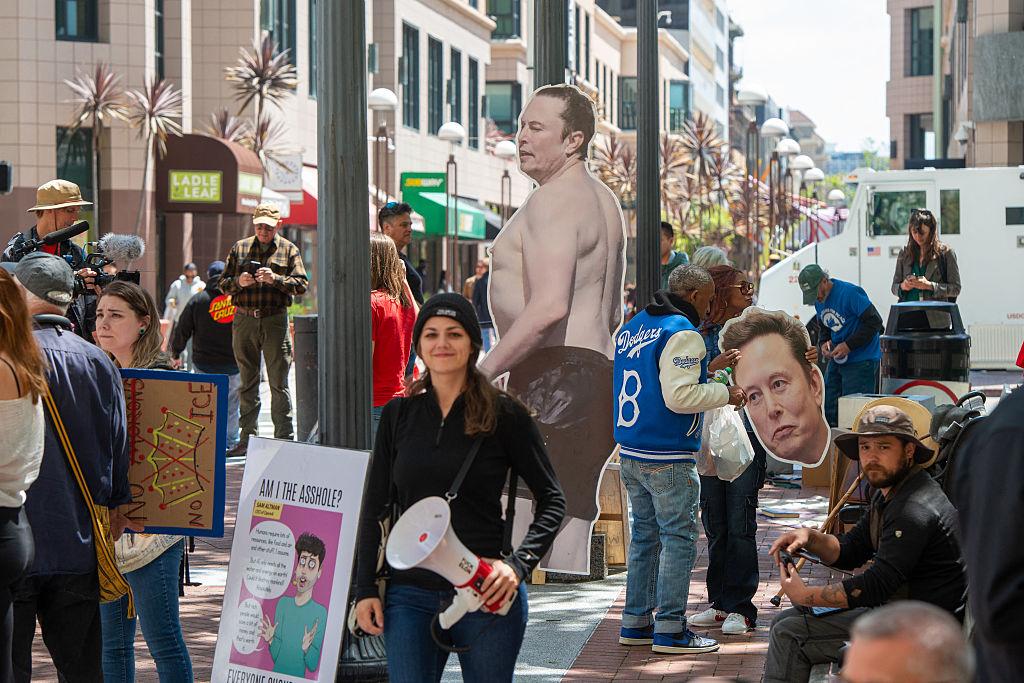
- The scene outside: Typically, people demonstrating outside a courthouse during a trial support one side or the other. In this case, though—as one of the pleasant people holding signs saying things like NO AI OVER PEOPLE told me Monday—the demonstrators hoped that there would be no winners.
“StopAI, QuitGPT, TeslaTakedown …” the protestor rattled off, noting the names of a loose consortium of like-minded organizations assembling near the courthouse to make their opinions heard. A few feet away, some of the TeslaTakedown folks held up signs featuring ghoulish images of Altman and Musk asking “Am I the Asshole?” and answering “Everyone Sucks Here.”
- Favorite prospective juror who did not make the cut: The gal who fretted about what would happen to her scientific research if she had to serve on the jury for multiple weeks, but looked on the bright side: “The organisms wouldn’t die,” she admitted. “I’d be able to go in and feed them.”
- Favorite prospective juror who did make the cut: The man who said he’d worked in “classified product development.” When the judge asked him what that meant, he replied: “It means I can’t tell you what I worked on.” (It will shock you to know that Lockheed Martin and Northrop Grumman were involved.)
Musk will be back on the stand Wednesday for the remainder of his direct testimony, followed by a cross-examination that the opposing counsel estimated should take two to three hours. Altman and Brockman had been present in the courtroom on Monday and Tuesday morning, but Altman bounced right before Musk took the stand—leading to a mildly awkward moment when Musk’s lawyer asked him whether he saw Altman sitting in the courtroom (expecting that his client would get to dramatically point at the man he’s suing) and a squinting Musk had to answer that no, he didn’t. (Brockman did stick around, scribbling in a mini yellow pad of paper during Musk’s testimony.)
Regardless, Jared Birchall, Musk’s close personal operative, is expected to follow Musk on the witness stand either Wednesday or Thursday. Birchall is a guy who wears many hats—fixer, comptroller, Neuralink CEO—but overall, he’s the head of Musk’s family office. (I was sad that its name, Excession LLC, wasn’t said aloud in court, but there’s still time!) Musk said Tuesday that back when he was sending quarterly payments to OpenAI, it was Birchall whom he tasked with transferring the funds every quarter.
If there was one clear through line that emerged in Musk’s Tuesday testimony, it was his enthusiasm for ambitious projects with moon shot—Mars shot?—goals. He used phrases like “multiplanetary civilization” and “solve traffic”; he enthused about all the good things that artificial intelligence can be used for, all the ways it could help make life more convenient.
“If you ask AI to analyze this court case, for example,” he told the members of the jury, “it will give really good analysis.” He paused for a moment, then added: “You need to be careful it doesn’t hallucinate.” The man was under oath, after all.