

There is a divine symmetry at the core of this matchup between the Denver Nuggets and Minnesota Timberwolves, which has surely become the NBA’s most compelling rivalry of the decade. Fitting, given that they share a common architect, Tim Connelly, who left his front office post in Denver in 2022 to retool the Minnesota franchise, now as well equipped to dismantle his former team as any in the league. Perhaps that’s why the two teams fit like jigsaw pieces. After splitting the first two games of their first-round series, the teams are now 15-15 against each other since the start of the 2022-23 season. Patterns emerge in every best-of-seven series, but this is the only matchup this postseason that presents as a fractal.
The symmetry of the series has been so precise that time has basically collapsed on itself. The first two games have each yielded a tie at halftime. On Monday night, Game 2 saw Denver sprint out to a commanding 39-25 lead in the first quarter, only to be neutralized, with Minnesota leveling things out by outscoring the Nuggets 39-25 in the second. Jamal Murray tied the game at halftime last night with a 3-point heave at the buzzer, just as he did in 2024. Two years ago, the Wolves posted a statement win against the Nuggets in Game 2, reaching defensive nirvana for one night in the absence of anchor Rudy Gobert; on Monday, the Wolves posted a statement win against the Nuggets in Game 2, featuring a fourth-quarter defensive master class against arguably the greatest pick-and-roll duo of all time—this time, with Gobert as the essential catalyst. “How he guarded Jokic at the end was super inspiring to the team,” Wolves forward Julius Randle said of Gobert’s defensive effort in the fourth. “Him getting stop after stop at the end of the game, it was huge for us.”
Jokic and Murray combined for just four points on 2-of-12 shooting in the final frame of the 119-114 loss. Their shots went flat, clanking off the front rim. Gobert was the perfect foil for Jokic down low; Jaden McDaniels stalked along the court as Murray’s constant shadow. Jokic has long been the ironic vision of peak male performance. His ability to shoulder a heavy burden under heavy minutes had always seemed like a superpower hidden by his doughy exterior, the ever-present scratch marks on his arms, and his heaving breaths. But on Monday—despite his dramatically streamlined physique, sudden and explosive enough to blow by Gobert for a driving dunk late in the fourth—Jokic didn’t just look exhausted, like he normally does. For once, his performance reflected it, too.

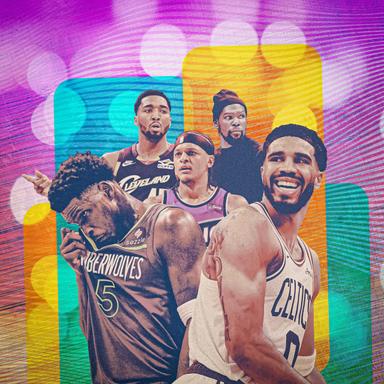
Everyone’s playing through something in the playoffs, as the old adage goes. A major factor in the Wolves’ Game 2 resilience was how Anthony Edwards set the tone from the jump. Less than three minutes into the game, Edwards’s legs splayed awkwardly on a crossover as he tried to protect the ball from Jokic after gathering a rebound. He gave up the ball as soon as he approached half court, winced, and put his hands on his knees. It looked bad. And then he was just back to being Ant, exploding downhill on drives, catapulting himself to make the weakside denial, planting his feet harder and more violently than anyone with knee soreness should ever dare to. Edwards has been dealing with runner’s knee, a painful bit of inflammation around the knee joint that sidelined him for 11 of the Wolves’ final 14 games of the regular season. It’s clearly affecting him. It’s also … not?
“That shit’s ass,” Ant would say in critique of his inefficient Game 2 performance—30 points on 10-of-25 shooting, 10 rebounds, a steal, and two blocks in 40 minutes—but it was exactly the gritty, maxed-out performance that the team needed as an example. He didn’t always have his legs underneath him on his jumpers, but whenever he needed to put his body on the line, he did.
Part of the allure of Edwards’s game is how quickly he can shrug off just about any impediment: shooting slumps, two decades of franchise futility, postgame propriety. Most 20-somethings go through life with an unfounded sense of invincibility built largely on ignorance and a lack of experience. Edwards pushes that energy to the nth degree, forging a secondary superpower that girds his actual superpowers of strength, speed, and flight. Elite athletes in their youth appear capable of extreme compartmentalization of pain and discomfort in the pursuit of something more immediately gratifying, not unlike a toddler’s lack of temperature sensitivity on a snow day. “It’s been like a month and a half since I played basketball,” Edwards said after Game 2, when asked how his body was holding up. “I missed it. That’s the most fun I have my entire life, so just being out there, I’m enjoying every moment, no matter how it feels.”
Ant, in all his charisma, seizes the moment in a way that almost erases the past and blacks out the future. But while the rest of the Wolves march to the beat of Edwards’s drum, history isn’t so easily disregarded by the rest of the rotation. Familiarity, including in the NBA, breeds contempt. That’s the only way to frame the shit talk coming from the Wolves locker room after the game. McDaniels was asked about what fueled the team’s offense in Game 2. “Go at Jokic, Jamal, all the bad defenders,” McDaniels said after the game. “Tim Hardaway, Cam Johnson, Aaron Gordon—their whole team. They’re all bad defenders.”
McDaniels’s words will inevitably become whiteboard fodder in the coming days, but he wasn’t wrong in his general assessment. The Nuggets had their worst defensive rating of the Jokic era during the regular season, and it’s bled into the early stages of the postseason. The Wolves reasserted themselves in this series by dictating the Nuggets’ options in defending the two-man game, forcing Jokic to flip his hips as one of the Wolves’ rangy athletes turned the corner and blazed toward the rim. Paint touches led to shot attempts at the rim and possessions when the ball swung around the horn to the open man. The Nuggets’ ultimate home-court advantage, altitude, looked more like a curse in Game 2. If even two more possessions had gone Denver’s way down the stretch, the series could’ve been heading to Minneapolis with the Nuggets up 2-0. In another timeline, perhaps that’d be the case. But the competitive compatibility of these two teams can make it feel like this would be the ultimate first-round matchup in every timeline.
Monday night did feature a shocking come-from-behind upset, but it happened in Madison Square Garden’s panopticon, not at Ball Arena. After the Wolves pulled off the biggest Game 7 comeback victory in NBA history against the Nuggets two years ago, there’s not much left that these two teams can do to truly shock us. The Nuggets and Wolves have trained us to expect massive swings of momentum and a sort of tension that manifests beyond a close score. Wins can be lopsided, losses can be narrow, but the puzzle of this matchup is endlessly generative. Each game is a variation of a theme, one way or another becoming the kind of showcase of postseason basketball that reminds you why you love this sport in the first place. The immortal hand or eye of the basketball gods has framed this fearful symmetry. The best-of-seven limitation might be the only thing keeping this fated series from stretching into infinity.