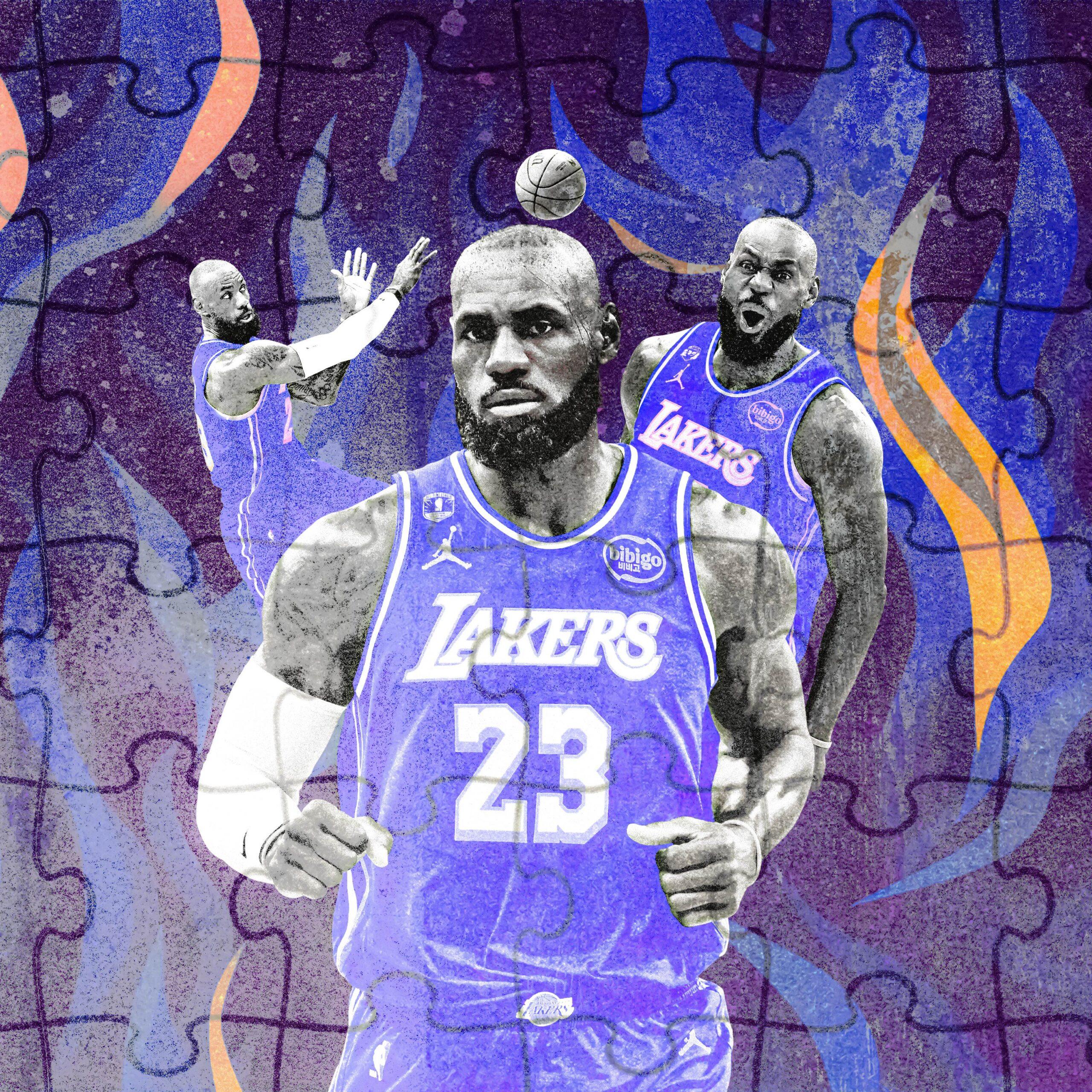

LeBron James’s 23rd NBA season has been a transient wave of discomfort, mastery, pessimism, and hope. From a basketball perspective, it’s been nearly impossible to analyze, let alone process. Here we have a 41-year-old tank with no historical parallel. But at the same time, up until the past few weeks, when the Los Angeles Lakers started their nine-game win streak and eliminated any chance of falling into the play-in, LeBron’s swan song has felt more trivial than I ever could have imagined; his innate ability to draw attention was on display for a bunch of stuff that had little to do with basketball.
To explain, let’s start with this season’s most significant underlying tension: James is averaging 21.4 points, 6.8 assists, and 5.6 rebounds per game for an organization that can’t wait for him to leave. Since February 2, 2025, the Lakers have belonged to Luka Doncic, a prodigious top-five talent who’s been surface-of-the-sun hot this month, averaging 37.1 points, 8.5 rebounds, 7.5 assists, and 2.3 steals per game in March, with a 62.8 true shooting percentage.
Every personnel decision the franchise makes has to be with Luka’s best interests in mind. Since we’re talking about the NBA’s all-time usage leader—currently boasting the highest usage rate of his career—that means surrounding him with rangy defenders who don’t need the ball and can finish the open looks that he creates. James is many things, but there are dozens of more athletic and affordable options who can do what’s described above better than he can. (Before the All-Star break, LeBron was making only 30.5 percent of his 3s.)
He’s also never been scolded for trying to fit out. The unfamiliarity of seeing LeBron conform to his environment instead of shaping it himself made it a little too easy to dismiss that his selfless approach and all-encompassing skill set were tailor-made to be the perfect right-hand man. What’s the correct basketball play? LeBron will happily make it.
Still, as the NBA’s all-time leader in points and games played, this is someone who’s spent nearly a quarter century as the fulcrum of his team’s offensive strategy. Now, as he adapts to a jarring functional modification as the Lakers’ third option, LeBron’s time is typically spent standing in the corner, reacting to how defenses react to Doncic. For a vast majority of this season—from his early bout with sciatica to an overly sentimental All-Star selection—James has not looked particularly comfortable on the periphery; he’s off the ball more than ever, and, for the first time, his team’s offense has been better without him. His defense is (understandably!) spotty, as he's spent over half his life playing professional basketball. For every chase-down block, there are several closeouts wherein his body is unable to stop when his brain tells it to:
Hovering over it all is LeBron’s on-court relationship with Doncic, which, for months, could politely be described as a work in progress. The two are brilliant, hyper-skilled, and physically imposing. They’re also below-average defenders who have occasionally been in conflict with each other on offense. Lineups that feature both have been underwhelming, fueling constant speculation about where James will be next year. Will he go back to the Cleveland Cavaliers? Will he join forces with Steph Curry on the Golden State Warriors? Will he ring chase on a mystery team (like San Antonio)? Will he retire and rekindle his interest in owning an expansion franchise?
These questions shouldn’t be dismissed, but they also don’t deserve to take precedence over all the ways James has (quietly?) elevated his team in a much smaller role than we’re accustomed to seeing. The Lakers, suddenly, are very good. As someone who wrote them off just a month ago—I saw a flawed, old, inelegantly constructed team that didn’t care much for defense and would exit the postseason quickly, if it made it at all—I’ve been thinking more and more about James’s impact on a team that’s won 11 of its past 12 games, sits in third place, and suddenly looks dangerous enough to reach the NBA Finals.
Last Wednesday against the Houston Rockets, LeBron was a revelation. He scored 30 points and missed only one shot. The 13 he made were largely an eye-popping accumulation of alley-oops, runaway-train finishes, and putback dunks, and his productivity was largely a by-product of all the ways Doncic torched Houston’s defense. The four-time MVP’s force and athleticism were distinguishable enough to make you wonder exactly where his apex can be a month from now, right as the Lakers set forth on a playoff run.

More on the NBA
But an even more pleasant surprise was how comfortable he looked beside L.A.’s new franchise player, someone who (deservedly) sucks up all the oxygen in a room. This might’ve been the first time in LeBron’s entire life when he started a season with someone else as the best player on his team. It took time for him to find a role that accentuated Doncic (and Austin Reaves), ultimately realizing that less of him would be more for the Lakers. (This month, 71.4 percent of LeBron’s baskets have been assisted. Heading into March, that number was 51.7!)
To quickly zoom out for a moment, let’s take stock of LeBron’s sacrifice. He’s attempted 15 or fewer shots in nine straight games, which is the longest streak of his 23-year career. A short list of players averaging more shots since March 1: Maxime Raynaud, GG Jackson, and Saddiq Bey. Two years ago, James ran 19.5 pick-and-rolls per game as a ball handler. This year, he’s down to 9.4.
According to Bball-Index, compared with last season, only five players have seen a larger drop in touches per game in 2025-26. Only 10 players have seen a larger drop in true usage percentage. Only Scottie Barnes and Zach LaVine have seen a larger drop in their on-ball action share. But, especially lately, all of LeBron’s willingness to relinquish direct influence over the game has not been in vain.
James is still finishing at the rim as well as he ever has and making 59.0 percent of his 2-point shots—which is above both his career average and three of his four MVP seasons. He still has that old-man baseline turnaround, impeccable touch in the paint, and a first step that’s threatening enough to make opposing bigs give him a cushion. Notably, 64 percent of his shots at the cup have been assisted, which is by far the most of his career (six years ago, that share was just 29 percent).
And despite a tangible decline in James’s physical quickness, his brain still operates at warp speed. The court mapping is genius, and his vision is pitch-perfect. According to Bball-Index, LeBron ranks first in passing versatility, which estimates the range of playmaking reads a player can make. Yes, one of the best passers in NBA history can still throw every pass imaginable, on time and on target—lobs, pocket passes, corner skips out of a pick-and-roll, no-look dimes from the post, touch passes in the paint. James can get into the guts of a zone and infect it from the inside out. He can grab a defensive rebound, start a fast break, and find an open 3-point shooter in transition. He can catch it on a short roll and then download the defensive rotation before it happens.
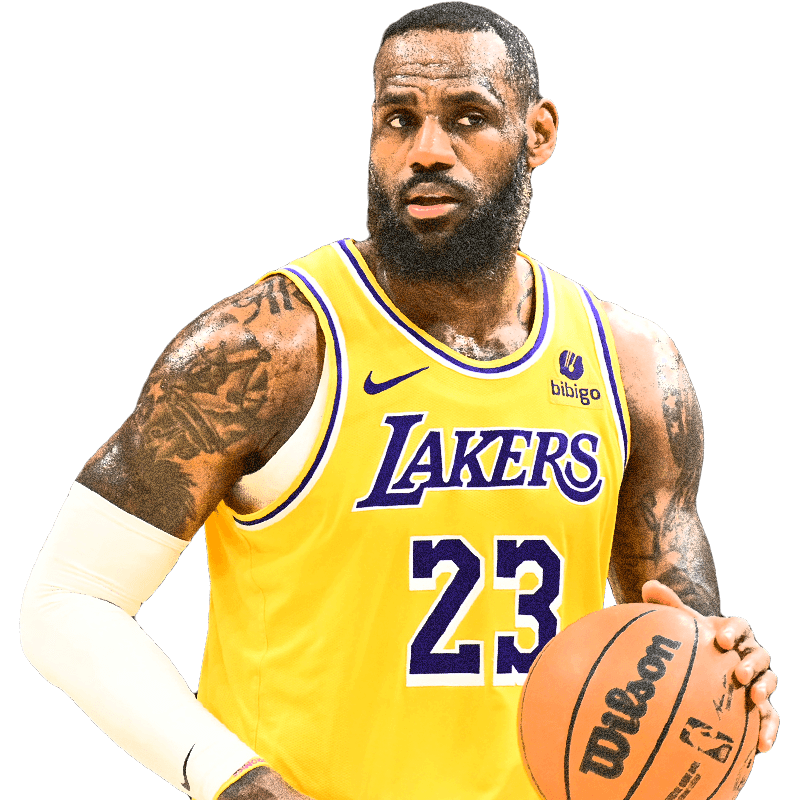
For all the talk of his role being reduced, James is generating about the same number of points per game as Anthony Edwards and still racking up triple-doubles (as he did on the second night of a back-to-back in Miami on Friday night). His defense on and off the ball reminds no one of Kawhi Leonard, but his demise is overstated. He’s still an immovable slab of iron when he needs to be, and the Lakers are about average (which is a major win!) on that end when James is on the court.
On offense, his drives are still thunderclaps that make defenders question just how much pain they’re willing to endure on the off chance a referee sides with them over someone who spends fewer minutes in foul trouble than any rotation player in the league. To boot, he’s averaging 1.26 points per chance attacking the paint off a closeout, which is 10th best in the league:
And it’s not like the two operate in completely separate silos when he shares the court with Luka. They might not be Stockton and Malone, but their chemistry sparkles in transition, where James averages a league-best 5.8 fast-break points per game. It’s an elite quarterback gift wrapping a touchdown to his uncoverable tight end in the back corner of the end zone over and over and over again:
Some of this will get neutralized by more focused defenses in the playoffs, but it’ll still be good for a basket or two per game, critical easy points that can turn a close loss into a tight win. And in the half court, L.A. will also squeeze everything it can from one of JJ Redick’s pet plays, a screen-the-screener action that directly involves his three best players. Since the All-Star break, the Lakers’ net rating when Luka, LeBron, and Reaves share the floor is plus-14.3. This growing synergy is one reason:
LeBron’s evolution into someone who’s overlooked but still highly effective is surreal and, ultimately, the best-case scenario for a fleeting roster that had more than one chance to mail its season in. The question was never about his production. It centered on whether he could channel his remaining talent to thrive in a supporting role.
In one sense, this has never happened before: a 22-time All-Star who now exists somewhere between a pale imitation of his former self and one of the most complete players in the league. These are uncharted waters for LeBron and for us. What recently looked like a lost, entirely forgettable season now has real stakes because one of the greatest players ever was modest enough to take a back seat. There was zero guarantee he would be willing or able to do it. But, for approximately the 900th time in his career, doubting James turned out to be the wrong call.