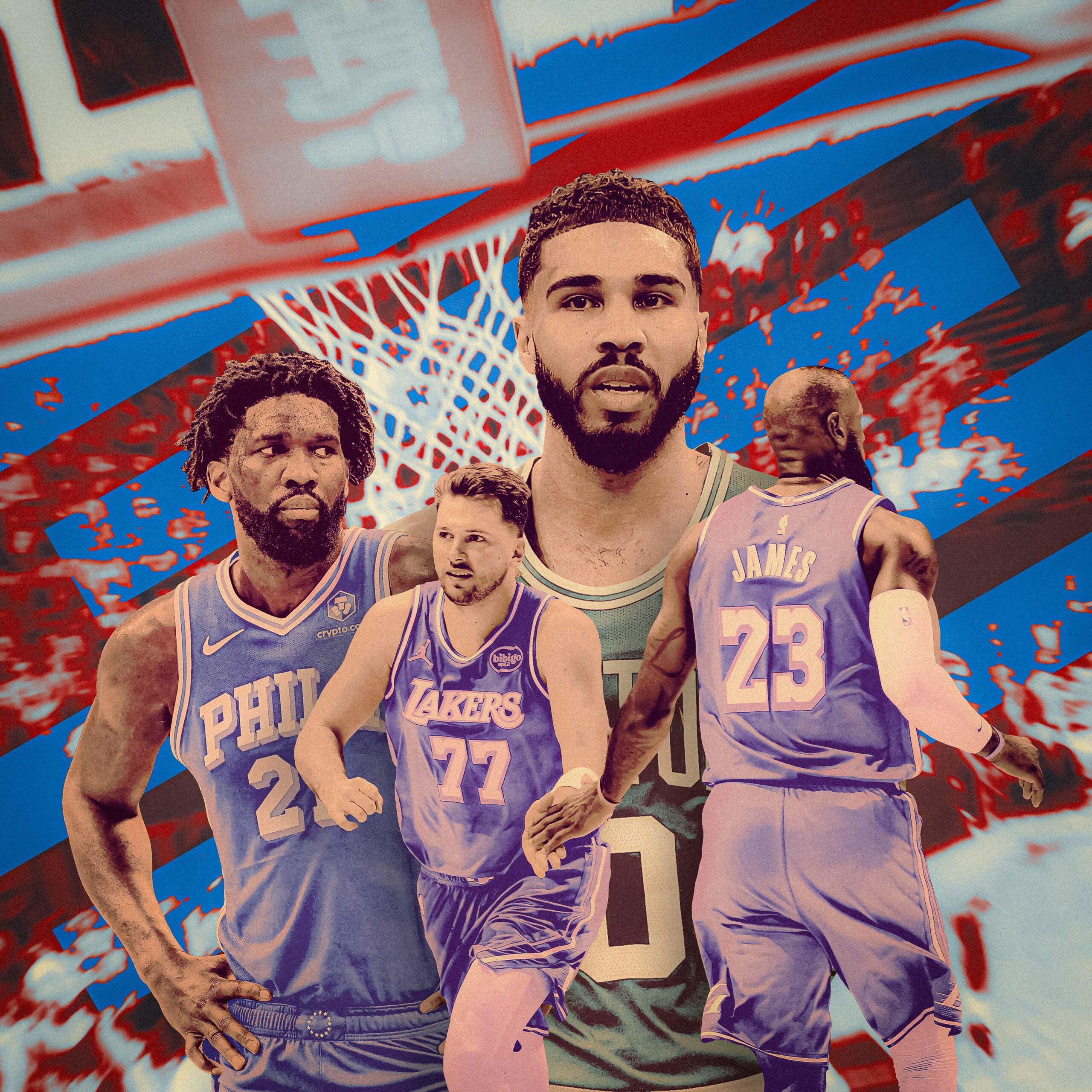

Now that a surprisingly competitive All-Star Game is officially in the rearview mirror, it’s time to preview the homestretch of a regular season that’s still loaded with so many questions. Here’s a look at six questions that I find either meaningful or fascinating and that will dominate the discourse over the next two months.
Can Joel Embiid be trusted?
A few weeks ago, I was pretty confident in the Philadelphia 76ers’ ability to make their longest playoff run since 2001. Then two discouraging things happened. The first was Paul George’s 25-game suspension for violating the NBA’s drug policy. The second was Daryl Morey’s decision to trade away a player who could conceivably contribute in the playoffs just so that the Sixers could duck the tax and add a draft pick. There are several takeaways from that latter development, but the main one is evident. Despite his impressive play this season, Philadelphia clearly doesn’t believe that Joel Embiid can hold up physically over the next couple of months.
My colleague Zach Lowe has repeatedly stated that Philly’s personnel decisions must be based on 25-year-old Tyrese Maxey’s timeline. I could not agree more; most optimism about the 76ers’ short-term prospects comes from the fact that Embiid is no longer their best player.
But while the East is a bit more respectable than people give it credit for, there’s no obvious favorite that’s expected to make the Finals. This is where skepticism on whether Embiid can stay upright collides with the truly remarkable performances he’s had in the new year.
In 17 games, Embiid has averaged 29.9 points, 8.1 rebounds, and 4.5 assists in 34.2 minutes. His true shooting is a razor-sharp 66.4 percent. The Sixers are plus-9.0 points per 100 possessions with Embiid on the court and minus-8.4 points per 100 possessions when he sits, incredible on/off splits that reflect his value and dominance. For the season, Philadelphia’s offensive rating is 8.1 points per 100 possessions above the league average when he shares the floor with Maxey. The only duos who’ve contributed to a more efficient attack play for the Nuggets, Hornets, Thunder, and Knicks. This sounds like a bona fide title contender!
But then, right on cue, “right knee management” kept Embiid out of Philadelphia's last two games before the All-Star break. That uncertainty will always be a grand piano dangling over the franchise’s head. And at this point, it’s unrealistic to think otherwise. Gaudy statistics notwithstanding, Embiid’s physical limitations have never been more noticeable, particularly when his slow play paralyzes what could be a more dynamic basketball team.
The Sixers don’t rebound well with Embiid on the floor. They allow a crap ton of shots at the rim, and their transition defense gets absolutely pummeled. I’d be exaggerating if I called Embiid a weak link on defense, but there are definitely times when it’s fair to call him a squeaky wheel. One example: Philadelphia strains to prevent him from directly engaging with certain matchups whenever it can—even if it’s a simple ask, like in the play seen below.
As you saw in the play above, in an effort to keep Embiid near the paint, Maxey switched onto Ivica Zubac as he came up to set a ball screen for Kawhi Leonard. The Sixers switch that (putting Maxey on Zubac), and then Embiid scram switches back onto Zubac to avoid an obvious mismatch versus Leonard. This is taxing stuff, but the reality is that it’s also necessary: The alternative is to have Embiid drop back to the free throw line as one of the best shooters alive gets a clean look—exactly what happened a few plays later.
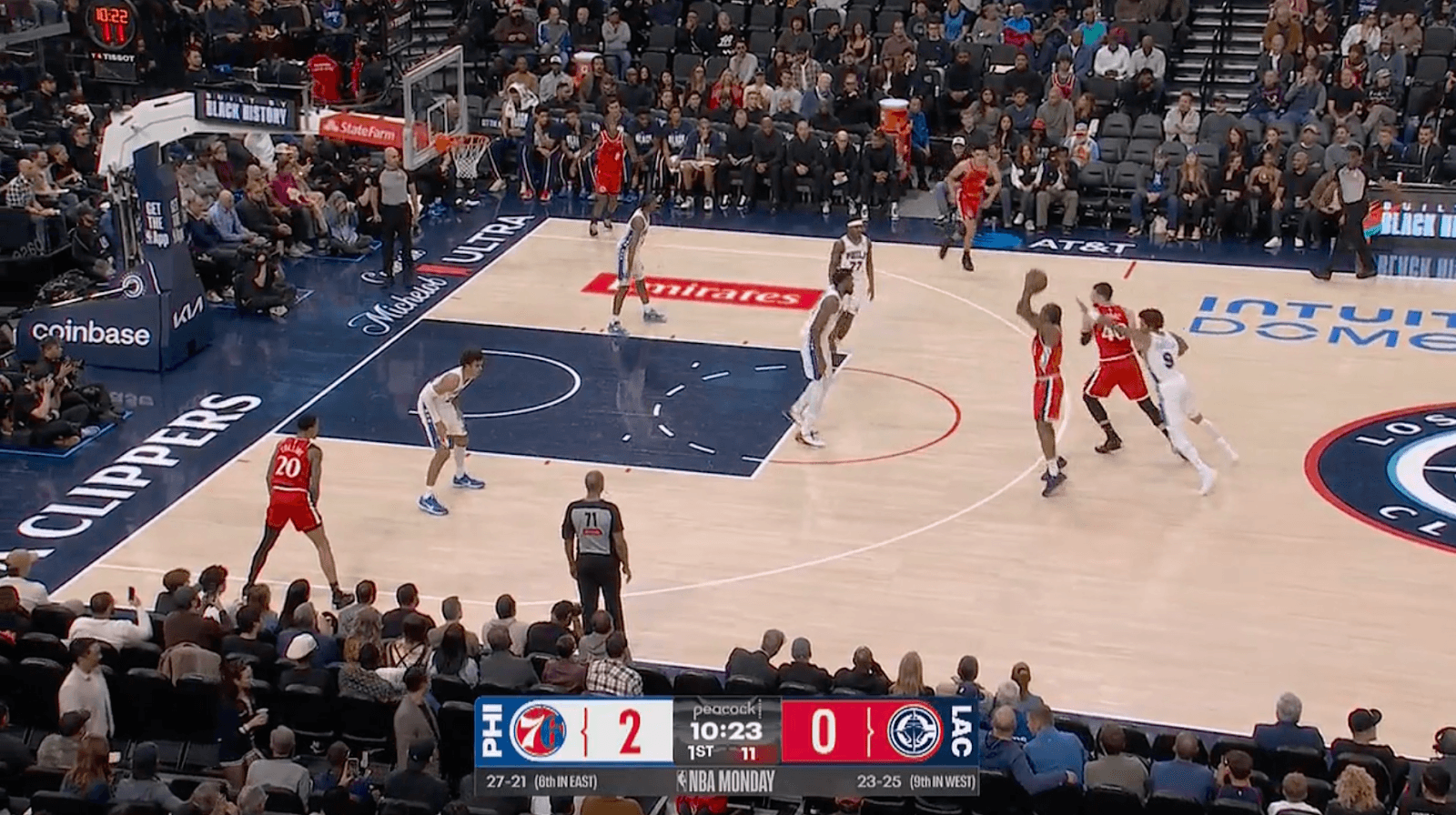
According to Sportradar, Embiid has guarded 637 pick-and-rolls as the screener’s defender this season. He ranks in the 91st percentile for possessions when he’s in a drop and in the 24th percentile in points allowed per chance. This isn’t good. If Embiid is healthy enough to play in the postseason, the Sixers must do whatever they can to hide him on defense, and opponents will do whatever they can to exploit him.
Now, the Sixers are obviously better with Embiid than without him. And if the version of him that casually obliterated the Los Angeles Lakers a couple of weeks ago can be replicated a dozen times three months from now, the Eastern Conference may be flipped on its head. I wouldn’t bet on it, but crazier things have happened. [Gestures to every time the Sixers have shot themselves in the foot since Embiid was drafted.]


Will the Lakers avoid the play-in tournament?
The Los Angeles Lakers might be the most perplexing 33-21 team in NBA history. What’s their ceiling? What’s their floor? When Luka Doncic is healthy, anything feels possible. He leads the league in scoring and is posting the highest usage rate of his career while living at the free throw line and manipulating defenders like a puppet master. In his first full season as a Laker, he ranks seventh in estimated plus-minus and is shooting 99.9 percent at the rim. I don’t care what his playing weight is. He could weigh 300 pounds, and there would still be no reason to doubt Doncic in the playoffs. In crunch time this season, the Lakers are 15-3 and have the NBA’s most efficient offense.
At the same time, the Lakers are outscoring opponents by only 0.9 points per 100 possessions when Doncic is on the court on the season. That’s … concerning! When you zoom out and look at pretty much every other aspect of the Lakers, their success feels like fool’s gold. By a significant margin, Los Angeles leads the league in a stat called win differential, which compares every team’s actual record with what its net rating suggests it should be. In other words, it’s a fraud detector. L.A.’s plus-6.4 win differential doubles up the second-place Orlando Magic, making it reasonable to deduce that the Lakers might be imposters hiding in plain sight.
Measure JJ Redick’s blood pressure at halftime, and you’ll probably understand why. Too often this season, the Lakers have displayed either questionable effort or poor execution. It’s hard to win when both qualities are absent. Complicating matters: L.A. is somehow better when LeBron James and Doncic are both out of the game than when they share the floor.
And not to bury the lede, but Los Angeles ranks 23rd in defensive rating and is a bad week away from falling into the play-in tournament (the Lakers are fifth in the West but only 1.5 games up on the seventh-place Suns). Their work at the trade deadline was effectively meaningless (and cost them a second-round pick). Gabe Vincent is one of the least effective players in the NBA, but swapping him for Luke Kennard does very little to solve any of L.A.’s most debilitating problems. Lakers brass would beg to disagree. “Clearly, right now, he’s the game’s best shooter,” Lakers president Rob Pelinka said last Saturday. “When you get to add the best shooter in the game to your group at the deadline, it’s a great opportunity. So, we seized it.”
I’m not sure what Pelinka is supposed to say after making a trade that doesn’t move the needle, shore up the frontcourt, or help the Lakers build a contender around Doncic, but it probably shouldn’t be that. Add it to the book of ridiculousness that will be laughed at after the Lakers eventually get serious and redo their front office. (Seeing Deandre Ayton and Jaxson Hayes on the Lakers roster should make Pelinka sob, especially when someone reminds him that Mark Williams exists.)
As great as Doncic is, this is a one-dimensional, top-loaded, transitory team that, barring a few injury-related breaks and some magical offensive performances, will likely make a swift exit from the playoffs. Doncic is the only player on this roster who knows, for sure, that he’ll still be wearing the same jersey next season; the $56 million worth of cap space that the team can open up this summer is more relevant than whatever the Lakers are able to accomplish over the next couple of months. Whether they fall into the play-in or not, a first-round series against the Thunder, Spurs, Nuggets, Rockets, or Timberwolves will confirm what L.A.’s record can’t: This is a painfully average basketball team.
What will Jayson Tatum’s comeback look like?
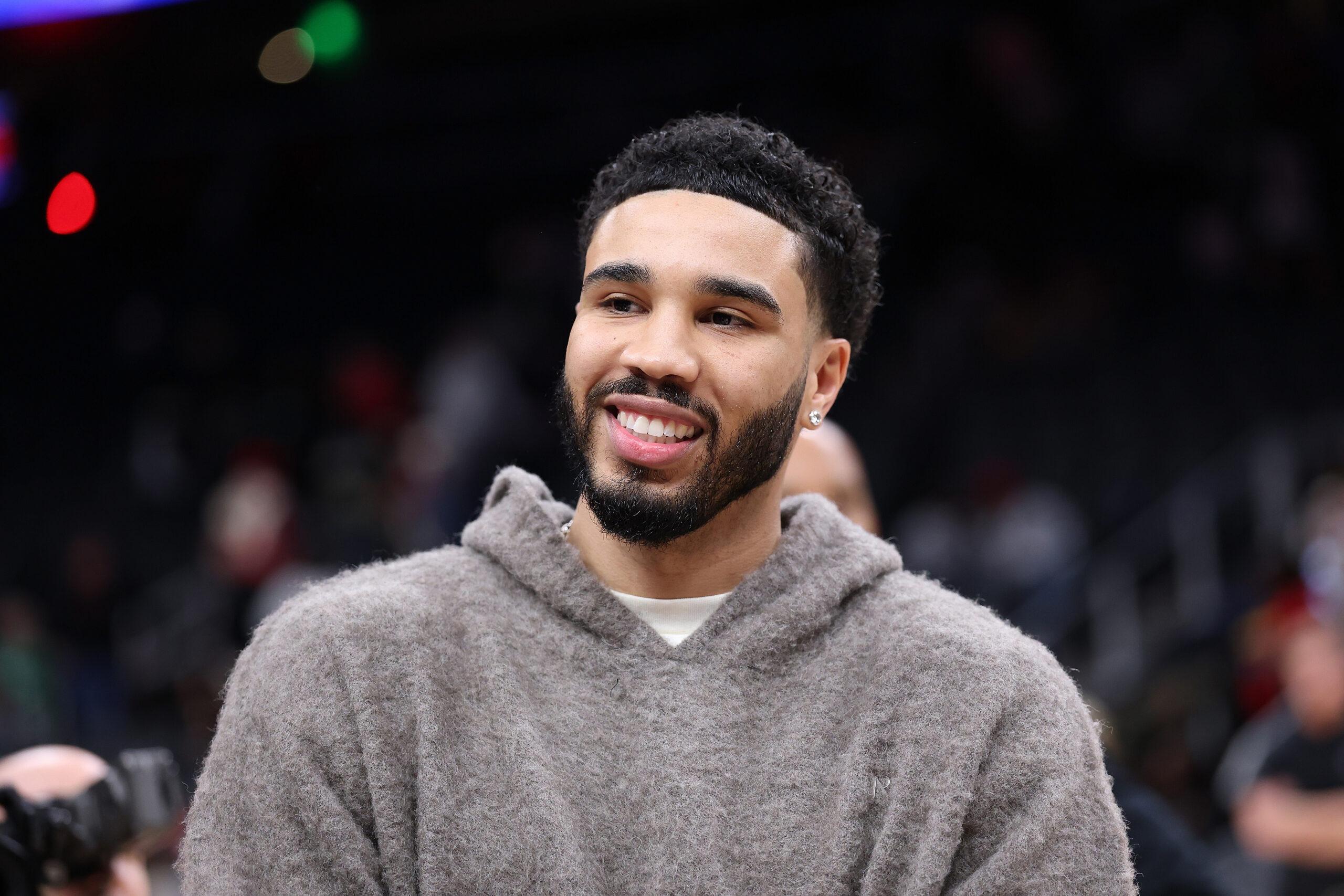
Jayson Tatum has stayed coy when talking publicly about possibly returning to the Boston Celtics this season. But pretty much all of his actions—lengthy workouts in front of the media, controlled five-on-five scrimmages with coaches, practice time with the organization’s G League affiliate—indicate he’s doing everything in his power to come back sooner rather than later.
Meanwhile, the Celtics have been surprisingly awesome without him. Boston is in second place in the East. Jaylen Brown is going to make an All-NBA team, Derrick White is going to make an All-Defensive team, Joe Mazzulla may win Coach of the Year. They rank third in net rating, with the second-best offense in the league and a defense that’s finally crept into the top 10.
Boston traded Anfernee Simons for Nikola Vucevic at the deadline and recently shifted Payton Pritchard back into a sixth man role. These decisions probably aren’t a coincidence. Let’s assume Tatum makes his debut on March 1 in a home game against the Philadelphia 76ers. That gives him about six weeks to get reacclimated before the playoffs. What he’ll look like is anyone’s guess. But what’s more interesting is how he’ll eventually fit into a clearly defined, undeniably potent ecosystem.
Tatum’s superpower is his adaptability. He accentuates everyone around him and knows how to let them provide support. He’ll guard whoever, take whatever shots are necessary. He’ll isolate, post up, move off the ball, function in a pick-and-roll as the ball handler or screener. He’ll box out, protect the paint, and ooze his talent into every nook and cranny that Boston needs filled. Tatum’s role has always been as large as it is broad, something no other superstar in the NBA can say. In that vein, he’s probably the only perennial first-team All-NBA player who, if asked to assume a more ancillary capacity after stepping into a situation like this, could do it. Tatum does not disturb the peace. That’s his other superpower: metacognition. He’s already been around this team all season. He understands why they’re winning and, presumably, where he’s most needed.
Knowing all of that still doesn’t reveal the shape the Celtics will take or whether younger teammates will defer too much to Tatum and reduce their own contributions, which have helped make this Celtics team what it’s been. There are so many variables. But the real question, to me, is this: How much of Boston’s current identity is what was essential for the team to adapt to Tatum being out, and how much of it is just the team adopting leaguewide trends this season?
Boston’s full-court pressure, on-ball intensity, and offensive rebounding are all recent points of emphasis. The Celtics have always prioritized paint protection under Mazzulla, but this year they’ve completely sold out to keep opponents away from the rim. (Only the New York Knicks are allowing fewer points in the paint this season compared with last season.) One consequence here is that the Celtics are allowing way more 3s than they ever have. Would Tatum’s size in the frontcourt allow Boston to dial back its help and stay a step closer to the perimeter?
Some of the other changes made without him have also helped Boston become the force it currently is. These may be regular-season advantages that fade in the playoffs, though. The Celtics still take a crap ton of 3s, but no other team has shifted a greater portion of its shot diet from behind the arc to the midrange this season. Will Tatum return as a primary facilitator who can offer Brown, White, and Pritchard the breaks they need and up their efficiency? Or—for a team that’s now driving the ball more, registering fewer potential assists, and stamping out live-ball turnovers—will that level of engagement confuse Boston’s modus operandi? If it ain’t broke, don’t fix it.
None of this is meant to suggest that Tatum will intrude upon a situation that doesn’t need his absurd all-around skill. But before he steps on the court, gets comfortable with his body, and finds a role that works for him and the team, no one knows whether he’ll alter how Boston plays or enhance what it's already doing.


Can the Spurs win the West?
Are we sure the Oklahoma City Thunder have this thing locked up? Both Jalen Williams and Shai Gilgeous-Alexander are injured, and neither has a timetable for a return. And with the Thunder’s focus on another lengthy playoff run, there’s a decent chance they won’t rush either star back. (Especially J-Dub, whose pernicious hamstring has derailed most of his season.) Oklahoma City’s health issues don’t stop there. Ajay Mitchell has been out since January 23 with an abdominal strain. Alex Caruso has been in and out of the lineup and is averaging the fewest minutes per game since his rookie season. Isaiah Hartenstein has battled lower-leg issues the past couple of months. Caution is key.
Getting healthy and winning the conference could be daunting, particularly in a world where their archrival employs a ruthless 7-foot-4 MVP candidate. Victor Wembanyama and the San Antonio Spurs own the tiebreaker with OKC and are only three games back at the break. They’re also 8-2 in their past 10 games, while the Thunder are only 5-5.
The 1-seed has significant perks. Obviously home-court advantage in the first three rounds is massive, but whoever gets the 2-seed this year will likely have to play the Denver Nuggets in Round 2. If the Spurs can avoid having to go through Nikola Jokic and SGA, they will have a legitimate shot at reaching the NBA Finals. There are real stakes here. Keep an eye on this race.
Can any buyout candidates move the needle?
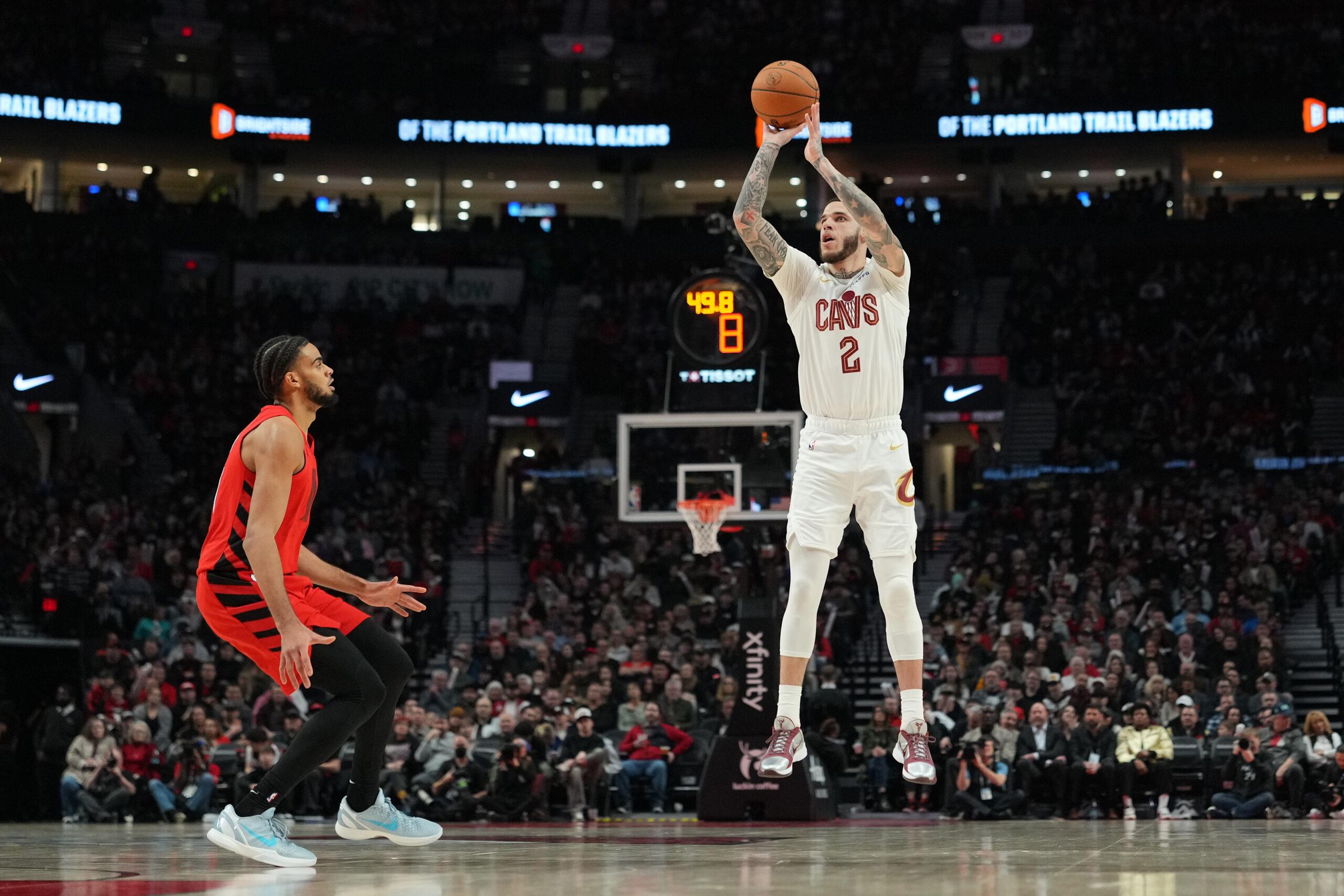
For me, the player to watch here is Lonzo Ball, a player I somewhat irrationally am still holding out hope for. Ball was acquired by the Cleveland Cavaliers in an offseason trade that seemingly made them clear favorites to come out of the Eastern Conference. He had “missing piece” written all over him: a hyperintelligent connective player who would knock down outside shots, make plays on the defensive end, and close out games when Cleveland needed a bit more size in its backcourt. Alas, he was not, in fact, their missing piece.
In early January, Ball was yanked out of Cleveland’s rotation because he forgot how to shoot. On the season, he’s made just 27.2 percent of his 3s, which is incredibly problematic considering he’s also converted only 13 baskets inside the arc. That’s 13 2-point field goals in 728 minutes of action. If you’re going to miss open 3s and you can’t put any type of pressure on the rim, good luck sticking around in today’s NBA. At the deadline, after trading for Dennis Schröder, Keon Ellis, and James Harden, the Cavs decided to dump Ball’s salary.
Call me naive, but I still think that Ball could be a very helpful player here who could provide a memorable moment or two in this postseason. Put Ball on the Celtics, Timberwolves, or Nuggets—all title contenders with an open roster spot—and it's conceivable he'll find a way to make them better without ever being construed as a necessity. He’s cerebral and processes action incredibly quickly. At his best, Ball makes defenses think. He’s kinetic. The ball pops out of his hands as soon as he touches it. Everything is a twitch in service of the next action. It’s positive energy.
Is his shot permanently broken? Perhaps. Maybe his body can no longer withstand the rigors of an 82-game season, and it’s no use giving minutes to someone who can’t be relied on from one day to the next. The good news, though, is that over half of this season is already in the books. Any club that signs Ball later this month is getting someone who understands, fully, that he’s but one cog functioning in a team sport. If he can knock down some shots and curb his turnovers, maybe Ball can still be a very good team’s “missing piece” after all.
Who will win the lottery?
Unfortunately, tanking is going to be a major story line that will persist for the rest of the season, like an inescapable, stench-filled fog. Right now, the Washington Wizards, Indiana Pacers, Utah Jazz, Memphis Grizzlies, Sacramento Kings, Milwaukee Bucks, Brooklyn Nets, Dallas Mavericks, and Chicago Bulls are the primary culprits. That’s basically one-third of the league. Good stuff. Since it would not be fun or worthwhile to describe how inept each one of these teams plans to be, I’ve decided to power rank them, based on who I most want to actually land the no. 1 pick.
9. Sacramento Kings. With apologies to a fan base that does not deserve the torture Vivek Ranadivé hath wrought, I don’t want to throw Darryn Peterson, Cameron Boozer, or AJ Dybantsa into the seventh circle of NBA hell.
8. Milwaukee Bucks. The mere possibility of Milwaukee trading the no. 1 pick in a league-altering draft just to convince Giannis to sign an extension, and then still watching him demand a trade a few weeks later, makes my head want to explode.
7. Washington Wizards. I don’t really understand what they’re doing and would prefer not to see Peterson, Boozer, or Dybantsa land on a weird team that has Trae Young and Anthony Davis on it.
6. Memphis Grizzlies. They did the right (and hard) thing by pivoting away from a core that got market corrected by the Oklahoma City Thunder. It’d be nice to see Memphis, a little-engine-that-could organization in desperate need of a new face, immediately get its man.
5. Dallas Mavericks. I can’t really process how great Cooper Flagg is already. Pairing him with another teenager who might already be as good would make the next 10 years of Western Conference basketball feel like a mosh pit (complimentary).
4. Utah Jazz. How good would the Jazz actually be next season if they got the top pick? Lauri Markkanen, Jaren Jackson Jr., Keyonte George, and a potential superstar in waiting? This might be scary hours.
3. Chicago Bulls. I know they’re infected by one of the worst owners in professional sports, but NBA basketball is better when marquee franchises aspire for more than the play-in tournament. It’s time we resuscitate one of the saddest situations in the league.
2. Brooklyn Nets. It’s a well-run organization in an awesome city with a smart coach that’s in need of a top-shelf, can’t-miss building block. (Unrelated: I live in Brooklyn, attend Nets games, and would like them to be good and relevant as quickly as possible.)
1. Indiana Pacers. They deserve it.