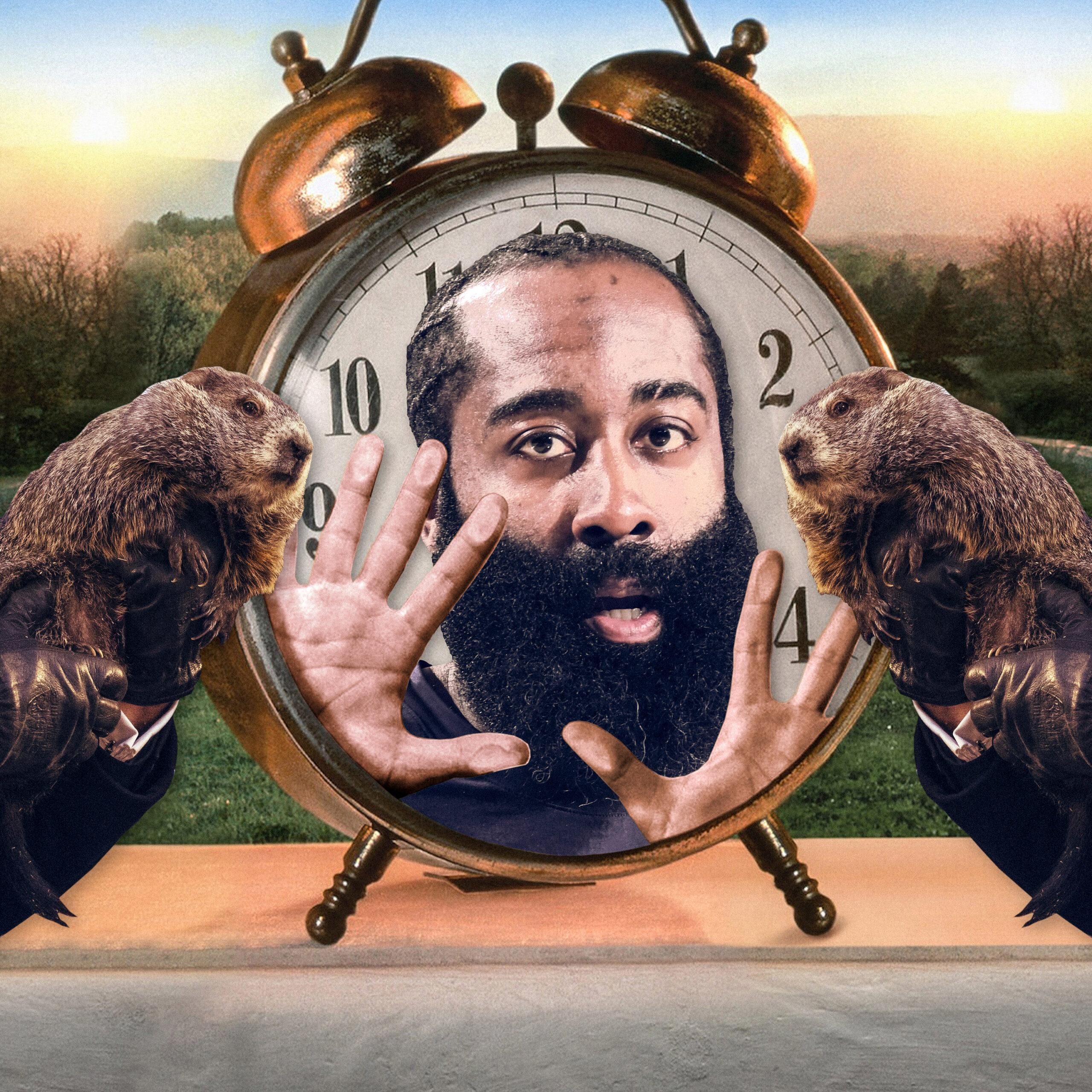

It must have been a courtesy from the all-encompassing will of nature that the rumors of James Harden’s imminent departure first arose late on Groundhog Day. Welcome to the time loop that is Harden requesting an in-season trade, and rather expediently getting his way (again). The fourth trade in six seasons. This time: to the Cleveland Cavaliers, who have acquired the former MVP and 11-time All-Star from the Los Angeles Clippers in exchange for Darius Garland and a 2026 second-round pick.
That a trade package for Harden, at the advanced age of 36, would consist of a two-time All-Star 10 years his junior and a future second-round pick is a testament to both Harden’s seemingly immortal on-ball prowess and Garland’s on-court fragility. Say what you will about Harden’s physique over the years, but there are few questions about his availability. As of Monday night, Harden has played in 91.5 percent of the Clippers’ regular-season games over the past two and a half seasons. Garland has played in just 73.5 percent over the same span—and has been out since mid-January with a right toe injury that occurred just as he was rounding back into form after left toe surgery during the offseason.
Harden is still a better player than Garland is right now, and he’s more durable. Given the stakes and the timeline that these Cavs are on, the deal was imperative. After a dreary start to the season, the Cavaliers are now just 2.5 games behind the New York Knicks for the 2-seed in the East. Harden gives the team an opportunity to make good on the lofty expectations that the Cavs failed to meet in the first half of the season.
“In Cleveland I see an opportunity to win in the East—they got a very good team, coaching staff, all of the above,” Harden told ESPN’s Ramona Shelburne late Tuesday night. “So as much as I wanted to stay in L.A. and give it a go—I’ve never won one before. As a basketball mind, I think we have a bit better chance.”


It’s a future-blind championship push: bringing a perennial postseason underperformer to a perennial postseason underperformer and hoping for the ultimate double negative. Could it be crazy enough to work? Harden will elevate both Cleveland’s floor and ceiling, if only temporarily. He’s averaging 25.4 points (his most since he led the league with Houston) and 8.1 assists per game on 42/35/90 shooting this year. He is still an offense unto himself, an all-time savant at sensing a defender’s weakness and adjusting the weight and timing of his hypnotic crossover stepback pull-ups in isolation. (According to Synergy Sports, Harden has created more points per game out of isolations this season than any player since … himself back in 2019-20.) He is still an elite lob artist who will make Evan Mobley’s and Jarrett Allen’s lives much easier out of the pick-and-roll—assuming they’re both still on the team after the deadline. And for all his defensive foibles, the sheer height and length advantage he has over Garland ought to make a difference to the overall defensive scheme. Harden’s 87 deflections on the season would slot in behind only Donovan Mitchell, Allen, and Craig Porter Jr. on the Cavaliers.
But the introduction of Harden also brings about a specific tension of order within the offense. There are few stars in NBA history who have been more ball dominant than Harden, and even fewer who can justify such means. The feeling-out process he’ll have playing alongside Mitchell will be similar to the process he went through with Tyrese Maxey, Kyrie Irving, and Chris Paul in the past—although perhaps this is the first time that Harden’s backcourt mate is decisively the better and more efficient scorer.
As ever, the question has to be asked in new environs: Can James Harden settle into a more complementary role? Although the more instructive question is: How might the offense coalesce as Harden and Mitchell ease each other’s respective creation burdens? Mitchell’s usage rate is as high as it’s ever been as a Cavalier; Harden’s usage rate is as high as it’s been since he left the Rockets. These are two offensive engines who have been over-tasked this season and are trying to keep their respective wildly underperforming teams afloat. Having two elite on-ball creators who can shoot 3s at volume and get into the lane at will is a rare luxury; the fact that both Harden and Mitchell have been excellent on catch-and-shoot 3s over the past five seasons is icing on the cake.

Cleveland has 31 games to figure out the dynamic of its new backcourt and, more importantly, figure out what none of Harden’s five previous employers have been able to do with him: how to maximize his ability deep into a postseason run. Harden is getting to the free throw line at a rate he hasn’t since his prime. But those whistles become scarcer in the postseason, and that change has historically tanked his overall effectiveness in a best-of-seven series. As durable as Harden has been, there is a lot of tread that wears away over the course of a season when you exert as much control as he does on a nightly basis. There are already some signs of that this season: His shooting percentages degraded in his final 19 games as a Clipper, a stretch when the team was righting the ship and Kawhi Leonard was regaining demigod form. The Cavs must be hoping that they aren’t catching a falling knife—but that’s the risk you take by bringing on a 17-year veteran who agreed to be traded away from the NBA’s hottest team, which had won more games since mid-December than anyone else in the league. Circumstances, whims, and objectives can all change in an instant.
After its recent turn of fortune, did Harden not see a path to winning in Los Angeles, which is 23-26 and ninth in the West? Did he not see a path to a longer-term financial commitment from the Clippers organization? Or was it as he said—purely about striking at an opportunity to win in the weaker Eastern Conference? “In life, not even just basketball, when things don't work out, there are ways to end things in relationships without having to crack each other,” Harden—who practically forced his way out of Philadelphia after calling team president Daryl Morey a liar—told Shelburne. “OK, maybe we just don't see a future with each other. Maybe we just outgrew each other, whatever the case may be. I feel like other situations weren't like that.
“[I] didn't want to feel like I was holding the Clippers up in their future,” Harden continued. “I wanted them to actually have a chance to rebuild and get some draft capital.”
Harden has evidently grown pensive in his older age, more attuned to timelines and the benefits of reciprocity. His past self might have focused solely on his own destination and not on the people and mechanisms that had gotten him where he wanted to be. "Originally, when I was going through everything I was going through, you know, in Houston, Philly was my first choice," Harden said, nearly four years ago, at his introductory press conference after being traded by the Nets to the Sixers. "It just didn't happen. Details—I don't really want to get into the Brooklyn situation.”
At the very least, Harden’s acknowledgment of the goals and needs of all parties involved is a different wrinkle in his all-too-familiar trade justifications. That’s growth, even if it’s clear that Harden isn’t quite done cycling through old patterns.
Punxsutawney Phil saw his shadow on Monday, which has historically been taken as a prophecy of a long winter. Except Phil’s gotten only 35 percent of his annual predictions correct over the past 20 years—a lower mark than Harden’s career 3-point percentage. Pitiful. A thousand people freezing their butts off, waiting to worship a rat. Yet there is something to be said about tradition and ritual. Does it matter how accurate a groundhog is at predicting seasonal weather systems? Of course it doesn’t. But we turn our attention to Phil every year anyway. We honor what endures amid the passage of time.
It’s been a season of contemplating legacies. There is hope and dread in visualizing Steph Curry’s perfect farewell or LeBron James potentially making one final homecoming. At his current pace, Kevin Durant will surpass Michael Jordan for the fifth spot on the all-time scoring list at some point this season—cementing his place in the NBA’s annals as the most talented scorer the game has ever known. These are possibilities built on years upon years of excellence and consistency. Along those lines, it’s only right that we acknowledge and celebrate Harden’s near-annual in-season trade the same way, as one of the most consistent events of this tumultuous decade. The years may change, as do the locales—from Houston to Brooklyn, Brooklyn to Philadelphia, Philadelphia to L.A., L.A. to Cleveland—but the whims of Harden’s itinerant basketball soul have remained so reliably fickle as to induce a state of déjà vu upon the entire league over and over again. It’d almost be comforting if it weren’t so jarring each time round.