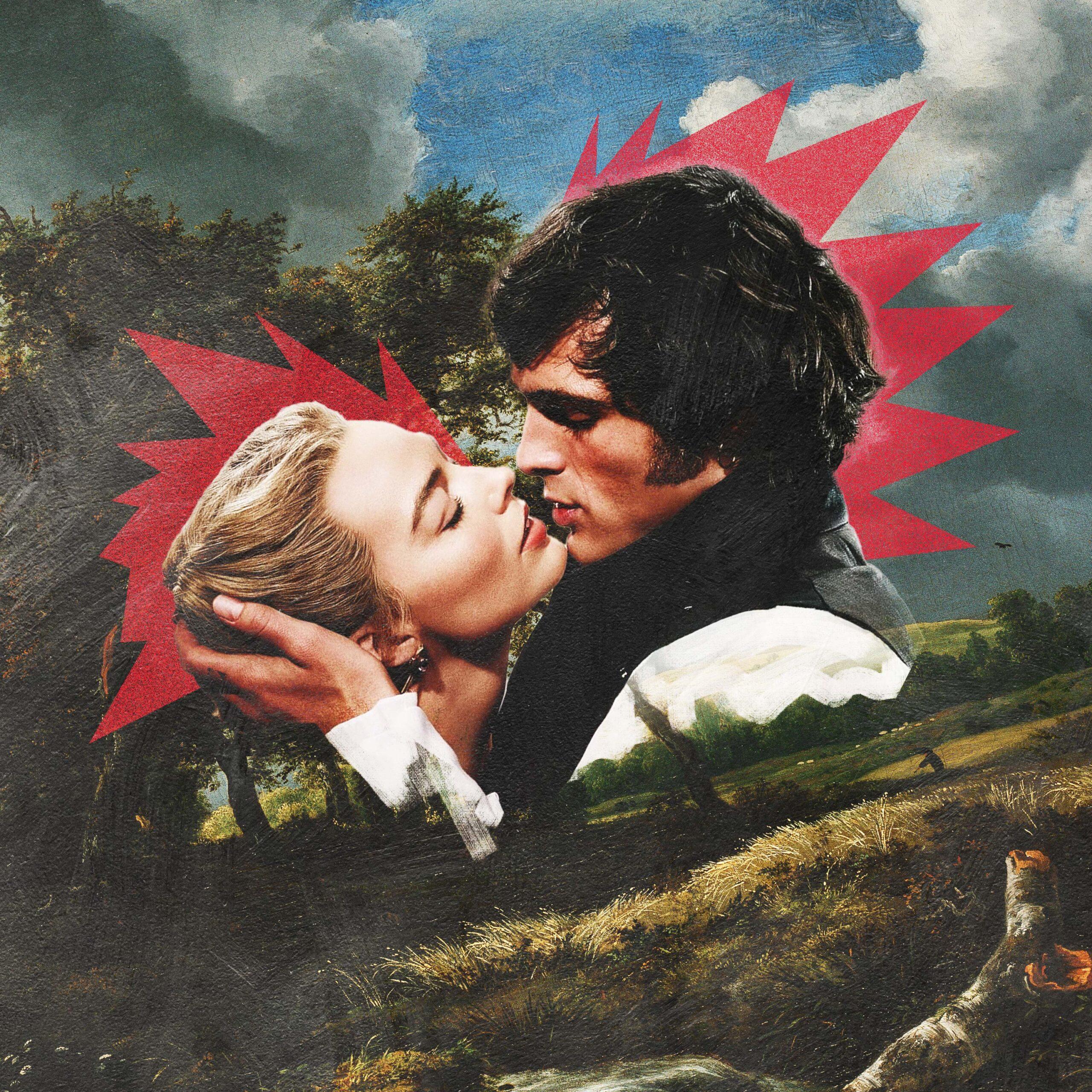

“He dashed his head against the knotted trunk; and, lifting up his eyes, howled, not like a man, but like a savage beast getting goaded to death with knives and spears.” —Emily Brontë, Wuthering Heights
Heathcliff’s rage vents itself on helpless trees and puppies; English lit majors’ rage, meanwhile, is exercised on Reddit and Twitter, where teeth gnashing and head bashing begin anew every time a Wuthering Heights teaser or skin-room explainer comes out. Brontë heads, self-styled historians, and the usual complainers bemoan the casting of two fit Australians as the ghoulish and perverse lovers Heathcliff and Cathy; the whitewashing of a character described as a “gipsy”; all those heaving, dripping bosoms; the kinky grass munching; the red latex dresses and white wedding gowns; and of course those genetically modified strawberries.
I’d worry for director Emerald Fennell’s equanimity if I didn’t suspect that she gets off on the backlash, much like a nun who gets off at a hanging. As Fennell herself will tell you, if you challenge her on the liberties she’s taken with her source material, her new movie, dropping on Valentine’s Day weekend, isn’t supposed to be a faithful adaptation of Emily Brontë’s Wuthering Heights. (Hence those self-pronouncing scare quotes around the title that Warner Bros. is demanding everyone include.) “There’s a version that I remembered reading that isn’t quite real,” she says at a press junket, tickling ferns creeping up to caress her, the manufactured fog of the set doing what it can to transport you to the eldritch world of the West Yorkshire moors. “And there’s a version where I wanted stuff to happen that never happened. And so it is Wuthering Heights and it isn’t.”
It’s easy to imagine, based on the movie’s sweaty décolletage and finger play, the “stuff” Fennell was imagining when she read Wuthering Heights at 14. Her version is the phantasmagoric vision of adolescent fantasy, where kneading bread and the sticking of one’s finger in a gelatinous fish mouth stand in for actual grown-up sex. For teenagers, Heathcliff’s grave-fondling obsessiveness—clearly a preoccupation for Fennell—seems like the height of love. But there’s a reason we don’t give teenagers millions of dollars to make their own adaptations of books they read in English class. They’d obviously be bad about balancing budgets and making call times, but they’d also just make the hot dude from the book cover come to life and put him in their on-screen fantasies about forbidden love and fucking (eternal themes for teens and also for Fennell).
Like a high schooler writing a term paper, Fennell’s made a whole career out of flattening thorny subjects—rape and gender in Promising Young Woman, class and envy in Saltburn, and now, apparently, toxic love in Wuthering Heights. What she’s skilled at is setting her stories in florid, enticing displays of what she’s apparently critiquing; her movies luxuriate in sugar-coated excess and dance through grand manses to smash songs about murder. And they always look so good—who wouldn’t want to party and die in the gardens at Saltburn?—and are filled with people so hot that they almost convince you there’s something more to them. There’s pleasure in the indulgence, and Wuthering Heights’ blood-red rubber floors and tablescapes overflowing with jellies also create a world to get hazily lost in.
Margot Robbie’s milkmaid bodices, cellophane lingerie, and Chanel jewels may not seem all that fitting for the Georgian setting or for the screeching, wild-eyed Cathy of the book, but they are undeniably pretty to look at. Much as the internet may object, the world Fennell’s created is an alluring one; even if it’s based in a campy fever dream version of the book, it channels its frequencies and tunes its emotional melodramas into the weeping walls of Thrushcross Grange and the oppressive obsidians of Wuthering Heights. Early reviews of the movie are mostly in thrall to those settings, acknowledging the “opulent design,” Fennell’s naked desire to use the excess of her designs to create a love story that crosses space and time. What critics might not agree on, though, is whether she’s justified in sanding down the jagged edges of Wuthering Heights to tell a prettier, more digestible story. (Some celebrate a more “smooth-brained” Wuthering Heights, while others say it’s the perfect symptom of a culture that “denigrated literature to the point where it’s no longer intended to expand the mind but to distract it.”)
It’s hard, for instance, not to trip on Fennell’s and the cast’s and the entire Warner Bros. marketing department’s insistence that this is the “greatest love story ever told.” They’ve all been hyping it up as the next Titanic, while the movie poster intentionally hearkens back to Gone With the Wind.
Fennell says she first got the idea of adapting Wuthering Heights from that most potent of muses: Jacob Elordi’s sideburns. He looked just like the Fabio-esque Heathcliff on her childhood copy of the book, a romantic hero who could launch a movie and a thousand crushes. But then there’s Heathcliff in the book, who says of his new, insipid bride Isabella Linton: “She abandoned them”—her loving family and cushy lifestyle at Thrushcross Grange—“under a delusion, picturing in me a hero of romance, and expecting unlimited indulgences from my chivalrous devotion.” He casts his spell on Isabella just because she’s been making up girlish daydreams about him, and it seems like Fennell is basking in the glowing, happy light of similar teenage daydreams rather than trying to paint a more difficult picture of a more difficult man.
In the book, most people hate Heathcliff on sight—most likely because he’s “dark-skinned” and looks like a “gipsy.” Much of the firestorm around Fennell’s adaptation has come from her decision to cast Elordi instead of an actor who’d be more in line with how Wuthering Heights describes the character: as racially ambiguous and always at odds with the provincial white society he’s landed in. Heathcliff’s an outcast because he was fished up from the gutters of Liverpool and doesn’t have the manners of polite society, sure, but most people also just take an instant dislike to him, and it’s not a far leap to determine that it’s because of his race. Cathy and Heathcliff’s romance is forbidden because he’s an uncouth farmhand and because of his untraceable but almost certainly non-English, non-white ancestry. As many online have been eager to point out, having Elordi in the part excises a dimension of the book that made it challenging for readers in the 19th century and still relevant today.
And even if you want to excuse the casting of a white actor, it’s actually just kind of impossible to hate Elordi on sight. He’s much easier on the eye than the brute he’s playing, and even elsewhere, as Frankenstein’s monster (or one of Sam Levinson’s), he can’t help but charm. Robbie’s basically been acting like she fell in love with Elordi on set, and when you hear stories about him picking her up with one arm or filling her room with roses along with a note signed from Heathcliff, it’s easy to understand why—and to understand that we, the popcorn-munching, romance-deprived audience, are supposed to feel the same way: seen and picked up by a very handsome, very tall, very fantastical man who’s got the perfect amount of rough edges.
And then there’s Barbie herself as Catherine, a similarly controversial casting choice. The book’s Cathy is famously brunette, in contrast with Robbie and with the limpid, golden-haired Edgar Linton, whom she ends up marrying. But, sorry to the internet, Cathy could still be Cathy if she’s blond. A more pertinent criticism of Robbie’s casting is that it’s kind of hard to swallow this dialogue from a character who’s not a teenager:
Cathy’s talk of grand houses and falling in love—and her baiting of Heathcliff and jealousy over a landlord’s daughter—makes a lot more sense coming from a petulant 19-year-old than from a grown woman. In the book (and presumably in the movie, too), Cathy pinches her maid in a fit of pique, throws over Heathcliff because she wants to be rich, bosses around her doting husband, and goes on a hunger strike when she doesn’t get her way. Fennell’s proudly declared that she hasn’t changed much of Cathy’s dialogue even though she’s aged up the character, which may just have the effect of making her brattiness and self-absorption seem even more appalling. To defend the casting choice, Fennell has said that Robbie “is the type of person who, like Cathy, could get away with anything. I think honestly she could commit a killing spree and nobody would mind.” So far, Robbie hasn’t been getting away with much.
Fennell’s tried to cover herself from all the criticism by saying that Wuthering Heights could get adapted by a different director every year and yield fresh delights with each new version. And there may be a purpose to the changes she’s made, especially all that sex with dog collars and horse reins: She could be challenging the prudishness of the current moment, calling us to play in her dreamworld of Georgian-era BDSM. And her argument that wall licking and tongue wagging are a way to preserve the original’s shock value does make sense; the initial outrage provoked by both the book and the movie might actually be the biggest similarity between them. Reviewers tore it to pieces when it came out; as Clare O’Callaghan, author of Emily Brontë Reappraised, says, “People did not know what to do with this book, because it has no clear moral angle.” Heathcliff’s an irredeemable villain who never finds any kind of forgiveness or satisfaction in this life, but he’s also an irresistible love interest; Cathy’s a self-absorbed brat who spoils the lives of pretty much everyone around her, just for the fun of it. The movie’s just pushing it even further, shocking us this time around with sex instead of amorality. Or maybe Fennell just wants to make cruelty look pretty and sexy.
In the end, as visually or sexually stimulating as it may be, her version also seems like one of the less interesting possible interpretations of Wuthering Heights: a horny teenager’s idea of the book. Whatever her intentions with the movie, though, Fennell and her marketing team have been savvy about stoking the rage of their potential audience. They’ve already driven plenty of new readers to the book, and if early prognostications are right, they’ll drive the masses to the movie, as well. Heathcliff himself showed that love is basically the same thing as hate; both really just come down to obsession. And despite, or really because of, its potential flaws, it’s clear that untold numbers of people are already obsessed with this movie. I have to imagine that watching it will be a little like going to an orgy: You might get overwhelmed if you try to make sense of all the hedonism around you, but focusing on some of the details—those lovely red capes, Elordi’s gold earring, the rocks obtruding into the walls of Wuthering Heights—may provide satisfaction. Which, of course, shouldn’t be confused with love.