
When I opened the email containing the super-secret, heavily embargoed list of the people elected to the Pro Football Hall of Fame’s class of 2026 early Thursday morning, my only reaction was relief.
Not pride. Not happiness. Simply relief. I am one of the 50 selectors responsible for choosing this class, and at least when it came to the modern-era player candidates announced Thursday night, we didn’t get it wrong.
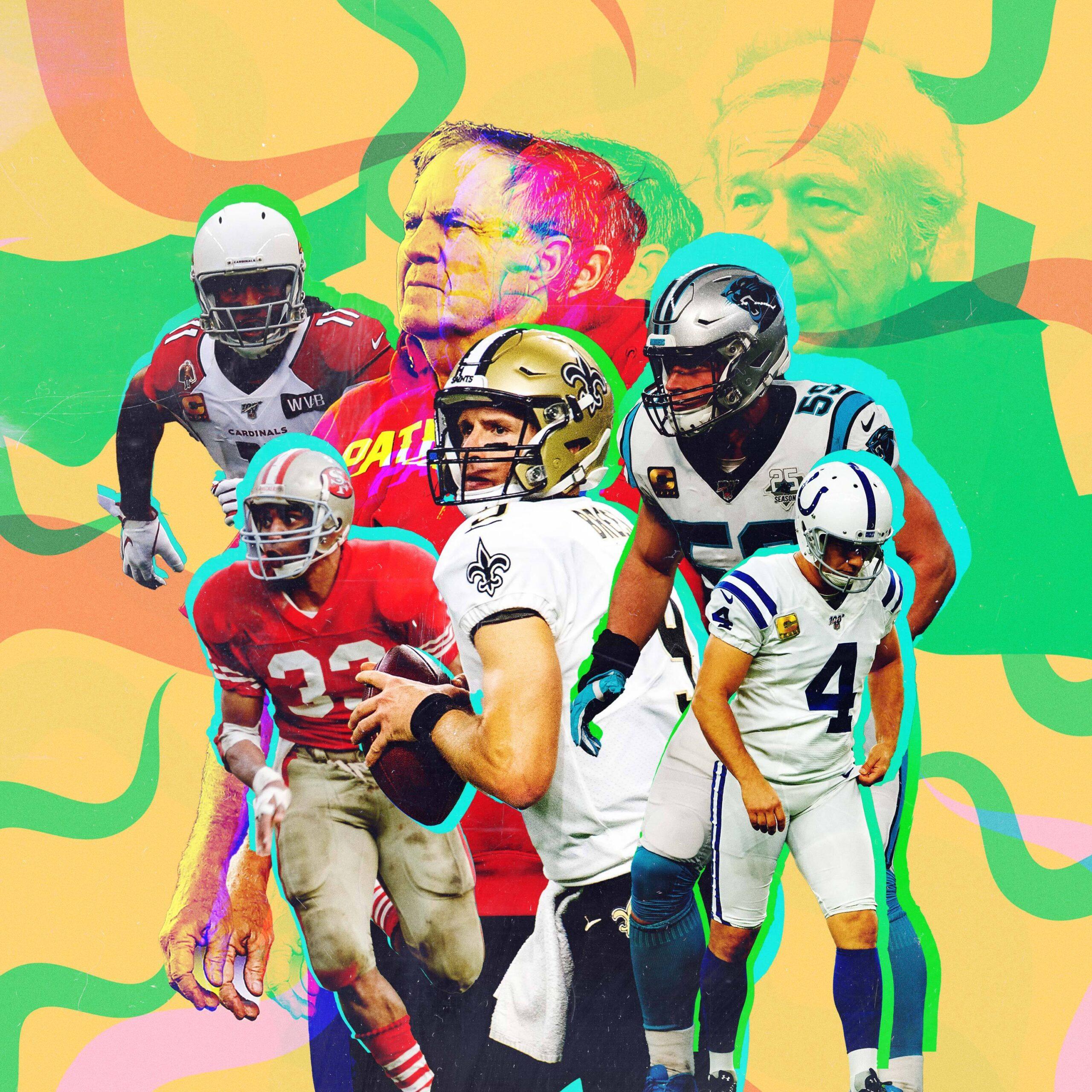
Four modern-era candidates will get their gold jackets this summer: New Orleans Saints quarterback Drew Brees, Arizona Cardinals receiver Larry Fitzgerald, New England Patriots and Indianapolis Colts kicker Adam Vinatieri, and Carolina Panthers linebacker Luke Kuechly. They will be joined in Canton by 49ers running back Roger Craig, the lone member of the pool of senior, coach, and contributor finalists to make the cut for the class of 2026. Brees and Fitzgerald were elected in their first year of eligibility. Both Kuechly and Vinatieri got in on their second ballots.
Unfortunately for those new Hall of Famers, the story of their election and eventual enshrinement is more about who isn’t part of their class. Thursday’s announcement of the class of 2026 officially confirmed the news ESPN reported last week: New England Patriots coach Bill Belichick didn’t get in on the first ballot. It was a stunning snub, one that revealed deep problems with the election process as a whole, particularly as it relates to the path for coaches, senior candidates, and contributors to make it to Canton. Is the process too secretive and in need of some transparency? Is the 80 percent threshold—40 of 50 votes—simply too high? Are voters split into factions? Or too dug in on senior candidates?
The Hall of Fame has been one of the biggest stories of Super Bowl week, for all the wrong reasons. Simply put, we failed to put the best and most qualified candidates into this class. This should have the Hall of Fame board considering significant changes to the voting process—not just to avoid future embarrassment but to make sure we are in a position to get it right.
So what went wrong? One of the biggest concerns from others in football media and in the broader football fandom in the wake of the Belichick snub is the shroud of secrecy that envelops the entire process. Now that the class has been announced, I feel like it is my duty as one of the 50 selectors to provide some transparency about my own thought process, and reveal my final ballot.


More on the Hall of Fame Controversy
Before I get into how I voted, a little background. I have been a selector for five years, first joining the committee in a spot reserved for the representative of the Pro Football Writers of America as we worked to elect the class of 2022. I have been an at-large selector for the past three years. Being on this committee is one of the greatest honors of my career, and it is something I take extremely seriously. It requires a lot of work throughout the year—hours spent on the phone with former players and coaches from different eras discussing the guys they played with and against, as well as solo historical research as we whittle the list of eligible players down to the group of finalists who eventually make it “into the room”: the group of 15 modern-era players who are presented in the formal selection meeting in January. This year, I was a member of the subcommittee that selected the contributor finalist (Patriots owner Robert Kraft), and twice previously, I was an alternate on the coaches subcommittee.
What is discussed during these meetings is confidential. That is a core tenet of the Hall of Fame bylaws. That confidentiality means that among ourselves, we should be able to speak freely, ask questions, and challenge others’ opinions while opening ourselves up to new ideas and perspectives on the finalists. Last month, we spent about eight hours discussing the finalists and ultimately casting our votes.
First, we were required to vote for three of the five candidates in the coach/contributor/senior pool. To get elected, a finalist from this group needs 80 percent of the vote—that means 40 votes. If no candidate reaches 80 percent, the one candidate with the highest total gets elected. Craig was the only one of the five candidates to make the class of 2026, making it two years in a row that the coach, contributor, and two seniors were shut out.
This process used to be a simple up-down vote but was changed two years ago to this current format that forces voters to pick three of five. I think we can say now that it isn’t working. Pitting the coach, contributor, and three seniors against each other in a zero-sum game means we are not electing the best of the best. We now have two years’ worth of evidence to show that this process is failing that entire group of finalists and making all of us look silly.
Now, about my ballot. I voted for Bill Belichick, Robert Kraft, and Roger Craig. Picking Belichick was a no-brainer (or so I thought), even when accounting for the Spygate scandal. While I did not expect him to go in unanimously, I was stunned to learn last week that at least 11 of my fellow selectors did not vote for him. I voted for Kraft because the Hall set a precedent in recent years for what a Hall of Fame–worthy owner is when it elected Jerry Jones and Pat Bowlen (decisions that were made before I joined the committee). That means having a significant impact on the league’s business and growth, as well as a long record of on-field success. Kraft, whose franchise has been to 11 Super Bowls, including Super Bowl LX, checks those boxes. I voted for Craig because I believe he was a player who was truly ahead of his time, one who, if he played in a different era, would have been one of the biggest stars.
For modern-era candidates, we considered 15 finalists: Bengals offensive tackle Willie Anderson, Saints QB Drew Brees, Saints guard Jahri Evans, Cardinals receiver Larry Fitzgerald, 49ers running back Frank Gore, Rams receiver Torry Holt, Panthers linebacker Luke Kuechly, Giants QB Eli Manning, Ravens pass rusher Terrell Suggs, Patriots and Colts kicker Adam Vinatieri, Colts receiver Reggie Wayne, Vikings defensive tackle Kevin Williams, Cowboys tight end Jason Witten, Cowboys safety Darren Woodson, and Ravens guard Marshal Yanda. After a few hours of presentations and discussions, we each voted to cut the group to 10, eliminating Manning, Holt, Wayne, Evans, and Williams.
After another round of voting, Witten, Woodson, and Gore were eliminated, leaving a final seven: Anderson, Brees, Fitzgerald, Kuechly, Suggs, Vinatieri, and Yanda. Voters were instructed to vote for five, and each player needed to get 80 percent of the vote to be elected.
This is my final five: Brees, Fitzgerald, Kuechly, Vinatieri, and Anderson. To me, Brees and Fitzgerald were slam-dunk first-ballot Hall of Famers. Kuechly should have been in last year; he has as clean a résumé as any defensive player we have considered during my time on the committee. I did not vote for Vinatieri when he was among the final seven last year, but presented with the preeminent kicker of his generation for the second time, I did not hesitate to vote for him. I picked Anderson over Suggs and Yanda because he has a compelling case as the best right tackle of his era, and as part of the top seven in consecutive years, it was time for him to get over the hump.
This class certainly won’t feel satisfying for everyone. Ravens fans will surely feel slighted that both Suggs and Yanda came up short. Voters—and there are many—who believe the Hall is electing too many players on their first or second ballots, prolonging the wait for other worthy candidates, will be frustrated that there is still a logjam of candidates at a handful of positions, particularly wide receiver, guard, and pass rusher. The decisions won’t get any easier in 2027, when players like Ben Roethlisberger, Rob Gronkowski, Richard Sherman, and Adrian Peterson will become eligible for the first time.
Of course, we’ll also be considering Belichick and Kraft once again in their respective subcommittees. The question is whether it will be the same voting process that has failed us twice now. It’s now up to the Hall of Fame to ensure there’s a process in place that is fair for everyone and will help the institution restore some of the credibility it just lost.