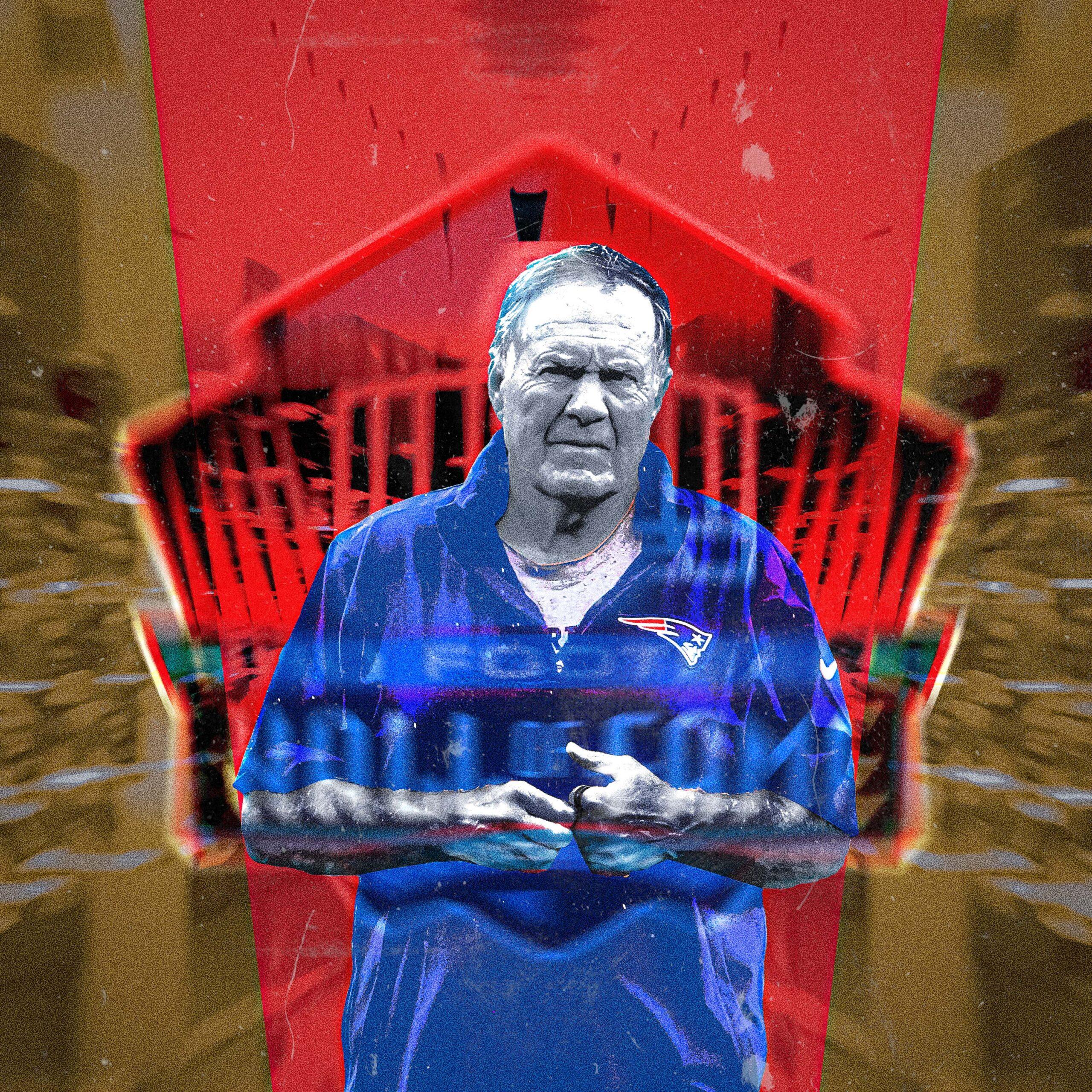

If you thought Shedeur Sanders making the Pro Bowl would be the most embarrassing football-related voting result we saw this week, guess again. ESPN reported Tuesday that Bill Belichick will not be a first-ballot Hall of Famer. He reportedly failed to get 40 votes from the 50-person committee that decides who is worthy of enshrinement and now will have to wait at least one more year before donning a gold jacket.
Belichick not making the Hall in his first year of eligibility is a disgrace. This result greatly damages the credibility of the Pro Football Hall of Fame and should put a spotlight on both the voters and the process that led to this outcome.
Every NFL fan should be familiar with Belichick’s accomplishments, but let’s go over them for posterity. With six Super Bowl wins, he has the most Lombardi trophies of any head coach in league history—the next most is Chuck Noll with four. Plus, Belichick was a part of two Super Bowl wins as the Giants defensive coordinator in the 1980s and early 1990s—eight rings in total. His all-time record as a head coach of 333-178 gives him the second-most wins of all time (only Don Shula has more, with 347). And Belichick’s 31 playoff wins rank first all time, as does his postseason winning percentage of .705 among coaches with at least 25 postseason games. His Patriots won the AFC East 17 times, the most divisional titles by any coach in history. Belichick’s résumé puts him closer to the greatest coach of all time than whoever you think is the best coach to never make the Hall of Fame.
So how could this happen? The most straightforward reason is that some voters punished Belichick for his cheating scandals. “The only explanation [for the outcome] was the cheating stuff,” one source told ESPN. “It really bothered some of the guys.”
The 2007 Spygate scandal is the big one—the Patriots were caught filming the defensive signals of the New York Jets. After an investigation, the NFL fined Belichick $500,000, while also fining the team $250,000 and docking New England its 2008 first-round draft pick. The NFL confiscated and destroyed the tapes, meaning we don’t really know just how much Belichick and Co. were trying to cheat by filming the Jets. But the truth of that situation has always been murky—teams are actually allowed to film during games, but only from certain designated areas. The Patriots violated that rule by filming from their own sideline. Belichick claimed that the team rarely even used the footage and never looked at it until after the game. Still, the severity of the punishment from the NFL speaks to the seriousness of the situation.
But that was 2007. Belichick coached the Patriots for another 16 seasons following that scandal, a span that included 12 consecutive winning seasons and three Super Bowl victories. Spygate couldn’t have been that impactful if the Patriots’ success continued unabated after it, when there was a spotlight on their coaching procedures and gameday operations. And while there were a few other scandals during that time—Deflategate and Bengalsgate come to mind—this was not a steroids-in-baseball long-term mockery of the sport. Belichick may have lived his coaching career pushing the line between cheating and competitiveness, but ultimately opponents couldn’t consistently beat his Patriots because they simply weren’t as good.
We know that at least one voter felt Spygate should be at least temporarily disqualifying, however. According to that same ESPN article, former Bills and Colts GM Bill Polian had lobbied some of his fellow voters to make Belichick “wait a year” as punishment for his cheating scandals.
Polian quickly denied that report and told Sports Illustrated’s Matt Verderame that he voted for Belichick.
Only later Tuesday evening, Polian told ESPN’s Don Van Natta Jr. that he couldn’t remember whether he voted for Belichick or not when the committee met on January 13.
Regardless of whether Polian campaigned against or for Belichick, in the formal meeting or in private conversations before it, the fact that he can’t even remember who he voted for two weeks prior doesn’t exactly lend credibility to the Hall of Fame’s selection committee.
Still, Polian is just one voter. It took at least 11 of them to keep Belichick out of the Hall of Fame. Did that many really feel Spygate should hold him back?
Another possible explanation is that voters made it personal. The ESPN report quoted another source familiar with Belichick's thinking, who said, “Politics kept him out.” It’s true that Belichick was probably not very kind to many of the media members who make up much of the Hall of Fame’s 50-person voting panel. But the Hall of Fame isn’t a Hall of Friends. If some voters kept him out simply because they didn’t like him, then they aren’t taking their responsibility to, in the words of the Hall, enshrine “the finest the game has produced” seriously.
Something similar happened in 2016 and 2017, when Terrell Owens didn’t make the Hall of Fame in his first two years of eligibility despite retiring as the league’s all-time second-leading receiver. Back then, one voter explained that he didn’t think Owens should make the Hall so quickly because of his reputation as a difficult-to-work-with teammate, his history of ugly contract negotiations, and his lack of a Super Bowl ring. Owens thought it was because so many media members just didn’t like him.
There’s one final culprit that may have led to this travesty: the voting process itself. Last year, the Hall of Fame changed its voting process to be more stringent about who it lets in—and a massive error here may have been what ultimately doomed Belichick.
Each year, the voters consider 15 modern-era nominees and five more nominees that come collectively from smaller committees for seniors, coaches, and contributors. In years past, members of this latter group simply needed 80 percent approval from the committee to be inducted, as determined by a simple up-down vote. But as of last year, voters can vote for only three of the five senior/coach/contributor finalists—making it difficult, though not impossible, for multiple candidates to reach the 80 percent threshold.
Belichick was the coaching candidate this year, Patriots owner Robert Kraft was the contributor candidate, and Ken Anderson, Roger Craig, and L.C. Greenwood made up the three senior finalists. Belichick missing means that at least 11 of the 50 voters felt that three of those other candidates were more worthy of inclusion than Belichick. That’s a very strong field of seniors, but surely no one here has a stronger case than Belichick, right?
Well, this is where the new voting process can introduce some unfortunate game theory. Voters must vote for three candidates, and no more than three—meaning that every vote for a candidate comes at the expense of another. It could be that more than 40 voters thought Belichick was worthy of the Hall of Fame but also felt strongly about one of these other nominees, and figured that Belichick would be an automatic enshrinee. With that logic in mind, a voter might figure to leave Belichick off their ballot, assuming the coach would get enough votes from others, in order to pick someone else whom they hope sneaks in. It becomes a prisoner’s dilemma of sorts—and the result is that in some years the most worthy candidate could miss the Hall entirely. Last year, only one of the five candidates in the coach/contributor/senior pool—Sterling Sharpe—was enshrined.
This three-of-five process also makes no allowance for if the nominated class is strong or weak. A very strong class could see all the votes split and only one candidate clearing the threshold. But a weak class of finalists could produce the opposite result, where votes pile on to two or three just-OK nominees, who then all make it. It’s an absurd way to decide, and after this year’s stunning result, it seems to need an immediate overhaul even though it's been in place for just two years. It is still unknown whether Kraft or any of the three senior finalists has been elected. Those results are set to be revealed on February 5.
To add to the complication, two years ago the Hall of Fame cut the waiting period for retired coaches to become eligible from five years to one. This is why Belichick is eligible now despite having coached the 2023 season, while Tom Brady, who retired after 2022, won’t be eligible until 2028. But the coaches who retired earlier—who were subject to the five-year waiting period—are getting the short end of the stick. Mike Holmgren was the coaching finalist last year, didn’t make it, and now didn’t make it out of the coaching committee for the 2026 class because the committee chose to advance Belichick instead. Coaches like Pete Carroll and Mike Tomlin could be eligible in 2028, assuming they don’t return to the sidelines. The committee can advance only one nominee per year, so the door may be essentially shut for Holmgren, Mike Shanahan, and a bevy of other coaches the committee considers.
Exactly how Belichick failed to become a first-ballot Hall of Famer will probably remain a mystery—the Hall of Fame does not publish any vote totals, and it doesn't reveal who voted for whom. But it feels likely that this could have been a result of all three scenarios. A few voters probably felt Belichick shouldn’t get in because of Spygate and other cheating scandals. A few just didn’t like the guy. A few thought he’d be a shoo-in and wanted to advocate for someone else.
But none of these reasons are close to good enough. This result is an embarrassment. If it was the voting process that let Belichick slip through the cracks, then that process needs to be changed. If the voters didn’t want to select him, then the voters need to be changed. In any scenario, the Hall of Fame not picking Belichick is a joke—and a clear sign that the system is broken.