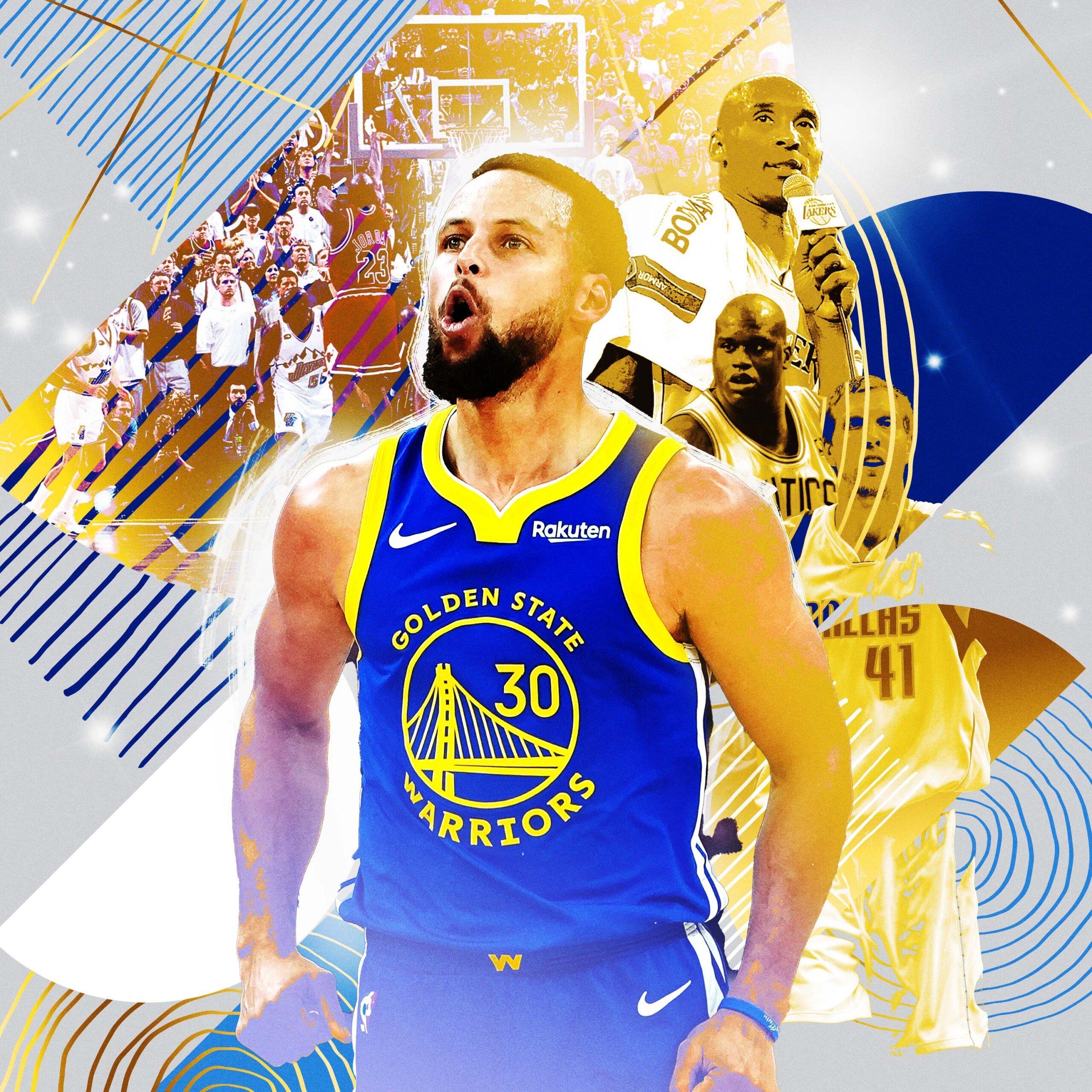
Steph Curry’s Final Act: “There Are No Perfect Endings”
NBA stars rarely get fairy-tale endings. But Steph still has his joy, and the hope for one more meaningful run. “There’s still enough of a chance,” he says.Steph Curry’s Final Act: “There Are No Perfect Endings”
NBA stars rarely get fairy-tale endings. But Steph still has his joy, and the hope for one more meaningful run. “There’s still enough of a chance,” he says.
Stephen Curry is trying to envision his future, but the past keeps intruding on his train of thought. A jersey from his first NBA championship. A slab of hardwood from the last time he faced Kobe Bryant. A ticket stub from his freshman season at Davidson.
“What?! This is my second game!” Curry says upon seeing the stub dated November 11, 2006, a game in which he scored 32 points against Michigan. “That's crazy. My first 30-piece!”
It’s late on a recent Sunday in Minneapolis, where Curry and the Golden State Warriors have just recorded a much-needed victory over the Minnesota Timberwolves. Back at the team hotel, a small conference room has been converted into a virtual Steph shrine, every table covered in memorabilia, all awaiting his sweeping signature, which Curry dutifully reproduces, over and over, with the same rhythmic consistency of his signature jump shot.
About a thousand items—jerseys and trading cards, basketballs and magazine covers—are spread across the room, spanning two decades, from Curry’s college days through his 17 years with the Warriors. A small army of staffers from USA SM, a collectibles company that works with Curry, keeps it all moving. Every few seconds, a signed piece is swished away and replaced by another in need of Curry’s flourish. Yellow sticky notes give detailed instructions—sometimes a mere signature, sometimes a requested inscription. Baby-faced assassin. Golden Dagger. Night-Night. Nuit-Nuit.
Like the Warriors at their peak, everyone in Curry’s orbit is moving in sync, a finely attuned ensemble keyed to his unique rhythms. Scribble, swish, repeat. Scribble, swish, repeat.
In a very tangible sense, Curry’s Hall of Fame career is now passing before his eyes. Yet even as he marinates in his glorious past—the four championships, the back-to-back MVPs, and the thousands and thousands of 3-pointers—he swears he’s not done making memories ... or basketball history.
“If we get in the mix, we always feel like we can get it done,” Curry says, speaking with The Ringer as he works his way through the memorabilia. And by “get it done,” he means win another championship, his fifth, which would place him (and costar Draymond Green) in a tier with legends like Bryant, Magic Johnson, and Tim Duncan. “Getting greedy,” Curry says with a smile. “We know what number five means in terms of who we would join, from a legacy perspective.”
He concedes that this will sound “outlandish,” given his own age (37), Green’s age (35), the Warriors’ record (27-23, eighth in the West), and a recent season-ending knee injury to star forward Jimmy Butler (age 36), among other obstacles. He admits to the audacity. “I like that audacity,” he says. “The reason we got here, it hasn’t been about the money. It hasn’t been about anything other than winning, and that’s kind of the gas that’s still in the tank for what we’re trying to do now.”
It will be another few days before reports surface that the Milwaukee Bucks are ready to trade Giannis Antetokounmpo, with the Warriors mentioned as a strong suitor. A single trade could infuse new life into what Golden State coach Steve Kerr recently called—accurately—this “fading dynasty.”
Of course, Kerr would love to coach Curry and Green to a miraculous fifth title. No one associated with the Warriors has quite yet given up on that dream. But they’re all acutely aware of the odds—and of NBA history.
The reason we got here, it hasn’t been about the money. It hasn’t been about anything other than winning, and that’s kind of the gas that’s still in the tank for what we’re trying to do now.Steph Curry
It’s been 12 years since the Warriors began this dynastic run and four years since their last title. Dynasties aren’t supposed to last this long. Teams built around aging stars don’t generally win titles. And, well, feel-good endings are rare in this league. Every star would love to leave on top. Few ever do. The best most of them can hope for is to be reasonably healthy, reasonably impactful, and on a reasonably competitive team.
But the truth is, Curry’s legendary run is more likely to end with a bummer than a banner. And the same probably goes for LeBron James (41) and Kevin Durant (37), the two other stars who have defined the era.
Curry has seen enough in his own time to recognize the pattern.
Ten years ago, Bryant went out in a blaze of glory, scoring 60 points in his final game with the Los Angeles Lakers. But Bryant missed the playoffs his last four seasons and made his last Finals at age 31.
Shaquille O’Neal, Bryant’s former costar and rival, literally limped away from the game in 2011, at age 39, after playing sparingly for a Boston Celtics team that lost in the second round. O’Neal’s last Finals appearance came in 2006, at age 34, as Dwyane Wade’s costar in Miami.
Paul Pierce, Kevin Garnett, Steve Nash, Vince Carter, and Grant Hill all wound down their careers as role players and locker-room mentors, often in unfamiliar uniforms.
Duncan fared better than most, winning his last championship at age 38—thanks in large part to the burgeoning stardom of a 22-year-old Kawhi Leonard—and making the playoffs in every year of his 30s. Even in his twilight, Duncan could check the “relevance” box.
Dirk Nowitzki, who took Dallas to the championship in 2011, at age 32, was not so fortunate. He played eight more years, without winning another playoff series. His final season was marred by ankle problems. The lone upside was that he stuck around long enough, at age 40, to tutor Luka Doncic.
“My last year was super tough,” Nowitzki told The Ringer. “Obviously, I couldn’t move well, and it was kind of tough for [coach Rick Carlisle] to plug me in there. We weren’t really a winning team anymore. We weren’t really in the playoffs. So we kind of had the luxury to develop our younger guys with Luka’s first year and obviously have me still play a bit here and there.”
Nash, Nowitzki’s close friend, tried to extend his own championship window by joining a Lakers team with Bryant, Dwight Howard, and Pau Gasol in 2012. He retired after two injury-marred seasons, with little to show for it.
So, to recap: lots of pain. Not a lot of playing. Not much winning. No one carrying off our heroes on their shoulders under a hailstorm of confetti, like they do in the movies.
That’s the thing, isn’t it? We were raised on fairy tales and fantasies. We want our real-world heroes to remain forever invincible, all powerful, even as their chins go gray.
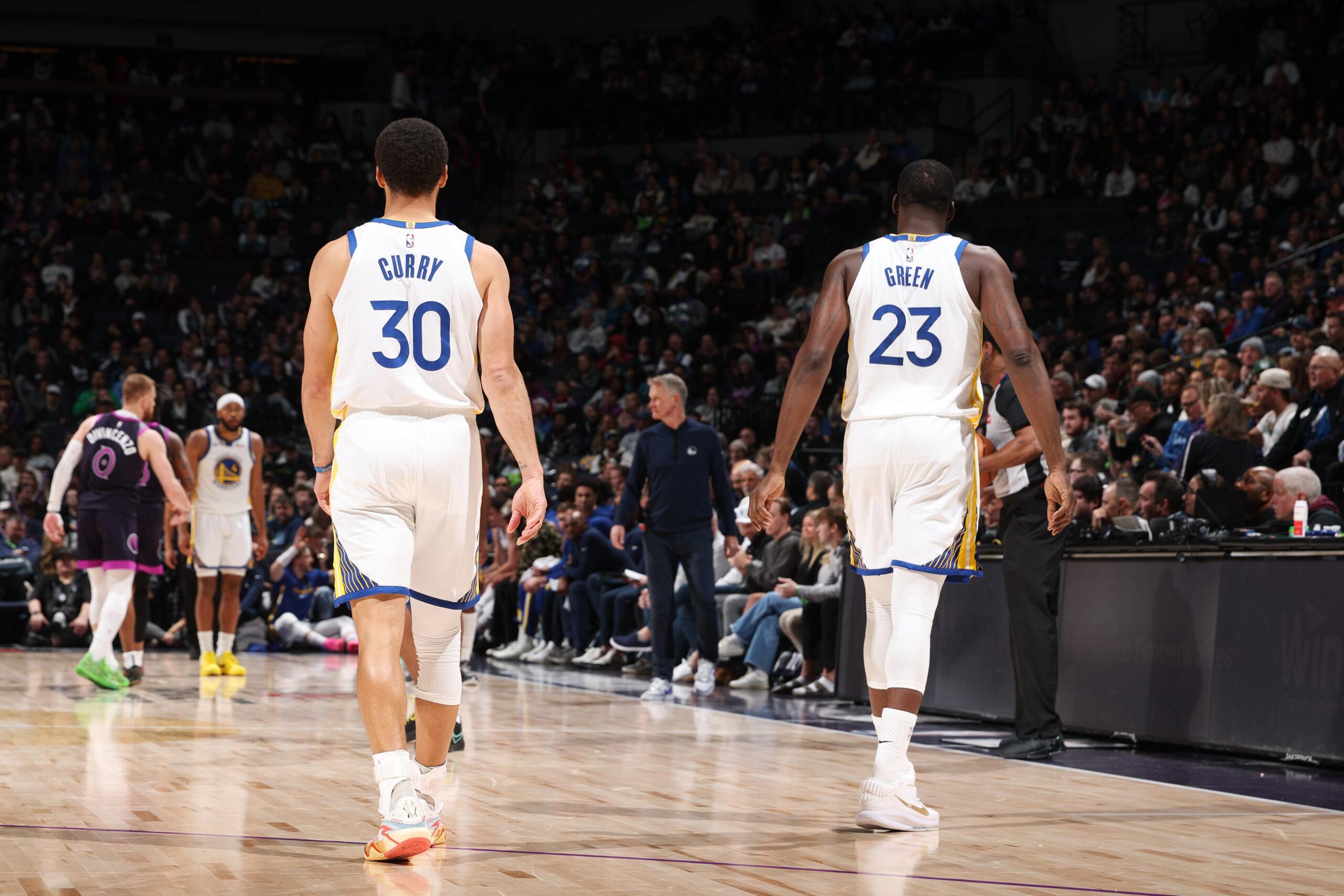
Stephen Curry and Draymond Green during the game against the Timberwolves on January 25
The greatest walk-off by an NBA legend? That’s easy. June 14, 1998. Game 6. Salt Lake City, Utah. Michael Jordan in the shooter’s pose, his jumper sailing over Bryon Russell for the win. For the championship. His sixth and final ring with the Chicago Bulls.
“If he retires, it will be the purest departure in the history of sports,” Bruce Jenkins wrote in the San Francisco Chronicle the next day. Seven months later, Jordan did exactly that, prompting Dan Le Batard of the Miami Herald to proclaim it “the single best retirement sports has ever seen.”
Of course, it turned out it wasn’t a final departure at all. Jordan unretired three years later and played two respectable—albeit unmemorable—seasons for the Washington Wizards. MJ wasn’t really MJ anymore. The Wizards weren’t a playoff team. And Jordan’s perfectly scripted ending was deleted, in favor of a much messier final chapter.
The romantics among us might bemoan the final edit. But the athletes themselves generally do not. Durant, a D.C.-area native who was 13 years old when Jordan joined the Wizards, sees a different kind of beauty in Jordan’s chosen finale.
“Even though [Jordan] had won the championship, he still felt like he had something in the tank to give,” says Durant. “It’s not all about winning the title or being on the top of the mountain when you leave—just about knowing deep down [in] your heart that you got more to give to the game.”
There’s a subtle battle being waged here, between practicality and nostalgia. Kerr, too, was charmed by the vision of his then-Bulls teammate strutting off into the sunset as the reigning champion, at the peak of his powers. But a player retiring at his peak by definition still has more to give—and walking away at that moment means leaving points and wins on the table.
“To the athletes themselves, the most important thing is doing what they love,” Kerr says. “And so if they do what they love, beyond the point of what the fans want, then everyone looks at it as an imperfect ending. But … there are no perfect endings.”
The point is that leaving on top is not necessarily the same as leaving on your own terms. And it’s the latter that resonates most with those who play the game.
“I would argue that Michael did go out on his terms,” says Kerr, who played alongside Jordan for his final three titles. “He felt like playing, and so he went and played for the Wizards for a couple years. Fans look at it and go, 'What a shame. He should have retired after that shot.’ But that’s the fans, right? Michael Jordan wanted to keep playing basketball, so he kept playing basketball. So what does 'going out on your own terms’ mean? For some guys, it means playing until the very last drop, and then I can’t play anymore.”


More on Steph’s Career
In today’s NBA, that “last drop” is arriving later and later, thanks to sports science and modern training routines. In another era, Durant, James, and Curry might already be retired, or playing bit roles. Instead, all three just made the All-Star team—Curry as a starter, the other two as reserves—and all three are anchoring likely playoff teams. Before this season, only five players over age 37 had ever posted a player-efficiency rating over 20, with a usage rate of at least 25 percent: James, Duncan, Jordan, Kareem Abdul-Jabbar, and Karl Malone. At the moment, James, Curry, and Durant are all on pace to join (or rejoin) the club.
Durant, who’s leading a young and potent Houston Rockets team, arguably has the best shot at making another Finals and perhaps winning a third ring. But when Durant talks about how this all will end, whenever that may be, his goals are much more basic. He wants to go out gracefully, like Duncan in 2016.
“Didn’t win a championship that year, but still contributed to a good team, still was held to a standard every day as a player and retired when he wanted to,” Durant says of Duncan. “That’s kind of what I want to do. Still help a team. I’m not saying I’m gonna be a superstar or retire as an All-Star, but I want to be able to help a team.”
There’s a recalibration that happens as the all-time greats see their skills wane and their windows close. Nowitzki focused on tutoring Doncic. Pierce opted to chase another ring with the Clippers. Carter transformed into the ultimate end-of-bench mentor, in Atlanta and Sacramento, while setting the record (since eclipsed by James) for the longest NBA career, at 22 years.
Distinctly unglamorous endings, all—but respectable nonetheless.
Try to force a storybook ending, and it just might backfire. Witness Chris Paul, returning to the Clippers last summer at age 40 to rejoin the franchise he once put on the map, to close out his career with a little sentimentality and symmetry. The happy reunion lasted all of six weeks before the Clippers, weary of Paul’s bossy personality, sent him home. He’s been in limbo ever since.
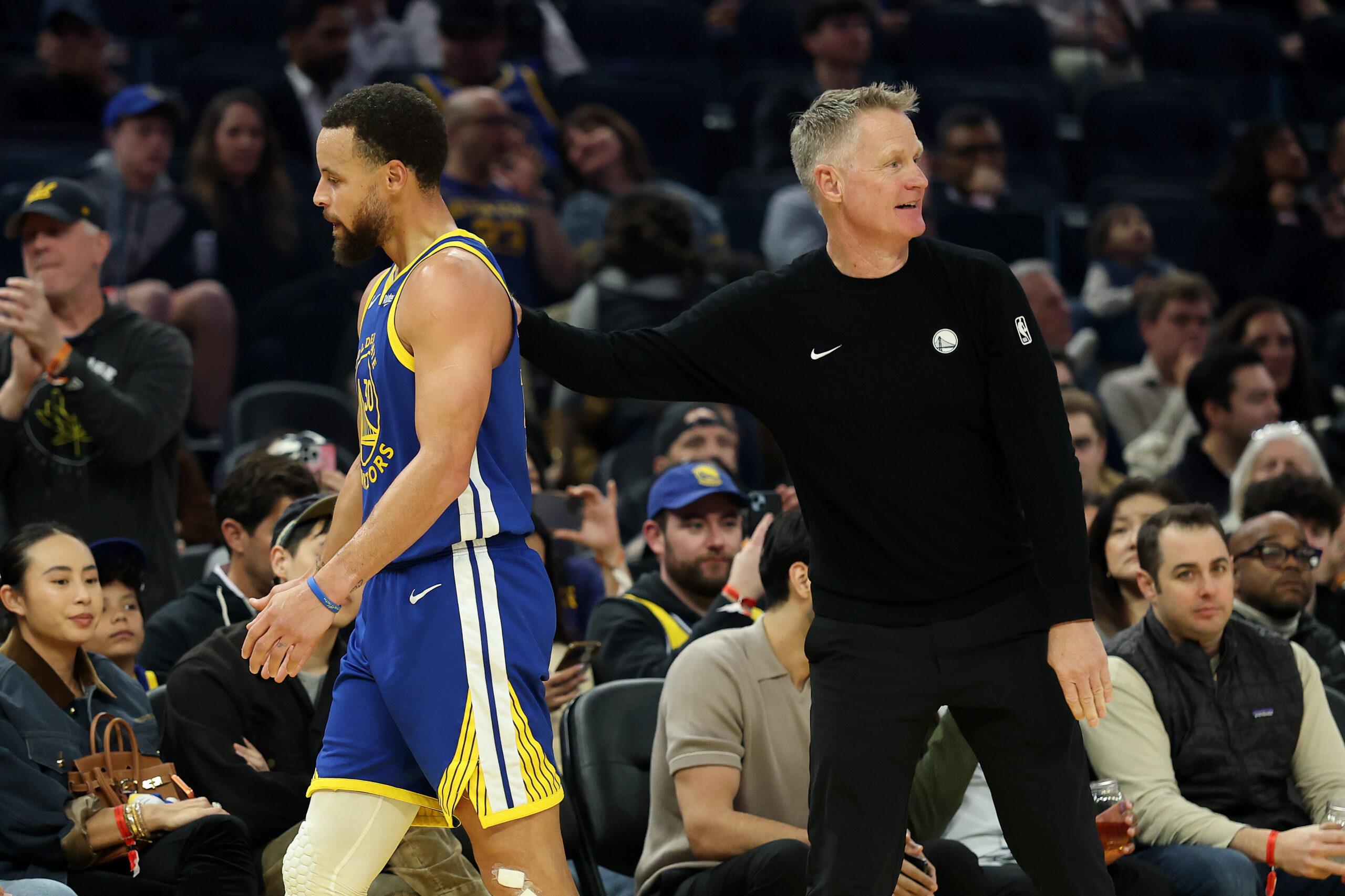
Steve Kerr talks to Steph Curry after he was taken out of the game against the Milwaukee Bucks on January 7
The memorabilia keeps coming—pristine trading cards, glossy photos, a stack of Sports Illustrated covers, a chunk of floorboard from a preseason game in Shanghai—and Curry continues faithfully certifying his past. As for his future? His final chapter? Yes, he thinks about it often, more often than ever.
Especially after watching Butler’s right knee buckle on January 19. When Butler tore his ACL, it effectively ended any hopes of a deep playoff run this spring and cast a pall over next season, too.
“I don’t think I’ve stopped thinking about it since he got hurt, to be honest,” Curry says. “Just the human nature part of it comes in, where you feel like things change drastically. … Me and Coach [Kerr] and Draymond talk about it a good amount, the way our contracts are aligned, the fact that last year, we had such a clear identity and we were so close to getting over the hump.”
The Warriors’ vets believed, to their core, that they were firmly in the hunt before Butler went down. They’d won 12 of 16 games. The offense was humming again, the defense stout. Was another deep playoff run so crazy to consider? After all, they’d shown their potential last spring.
After acquiring Butler, the Warriors won 23 of their final 31 games, knocked out the higher-seeded Rockets in the first round of the playoffs, then won the opener of their series against the Timberwolves. Curry went down with a hamstring injury in that game, and the Warriors lost the next four without him. But they all firmly believe they were one healthy hamstring away from a trip to the Western Conference finals.
“One of my mentors used to say, 'Your perspective will change when the information changes,’” Curry says. “Right now the information is we were close and are still in that fight to be in that championship conversation with this current team—Coach Kerr, myself, Draymond—and then Jimmy gets hurt and the information changes, and you’re trying to figure it out in real time.”
Looking at the bigger picture, Curry says: “There’s still enough of a chance. … I tell Coach all the time: We just want to play relevant, meaningful games, meaningful basketball. Everybody’s trying to win a championship. Meaningful basketball is a catchall for what these last three years have been. It doesn’t mean you’re making a championship every year, the Finals every year. It doesn’t mean you’re guaranteed to win. It’s just all 82 … there’s like that rush of ‘We can make this happen.’”
This much is clear: Curry treasures his longtime partnership with Green and Kerr, and he still has faith in the franchise to build a contending roster around them, even in the wake of Butler’s injury. The track record isn’t perfect, but the Warriors have never stopped trying to extend the dynasty—as evidenced by their acquisition of Butler last year and their reported pursuit of Antetokounmpo now.
However Curry’s final chapter unfolds, it will almost certainly end where it began. Like Bryant, Duncan, and Nowitzki, he wants to be a one-team star. “I never would see myself be in a situation where I’m chasing another championship anywhere else but here,” he says. “There’s a certain mentality that we’re all trying to figure this out together. But it doesn’t pacify the desire to win.”
For now, the Warriors will go as far as the aging Curry can take them. Even now, he has the skills, athleticism, and gravity to anchor a playoff team—unlike Bryant, Nowitzki, and so many others who faded in their mid-30s. Bryant, notably, never surrendered his alpha-dog role, right through that 60-point, 50-shot finale in 2016. But when the time comes, Curry says he can envision shifting into a supporting role as he ages, as Carter, Hill, and others gracefully did. The way he sees it, he’ll always be a shooting threat, which means he’ll always have value, “as long as you’re not a traffic cone on defense.”
“Even off the bench, I can see it as a path,” Curry says. “As long as it’s positioned toward winning at the highest level, then you can kind of be fulfilled. Right now I feel like I still can obviously lead a team, but I don’t need that as the only way to enjoy basketball.”
As for the ultimate decision that so many stars have struggled with—when to walk away for good—Curry has a simple barometer, one that he and James have discussed frequently. It’s not about how many games or seasons they think they have left, but how many offseasons. Because for stars at their level and their age, the offseason routine dictates everything. And it’s grueling.
I never would see myself be in a situation where I’m chasing another championship anywhere else but here.Curry
“It becomes harder and harder to get up in the morning and want to put the time in,” Curry says. “But it’s so rewarding once you get to the end of it, because the easy part now is just going and get back to your happy place”—that is, the games themselves. “That’s not saying this regular season is easy. But it’s the most fun. The offseason is not fun, at all.”
As he goes through his mental checklist, Curry mentions family considerations (as a father of four) and personal sacrifice, team structure, and all the usual competitive factors before settling on the biggest key: “Your joy for the game. Do you get fulfilled still when you’re out there hooping? … I still love it. It’s still my happy place. I still get lost in the game. If that ever goes, then you would know immediately.”
There’s more than one way to go out right, as Kerr can attest, based on his own (albeit more humble) career. In 2003, in what turned out to be his final season, Kerr came off the bench and hit all four of his 3-pointers to help Duncan and the Spurs defeat the Mavericks in Game 6 of the Western Conference finals and clinch a trip to the Finals.
“That moment that I had is still my favorite moment in my career,” Kerr says, placing it ahead of his championship-clinching shot for the Bulls in 1997. “Because I was just, like, hanging on, but I was working so hard to just stay ready. And then I had that moment. It gives me chills just thinking [about it]. I had one moment that year, and then I walked away. And it was the perfect way to go out.”
So maybe Curry never wins another title or makes another Finals. There are still moments of glory to be scripted. Maybe it’s a logo shot that thrills the crowd in Chicago on some cold January night in 2028. Maybe it’s a vintage Curry flurry in a first-round playoff game in the spring of 2029. Maybe it’s getting his 4,500th 3-pointer or his 5,000th. Maybe it’s becoming the first 40-year-old to hit 300 3s in a season. Or maybe it’s helping the next young Warriors star, whoever he might be, get his first playoff win.
Maybe James joins the Warriors next season, and the old rivals turned friends try to make history together. Or maybe the Warriors land Antetokounmpo, and we rip up this entire premise while wondering how many more titles they could grab. Whatever’s next, there will assuredly be magical moments along the way, something that brings Curry satisfaction and fans joy and lets us all savor, just a little bit longer, the brilliance of an all-time great.
When Kerr is asked what kind of conclusion he’d wish for Curry, as his friend and coach, he ticks off the usual items—good health, a relevant team, and, sure, another title run, however unlikely history suggests it may be.
“I want what all the fans want; I want the fairy-tale ending,” Kerr says. “I want him to hit the game-winning shot in the NBA Finals and to walk away with his family.” He pauses, then adds with a chuckle, “And you know, it’s not happening. Just telling you now, it’s not gonna go that way. It doesn’t work that way.” He mentions again that the Warriors are “an aging dynasty,” but he stresses, “All we want is a shot. We want one more shot.”
Yet Kerr sees something else each night as Curry takes the court, a feature more resonant than ring counts or advanced stats.
“He brings fans so much joy watching him play basketball,” Kerr says, “and isn’t that the real value in what we do?”
The truth is, there are no perfect final chapters in this league, no fairy-tale endings. But it doesn’t mean you can’t have a satisfying conclusion or a happily ever after.