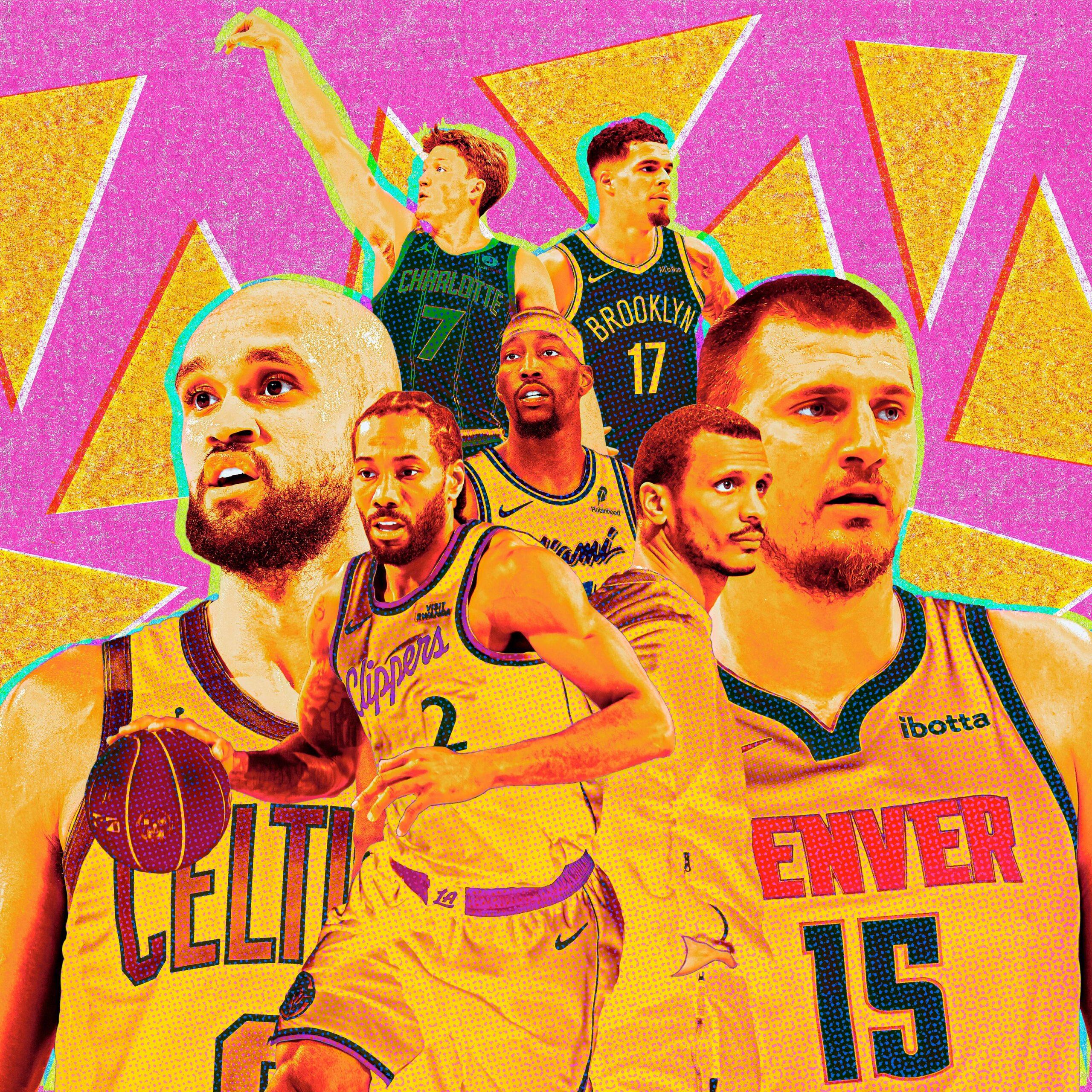

We’re halfway through the most compelling NBA regular season in quite some time. It’s January, the meaningless dog days of the basketball calendar when outcomes aren’t supposed to matter. Instead, there’s an unusual degree of tension throughout the league—Saturday afternoon’s tank-off between the Dallas Mavericks and Utah Jazz notwithstanding. Nearly a dozen teams can look in the mirror and truly believe they either are or will soon be good enough to reach the Finals. On the other side of that coin, the disappointing clubs have become fertile ground for frustrated stars looking for a change of scenery.
So, at the halfway point, with the trade deadline right around the corner, it’s as good a time as any to highlight all the weirdness with some midseason awards, predictions, and made-up superlatives that take stock of where we are and may be headed.


Defensive Player of the Year (Who Isn’t Victor Wembanyama)
I like it when there’s no obvious Defensive Player of the Year. Right now, we have a few relatively new candidates (Chet Holmgren, Scottie Barnes, Amen Thompson) mixed in with some familiar faces (Rudy Gobert, Evan Mobley, Bam Adebayo). You can’t go wrong picking any of those names from a hat. All are more than deserving. I chose someone who almost definitely won’t win DPOY but who deserves to stand on even ground with the consensus favorites: Derrick White.
There’s a long-standing belief that guards and wings can’t impact every defensive possession quite like an imposing rim protector can. There’s definitely some truth to that statement, but the gap between a big man who blocks, alters, and deters a ton of shots at the rim and a guard who can navigate ball screens, switch into almost any position, force turnovers, and pretty much always rotate to the right spot a beat before he’s supposed to is rapidly narrowing.
Why not get yourself a defender who can do all of the above? If you’re looking for counting stats, White is second in stocks, and his 1.5 blocks per game are currently the most in NBA history by anyone shorter than 6-foot-5. If you like advanced numbers, among all players who average at least 30 minutes per game, White ranks second in defensive estimated plus-minus. He’s an elite paint protector, wreaks havoc in passing lanes, and defends every position.
The only players who have a larger impact reducing opposing shots at the rim are Rudy Gobert and Donovan Clingan. Getting to the basket is incredibly difficult when White is on the floor. And when he actually contests a shot there, opponents are shooting only 53.3 percent, a number so low that only two players (Isaiah Stewart and Chet Holmgren) are better. To boot, according to Sportradar, only two players have contested more 3s: Clingan and Dyson Daniels.
White is everywhere. He’s an excellent deterrent in gaps, at the nail, or sliding through the lane to load up on the strongside. According to Bball Index, he ranks in the 96th percentile in help effectiveness rating—a stat that measures how disruptive players are when engaged off the ball—and the only players who actually do engage more than him are big men.
The ball moves faster than a body, but White does whatever he can to mitigate that disadvantage by staying locked into a ready position, always bouncing on his toes, head on a swivel, ready to crash the paint, sprint back out to the 3-point line, scram switch a big man out of a mismatch—whatever it takes. It’s a spectral haunting that combines A-plus awareness with A-plus effort:
There’s always been a cerebral sensibility to White’s game. This season it’s been unleashed in new, creative ways. If Mike Vrabel watched the Celtics game in Portland last month, he would’ve marveled at White’s impersonation of a free safety in the middle of Boston’s 2-1-2 zone—plopped into an ostensible soft spot to flummox offenses that would otherwise attack it:
Every coach’s dream, White can pull off just about anything Mazzulla tells him to do. In Boston’s recent win against the Clippers, he opened the fourth quarter guarding Brook Lopez and crushed the matchup. In December, he was politely asked—as a 6-foot-4 guard—to stop the 7-foot-1 Lauri Markkanen. Watch the plays below, and ask yourself whether Gobert or Holmgren can do what White does. How about Adebayo or Wembanyama? (These are rhetorical questions; the answer is no, they cannot.)
It all sits on top of his signature ability: extinguishing a fast break. The chase-down blocks deserve a blue ribbon, but what makes White truly special is his instincts. The angles he takes at full speed, the way he stays in front of ball handlers and forces them to think a beat longer than they want so that his teammates have time to scurry back and help, how he deals with and initiates contact without committing a foul. It’s elite. Boston’s opponents score 41.1 fewer points per 100 transition plays that come off a steal with White on the court, which puts him in the 98th percentile. Translation: He flips one of the easiest scoring opportunities in basketball on its head better than just about anybody.
Again, big men matter quite a bit. They rebound, alter layups, and intimidate everything that happens in the restricted area by way of being very large. But in an NBA that’s rapidly changing, lightning fast, jarringly random, and less reliant on formulaic pick-and-rolls, defenders with instantaneous reflexes, toughness, and versatility are priceless. Can you chase a shooter off a pindown and deter a shot at the rim? This year, it’s hard to find a defender who checks off more boxes than White.
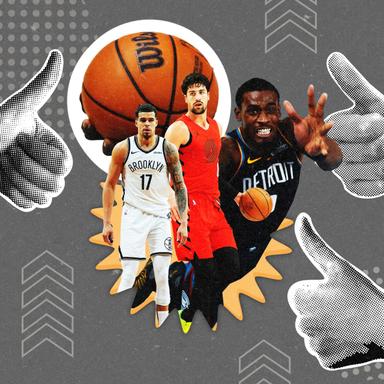
Trade Machine Deep Cuts Who Can Actually Swing a Playoff Game
This is more of an offbeat categorization than some kind of award, but, in anticipation of a trade deadline that probably won’t be very sexy, I wanted to highlight five role players on lottery teams who can make a good playoff team a little better. All are quality contributors who can’t be played off the court in a seven-game series. All should be attainable, given that they’re currently employed by teams that aren’t bending over backward to win games. And all are either on an expiring contract or outperforming whatever they’re owed in the future.
- Saddiq Bey, New Orleans Pelicans: a forgotten man in New Orleans who is pretty much back to where he was before a torn ACL forced him to miss all of last season.
- Ayo Dosunmu, Chicago Bulls: a speedy, physical guard who ranks sixth in 3-point percentage.
- Day’Ron Sharpe, Brooklyn Nets: a gritty offensive rebounder who knows how to find open 3-point shooters amidst all the chaos and tends to define most second-chance opportunities.
- Svi Mykhailiuk, Utah Jazz: good enough to be removed from Will Hardy’s rotation because he was helping the Jazz win too many games.
- Naji Marshall, Dallas Mavericks: tough two-way forward who's only making $9.4 million next season (Dallas is projected to be well into the luxury tax, so if they decide to take a step back and build around Cooper Flagg, shedding salary will be a prerogative).
None of these names will break the internet if they’re traded before the deadline. They aren’t Giannis Antetokounmpo, Anthony Davis, or Ja Morant. But for teams that want to make some noise in the playoffs and keep their powder dry, all can be a bargain.


Most Under-the-Radar Star Who Might Get Traded in the Next Six Months
I would never go out of my way to trade Bam Adebayo. He is, again, a Defensive Player of the Year candidate who can guard every type of player anywhere on the floor: primary playmakers, low-post bruisers, off-ball shooters. None are happy campers whenever Adebayo is within arm’s length. Among centers, Bam’s ability to put it on the floor, pass, and make 3s has shown that he can function in just about any offensive system, whether it’s at a chaotic warp speed or methodically oriented pace. Few players in the league, if any, go harder every night, an untrackable skill that’s all the more impressive when you realize he's rarely in foul trouble.
In an Eastern Conference that may be wide open for the foreseeable future (even more so if Giannis Antetokounmpo goes West), the Miami Heat should look to add talent, not remove their franchise player from the equation. But there’s one slight issue that’s worth keeping an eye on: Kel’el Ware is a gigantic 21-year-old whose length and touch provide seemingly limitless potential. He shoots 3s, rebounds like a demon, and protects the rim. He’s also, apparently, in the eye of Erik Spoelstra—incompatible with Adebayo. The numbers support that opinion. In 785 minutes with Adebayo and no Ware, the Heat’s net rating is plus-9.4. In 266 minutes together, that advantage drops to minus-6.2. The two centers have not shared the floor since January 6. That means no crunch time for Ware, and fewer opportunities to match up against the other team’s best players. (Against the Celtics last Thursday night, Spoelsta benched Ware in the second half and played Nikola Jovic at the five when Adebayo was on the bench. It didn’t go well.)
This doesn’t necessarily mean a dramatic change is on the horizon. Adebayo’s ability to drive, pass, and shoot can make most of his on-court partnerships reconcilable, and he can literally do anything on defense that the Heat need him to do. The Heat can be patient and look at different ways for Adebayo and Ware to complement each other in the future. (Adebayo turning into Ray Allen last week certainly helps.) Or maybe the problem can be solved by trading Ware for more reliable help. But in the meantime, on a team that’s barely above .500, it’s awkward.
There’s another important variable worth mentioning, though: Bam’s appeal around the NBA. Adebayo is 28 years old and a culture-changing presence. His value would translate to just about any environment, from bona fide contenders to bottom-up rebuilds.
How interested in Adebayo would a team be that’s looking to take a big step next season with a bunch of stuff to offer (like the Brooklyn Nets, Utah Jazz, or Charlotte Hornets, who happen to own one of Miami’s first-round picks)? How about a decent club that’s ascending but needs more punch in its frontcourt, like the Atlanta Hawks? What if the Orlando Magic called about swapping him for Paolo Banchero? My point is that if the rest of the NBA knew Adebayo was available, some of the offers to snag him could be too good for the Heat to ignore. Next season, his three-year, $161 million extension kicks in, and Adebayo is currently having the least efficient season of his career for the second year in a row. Translation: the time might be right to really shake things up.
Miami’s books are fairly clean right now, but Norman Powell is about to become an unrestricted free agent, and Jaime Jaquez Jr. and Tyler Herro are up for an extension this summer. There’s a lot of moving parts that need to settle. All the while, Giannis Antetokounmpo could wake up tomorrow and decide he wants to live in South Beach. It’s bizarre to picture Bam in a different jersey, but this organization has been mired in mediocrity for far too long. Change feels imminent.
Most Valuable Player (Since Thanksgiving)
For almost two months, Kawhi Leonard has been a top-five player operating at the absolute peak of his powers. His 662 points since November 27 led the league until Shai Gilgeous-Alexander passed him a few days ago—when, after 24 straight games, a knee contusion Leonard suffered last week in a win over the Pistons kept him on the bench. Over that stretch he’s averaging 30 points, 6.8 rebounds, and 3.5 assists. He ranks third in usage rate with a silly 63.5 true shooting percentage, and the Clippers are (by far) a team-high plus-128 with him on the court and (by far) a team-low minus-74 when he sits.
The shooting splits (49.9/39.9/93.3) are absurd, and the shotmaking is absurd. He’s converting 80 percent of his looks at the rim and 40.4 percent above the break. Kawhi is currently one of six or seven players alive who can make an entire defense feel like it’s all-hands-on-deck after they hit two or three shots in a row. And on the other end, as a two-time Defensive Player of the Year, Leonard is tilting games on their axis by reestablishing himself as the guy who can seemingly snag the ball whenever he wants. He’s averaging more steals than turnovers, ranks first in deflections, and, so far this season, leads the NBA in steals per foul.
Extended sidebar, because I find the “best two-way player” debate that Jaylen Brown stirred up a few weeks ago to be really compelling. Here’s a look at how Leonard compares with Brown for the entire season in a bunch of statistical categories.
It’s an overview of two incredible players. One is deservedly praised for the miraculous year he’s having for this season’s most surprising team. The other is, by and large, seeing his greatness overshadowed by his team’s disappointing overall record and off-court drama he may or may not have anything to do with.
With all due respect to Brown—whom I voted to start in the All-Star game and who is having a mind-blowing MVP-esque season—the most notable difference between him and Leonard, to me, is how they’re treated by the other team. Defenses don’t quiver when Brown takes a contested jumper against one-on-one coverage. They switch screens when he’s the ball handler at a higher frequency than they drop or show. Blitzes are rare. Some of that’s to limit the voluminous 3-point shooting Brown has around him, but even when he gets a mismatch, the switches that are designed to encourage hero ball don’t induce total panic 20 feet from the basket.
Meanwhile, Leonard is blitzed at twice the rate Brown is, per Sportradar. He commits way fewer turnovers and is way more efficient. When he gets a smaller defender on him, it’s a five-alarm fire. He’s used to this type of attention, though, and toys with double-teams that every so often grip the attention of a third defender.
On top of all that, Leonard is getting to the line quite a bit, leads the league in free throw percentage, and, when isolated on the wing, presents an unbothered affect that sucks the soul from whoever’s in front of him. It’s a drawling puppet master, setting defenders up throughout a game, knowing he has an endlessly precise collection of counters to solve every adjustment.
The Clippers are in 10th place. Leonard obviously won’t seriously compete for MVP, and I’d be surprised if any voters even granted him a pity fifth-place spot on their official ballot. NBA fans fuss over his injury history, even as he disembowels their favorite team in real time. All that’s fine. Until Kawhi no longer strikes fear in other professional basketball players, I’ll be here to remind whoever will still listen that he’s one of the greatest all-around players in league history, a generational winner, and still able to reach a level of dominance that 99.9 percent of the league can’t reach.
Most Desperate Team Heading Into the Trade Deadline
If an award were given to the individual who was “Most Likely to Bury His Own Team 10 Feet Underground Before Salting the Earth Under Which It Rests,” then Bucks GM Jon Horst would win it in a landslide. Horst’s commitment to keeping Giannis Antetokounmpo on the Bucks runs parallel to the monomania that drove Francis Ford Coppola to make Megalopolis. But I wouldn’t call an 11-seed that has no chance to win anything meaningful “desperate.” This category speaks to something else.
I won’t say the title is up for grabs. But more teams than normal can reasonably say they’re one player away from making a deep playoff run. And since it’s impossible to detach desperation from expectations (and the amount of money it took to create them!), the Cleveland Cavaliers are pretty desperate. Coming off a pair of impressive wins against the Philadelphia 76ers, Cleveland is currently 24-20 and ranks 10th in net rating. That’s not bad. It also entered this season with by far the most expensive payroll in the league as a shoo-in to make the conference finals. Whenever the Cavs appear to steady their ship, they lose a home game to the Jazz. Their net rating when Darius Garland, Jarrett Allen, Evan Mobley, and Donovan Mitchell share the floor is plus-10.6, but the Cavaliers are just 7-6 when those lineups appear in a game. Garland is hurt again, too, injuring the foot he didn’t have surgery on over the summer while diving for a loose ball a few days ago. This brings me to my favorite fake trade proposal.
Every team that wants to win a championship should place at least one call to Brooklyn Nets GM Sean Marks about Michael Porter Jr. What if Cleveland offers Darius Garland? Do the Nets jump at that opportunity? Do they scoff? Would the Cavs ask Brooklyn for a pick, being that they’re giving up the younger player on a longer contract? Would the Nets get pissed because they’re giving up the better player? Which side is more concerned with their potential new acquisition’s injury history? I don’t know the answer to these questions. What I do know is that Porter would be a terrific fit in Cleveland and that his size makes him far more suitable for postseason play (i.e., defense) than Garland has been.
Garland is awesome, though—before he got hurt last week in Philly, he was starting to move with the same zip he had before turf toe temporarily disrupted his career last year. He’s fantastic off the ball, is basically impossible to stop in space, and provides the same type of gravity MPJ has, with more dynamic on-ball versatility. If the Nets want to sell high on Porter, this is a very good way to do it. Garland’s defensive limitations are less severe on a team that isn’t trying to win the NBA title anytime soon. (And taking Porter off the Nets would likely improve their odds in the lottery.)
On the other side of things, Cleveland gets to add the Eastern Conference’s Lauri Markkanen, a bucket-getting All-Star who barely touches the ball and makes everyone else’s life so much easier. Losing Garland would force them to modify their offense and put the ball in Mitchell’s hands even more; Allen would permanently lose his primary pick-and-roll partner, which would suck. But the playoffs and the regular season are two very different animals. MPJ has a ring. He has a track record of holding up defensively in the playoffs and would provide even more heft on the glass while easing some of the strain Mobley feels having to insulate Cleveland from any size-related vulnerability felt in a playoff setting when any combination of Garland, Donovan Mitchell, and Sam Merrill share the floor. Fewer cross matches in transition and opportunities for the offense to hunt mismatches in the half court will go a long way. (And I haven't even mentioned the ancillary benefit of keeping Porter away from the Detroit Pistons, a younger division rival that has overtaken the Cavaliers’ corner.)
This trade, combined with their eventual return to full strength, might make Cleveland the best team in the East. The Cavs already launch a ton of 3s. If they can add one of the best movement shooters alive and reinforce their defense in one fell swoop, this team would probably be favored against any Eastern Conference team in a seven-game series.
Most Intriguing Trio That Can Tilt the Eastern Conference
With a hat tip to my semi-regular “While You Were Scrolling” column, I wanted to shout out the three best players in Philadelphia as they develop on-the-fly chemistry and make an earnest attempt to reach the NBA Finals. Now that Joel Embiid is no longer the team’s best or most important player, this is a reasonable goal.
In 267 minutes, the Sixers have a plus-8.5 net rating when Embiid, Tyrese Maxey, and Paul George share the court. Whenever something cool happens that directly (or indirectly) involves all three of them, it’s meaningful. A good example came a few weeks ago against the Knicks, when Philly repeatedly ran an empty corner pick-and-roll with Maxey and Embiid on the left side of the floor.
On the first go-around, New York decides to guard it with three defenders, sliding OG Anunoby over to take away Embiid’s dive as Mikal Bridges and Mitchell Robinson stay on Maxey. It’s not a bad idea at first, but it turns into one when the ball gets swung to PG in the opposite corner as he pops out of a pin-in set by Dominick Barlow.
On the next play, when Maxey hits Embiid with a pocket pass, Anunoby glues himself to George while Karl-Anthony Towns rotates over as the third defender. Embiid makes the easy pass to Towns’s man, Barlow, cutting to the basket. It’s Whac-A-Mole.
Some of Philly’s success in that game was thanks to the Knicks not having Josh Hart and looking a bit stiff with their double-big lineups. But the problems Philly is able to create with all the attention Maxey, Embiid, and George demand can’t be ignored.
Obvious health concerns aside, these are three players who evince a bygone era that typically rewarded teams that collected max contracts with little concern over the supporting cast. But Philly’s three max contracts feel less damaging by the day. Not only are George and Embiid healthy, but the Sixers have legitimate depth and athleticism behind them. If they grab another shooter at the trade deadline (they rank 25th in effective field goal percentage), they just may, at long last, survive the second round.
Midseason Awards!
It’s pretty straightforward here: my actual awards, meant to celebrate everything that happened in the first half of the season.
MVP: Nikola Jokic
The minutes disparity between Jokic and SGA isn’t nothing; Denver’s three-time MVP has played about 250 fewer minutes than Gilgeous-Alexander, who’s missed only two games all season. But it’s also not everything when comparing two great players who, in my opinion, aren’t that close. If Jokic and SGA were neck and neck as offensive players, then the argument about Gilgeous-Alexander’s defense being a reasonable tiebreaker would hold weight. But it simply isn’t the case. Jokic leads the NBA in rebounds and assists and generates 7.8 more points per 100 possessions than SGA does for his team. He’s far more efficient, with better advanced catchall numbers, and the Nuggets are in third place, with the league’s best offense. Some disagree with me, but I don’t think this debate is irreducible: When the best player in the world is having his best season, he’s also the MVP.
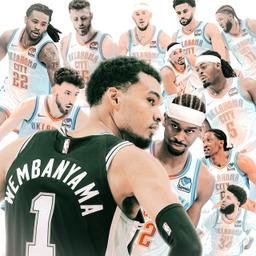
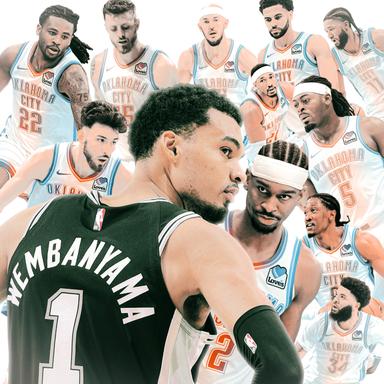
Defensive Player of the Year: Victor Wembanyama
Water is wet. Grass is green. Social media is bad for humanity. Victor Wembanyama is the best defender in the NBA.
Rookie of the Year: Kon Knueppel
Is there a world where Knueppel and Cooper Flagg share this award? A little Jason Kidd and Grant Hill, Part Deux? Probably not. As clearly awesome—and better on defense—as Flagg is, Knueppel is significantly more efficient while averaging more points per game, with the ball in his hands far less often. They’ve been comparable playmakers, too, but Knueppel has the overall edge.


Coach of the Year: Joe Mazzulla
During a recent conversation I had with an NBA executive whose team recently lost to the Celtics, he called them an “absolute buzz saw” and didn’t dismiss the idea that they could reach the NBA Finals. This team is in second place, with the second-best offense in the league. Therefore, Mazzulla might be the best coach in basketball.
Sixth Man of the Year: Isaiah Stewart
Stewart might be the best rim protector in the league! Opponents are shooting 43.5 percent at the rim when he’s close enough to contest them—first in the NBA by a mile. Meanwhile, the Detroit Pistons are in first place because their defense is elite. 2 + 2 = 4.
Most Improved Player: Deni Avdija
This is inarguable. The man might crack a few MVP ballots.