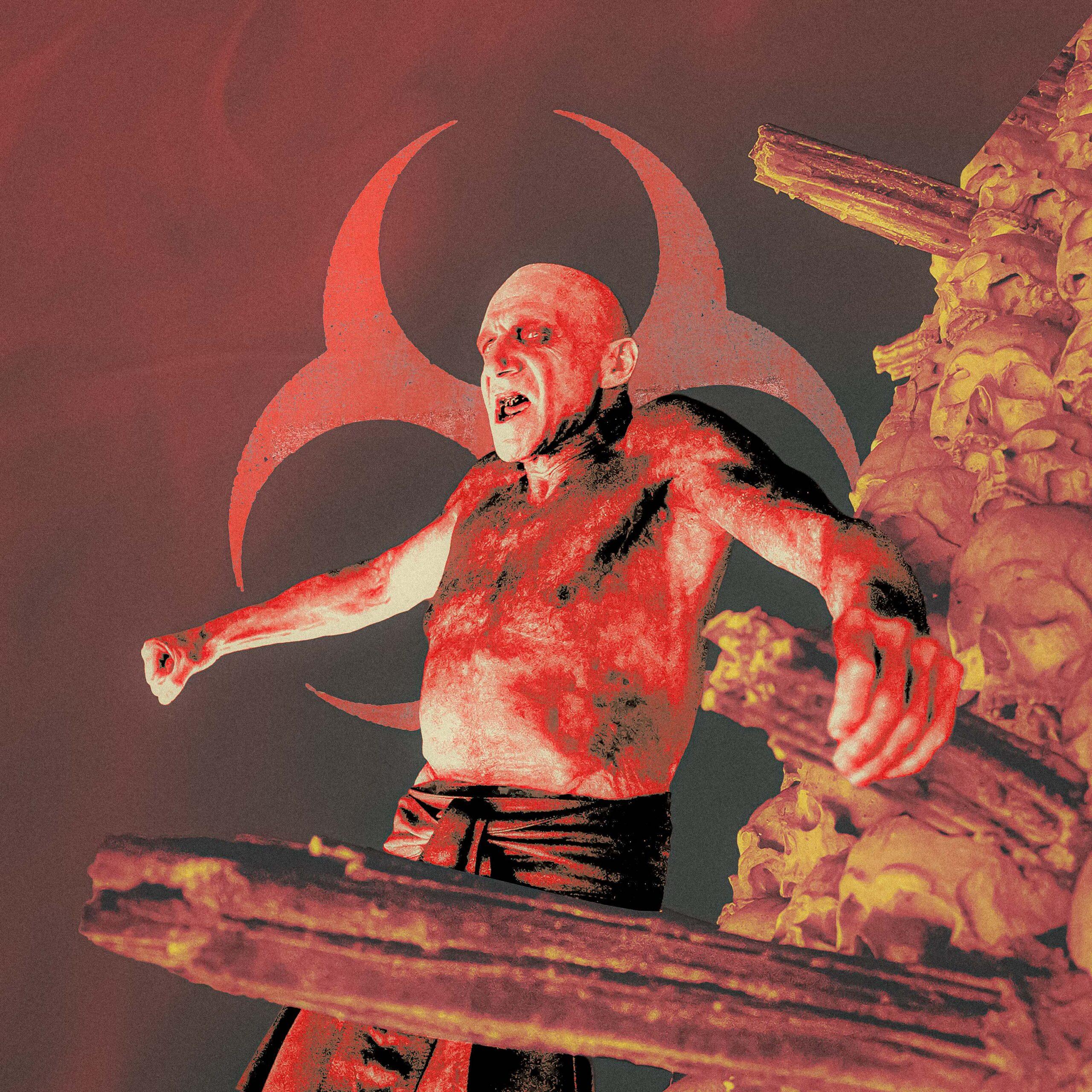

Eighteen years elapsed between 28 Weeks Later and the release of its sequel, 28 Years Later. Now, just seven months after director Danny Boyle and writer Alex Garland returned to their rage virus–infected world to launch a new film trilogy, the latest entry in the revitalized horror franchise has arrived: 28 Years Later: The Bone Temple.
Directed by Nia DaCosta (The Marvels, Candyman) and written by Garland, The Bone Temple seamlessly picks up where 28 Years Later left off and carries the trilogy’s momentum into the new year. The film not only dutifully builds on its predecessor, but it also sets up the forthcoming final installment, deftly connecting the three new Garland-penned movies. But The Bone Temple, which was shot back-to-back with 28 Years Later, is much more than just an intermediary. Thanks to another gem of a script from Garland, the stylistic flourishes DaCosta adds to an idiosyncratic franchise, and some indelible acting performances, it’s also a wildly entertaining self-contained film.

The Bone Temple follows Spike (Alfie Williams) as he’s forced to join the ranks of the eccentric, tracksuit-wearing gang—known as the Fingers—that saved him from an infected horde during the jarring conclusion of 28 Years Later. Led by Sir Lord Jimmy Crystal (Jack O’Connell), a sadistic, devil-worshipping cult leader, the Fingers travel the quarantined British Isles torturing innocent survivors and slaying the infected with a carefree ease. Before long, Spike and his new companions/captors cross paths with Dr. Ian Kelson (Ralph Fiennes) at his imposing bone temple, where his informal experiments with a familiar (and hung) alpha named Samson (Chi Lewis-Parry) have taken a remarkable turn.
The last chapter of the 28 Years Later trilogy won’t have nearly as fast a turnaround as The Bone Temple did; the untitled film wasn’t even green-lit by Sony Pictures until December, after The Bone Temple received a strong reception at early screenings. But Garland’s script is already finished, and though Boyle hasn’t officially been announced as the threequel’s director, he’s previously expressed his desire to finish off the trilogy he started. When The Hollywood Reporter spoke to the English filmmaker in June and asked whether he’d be back to helm the third film if it received the funding, Boyle said: “Absolutely. That’s the idea. That’s the plan. Plans. Ha! What do you do to make God laugh? Tell him your plans. But, but yes, that’s the plan.”
It may take some time for us to see the rest of that plan unfold, but there’s enough to chew on in The Bone Temple for even Samson to be satiated. And the film has also shown us exactly where this trilogy is headed next. Let’s talk about it.
The Death of Kelson and the Rebirth of Samson
For as much as the 28 Days Later franchise presents the infected as terrifying, mindless creatures, the alphas showcase how the rage virus has evolved over the film series’ extended passage of time. They are bigger, faster, stronger, and, most importantly, smarter than your average zombie. They lead packs of infected, and they can tear the heads off of their victims with their bare hands.
In 28 Years Later, Samson is introduced in a horrifying, gruesome fashion. He rips off the head of a Swedish soldier, pulls out his spine in one clean motion, and then uses it as a weapon against one of the soldier’s comrades. It isn’t until Samson is greeted by Kelson for the first time that he’s referred to by the name that the good doctor has bestowed upon him, on account of his biblical strength and luxurious hair. Unless Samson is anesthetized by Kelson’s blow dart concoction of morphine and xylazine, he seems to be as feral and bloodthirsty as the rest of the infected.
Still, Samson has one curious moment on an abandoned train when he stops chasing Spike and his mother, Isla (Jodie Comer), for a moment to pick up the corpse of an infected pregnant woman who had just given birth. He then resumes his pursuit with twice as much urgency. The infected alpha otherwise shows few signs of having any deep-rooted remnants of his former humanity. The Bone Temple builds on these narrative foundations as it develops Kelson and Samson’s relationship into the unexpectedly tender heart of the film.
While Kelson’s true nature remained a mystery for much of 28 Years Later, The Bone Temple focuses more on his perspective as it provides a window into his solitary way of life at his ever-expanding monument to the dead. With Fiennes delivering a mesmerizing performance that’s as funny as it is poignant, Kelson reemerges as a protagonist who helps elevate this film into one of the most impactful entries in the franchise. The lonely doctor sees a glint of hope—and humanity—buried somewhere deep within Samson’s enraged mind, and he sets out to unearth it.
At first, Kelson continues to quiet Samson’s madness with his morphine-xylazine cocktail, repeatedly putting him into a tranquil state that may have a positive, lasting effect on him. He speaks to Samson and heals his wounds; he even dances with him to the tunes of Duran Duran, all while he’s lathered in bright-orange iodine and Samson’s not-so-private parts are hanging out. (At some point Kelson gifts him with a loincloth, which Samson dutifully wears.) In one such encounter, Kelson boldly takes some of his own medicine and falls asleep next to the blissed-out Samson, only to wake up alone with his head still firmly attached to his body.
When Kelson concedes that his morphine supply is running low, he makes the decision to humanely euthanize Samson. But just as he’s about to inject him with a syringe, Samson looks up into the starry night and utters one word: moon.
It’s a stunning development, and the first instance in the series of an infected host speaking. Kelson wisely theorizes that the rage virus inflicts the victim’s mind with psychosis, and he develops what he hopes could be a cure for Samson. He’s forced to expedite his treatment plan when Jimmy and the Fingers arrive at his bone temple, believing Kelson to be Satan himself, and so he misses the moment when the furious fog clouding Samson’s brain is suddenly lifted. As Samson returns to the train where he met Spike and Isla in 28 Years Later, his memories start to flood back. Samson’s visions of his past life begin to blur into reality, and he awakens from his daydream with a clear mind—along with an infected horde surrounding him and ready to strike.
In a devastating turn of events, Kelson dies trying to help liberate Spike from Jimmy and his crew’s clutches. But he spends his final moments with his unlikely friend: Samson returns to his side just in time to say, “Thank you, Kelson.” And with his last breath, Kelson replies, “Memento mori”: Remember you must die.
Kelson’s death may extinguish the hope of a cure spreading beyond this single alpha, yet Samson remains as a living testament to Kelson’s greatest achievement. His very existence presents the possibility that this strange, extraordinary doctor’s improbable discovery could somehow be replicated. But the last time someone tried to develop a cure in the 28 Days Later franchise, it didn’t go so well. In 28 Weeks Later, a safe zone in London breaks down when an infected woman—who appears to have a genetic immunity to the rage virus—is taken in to be studied. Her son shares her immunity, except they’re both asymptomatic carriers. His survival at the end of the movie allows the virus to spread beyond the United Kingdom’s borders into the rest of Europe.
That said, 28 Weeks Later was the weakest entry in the franchise, and the sole movie that Boyle and Garland played no major part in. Ahead of 28 Years Later, Boyle noted in interviews that the events of 28 Weeks Later wouldn’t factor into his return to the franchise; his film even features an opening line of text that quickly dispels its significance.
“There’s nothing wrong with 28 Weeks Later,” Boyle told Collider in June. “We just decided not to follow those story elements. And it’s a bold choice we decided to declare up front by saying the rage virus was driven back from mainland Europe.”
Even if 28 Weeks Later bears little to no importance to the 28 Years Later trilogy, the story demonstrated the challenges of developing a cure amid the rapid decline of the world’s institutions. Now, Kelson may have found a simpler solution that heals the infected victims’ minds (if not their bodies). But almost three decades into the age of rage, resources are even harder to come by. And with the doctor no longer around to replicate his work, the prospect of salvation may be fleeting.
The Bone Temple opens up all sorts of new narrative avenues for its sequel to explore, with Samson becoming a conscious, self-aware infected. The other infected immediately recognize Samson as different, despite his unchanged appearance, and so the hulking alpha has been reborn into a life where everyone will want to kill him. Yet there is at least one other infected anomaly: the baby, whom Spike named Isla. Spike brought her back to the safety of Lindisfarne at the end of 28 Years Later, and her miraculous birth could also have massive implications for this dying slice of the world. If Samson is indeed the father, a reunion might be in order.
Spike and Kelly
Kelly (Erin Kellyman), formerly known as Jimmy Ink, really believed that Kelson was Old Nick. It’s hard to judge her naivety given the awe-inspiring pyrotechnic performance he delivered at the epic, hellish bone temple. But the deadliest Jimmy in the crew didn’t believe in her Teletubby-loving leader. When Sir Lord Jimmy Crystal stabs Kelson and is revealed to be an even bigger fraud than the Iron Satan, she turns against him and kills the lesser Jimmys the moment they step in to defend their namesake master. However, she spares the latest initiate and her new traveling companion: Spike.
The Bone Temple doesn’t reveal much about Kelly’s origins, but she’s quickly established as the only Jimmy who sympathizes with this lost tweenage boy who clearly doesn’t belong in a merciless satanic cult. Jimmy Ink protects Spike from the Fingers until they’re the only two tracksuits left standing. And after she fittingly crucifies Jimmy Crystal on an upside-down cross, immortalizing him on the same inverted symbol he’d worn around his neck since childhood, Kelly reintroduces herself to Spike with her proper name before they leave their lives as Fingers behind at the Bone Temple.
It seemed possible that Spike would lead his new friend back to the comfort of his home on Lindisfarne. After all, the kid had suffered a pretty rough introduction to the harsh outside world between 28 Years Later and The Bone Temple. But that’s not at all what happens.
The last time we see Spike and Kelly in The Bone Temple, they’re sprinting away from an infected horde in a satisfying cliff-hanger that tethers the 28 Years Later trilogy to the movie that started it all: 28 Days Later.
The Return of Jim
“Those who forget history are doomed to repeat it.”
Cillian Murphy’s Jim recites this famous George Santayana quote as he helps prepare his daughter, Sam (Maiya Eastmond), for the history exam he’s going to give her the next day. The line comes within the context of a lesson on World War II, but it hits different in a postapocalyptic world—especially when it’s delivered by the man who kick-started the horror franchise in 2002.
At the end of 28 Days Later, Jim—a former bike courier—has found a peaceful home in the countryside with his new romantic partner, Selena (Naomie Harris), and a young survivor named Hannah (Megan Burns), whom they’ve bonded with after their run-in with a group of creepy, lustful soldiers. The movie concludes with them unfurling a massive help sign to a jet flying overhead, but it’s unclear if their message is received.
Almost three decades later, we find Jim with a girl we can probably assume to be his and Selena’s daughter, living in a similarly remote setup in the countryside. The closing sequence in The Bone Temple is brief, but it’s enough to show that Jim has taught Sam well and has prepared her for any encounters with the infected. Sam is the one who hears the approaching horde before they go outside and see Spike and Kelly running for their lives far in the distance. “Do we help them?” Sam asks her father.
“Of course we do,” Jim replies, with a rifle at the ready.
The final sequence sets up not only the imminent meeting between the former Fingers and Jim but also the return of the franchise’s original protagonist as a central character. It feels almost unnatural for a 28 Days Later movie to lean into a modern franchise-building story tactic, yet it’s also fitting that—after all this time—Jim calmly reemerges as a father and a teacher in a muted scene.
“When you think of franchise filmmaking, you don't think about movies like this,” DaCosta recently told Entertainment Weekly. “So I wanted to stay true to that, as well. I didn't want it to be like, 'Here comes the hero on his horse.' No, this is f---ing bike messenger Jim. He can barely run up some stairs in the first film. Now he's a dad. And so I wanted to present him that way."
There’s still much to learn about the new Jim and Sam, as well as the whereabouts of Jim’s other companions: Selena and Hannah. When Boyle was asked at the Bone Temple premiere about whether Harris would be reprising her role from 28 Days Later, he said, “At the moment it’s just Cillian.” Other details about the upcoming conclusion of the trilogy are scarce. Boyle, who spoiled Murphy’s cameo in The Bone Temple long before its release, previously teased that Jim would be a “very dominant element in the third film” and that it would be “a bigger story about redemption” centered on the former bike courier.
Whatever this threequel ends up becoming, DaCosta and her team did a tremendous job of ramping up the anticipation of its arrival with a standout blockbuster to start the new year. It’s rare for any modern franchise to turn around a pair of films in quick succession like this, and even rarer for them to be executed with two distinct creative visions that complement each other in such an exciting and refreshing way. Expectations will be high whenever the 28 Years Later saga returns for its final chapter. But with Murphy back to help it stick the landing, Boyle and Garland have the opportunity to tie together what is shaping up to be a special trilogy.