If there was any doubt that A Knight of the Seven Kingdoms would faithfully adapt George R.R. Martin’s 1998 novella, The Hedge Knight, the first episode of the series put it to bed. Here are the opening lines of Martin’s work:
The spring rains had softened the ground, so Dunk had no trouble digging the grave. He chose a spot on the western slope of a low hill, for the old man had always loved to watch the sunset. “Another day done”—he would sigh—“and who knows what the morrow will bring us, eh, Dunk?”
Well, one morrow had brought rains that soaked them to the bones, and the one after had brought wet, gusty winds, and the next a chill. By the fourth day the old man was too weak to ride. And now he was gone. Only a few days past, he had been singing as they rode, the old song about going to Gulltown to see a fair maid, but instead of Gulltown he’d sung of Ashford. Off to Ashford to see the fair maid, heigh-ho, heigh-ho, Dunk thought miserably as he dug.
Pretty much everything that happens in the opening minutes of the episode comes straight from the page—even the line where Dunk insists he didn’t eat that pie in Maidenpool. Some of Dunk’s internal thoughts in the book are conveyed in the show via his talks with his horses (a good way to deliver exposition without relying on narration), but for the most part, if you are a fan of Martin’s novellas, these scenes are exactly what you imagined in your head while reading.
But there is one giant problem with making a faithful adaptation of The Hedge Knight: The novella is only about 30,000 words long. You can listen to the entire audiobook in under three hours. The novella probably could have been adapted into a movie, but instead, HBO opted for six episodes of television. The running time for the entire season is just shy of 3.5 hours. Think about that: How many adaptations take longer to watch than to read?
To turn The Hedge Knight into a season of TV—even one with episodes all under 45 minutes in length—showrunner Ira Parker needed to expand in some areas. At first, it’s just small things. For example, the story that Plummer, the steward of Ashford and master of the games, tells Dunk about the “Ashford Chair” is completely original. Then we meet the two sex workers outside Lord Manfred Dondarrion’s tent. Those characters are new as well—in the novella, Dunk finds Manfred without much issue. But the couple of conversations Dunk has with those two women not only add a little color to the world, but they also give the audience some helpful exposition about what differentiates a hedge knight from a regular one (“It’s like a knight, but sadder”). The scenes also illustrate Dunk’s general discomfort around women, something that is important to his character but in the novella is mostly revealed through his interior thoughts.
But these are relatively minor changes. The type of adjustments we’d expect from any story adapted from the page to the screen. Then, in the final third of the episode, the show takes a big risk with the feast under Lord Lyonel Baratheon’s pavilion. None of this is in the novella. Lyonel’s speech, the dancing, his confronting of Dunk—all original. In fact, Lyonel is mentioned only once in the first half of Martin’s novella, when Dunk notes his pavilion as he rides into Ashford Meadow. “The crowned stag was for Ser Lyonel Baratheon, the Laughing Storm,” Dunk thinks. That’s it for Lord Lyonel until much later. He doesn’t show up in person until the tournament begins (and even then, it’s at a distance). And when he does, he isn’t particularly verbose—he gets more dialogue in this episode than he does in the entirety of The Hedge Knight (and he has yet to reappear in any of Martin’s other works).
That makes this scene in the pavilion a bit of a gamble. It’s the first time the writers drift dramatically from Martin’s writing. Get it wrong, and it could put the entire series in jeopardy and have HBO wondering whether The Hedge Knight should’ve been turned into a movie.
Luckily, though, they didn’t get it wrong. The scene is true to the characters, tone, and themes of Martin’s novella. And it fleshes out a great many details for viewers. It’s not until Lyonel is properly introduced in the novella that we learn he’s nearly as big as Dunk—here we can immediately see that, and we see how intimidating and eccentric he can be, what with his almost violent dancing and the contentious conversation he has with Duncan. We see how totally clueless Dunk is in any setting around nobility—he bumbles around Lyonel’s pavilion with a pastry in hand and dances like a middle schooler. (“Where I grew up, you learn to go unnoticed is all,” he explains.)
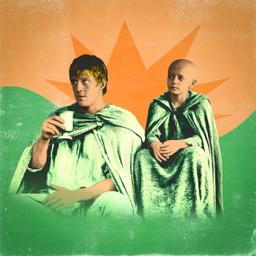
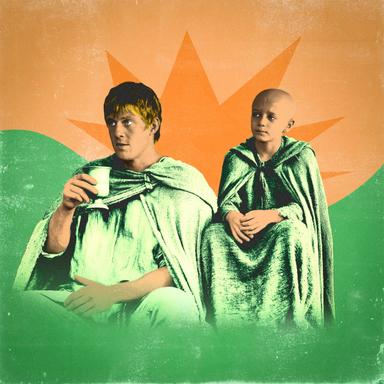
Finally, this scene reinforces the stakes for Dunk. It reveals that if he loses in the coming tourney, he can’t ransom back his arms or horse. As Lyonel tells him, “A knight with no horse is no knight at all.” The games may be good fun for a landed knight or a great lord, but for Dunk, everything is on the line. And as Lyonel sees it, Dunk has “no chance.”
This scene may not be in The Hedge Knight, but the sentiment it expresses is—on numerous occasions. Take this passage from the novella, illustrating Duncan’s line of thinking as he heads through the tourney grounds and sees the setup for the jousting:
Dunk stared at the grassy lists and the empty chairs on the viewing stand and pondered his chances. One victory was all he needed; then he could name himself one of the champions of Ashford Meadow, if only for an hour. The old man had lived nigh on sixty years and had never been a champion. It is not too much to hope for, if the gods are good. He thought back on all the songs he had heard, songs of blind Symeon Star-Eyes and noble Serwyn of the Mirror Shield, of Prince Aemon the Dragonknight, Ser Ryam Redwyne, and Florian the Fool. They had all won victories against foes far more terrible than any he would face. But they were great heroes, brave men of noble birth, except for Florian. And what am I? Dunk of Flea Bottom? Or Ser Duncan the Tall?
In the show, we do see Dunk ride into Ashford Meadow and stare thoughtfully at the jousting grounds. But the audience can’t fully get into his head. In the novella, he repeatedly agonizes over the tourney in his mind, but the show has to bring that out as dialogue. So that scene in the Laughing Storm’s tent not only brings some pizzazz and fleshes out a fun Baratheon character, but it also helps establish the stakes and Duncan’s doubts. It’s pretty brilliant.
That’s the major addition. But the episode includes another change, in the final scene. When Duncan and Egg see a falling star in the night sky, they comment on how it could bring them luck. This plays out more internally in the novella:
Egg soon fell asleep beside the dying fire. Dunk lay on his back nearby, his big hands behind his head, gazing up at the night sky. He could hear distant music from the tourney grounds, half a mile away. The stars were everywhere, thousands and thousands of them. One fell as he was watching, a bright green streak that flashed across the black and then was gone.
A falling star brings luck to him who sees it, Dunk thought. But the rest of them are all in their pavilions by now, staring up at silk instead of sky. So the luck is mine alone.
It’s a really beautiful thought and the perfect note to end an episode on, but it’s a thought. To translate it to the screen takes, again, dialogue. And the only person here with Dunk is Egg. So in the show, Egg remains awake, and Martin’s prose comes nearly verbatim out of his mouth: “A falling star brings luck to those who see it,” Egg says. “All the other knights are in their pavilions by now, staring up at silk instead of sky.”
And the final note now becomes a moment of connection between our main characters. “So, the luck is ours alone?” Dunk asks Egg.
Martin’s novella was already excellent. But for the show to shine, it needed to prove that it could adapt Duncan’s internal monologue to the screen and flesh out characters to pad the running time. Through the first episode, there’s little doubt it can.