‘A Knight of the Seven Kingdoms’ Won’t Be Peak ‘Game of Thrones.’ That’s Not a Bad Thing.
The newest Westeros-based series will be much smaller in scale than ‘Thrones’ or ‘House of the Dragon’—which is thrilling in a different kind of way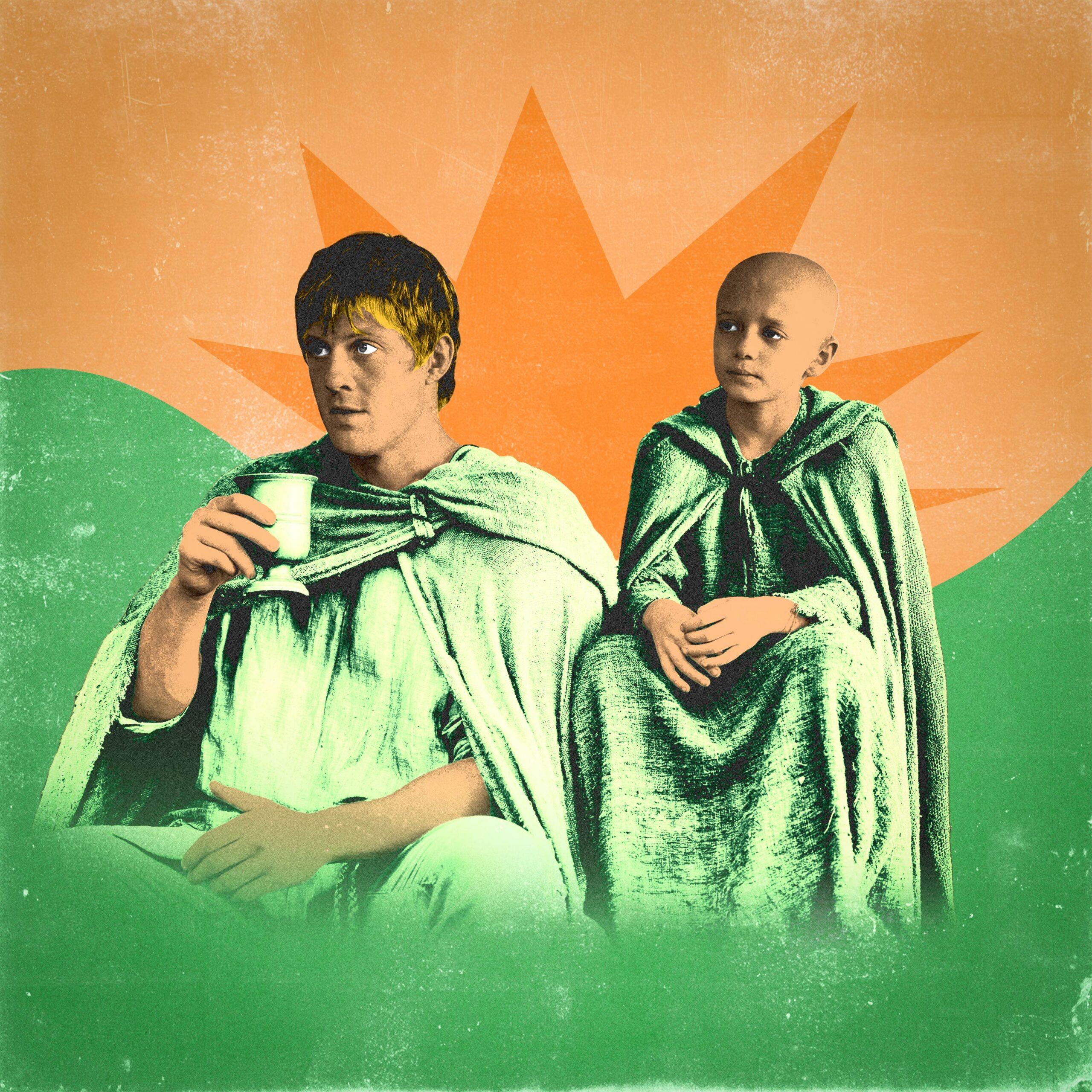

When we last left Westeros, the great houses were marching to war. In the final episode of Season 2 of House of the Dragon, which aired all the way back in August 2024, armies and dragons began to mobilize. The long-awaited Dance of the Dragons had begun.
Westeros returns to our TV screens this week—but we’ll still have to wait for that infamous civil war. This Sunday, HBO is launching its latest adaptation of the A Song of Ice and Fire franchise with A Knight of the Seven Kingdoms. The newest series hails from George R.R. Martin’s Tales of Dunk and Egg, a trilogy of novellas he wrote from 1998 to 2010.
But A Knight of the Seven Kingdoms will be much different from House of the Dragon or Game of Thrones. This is a tale with small stakes. The future of the realm does not hang in the balance. There are no dragons, and Westeros is at peace. Winter isn’t coming. Kingdoms is more or less a weekly buddy comedy that tells the life stories of Dunk, a lowly hedge knight, and Egg, his young squire and companion. There will be some jousting and some fighting but, overall, much less spectacle.
That’s not a bad thing. In fact, it might be the single best thing about this series. Dunk and Egg provide a breath of fresh air for the Song of Ice and Fire universe, as well as a different perspective of Westeros. Where HBO’s first two Westeros-based series are almost entirely about big noble houses and their machinations to obtain wealth and power, A Knight of the Seven Kingdoms is about a knight so humble that he initially forgets to title himself as “Ser Duncan” and not just “Dunk.”


So where are we in Westerosi history? A Knight of the Seven Kingdoms takes place roughly 80 years after the events of House of the Dragon and roughly 90 years before the events of Game of Thrones. And the Westeros we find ourselves in feels split down the middle between both those series. Like in Dragon, Targaryens still rule the Seven Kingdoms. Incestuous, silver-haired, prone to madness—they’re still the Targaryens viewers are familiar with. But these Targaryens don’t have dragons. Like in Thrones, the realm is ruled through a tricky web of alliances, loyalties, and military might, not flying, fire-breathing dinosaurs. Things are peaceful on the outside, but many of Westeros’s great houses are beginning to wonder why the Targaryens are still in charge …
Ser Duncan the Tall is not concerned with all that. Instead, this series is resolutely committed to the perspective of the smallfolk—something Martin reportedly insisted on. “The idea was to feel what Dunk was experiencing,” showrunner Ira Parker told The Times. “We wanted it to be muddy and tired and slippery and ungraceful.”
The stakes in the show are comparatively small as well. Dunk is a nobody from Flea Bottom who has spent the past several years squiring for Ser Arlan Pennytree, a hedge knight—a knight who roams the countryside looking for work, often sleeping under the trees or in the hedges since no landed house will have him. As one character tells us, a hedge knight is kind of like a regular knight, “but sadder.” Only Ser Arlan has just died of a chill, and Dunk is now penniless, without a home, and without direction. No one witnessed Ser Arlan knight Dunk just before Arlan’s passing, meaning Dunk can’t prove that he is now a knight. But there is an opportunity: A tourney is being held at Ashford Meadow. If Dunk can enter the lists and win a bout, he’ll be a champion, at least for a few hours. That could inspire a lord to take him into his house, and Dunk could spend his time sleeping under a roof and eating real meat and bread. A big step up from the hedges.
It’s a far cry from the fate of the Iron Throne. But the small stakes help the show feel more grounded than its predecessors. Similarly, there is very little magic in the novellas, and thus in the show as well. No dragons, no White Walkers, no red priests. Not even a direwolf.
“This could basically be 14th century Britain,” Parker told Entertainment Weekly. “This is hard nose, grind it out, gritty, medieval knights, cold with a really light, hopeful touch. It’s a wonderful place to be.”
The Hedge Knight, the first novella in the Dunk and Egg trilogy, is excellent, and this series adapts it very faithfully, though it also expands upon it in some key places while retaining Martin’s tone. It might not feel “big” like Game of Thrones or House of the Dragon, but an enjoyable romp through a more upbeat Westeros could be exactly what this IP needed. Season 2 of Dragon ended with a thud after HBO cut the season order from 10 episodes to eight at the last minute, resulting in a major battle getting pushed to Season 3 (expected out this summer) and a finale that didn’t really go anywhere. And everyone remembers how disappointing the end of Thrones was. A Knight of the Seven Kingdoms doesn’t have a million characters or story lines. It’s less expensive to make—and there is less to mess up.
Think instead about when Thrones would feature a plotline of two characters stomping around Westeros. Arya and the Hound, Brienne and Jaime, Tyrion and Jorah. A Knight of the Seven Kingdoms is somewhat like a Thrones season if it comprised just those parts of the story.
Martin’s other Dunk and Egg novellas are The Sworn Sword (2003) and The Mystery Knight (2010). Season 2 of A Knight of the Seven Kingdoms has already begun production and will presumably adapt The Sworn Sword. Stop me if you’ve heard this before, but Martin also says he has plans to write many more such novellas. Parker said that Martin has “10 to 12” outlines for additional Dunk and Egg adventures and that he’s shared those outlines with the showrunners. Right now, there are no plans for the show to go beyond Martin’s written work … but we’ve heard that before, too.
“Hopefully, everybody likes it and we get to keep doing these,” Parker told The National. “Certainly, I love doing it. I love writing in this world, and it’s a wonderful story. So, I hope we get to make as many of these as possible.”