

Welcome to Statue Season! Each week leading up to the 98th Academy Awards ceremony, we’ll be checking in on the closest races, the winningest narratives, and the plain old movie magic that will decide who’s taking home the gold on March 15, 2026. This week, we’re predicting what film could emerge as this year’s Oscars villain.
This time last year, Emilia Pérez was in its first stages of emerging as an Oscars front-runner. Some people had seen the movie, sure—it premiered in May at Cannes to great fanfare and had been streaming on Netflix for over a month—but even the savviest awards season trackers couldn’t have predicted the arc the film was about to take. This time last year, Emilia Pérez had yet to win its four Golden Globe awards, the penis to vaginaaa song hadn’t made the rounds on social media, and no one had dug into star Karla Sofía Gascón’s old tweets. The film’s trajectory from Best Picture favorite to bizarre curiosity to shunned embarrassment was about to take off—in other words, it was about to become the awards season villain.
Looking back at this made me wonder: Does (or will) this year’s Oscars have an Emilia Pérez? Or a villain of any kind? Some years don’t! Take a look back at the 96th Academy Awards (a.k.a. the Barbenheimer year)—outside of the two big blockbusters, there were fringe contenders like Anatomy of a Fall, The Holdovers, Killers of the Flower Moon, and The Zone of Interest, which are all still quite beloved. The closest a film came to a villain arc that year was, I guess, Maestro? But that film was never in any serious contention for a top prize—it won hardly any precursor trophies on the awards circuit—so the mixed reactions were never heightened by the film becoming an Oscar front-runner. Is the 2026 ceremony going to be another instance of wall-to-wall bangers that stand the test of time?
While the Emilia Pérez saga will be tough to replicate—thankfully, no Oscar player this year contains a song about genitalia—there are a few films in contention with villainous bona fides. Part of that is because three of the top Best Picture contenders (One Battle After Another, Sinners, and Marty Supreme) are broadly well-liked films that did well at the box office (despite what you may have heard from some Variety headlines) and that have passionate fans. These are the movies that many people are rooting for, and any film threatening to compete with them may just inherently attract some negativity. But that’s not all it takes to fulfill the awards season villain role—there are also a number of movies in Oscars contention that have already been subjected to some extremely polarized opinions. And with the Golden Globes taking place this weekend, it might be high time for our villain to finally emerge. But which film in particular will be filling our feeds with angry tweets over the next few months? Let’s round up the suspects.
Wicked: For Good
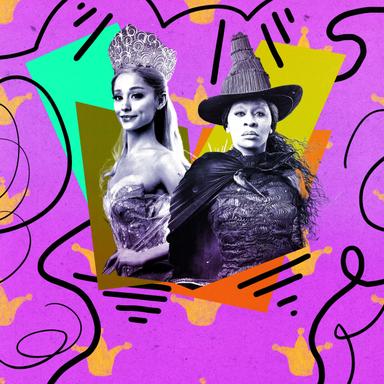
This is the most obvious pick. While Wicked certainly has a hardcore fan base that shelled out half a billion dollars worldwide to see For Good on the big screen, many of those fans are in agreement that the musical’s second act is much weaker than its first. Thus, the film got the most mixed reception of any Oscar player this year. And many of the negative reviews were straight-up pans, especially regarding the movie’s appearance: The New Yorker, for one, said that the “very, very bad” film was “so blindingly backlit that Oz seems to be under perpetual thermonuclear attack.” Ouch! 2024’s Wicked took on a slightly villainous role at last year’s Oscars—that film also did extremely well financially, but lighting discourse made the rounds on social media back then, too. After the second film’s reception took a significant dip from the first—and given the fact that there’s no Emilia Pérez around this year to overshadow the film’s villainy—Wicked: For Good could easily serve as the 2026 Oscars’ wicked witch.
That is, if For Good even makes it into the Best Picture slate. While critics famously do not vote for Oscars—many of them didn’t like Emilia Pérez, either, but that didn’t prevent it from being the most nominated film at last year’s ceremony—the negative responses to Wicked: For Good have some Oscar prognosticators taking it out of the Best Picture race entirely. Variety currently has it just outside the top 10, and Gold Derby has had its odds on a downward slide ever since it came out. Plus, it’s pretty difficult for a sequel to land a Best Picture nomination, regardless of its Rotten Tomatoes score—only 12 true sequels in Oscars history have gotten a nod in the top category. And of those, a mere two have ever won: The Godfather Part II in 1975 and The Lord of the Rings: Return of the King in 2004. That said, Wicked: For Good was quite popular (sorry) in the Oscars short lists, so it could still very much be a presence at the ceremony even if it doesn’t make it into the Best Picture slate. But its villain status will certainly be diminished if it’s ultimately excluded from the top category. We might be mourning the Wicked: For Good villain arc before it can even start.

Hamnet
Last Sunday, Jessie Buckley accepted the Critics’ Choice Award for Best Actress, which served as her first major trophy on the awards circuit for her turn in Hamnet. It could also very well kick-start a tear through the rest of awards season. Buckley has long been seen as the one to beat in the category, and although If I Had Legs I’d Kick You’s Rose Byrne has put up a fight in the precursor awards, the CCA might signal Buckley’s—and Hamnet’s—ascendance to Oscar front-runner.
While Hamnet has its fans and is acclaimed overall, its reputation as this awards season’s meatiest piece of Oscar bait could mean that its emergence as a formidable front-runner will double as its villain origin story. Buckley’s performance in the film is commendable, but the fact that it’s marked by lots of crying—and I’m talking mucus-y tears soundtracked by “On the Nature of Daylight”—which is pretty stereotypical of an Oscar-bait role, might make her, and the film’s, path to the statuette feel astroturfed. Many have already called the film “manipulative” and “grief porn,” and these criticisms will only continue to resurface (and probably get louder) as the Best Picture race gets tighter. And let’s not forget, Hamnet kicked off its campaign by essentially declaring itself as the “best film ever made”—I mean, how’s that for a villain entrance? The film might as well have announced itself with a clip of Ivan Drago’s entrance in Rocky IV.


Train Dreams
If you blinked, you may have missed the Train Dreams wars that took over Film Twitter for about 36 hours when Clint Bentley’s film hit Netflix in November. To recap, some found the picture to be meditative and moving; others hated the narration, the way it adapted its source novella, and the Nick Cave song that plays over the credits. Sounds like an Oscar player ripe for a heel turn! That Train Dreams wasn’t on many predictors’ radars when the Best Picture race first started to take shape, and that its Netflix distribution means that very few filmgoers actually saw it in theaters (if at all) would make its hypothetical jump to Oscar front-runner feel pretty out of the blue. That’s how the ascent of Emilia Pérez (also of Netflix) felt to a lot of people—so much so that my colleague Brian Phillips wrote an explainer on what the heck that movie even was. (A year later, it still feels like a fever dream.) If Train Dreams does start to make some noise in the Best Picture race, don’t be surprised if there are some knee-jerk impulses to defend more widely seen films against it—and to rehash debates over whether the narration was effective or contrived.


Timothée Chalamet
Timothée Chalamet vs. Leonardo DiCaprio in the Best Actor race is shaping up to be the Oscars version of Drake Maye vs. Matthew Stafford. (OK, but Marty Supreme did actually face a tough strength of schedule—it was released against Avatar!) It’s the young lion heading toward his coronation vs. the veteran legend turning in one of his best performances yet. Right now, the Marty Supreme stock is high, and with Chalamet coming off a CCA win, I’d say he’s off to an early lead. And he could definitely maintain that head start—if backlash to his, um, unique campaign tactics doesn’t derail him.
I realize that this wouldn’t quite fit in the Emilia Pérez villain framework I previously described. For one, Marty Supreme isn’t nearly as polarizing a movie—even if Kevin O’Leary had some bizarre notes for Josh Safdie on the ending—and Chalamet is a much more popular actor than Gascón ever was. But Chalamet pushing so hard—and so shamelessly—for that statuette could inevitably rub some people the wrong way. Look, I’m on the record as being charmed by Chalamet’s antics, and I even found the shout-out to his “partner of three years,” Kylie Jenner, at the CCAs endearing. That said, there are still three more months of campaigning ahead of us, and presumably, Timmy has more shenanigans up his sleeve. The tabloids are already taking note of his “arrogant” and “desperate” campaign strategy—might that sentiment trickle down to Oscar voters and fans and eventually shift the public opinion back to Leo? I’m just saying that it’s a long race, and maybe there are only so many bars of him calling himself “Himothée” that the general population can take.


Frankenstein
OK, this might be an overreaction to only the first major awards ceremony of the season, but it seems like a significant number of people were surprised that Frankenstein’s Jacob Elordi took home the Best Supporting Actor trophy at the CCAs—and not all of them were happy. That category is bound to be the Oscars’ fiercest race, with Elordi likely facing off against One Battle’s Sean Penn and Benicio del Toro, Sentimental Value’s Stellan Skarsgard, and Hamnet’s Paul Mescal. Skarsgard and the One Battle duo have been considered the front-runners, and if Elordi’s monster lumbers in to snag the prize with a performance (albeit a wonderful one) that was maybe boosted by some serious SFX makeup, it could shift Frankenstein from misunderstood creature to full-blown villain. Especially if Elordi’s performance elevates the movie as a whole—director Guillermo del Toro already directed a Best Picture winner fairly recently (and although The Shape of Water has its supporters, it’s far from the most popular Oscar winner ever). Frankenstein, while mostly acclaimed, hasn’t been nearly as effusively praised as some of this year’s other top contenders. Maybe Elordi’s campaign will fizzle out after the CCAs, but if he and the film as a whole stick around, don’t be surprised if some movie fans sharpen their pitchforks in response.


Sirāt
Admittedly, I have not seen this movie—and most people reading this probably haven’t either, because Sirāt was in theaters for only a one-week qualifying run in New York and Los Angeles in November and is supposed to get a real theatrical rollout sometime soon. But the fact that so few people have seen Sirāt and it’s still primed for a number of Oscar nominations—it was surprisingly a huge winner in the Oscars short lists—might just end up serving its villain arc. Like Train Dreams, Sirāt will have the out-of-nowhere element to it (to a stronger degree, since even fewer Americans have seen it) if we wake up on nominations day and it’s received five-plus nods. Something so unknown establishing itself as a challenger to already widely adored films like One Battle and Sinners could ultimately stoke some contention, regardless of the film’s quality.


Stock Watch
To paraphrase one of cinema’s great stockbrokers: Nobody knows if an Oscar stock is going to go up, down, sideways, or in circles. In this section, we’ll evaluate who’s on the up-and-up and whose momentum is sputtering out as the competition across categories heats up.
Stock up: Weapons’ Amy Madigan won the Critics’ Choice Award for Best Supporting Actress on Sunday—could Aunt Gladys become the rare horror character to be recognized with an Oscar? Marty Supreme’s Odessa A’zion could also sneak into the category after earning a supporting nod from the SAG Awards. Sinners’ Miles Caton is also on an upswing after landing the Best Young Actor award from the CCAs and earning a surprise Best Supporting Actor nom from SAG. One Battle After Another, meanwhile, earned a record-setting seven nominations from SAG, just a few days after completing a sweep of the big four critics awards.
Stock down: The SAG Awards often ignore international films, and as a result, Sentimental Value didn’t earn a single nomination, with Best Supporting Actor front-runner Stellan Skarsgard shut out right after losing the same award to Jacob Elordi at the CCAs. The Secret Agent’s Wagner Moura was also left out of the SAG Best Lead Actor slate, with Bugonia’s Jesse Plemons earning the nod instead. Train Dreams also completely blanked on the SAG nominations, missing out on nods for its ensemble as well as for its lead actor, Joel Edgerton.