

We loved him. Let’s make that clear from the beginning. We loved him irrationally and exuberantly, even the pieces of his personality you found annoying or petulant, even the parts of his game we were long told would never contribute to winning in a meaningful way. We loved him enough to be mocked in group chats and laughed at by other fans, enough to delude ourselves into thinking, Well, Luka wouldn’t have made sense here anyway. We loved him to the point that we’d defend his foul-baiting (he’s using the rules to his advantage!), explain away his defense (who cares, he’s an entire offense unto himself!), and demand, time and again, an end to the NBA chattering class’s collective amnesia over the run he sparked back in 2021. We Atlanta Hawks fans loved Trae Young right up until his final moments with the franchise, when he was dapping up teammates and coaches on the bench in Wednesday’s game against the Pelicans. Everyone was aware that it was time, perhaps well past time, for him to move on.
And now here it is: The Hawks have traded Young—a four-time All-Star and former All-NBA selection, an incandescently talented and profoundly flawed point guard—to the Washington Wizards. In return, they’ve received CJ McCollum, Corey Kispert, and not a single draft pick. It’s a shockingly paltry sum. Reportedly, Washington was the only team in the league that wanted Young, at least at his current salary of $46 million for this season with a $49 million player option for next.
He is a shooter who can’t really shoot and perhaps the worst defender in the league. Everyone, everywhere, from fans to front office types to even Trae himself, seemed to agree it was time for him to go. And yet you’ll have to forgive us Hawks fans if this whole thing leaves us a little sad.
The derision started on draft night. I was there, at the Barclays Center, on June 21, 2018. I was writing a story about another player, Michael Porter Jr., but fidgeting with nerves over what my Hawks would do with the third overall pick. One prospect loomed above the rest. Luka Doncic already had been named MVP of the EuroLeague, an honor completely unprecedented for someone so young. He appeared destined to be a star, maybe even a future MVP, and was perhaps the most can’t-miss European talent the league had ever seen. And yet, inexplicably, the Suns and Kings both passed on him with the first two picks, choosing Deandre Ayton and Marvin Bagley III instead. When the Hawks selected Doncic, my phone lit up with congratulatory text messages from friends. But reports of a trade were already circulating on social media. The Hawks did not intend to keep Doncic. They wanted someone else.


That someone else went wandering through the halls of Barclays a few minutes later, thin as a hangnail, short enough that several of the assembled reporters towered over him. For reasons that remain as baffling today as they were back then, he wore a suit with shorts. When he took the podium, voice soft and high-pitched, the 19-year-old Young looked delighted. The Hawks had traded Doncic to the Mavericks for Young and a 2019 first-round pick. He was on his way to Atlanta. Right away, he would be given the keys to the franchise.
Quickly, a consensus formed around the league: The Hawks had made a catastrophic mistake. We Atlanta fans all coped in our own ways. Personally? I decided immediately that I would embrace and root for Trae, this tiny maestro unlike any basketball player I’d ever seen, someone who had just led the NCAA in both scoring and assists.
Young’s play was disastrous that year in summer league, and was still disastrous in the early months of his rookie season. But at some point, he started to show that he could power an NBA offense, blowing past defenders and finding shooters anywhere on the floor, lofting one lob after another to athletic bigs in his vicinity, dropping tear-drop floaters and 30-foot 3s. The 2018-19 Hawks finished 29-53, 12th in the Eastern Conference. It was the most fun I’d had watching the team in years.
I grew up in suburban Atlanta and was 9 years old when the Hawks traded Dominique Wilkins for Danny Manning. My generation of Hawks fans was raised on Dikembe Mutombo and Steve Smith, and the generation after me on Joe Johnson and Al Horford. Lobs and logo 3s, crowd-shushing and shit-talking, all of that belonged to fans of other teams in other cities. We’d spent our entire lives rooting for a team whose ceiling was bland competence.
The best team in the history of the franchise—the 2014-15 version whose entire starting five was famously named Eastern Conference Player of the Month—was truly excellent. We loved them, of course. But outside the Hawks fan base, they were loved only by the kinds of fans who casually bring up Second Spectrum in conversation. They were perhaps the corniest, most profoundly uncool 60-win team in the history of the league. Young offered something different, a tiny dynamo hell-bent on destruction, either of his opponent or his own team. We’d turn on Hawks games not knowing which version of Young we were going to get.
And then 2021 happened. Let me say that again. Twenty-twenty-one happened. This, perhaps, has been the most crazy-making part of following the discourse around Young, the seemingly widespread commitment to explaining away the greatest moments in the history of the franchise.
Some important context: The 2020-21 season is the most successful in the 57-year history of the Atlanta Hawks. Yes, we know this is pitiful. That does not make it less true. You can make the case that there have been better Hawks teams—that 60-win, four-All-Star, 2014-15 team chief among them—but no Hawks team has ever gotten as close to reaching the NBA Finals.
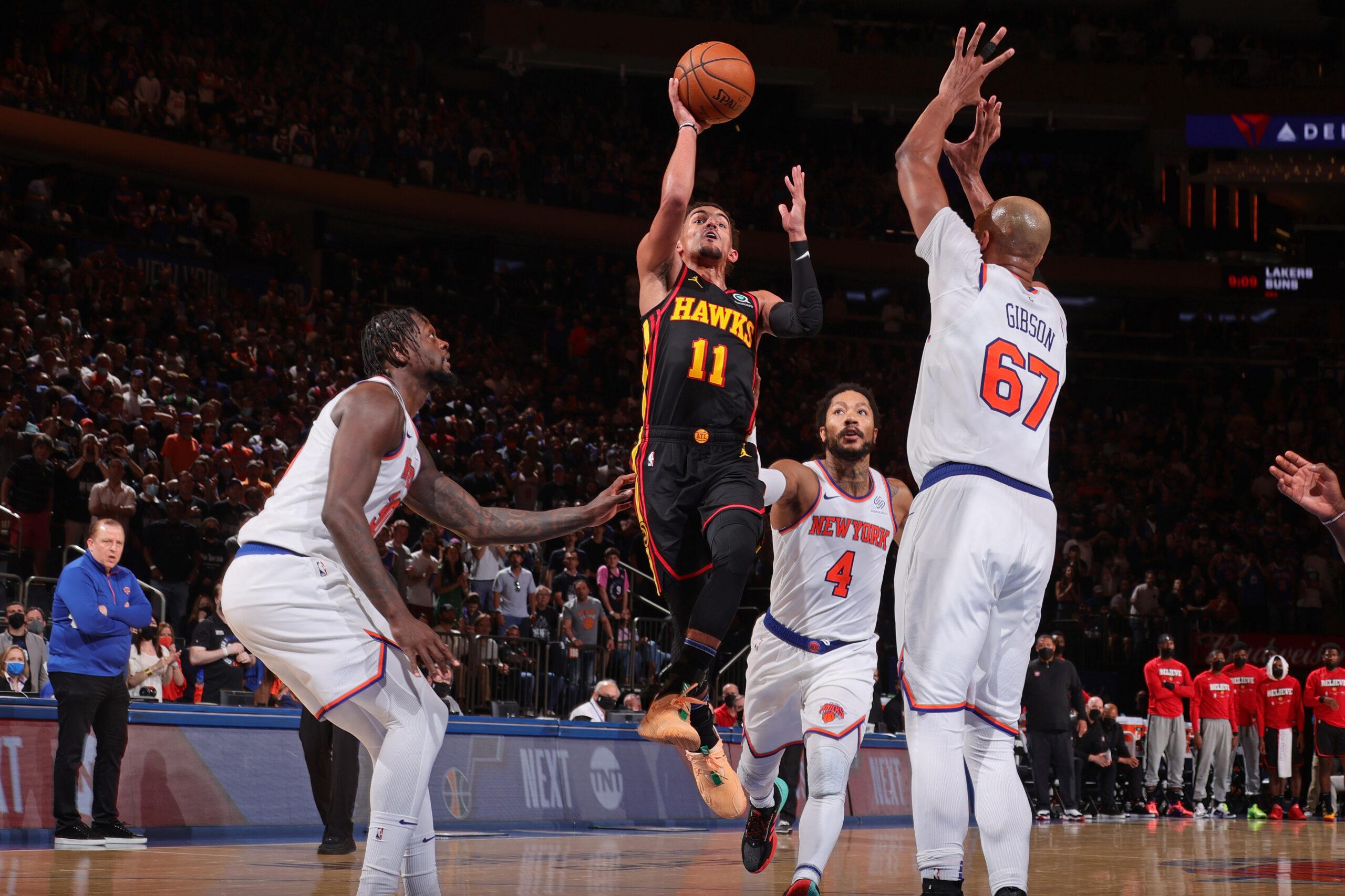
So, for us, 2021 mattered. It mattered that those Hawks finished the season on a 27-11 run, third best in the league during that stretch. It mattered that Young marched into Madison Square Garden and beat the favored Knicks with a buzzer-beater in Game 1 and a midcourt bow in Game 5, basking in the sound of the impotent chant, Fuck Trae Young! It mattered that he was the best player on the floor in the second round against the top-seeded 76ers, scoring 35 points in one win and 39 in another, tallying 18 assists in a third. Even in his worst shooting game of the series, a 5-for-23 Game 7, he still seemed in total control throughout the biggest moments.
Now, that series is remembered as the beginning of the end for Ben Simmons, who seemed so petrified of going to the foul line that he passed up an easy dunk on a critical possession late in Game 7. But that was one moment deep into a series that Young had dominated. On the floor in that matchup were two of the league’s unique and most frustrating talents. Simmons wilted. Young marched into Philly with a woefully undermanned Hawks team and left with a win, flagrantly unafraid. And it mattered, too, that Young went to Milwaukee and scored 48 points in a Game 1 win over the Bucks in the conference finals, lobbing to John Collins off the backboard and shimmying before his own 3s.
We are a city enraptured by players like Wilkins and Michael Vick and Ronald Acuña Jr., who are brash and flawed and undeniable. Finally, the Hawks had given us a star made in this image. And that Game 1 victory over Milwaukee—officially one more playoff win than the 2014-15 team that got swept by Cleveland in the Eastern Conference finals had—made 2021 the deepest run in Atlanta Hawks history.
And yet, Hawks fans have to admit, we got a little carried away. After coming two wins from reaching the Finals, we believed that we could do it again. The front office agreed. They ran it back with Collins, Kevin Huerter, Clint Capela, and De’Andre Hunter, all of them orbiting around Young. He responded with the best season of his career in 2021-22, leading the league in total points and total assists, something only one NBA player, Tiny Archibald, had ever done. Young posted career-best shooting numbers—46 percent from the field, 38 percent from 3—in the only season of his career that made the Steph Curry comparisons, if not quite legitimate, at least vaguely understandable.
But he did all of it for a Hawks team that could not recapture its prior magic, that regressed back to the mediocrity we’ve grown accustomed to for most of the franchise’s existence. Atlanta finished 43-39. In the ’22 playoffs, the Hawks lost their first-round series against Miami in five games. Young was terrible. He’s never been the same since.
The league is changing. Foul calls are fewer. Physicality has increased. The Heat punished Young in those playoffs. On too many nights since, other defenses have done the same. His shooting percentages plummeted in 2022-23 and have remained stagnant in the years that followed: low 40s from the field, mid 30s from 3. When Trae was at his absolute best, his mere presence on the court guaranteed that his team would play excellent offense; without another star player on the roster, the Hawks ranked ninth in offensive rating in 2020-21, second in ’21-22, and seventh in ’22-23. But when that efficiency falls, when his teammates grow disengaged watching him dominate the ball, when opposing teams don’t have to tilt the court so heavily in his direction, that’s when his defensive ineptitude becomes too glaring to ignore.
At some point, under head coach Quin Snyder, he at least started trying on that end of the floor. “He’s competed,” Snyder said of Young’s defense in 2023. Over the past couple of years, you could turn on the Hawks and watch Young fighting through screens, maintaining good position against bigger and stronger opposition, even picking up players full-court. “He’s got a lot of pride,” Snyder said, again in 2023, of that part of Young’s game.
And yet, no matter how much effort he gives, Young is never going to be taller than his generously listed 6-foot-2. He’s never going to have the muscle mass to keep up with more powerful athletes. His quickness can be, and always has been, an asset. But the numbers tell the same story as the eyes: Young is one of the biggest defensive liabilities in the NBA.
Meanwhile, this season’s Hawks have found something. At the moment, it’s not clear exactly what. But there are flickers of an identity, a long and endlessly switchable collection of eager and engaged players, led by rising star Jalen Johnson and flanked by Dyson Daniels, Nickeil Alexander-Walker, Onyeka Okongwu, and the inconsistent but still young Zaccharie Risacher. The 2025-26 Hawks have been decent (16-13) without Young in the lineup and abysmal (2-8) with him. And that’s the most painful part: When Young has been out there, he’s looked like he’s trying to fit in. Deferring more on offense, moving without the ball, doing his best to buy in defensively. But it’s not nearly enough.
Small, 10-game sample size aside, Young simply never looked like he belonged on this particular team. With him gone, reports have circulated that the Hawks want to go after Anthony Davis, which signals a clear intent: Atlanta wants to suffocate opposing offenses. With Young on the court this season, the Hawks had a defensive rating of about 126, which would rank worst in the league by a mile. Without him, that rating drops to 112, good for eighth. No team with Young playing heavy minutes can instill the kind of fear that the Hawks want to put in their opposition.
Still, we will root for him. This year in Washington, and wherever he might go next. It is not crazy to imagine that someday his jersey will hang in the Atlanta rafters. He is the best player we’ve cheered for in a generation and perhaps the most derided star in the league, someone we’ve loved with a little embarrassment and a lot of defiance, right up until now, the very end.