

The last meaningful play of Trae Young’s tenure with the Atlanta Hawks was a disaster that helps explain why he was traded to the Washington Wizards. It came two days after Christmas in a high-scoring back-and-forth bout against the New York Knicks. With 13 seconds left in the game, Atlanta found itself down one point and—even though he was 2-for-9 from the field in 31 minutes—decided to put the ball in Young’s hands.
The sideline out-of-bounds play was designed for Young to curl off a wide pindown set by Dyson Daniels. The Knicks responded with a switch, catching Young by surprise. Smothered by Mitchell Robinson, he picked up his dribble, pivoted back toward the sideline, and then threw a desperate pass that was intercepted by OG Anunoby. It was Young’s sixth turnover, capping off a disjointed, tentative sequence that ultimately cost Atlanta the game. In real time, it was curious. Why wasn’t the ball in the hands of Jalen Johnson, an ascending star who became the Hawks’ best player sometime last year? What about Nickeil Alexander-Walker? The action was awkward, and the end was telling. The big-picture questions it conjured up were impossible to ignore.
We’ve known that this day was coming for several months. Maybe even longer than that. If he wasn’t traded Wednesday night or any day between now and February’s trade deadline, it would’ve happened during the offseason. Atlanta’s unwillingness to extend its ostensible franchise player was the unofficial end of their marriage. And what a ride it’s been.
Young is a four-time All-Star who’s averaged 25 points and 10 assists per game across his career (he led the league in the latter stat last year). Bad players can’t do that. Since 2020, Atlanta has been an about average basketball team with him on the court and offensively inept without him. He led the Hawks to a conference finals appearance in 2021—a series that could’ve gone another way had he not stepped on official Sean Wright’s foot in the third quarter of Game 3, but I digress!—and had precisely zero All-Star teammates for his entire tenure, a fact that can’t be ignored when critiquing Atlanta's lack of playoff success since Young was drafted. (Everyone needs help!) But the counterpoints are loud. Young is the last of a dying breed: an inefficient, rigid, ball-dominant player whose playmaking brilliance can’t overcome the broad defensive shortcomings that render his team so vulnerable whenever he’s on the floor.

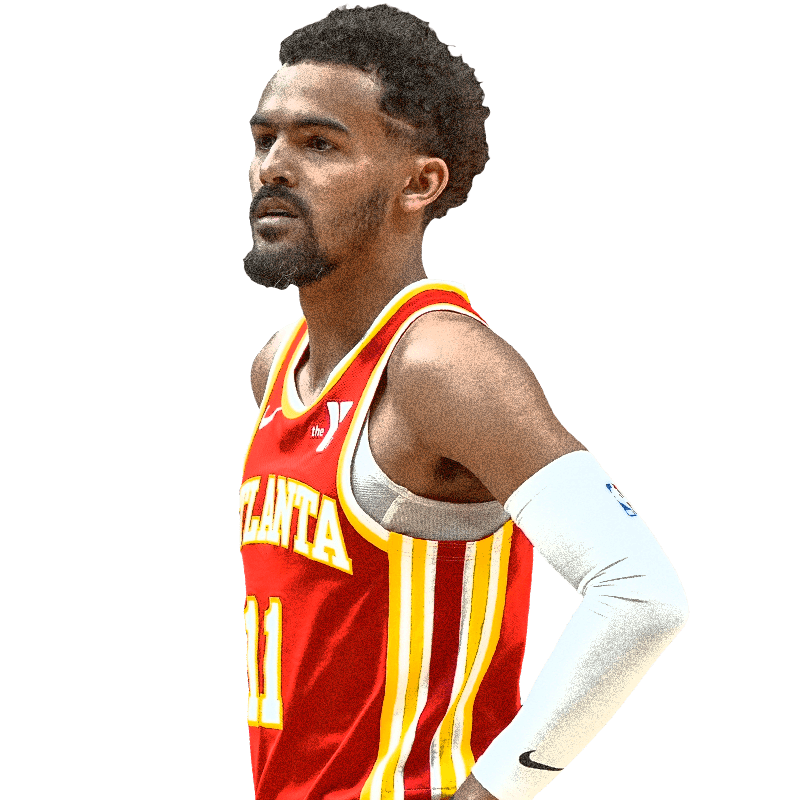
Coming off an impressive summer that turned them into preseason darlings, the Hawks have been inconsistent and disappointing. They’re 18-21, with the 18th-best offense in the league. It’s a development that can’t fall entirely at Young’s feet. He’s appeared in only 10 games and isn’t responsible for Zaccharie Risacher’s unsettling sophomore slump, Daniels’s broken jump shot, or Kristaps Porzingis’s health problems. In 1,602 minutes without him on the court, their net rating has been plus-0.1 points per 100 possessions, and their offense has been slightly below average and defense has been slightly above average. Which is to say: They aren’t particularly close to making a playoff run this year, and, even in the woeful Eastern Conference, their odds of even making the postseason currently sit below a coin flip. That’s the bad news. It also makes every report connecting them to Anthony Davis sound ridiculous.
I understand how attainable a Finals berth must feel for any team in the East that has a pulse. Right now, there’s nothing close to a bogeyman waiting at the top; it’s human nature to remember last season’s Indiana Pacers and wonder why that can’t be you in 2026. The Hawks can tell themselves that Davis is exactly what they’re missing. But, with all due respect to the two-way menace, who can still take over a game when he’s healthy, that line of thought borders on delusion. Davis will turn 33 in March. He’s already missed 18 games this year and has crossed the 65-game barrier in just one season since 2018. His last first-team All-NBA season was in 2020, and he’s guaranteed $58.5 million next season (which would tie up 35.2 percent of Atlanta’s cap and prevent it from spending money in free agency), with a $62.8 million player option in 2027-28. It would be irresponsible for such a young team to take on that much money owed to an oft-injured veteran and then double down with a massive extension. So, assuming that Atlanta’s front office has full autonomy to make decisions that make sense in the present and future, the good news is that there’s an obvious, better, and much easier short-term path forward: Do nothing! Risacher is 20. Daniels is 22. Johnson is 24. Onyeka Okongwu is 25. Alexander-Walker is 27.
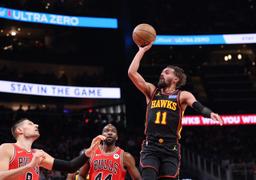
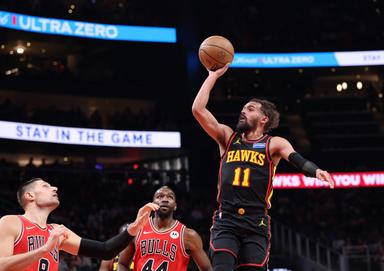
What this team needs is shooting—incoming players CJ McCollum and Corey Kispert will help!—and it can look to add some with the $30 million-plus worth of cap space it now has to work with this summer, on top of two incoming first-round picks (including one from New Orleans, which currently has the second-worst record in the league). Johnson is about to make his first All-Star team and has established himself as one of the better all-around forwards in the entire league. He’s an ideal cornerstone with traits worth building around: selflessness, supreme athleticism, a tireless work ethic, and an ability to work on or off the ball in ways that make his teammates better. Risacher was the first pick in last year’s draft and, despite a down second season, has the size and skill to eventually become an ideal rotation player. And there’s a decent chance that AJ Dybantsa, Darryn Peterson, Caleb Wilson, or Cameron Boozer will be added via that Pelicans pick next season.
Young was the face of Atlanta’s franchise for the past seven years. There were ups and downs. There was hope and an inevitable expiration date. Now that the Hawks have officially moved on—discarding a heliocentric pick-and-roll framework and no longer feeling the strain of his perpetual weak-link status on the other end—it only makes sense for them to take a deep breath and not throw their on-court identity into a blender before next month’s trade deadline. A fresh, exciting era is here, and, for the time being, the Hawks would be wise to let athleticism, versatility, and upside be their guide.