‘Stranger Things’ Bids a Shaky—but Poignant—Farewell
Our last two hours in Hawkins may have been clunky and excessive, but they ultimately reminded us of what Netflix’s flagship series did best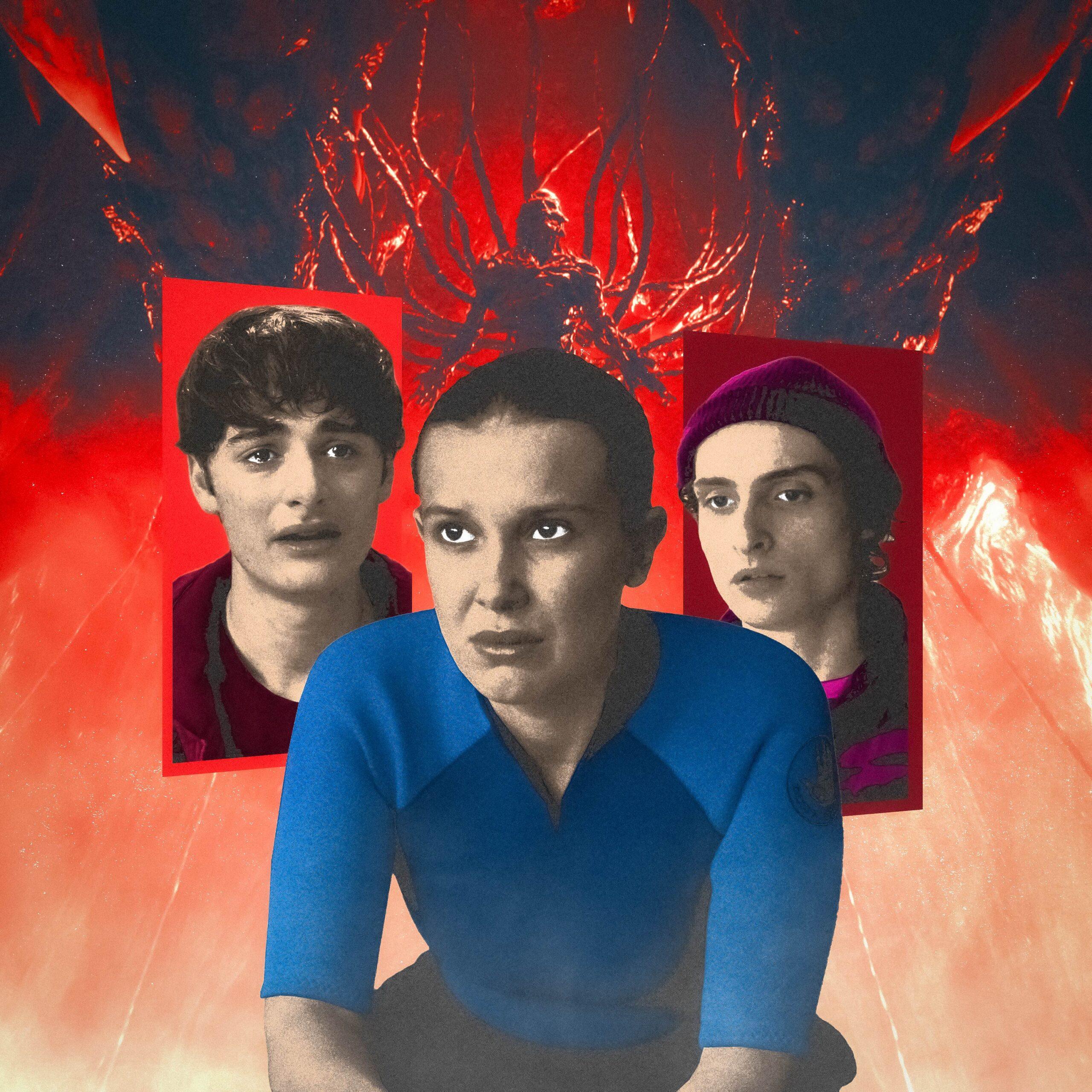


When Game of Thrones set the stage for its grand finale, the HBO drama seemed to have everyone’s attention, becoming perhaps the last (non-Super Bowl) piece of TV monoculture. But instead of bringing the fandom together, the series finale was akin to a group of children taking their last vicious swings at a frail piñata. Ahead of “The Iron Throne,” Thrones’ eighth season was already being picked apart for its haphazard storytelling, unresolved loose ends, and murky visuals, with each episode scoring lower reviews on sites like Rotten Tomatoes. As for the finale? So bad that a Change.org petition to remake the season with “competent writers” drew over 1.8 million(!) signatures. The rest is Westerosi history.
With such a hostile reception to a once-beloved series, you can understand why the Stranger Things actors were wary that the show could fall into a similar trap. When the first batch of episodes for the fifth and final season dropped on Thanksgiving, Stranger Things didn’t ruffle many feathers—it’s hard to draw conclusions about a season of television that, to invoke Dungeons & Dragons, was still in the early stages of its campaign. With the Christmas Day rollout, however, everything started to sour. The penultimate episode faced particular blowback, and while some of it was due to bad faith review-bombing that claimed Stranger Things became too “woke” with Will Byers’s coming out scene, there are also legitimate gripes with the direction of the recent episodes: They were languid, exposition-heavy, and, at times, a little boring. These criticisms weren’t a fatal blow, but they’ve put even more pressure on Stranger Things’ series finale to flip things Upside Down.
It might sound like faint praise to say that “The Rightside Up,” which dropped on New Year’s Eve, isn’t an abject failure, but when trying to land the plane for one of Netflix’s flagship shows—with so much fanfare, with so many pitchforks ready to be sharpened—anything that doesn’t explode on the runway is worth celebrating. And if the finale was going to be a mixed bag, what the Duffer brothers pulled off was the preferable version of it—with the episode getting off to a shaky start before Stranger Things finds its groove in the second hour. (That said, I really hope we get a moratorium on feature-length episodes of TV; if Severance thinks I’m going to sit through a two-hour finale when the third season airs in [checks notes] 2027, Apple’s got another thing coming.)
“The Rightside Up” picks back up with our heroes launching their plan to defeat Vecna, sending one party to fight him in the Abyss while Eleven, Kali, and Max rescue the kidnapped children from Camazotz. It’s exactly what we’ve come to expect from late-stage Stranger Things: The Duffers are clearly reveling in their Netflix blank check, delivering a small-screen blockbuster full of explosions, Lovecraftian monsters, and telekinetic faceoffs that would make Charles Xavier blush. But when nearly every episode from the past two seasons is over an hour long, the effect isn’t intoxicating as much as it is nauseating—spectacle for the sake of spectacle. This, I suspect, is where Stranger Things began to lose some viewers: Over time, the Duffers’ loving homage to ‘80s-era Spielberg was becoming indistinguishable from modern Marvel slop. Even the characters have been reduced to plot-delivery devices, spending nearly all their screen time either A) discussing their many, many plans or B) getting their friends up to speed.
The first half of “The Rightside Up” continues this disconcerting trend, focusing so much on the forthcoming battle with Vecna that you lose sight of what everyone’s really fighting for. (There are some obligatory “two characters play catch-up as they walk to Vecna’s lair” moments, but it feels like they’re just filling airtime more than offering anything insightful.) The bloodthirstiest viewers will also probably take issue with Stranger Things refusing to kill off any major characters in its climactic setpiece—unless you count Kali and, somehow, I don’t think a side character from the most-hated non-Season 5 episode in the show’s run is going to move the needle. Indeed, the final showdown was so by-the-numbers that, prior to the finale, some fans concocted galaxy-brain theories that Vecna was not only possessing Will but influencing our perception of events throughout the season. The real, less rewarding answer: The writing just hasn’t been cutting it.
Elsewhere, there’s a curious, last-minute attempt to add new dimensions to Vecna, revealing that he was corrupted by the Mind Flayer in a traumatic childhood memory. The impulse to ever-so-briefly humanize Vecna is telling, as it underlines that he was the victim of a sinister otherworldly force as much as Will was. But no sooner does the show ask you to sympathize with Vecna is Joyce Byers hacking his mangled head off with an axe, which at least gave Winona Ryder something to do. It’s a fleeting reminder of the show Stranger Things used to be—one that was more interested in how kids get broken than how monsters get beaten.
Lastly, there is Eleven’s grand sacrifice. Just as Kali foretold, Dr. Kay and the military are still hellbent on capturing Eleven to produce more telekinetic beings, so when our heroes plant a bomb in the Upside Down, Eleven elects to stay behind. Predictable? Yes. Affecting? Yes. Did Finn Wolfhard’s acting almost singlehandedly undermine the emotional impact of his character’s farewell with Eleven? Also yes.
If that’s how Stranger Things chose to wrap things up, I suspect its legacy would be something of a cautionary tale: a show that, as it soared in popularity, confused scale with substance. But then we get an 18-month time-jump, and those little tykes are graduating high school. The military has long moved out of Hawkins, and this once-cursed town has returned to a sense of normalcy. With it, Stranger Things goes back to basics, and the Duffers prove that, amidst the big-budget excess, they still have a solid handle on the little details that make their characters tick. Steve Harrington has become a baseball coach/sex-ed teacher, while Nancy Wheeler, Jonathan Byers, and Robin Buckley have moved out of town to pursue their own paths; Chief Jim Hopper proposes to Joyce after finally having a date at Enzo’s; Dustin Henderson is the school’s valedictorian, giving a chaotic good speech preaching that his fellow graduates defy conformity.
Even without the warm (low-key manipulative) inclusion of Fleetwood Mac’s “Landslide,” the finale hammers home that change is a scary, inevitable part of life, but the kids are all right. (They’ve tackled things far scarier than puberty, after all.) The fact that Stranger Things isn’t just a coming-of-age story in itself, but that we’ve actually seen the cast come of age over the course of the series, is one of the virtues of the show taking nearly a decade to finish. That passage of time is also something that may prove especially meaningful for audiences who’ve been with Stranger Things from the jump and seen their own lives evolve alongside it. When Stranger Things started, I had just moved to New York, lived in a pest-infested apartment, and landed my first job out of college; as we ring in 2026, I’m somehow still gainfully employed as a writer and moved in with my partner. Indeed, time makes you bolder.
It’ll surprise no one that Stranger Things’ final scene brings us back to where it all began: Mike Wheeler’s basement for a post-grad D&D session. After Max Mayfield roasts Mike for yada-yada-ing their characters’ happy endings in the campaign, he gives a longer, thoughtful answer that hints at what’s to come for everyone in the real world: Lucas Sinclair and Max enjoying young love; Dustin going to college but making time for bromantic adventures with Steve; Will moving to a city and finding an inclusive community. Then Mike shares his theory that Eleven never actually died. He posits that the image of her standing at the portal to the Upside Down was an illusion fabricated by Kali before she died, allowing Eleven to escape and live a peaceful life somewhere far away. There’s enough ambiguity that we can choose to believe Mike’s version of events, or accept that it’s a hearty dose of copium—or, if we want to get really cynical, it’s the perfect backdoor for an Eleven spinoff series.
In any case, Stranger Things leaves us with Mike climbing up the basement stairs as a new generation of kids falls under D&D’s spell, led by little Holly Wheeler. It’s about as evocative an image of leaving your childhood behind as you’re going to get—a bittersweet, understated coda that feels like the perfect tone for the series to strike after falling prey to empty spectacle. Time moves forward, the dice keep rolling, and Stranger Things understands that growing up doesn’t mean the story ends—it just means it’s someone else’s turn to tell it.