The Ending of ‘Stranger Things’ May Depend on the Series’ Worst Episode
Why second-season stinker “The Lost Sister” is suddenly so relevant


At the climax of the first half of the final season of Stranger Things, Will Byers becomes a sorcerer in real life, instead of in Dungeons & Dragons. But amid the bloody battle with the Demogorgons that precipitates Will’s transformation—just before Vecna debuts a leaner, meaner look on his runway walk out of the Upside Down—the Volume 1 finale foregrounds two other preexisting superpowered characters. One is a series staple, while the other has been unseen for so long that she was widely thought to be gone for good. The latter’s appearance is one of the season’s biggest surprises so far because of both who the character is and what she represents: a buzzer-beating attempt by the Duffer brothers to rehabilitate their series’ most maligned installment.
Throughout Season 5’s first four episodes, Eleven finds herself stymied by a government weapon that she calls her kryptonite: a painful pulse of some sort that nullifies her psychokinesis skills and all but incapacitates her. El’s kryptonite seems to be controlled by military scientist Dr. Kay (Linda Hamilton), who’s hiding something in a secretive, high-security section of the government’s base in the suddenly well-trafficked Upside Down. In Episode 3, Hopper and Eleven conduct a tag-team interrogation of Lieutenant Akers in an effort to learn what Kay is keeping there, but the kryptonite clouds El’s vision.
“I heard it behind the door, louder than before,” she says. “The doctor’s keeping someone there, someone powerful like me. It has to be.”
“It has to be what?” Hopper asks.
“The military, they have him,” El answers. “They have Vecna.”
El, we later learn, is only half right. Kay’s captive is someone with psychic powers. But as our last look at El until Christmas confirms, the former Hawkins National Laboratory test subject behind that locked door isn’t Vecna; it’s Kali.
Who?
You know, Kali. Kali Prasad. Eight? Is this ringing a bell for anyone who hasn’t recently rewatched the whole series?
OK, a Kali refresher could be in order. Eleven’s psychic sister is introduced in the first scene of Season 2, when she and her freak compatriots evade Pittsburgh police thanks to Kali’s projection of an illusion into one of the pursuing police officers’ minds. It’s immediately clear that Kali (who’s played in present-day episodes by Linnea Berthelsen) must possess psychic powers, à la El.
It’s not immediately clear how Kali fits into Season 2, but six episodes later, that tease (sort of) pays off in the form of a full episode featuring Kali and her crew. In “The Lost Sister,” El travels to Chicago to join her fellow former captive, who’s on a quest to track down and punish the people who imprisoned them when they were kids. Each is heartened to find in the other a long-lost link to their mutual tortured past.
Kali, who’s several years older than El, helps the younger girl harness her power by, essentially, dispensing the same advice Emperor Palpatine offers to Luke Skywalker: Give in to your anger. In Eleven’s case, this is framed as more of an empowering choice than a sinister one, and her rage heightens her telekinetic capacity.
Kali gives El a punk makeover, teaches her to say “bitchin’,” and enlists her help with her mission. But El soon realizes that she’s less bloodthirsty than Kali, and she resolves to return to Hawkins to reunite with her party. In the Season 2 finale, El remembers Kali’s advice about using her anger to tap into her power, and she channels her recollections of being mistreated by Dr. Brenner to close the Mothergate to the Upside Down. Aside from a few cameos or mentions in brief flashbacks, though—the most recent in Episode 6 of Season 4, when Henry Creel alludes to Eight’s escape from the lab—Kali wasn’t seen or mentioned again until last week’s episodes. More than eight years after “The Lost Sister,” the Duffers were wise to insert some Season 2 footage into “Sorcerer” to identify who this virtual stranger in Stranger Things was.
In the interim, the rough reputation of 2017’s “The Lost Sister”—to borrow a word from Kali—festered. Let’s play “Spot the outlier” in the graph below of the average IMDb user scores of every episode of Stranger Things, as presented at Rating Graph. One of these things is not like the others.
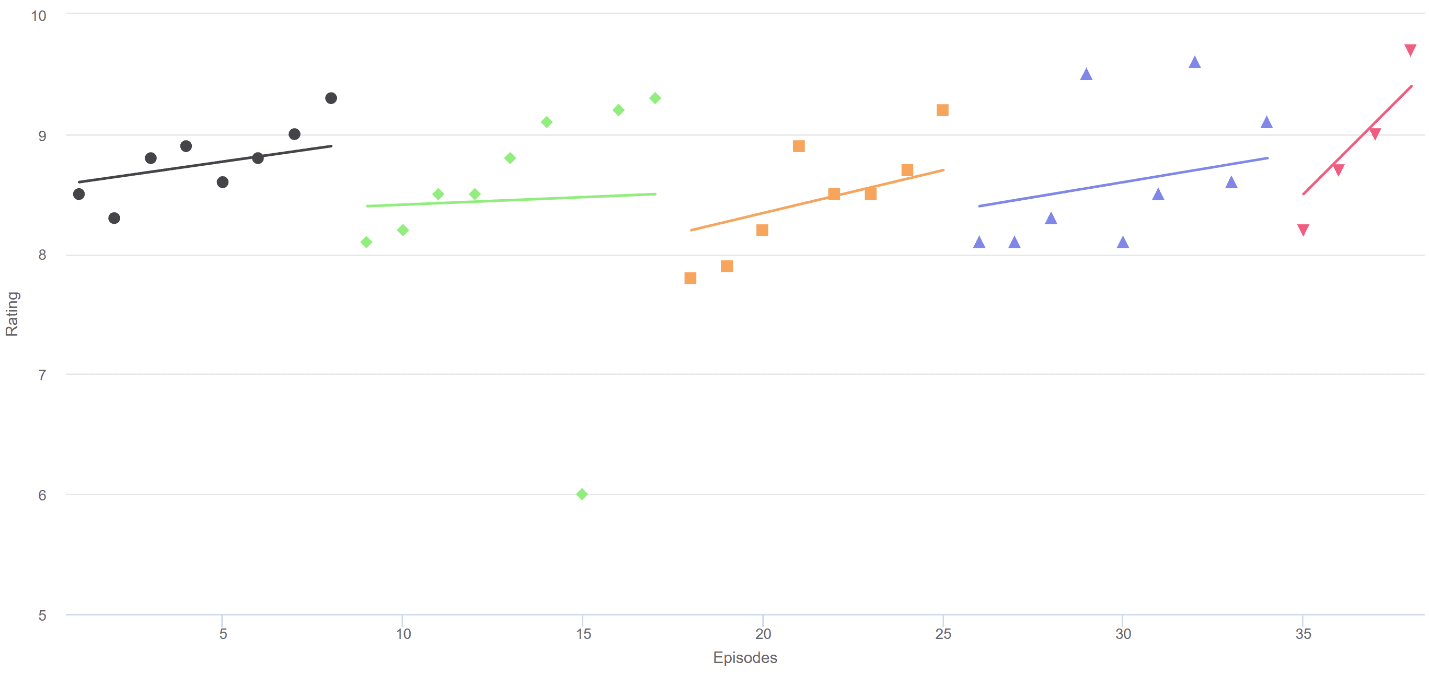
See that little green dot sitting at 6.0, so far below every other episode that it might as well be stranded in the Upside Down? That’s “The Lost Sister,” a.k.a. the consensus worst episode of Stranger Things—and, apparently (and improbably), an important prelude to the series’ last act.
In isolation, the episode isn’t so awful: 6.0 isn’t a terrible rating, as series low points go. But “isolation” is part of the episode’s problem: “The Lost Sister” takes place outside Hawkins and doesn’t feature any regular cast members besides Millie Bobby Brown. Beyond that, for years it seemed to be a side quest with next to no narrative value—a loose thread or dead end. To make matters more frustrating, the chapter comes after a cliff-hanger at the end of Season 2, Episode 6, “The Spy,” in which Hopper confronts a young Demogorgon. “We thought it would either be cool or really annoying to step away for an episode,” Matt Duffer said in 2017, and the audience strongly leaned toward the latter.
The Duffers weren’t much happier with how it turned out than the fans. As Matt Duffer reminisced last week to Variety, “We were shooting Season 2 really, really fast, because we were trying to hit this Halloween deadline. And the first script we wrote just flat out didn’t work, and then we had one week left to rewrite. I just don’t think we ever nailed it, obviously. I always felt bad that we didn’t figure that out for Linnea.”
“The Lost Sister” isn’t just a statistical outlier where Stranger Things is concerned. Relative to the baseline user score of the series it belongs to, it’s one of the most negatively rated TV episodes ever, which makes it quite audacious for the Duffers to evidently devote a portion of the series’ denouement to retroactively making it more meaningful.
The table below displays the lowest-rated TV episodes on IMDb (minimum 10,000 user ratings) compared with the average rating of each listed series, in terms of standard deviations below the mean—a measurement of distance from the average that accounts for how closely clustered around that average most episodes are. (A very consistent series would have a low standard deviation, whereas a series with steep peaks and craters in quality would have a high standard deviation.) The average rating of a Stranger Things episode is 8.6, with a standard deviation of 0.65. At 6.0, “The Lost Sister” is a full 4.0 standard deviations below the mean, which makes it the fifth-most disliked qualifying episode of any series and the second-most disliked among non–series finales.
Lowest-Rated TV Episodes, in Standard Deviations Below the Series Mean (Minimum 10,000 IMDb Ratings)
Aside from some of the most bemoaned finales ever—Dexter, Game of Thrones, How I Met Your Mother—the only qualifying episode more disliked (comparatively speaking) than “The Lost Sister” is The Walking Dead Season 10, Episode 21, “Diverged,” a pandemic-impaired “bonus” episode in which lead characters Carol and Daryl go their own ways and, individually, don’t do a whole lot. Viewers tend not to like it when a show separates or sidelines most of its ensemble, as in “Diverged,” “The Lost Sister,” and the Rick and Morty episode “Rise of the Numbericons: The Movie,” the only episode of the series that doesn’t include the titular Rick. Viewers also tend to hate the straight-to-TV Home Alone 4. And in case you weren’t aware, people (including me) really loathed the last season of Game of Thrones.
TV shows can correct course as their stories progress, but it’s a pretty tall order to rescue the reputation of an episode long after it’s aired. Yet that seems to be one of the Duffers’ goals for their closing slate. As Ross Duffer told Deadline, “As we hit this final season, it felt wrong to not bring [Berthelsen] back.”
Speaking to Variety, Ross expounded on that theme. “We want when someone watches through the entire show, it doesn’t feel like we dropped a storyline or a thread,” he said. “That it all connects. You see how everything fits together. And that was definitely a loose plot strand. But also, we really like Linnea and we felt that that episode just didn’t give her a chance to do what we know she’s capable of doing. So part of it was to put her back in and give her a moment.”
Even if “Sorcerer” renders “The Lost Sister” less disconnected from the series at large, it would probably be premature to suggest that the latest Kali episode (or the upcoming ones) will redeem the previous one. Volume 2 will tell whether the Duffers’ desire to give Berthelsen a makeup episode and to combat the perception that her previous appearances were pointless pays dividends. Sometimes, trying to make amends for a mistake or belatedly consummate the pursuit of something you sought in the past turns into rehiring Tony La Russa in 2020 or signing Kris Bryant in 2022. By then, the moment has passed.
The Duffers sound cognizant of the potential pitfalls of making major decisions for old times’ sake. “We wanted to give [Berthelsen] another chance to shine, but we talk about it every year, every season,” Ross told Deadline. “We didn’t want to just put her in, to put her in. We wanted her to have a real impact on the narrative and on Eleven’s journey.” He continued, “As you get into the second volume, you really see how she fits into the narrative and Eleven’s journey, and she plays a really important role moving forward. Linnea’s awesome, so it’s definitely a big swing for this season, but one we’re excited about.”
Brown seems similarly optimistic that Kali’s return—a subject of some fan speculation and theorizing in the years and days preceding the premiere of “Sorcerer”—will serve the story. “The Duffers don’t bring anyone back for no reason,” she told Deadline. “[Kali]’s definitely utilized heavily within the season. It’s really exciting because I don’t think Eleven has much family in her life, or at least people that entirely understand what she’s been through. … I think Will and Kali are the two people that know that trauma and so I think every scene I had with her felt more emotional and more intense than the rest.”
After Kali and El are reunited in “The Lost Sister,” Kali says, “I just feel whole now. Like a piece of me was missing, and now it’s not.” So what will this missing piece of the Stranger Things saga supply, now that her place on-screen is restored?
“We belong together,” Kali implores El just before they part in Season 2. “There’s nothing for you back there. They cannot save you, Jane.” El answers, “No. But I can save them.” Now, it seems, she’s saved Kali, whose head has been shaved like El’s used to be and who’s hooked up to blood bags and suspended inside a ring of “kryptonite” emitters, looking a little like Vecna in the Upside Down last season (and, for that matter, Palpatine on Exegol).
It’s unclear what part, if any, Kali played in the development and proliferation of El’s kryptonite. Kali can make others hallucinate whatever she wants; as she explains in “The Lost Sister,” “I can make people see, or not see, whatever I choose.”
Maybe Dr. Kay has been leveraging Kali’s abilities to create the psychic blast that debilitates Eleven. Or maybe she simply experimented on Kali to create a universal psychic suppressor; Kali, like El, appears to have been a target and victim of the technology. She doesn’t seem to be bait for El—after all, El couldn’t ID her from afar—but she could be fulfilling a similar purpose. “What she sees is Eleven as a weapon, and that’s all she wants,” Ross told Deadline about Kay, adding, “She’s just relentless in her pursuit of this one person in order to achieve her goal, which, as we move into Volume 2, we start to understand, really, what that goal is and why she wants Eleven so badly.” According to the Duffers, all will be revealed.
Lore in the Stranger Things play, The First Shadow—which seems to be bleeding into Stranger Things proper, judging by the significant cave in Season 5—suggests that Eight, Eleven, and the other kids got their powers from Henry’s blood. If Henry produced their powers, it would be fitting for them to defuse his—and one fan theory forecasts that they will. In the Season 4 premiere, Erica Sinclair rolls a 20 to vanquish Vecna after Dustin, who rolls an 11, fails to defeat him. Clearly, Eleven alone can’t save the world—but as always, she’ll have help. “You were the first,” Vecna tells Will in “Sorcerer.” If Will represents One (mirroring Henry’s designation in Brenner’s program), then his contributions, combined with those of Eight and Eleven, would add up to 20. Maybe Kali can make Vecna visualize the cave that terrifies him, much like she made Axel see spiders in Season 2.
Thus far, the Duffers have been constitutionally incapable of killing off major characters. Now, at a point when most shows whittle down their dramatis personae, they’re cramming another actor onto the call sheet. And although Kali’s off-screen history with Eleven goes back further than her history with any other surviving characters, the audience’s history with Kali is short and ignominious. The more time El spends with her, the less she can spend with Mike and the rest of her Hawkins found family, so there could be an opportunity cost to the new (old) addition.
In advance of the final season, the Duffers studied previous series finales to figure out what worked. “The best ones were very true to themselves,” Ross told Variety. “The shows that are trying to be super clever—I think that’s where it can go wrong really quickly.” By bringing back a character not seen since Season 2 in a presumably prominent role so close to the finish line, the Duffers are trying to be true to the past of Stranger Things. But they’re also trying to be a bit clever: Going back to—and hoping to purify—the poisoned well of “The Lost Sister” during the endgame of an almost decade-long series is a proverbial bold move. Later this month, we’ll see whether it pays off—and we’ll learn whether Kali was right about belonging with El, both in universe and on-screen.
Thanks to Rob Arthur and Zoltán Hajdú of Rating Graph for research assistance.