There May Never Be Another Show Like ‘Stranger Things’
It’s curtains for Netflix’s crown jewel—and perhaps an entire era of televisionThere May Never Be Another Show Like ‘Stranger Things’
It’s curtains for Netflix’s crown jewel—and perhaps an entire era of television
Steven Van Zandt, of all people, saw exactly where we were headed. It was late 2013, the year Netflix kicked off the streaming wars with two enormous hits, House of Cards and Orange Is the New Black.
“Netflix completely shook up the world,” Van Zandt told Rolling Stone back then. “They’ve been willing to invest and it’s opening a whole new golden era of television that I predicted back with The Sopranos. Now it’s gone to another level with digital distribution. This is just the beginning.”
The man known for playing both Silvio Dante and guitar in the E Street Band had a unique perspective on the matter. He starred as a mobster in hiding on the platform’s first original show, Lilyhammer. The Norwegian series, available in America exclusively on Netflix, wasn’t really a phenomenon. But it lasted three seasons, helping prove that people would indeed watch TV off the airwaves. “There’s going to be Google TV and Amazon TV,” Van Zandt continued. “People are going to start their own networks and it’s going to be wonderful to have that much money coming into the creation of content. It’s going to be very, very healthy for everybody.”
For a while, that was true. Netflix’s success forced the entertainment industry to take streaming seriously. Over the course of a decade, Google, Amazon, Apple, Disney, HBO, Paramount, and NBC Universal entered the fray. The swell of platforms led to a production boom, with hundreds of new shows getting a green light. Meanwhile, Netflix’s slate of original programming didn’t just expand—it exploded. In both size and scope.
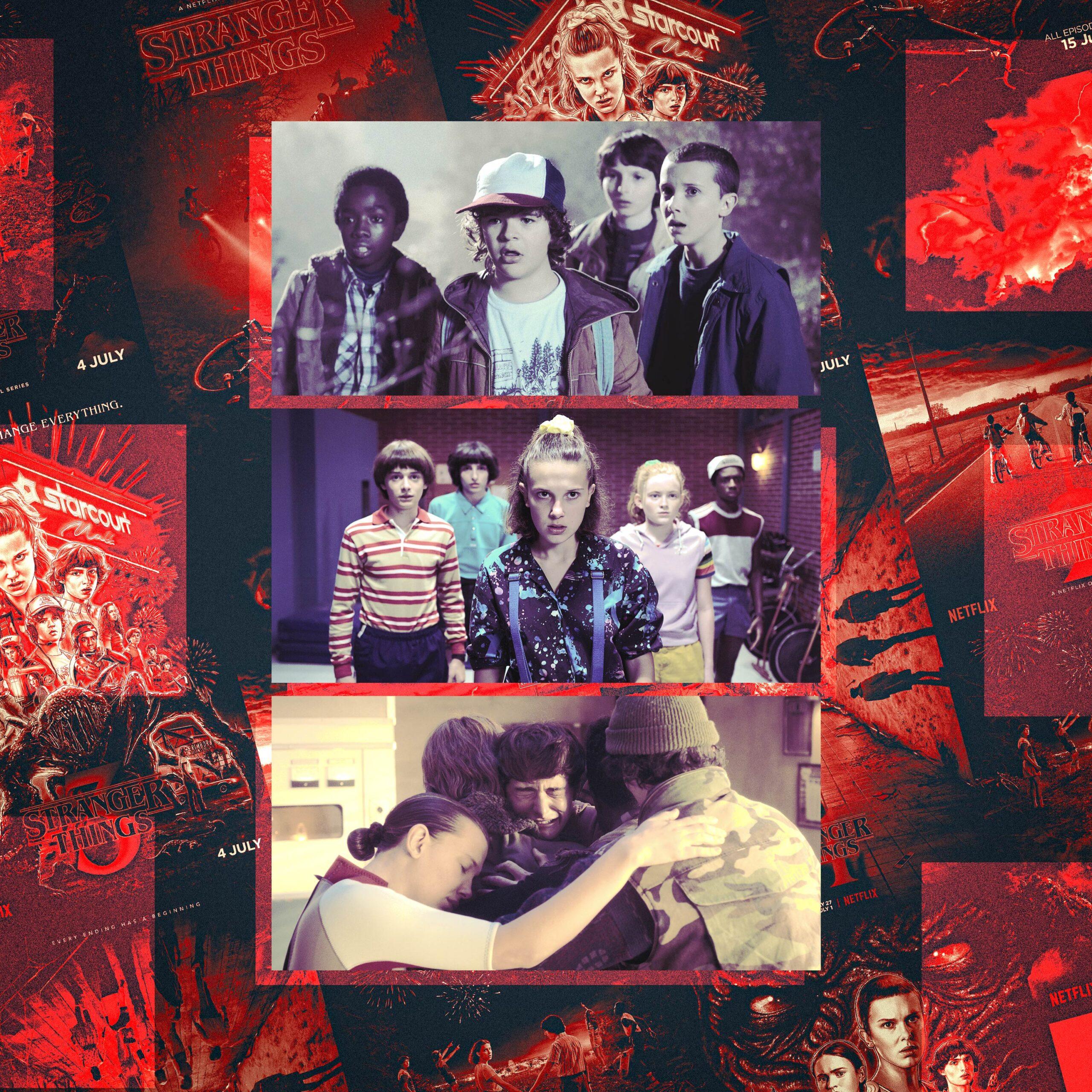
In the mid-2010s, filmmakers Matt and Ross Duffer pitched the company on what they dubbed “a love letter to the golden age of Steven Spielberg and Stephen King—a marriage of human drama and supernatural fear.” The two brothers envisioned the project as “an eight-hour sci-fi horror epic”—in other words, a TV series built like an old-school summer blockbuster. When Stranger Things premiered in July 2016, that’s what it felt like, and it was immediately apparent that Netflix had struck gold on a scale unlike ever before. The show quickly became a franchise of its own, complete with merchandise, marketing tie-ins, massive budgets, and a huge audience. By Season 2, the studio was reportedly spending $8 million per episode. That year’s premiere averaged 15.8 million viewers.
Since then, the Stranger Things footprint has only grown bigger. According to one analytics firm, the series has brought in $1 billion in revenue since 2020. And massive success has yielded a massive leash for the creators of the show: Several of the show’s 42 episodes, including the series finale, are movie length; more recent installments are packed with big-screen amounts of special effects. Things on this scale take time—and money. Stranger Things has needed nearly a decade to finish a five-season run, and according to Puck, the budget for the fifth season was between $400 million and $480 million.
What’s maybe more shocking than how much Netflix has spent, however, is how much Stranger Things forced other companies to spend. Mostly leaning on ready-made IP, nearly every streamer in the mid-2010s invested heavily in trying to find its own blockbuster TV hit. Think: The Lord of the Rings, The Last of Us, Fallout, Marvel, and Star Wars. In the quest to make billions of dollars instead of millions, the mission changed from making a great television show to making television that didn’t feel like television. Soon it became a cliché: “It’s a movie … told in 10 chapters.”
This did result in big cinematic hits like The Crown, The Boys, and The Mandalorian. But overall, results were mixed. Disney spent the early 2020s filling its streaming library with limited Star Wars and Marvel series. Shows like The Mandalorian, WandaVision, and Loki found traction, while one-offs like Secret Invasion, The Book of Boba Fett, Ms. Marvel, and The Falcon and the Winter Soldier did not.
Now, after years of unsuccessful overspending, and with Stranger Things set to finally say goodbye, a change is underway. In 2023, CEO Bob Iger, returning to his post after Disney’s board fired Bob Chapek, said that the company would cut costs by scaling back its original streaming content. He argued that the glut of new shows was fracturing the audience, not growing it. “Marvel is a great example of that. It had not been in the television business at any significant level, and not only did they increase their movie output, but they ended up making a number of TV series,” Iger told CNBC. “Frankly, it diluted focus and attention.”
“Disney is saying that money, instead of going to streaming, is now going back to theatrical,” says Entertainment Strategy Guy, an anonymous former streaming executive who now analyzes show business for a living. It’s no coincidence that the next time we see the Mandalorian and Grogu, it won’t be on TV. It’ll be on the big screen.
It’s also no surprise that the last episode of Stranger Things is getting a theatrical release. The finale feels like the end of an era that the series helped usher in. The blueprint—expensive TV that’s treated like a momentous event that happens only every few years—is already a relic. There may never be a show that costs as much and takes as long to produce.
More on ‘Stranger Things’
Just last month on The Watch, Chris Ryan wondered whether we’d get anything like Stranger Things again. “It’s hard to imagine another show lasting as long as this one, having this arc, seeing people become stars over the course of its run,” he said. “Do we think we’ll ever see another situation like this? Or is this the last gasp of blockbuster TV in a way?”
It’s true: Some penny-pinching streamers with an itch for cancellations have moved toward shorter TV seasons and fewer episodes. And across the board, no one seems to be as interested in letting blockbuster original ideas pick up steam organically.
Some studios have circled all the way back to the way of the ’90s, leaning on reliable, replicable premises that are easier to churn out and don’t require years of postproduction work. There’s no better example of that model than HBO’s biggest hit of the year. The Pitt is a medical drama that takes place in one location. The first season had a whopping 15 episodes, a comparative marathon in the world of streaming. It’s a throwback to the kind of television that used to make networks ungodly sums of money. And it’s proof that TV still has a heartbeat.
It’s a good thing, because the medium has needed a jolt. There have been times over the past decade when it’s felt like the studios have forgotten how to make TV. This has resulted in more than a few sacrificial lambs. In 2017, Netflix canceled the Wachowskis’ expensive but low-rated sci-fi series Sense8 after only two seasons. “We couldn’t support those economics,” CEO Ted Sarandos said back then. “If you put all your money into something that a very few people are watching, eventually you’ll have nothing for people to watch.”
Amazon bought the TV rights to The Lord of the Rings for $250 million and reportedly committed $750 million more to making six seasons of the show. But since its premiere in 2022, The Rings of Power hasn’t exactly become a cultural touchstone. The third season has been filmed, but it doesn’t have a release date yet.
Last year, Disney canceled the well-reviewed Star Wars: The Acolyte after a single season, citing a budget overrun. That came after the series was, according to The Hollywood Reporter, “review bombed from some quarters who perceived it as ‘woke.’”
Even legitimately great shows have fallen victim to the big-budget purge. Andor, created by Tony Gilroy, was an anti-fascist political allegory set in the Star Wars universe. It was blockbuster TV at its best. The ratings were huge. But unlike Stranger Things, it didn’t get to hang around for a decade. It ended this spring after a painfully short two-season run. During a panel at the ATX Television Festival in May, Gilroy revealed that the budget for the show was the size of several special effects–stuffed movies. “I mean, [for] Disney this is $650 million,” said Gilroy, who also wrote and directed Michael Clayton. “For 24 episodes, I never took a note. We said ‘Fuck the Empire’ in the first season, and they said, ‘Can you please not do that?’ … In Season 2, they said, ‘Streaming is dead, we don’t have the money we had before,’ so we fought hard about money, but they never cleaned anything up. That comes with responsibilities.”
People naturally fixated on the $650 million number. But do the math, and it amounts to about $27 million per episode. Considering how much work goes into something with such elaborate sets, costumes, and VFX, that’s not exactly an exorbitant figure.
Yet it’s unlikely that any streamer will drop that much money on a TV show again anytime soon. Disney does have plans to release a handful of live-action Marvel shows in 2026, but no live-action Star Wars series. “If you’re talking about genre-esque shows, either superhero fantasy or sci-fi with extraordinary budgets in some cases—which I don’t think Stranger Things necessarily started off that way, but it sort of was event TV that could go there—it does seem like there’s been a pullback,” Entertainment Strategy Guy says.
There are, of course, exceptions to the cull. Warner Bros. is supposedly dropping many millions on the new HBO Harry Potter series. House of the Dragon is also going strong.
What all of those shows have in common is that they’re part of tried-and-true franchises. Stranger Things was not, although it feels like it. That was by design. “I have a really hard time holding up Stranger Things as the shining antithesis of IP-based television when, for all its pleasures—that’s a show that I enjoy in many ways—it’s just entirely rip-offs of the past,” says James Poniewozik, the chief TV critic at The New York Times.
Even with all the nostalgia it has going for it, Stranger Things might still be a tough sell these days. In addition to their budgetary concerns, studios just have less patience for the long gaps between seasons that giant productions often require. The first three seasons of the Duffers’ show were released over four years. Then there were two three-year breaks between the next two. The series overcame the hiatuses—and the fact that its formerly young cast has grown up—but there’s always a risk of waning interest, and shows with less of a built-in audience have not been able to withstand similarly extended breaks.
“If another streaming platform had the chance to have an original property like Stranger Things land in their lap, they wouldn’t kick it out of bed,” Poniewozik adds. “It’s just IP is a lot easier to do and you get into less trouble for green-lighting it than you do original ideas. We still nonetheless have since seen things like Severance. Severance isn’t as much of a sort of popcorn-oriented property. Please God, we will never see a Broadway play based on Severance.”
By now, the early promise of the streaming boom has long since curdled. In the wake of the pandemic and the SAG and WGA strikes, exponential growth has given way to severe contraction. And now consolidation.
Currently on the verge of acquiring Warner Bros., Netflix has seemingly won the streaming wars. But until the spinoff, the studio is losing its crown jewel.
Alas, Stranger Things isn’t going away forever. The Duffers, who recently signed a production deal with Paramount, have been open about a potential spinoff. “The hope is you’re not just doing something to just do it,” Matt Duffer told Variety in October. “And Netflix has been surprisingly patient, although I think now, I feel that patience wearing thin a little bit with the show coming to an end. But they’re understanding.”
The urgency makes sense. The franchise is wildly popular, lucrative, and, even with all of its homages, original. It’s the kind of cinematic series streamers have coveted since it premiered nearly a decade ago. So Stranger Things will likely live on, even if its descendants cost less and take less time to make. Meanwhile, the era it helped kick off is pretty much dead.