

“I’ve got a B or B-plus life,” says freelance videographer Doug (Jack Black) to his semi-estranged best friend, Griff (Paul Rudd). The latter, who has no wife or kid to tie him down like his childhood pal, doesn’t see the value of grading on a curve. He’s got an A-for-effort plan that involves flying to the Amazon with a skeleton crew and remaking 1997’s campy cult classic Anaconda on the cheap, like the cheesy homemade monster movies of his and Doug’s youth. The question is how to reconcile their low budget with the high-concept tenets of “elevated horror.” “Themes!” says Doug dramatically during a brainstorming session. “You could be the white Jordan Peele,” Griff notes encouragingly.
Doug and Griff shouldn’t get their hopes up, and neither should you. Tom Gormican’s Anaconda—hereafter Anaconda 2.0—isn’t a virtuoso meditation on the process and psychology of filmmaking like Nope or a wry renovation of extant intellectual property like The Naked Gun (still the funniest mainstream comedy, joke for joke, of 2025). Instead, it’s a slick slab of mandatory wackiness, a slightly crispier piece of Epic Bacon than, say, Cocaine Bear. All respect to Rudd and Black, who’ve earned the right to make whatever they want, but the highlight of their collaboration here is the viral video of them discussing Elle Fanning’s apparent crush on Black.
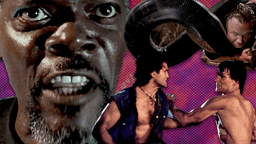
The challenge with poking fun at the original Anaconda—even in the form of an affectionate, scare-quoted homage—is that it’s already in on its own joke. Alongside Species (which is sleazier) and Deep Blue Sea (which outstrips it in terms of gore), it’s the platonic ideal of a mid-’90s studio thriller. “Anacondas are among the most ferocious creatures on Earth,” reads the title card of Luis Llosa’s film. “They regurgitate their prey in order to kill and eat again.” Forget Chekhov’s gun—this is how you do foreshadowing. The scene in which Jon Voight’s villainous snake poacher, Paul Serone, fulfills his destiny as serpentine backwash is punctuated with an audacious touch; slipping out of the great snake’s throat tract half digested, he bats a coquettish eyelash at Jennifer Lopez’s horrified heroine. It’s a wink-or-you’ll-miss-it moment in a movie that has one eye on the audience at all times. Serone’s fate serves as a succinct, visceral metonym for Anaconda’s gluttonous comedy pop-cultural consumption and regurgitation.
Exhibit B: The first time we see Ice Cube’s character, Danny Rich—apparently a USC alumnus and cinematographer hired by Lopez’s Terri Flores to shoot a documentary about a long-lost Indigenous tribe—he says, apropos of almost nothing, that it’s “gonna be a good day.” Because they’re in the Amazon, our man can’t get a Fatburger, see the lights of the Goodyear Blimp, or enjoy the Lakers beating the Supersonics, but the allusion still stands. And then, a few scenes later, Anaconda goes even deeper down the rabbit hole—er, snake hole—by showing Danny sitting on the deck of the crew’s rented steamer listening to Mack 10’s “Foe Life,” a song that Ice Cube cowrote, produced, and gets name-checked in (“Ice Cube, you know you rule hip-hop”). The implication that Danny Rich is both a doppelgänger and fan of Ice Cube is tantalizing enough; I prefer the reading that, in the world of Anaconda, Danny Rich is Cube’s assumed identity and that he’s trying to get away from it all by hiding out in South America with a ragtag crew of nonfiction filmmakers comprising Eric Stoltz, Jonathan Hyde, Kari Wuhrer, and a post–Bottle Rocket but pre-stardom Owen Wilson, at that point in full cud-chewing himbo mode as the dumbest guy on the ship.

More on ‘Anaconda’
“It is just me, or does the jungle make you really horny?” asks Wilson’s Gary—probably the best line in the movie, although the observation by Hyde’s uppity anthropologist, Warren Westridge, that “the last time I was in water like this, I was up all night picking leeches off my scrotum” comes close. The script for Anaconda was written by Hans Bauer, alongside the long-tenured, high-concept duo of Jack Epps Jr. and Jim Cash, best known for their work on Top Gun, a movie commissioned by Don Simpson based on a photo spread in California magazine (there was no time to read the article). “We write movies, not screenplays,” said Epps, who began his partnership with Cash in the ’70s by scribbling a series of ideas on a napkin in the Michigan State student union. Their shamelessness in suturing together some dusty B-movie clichés around a series of PG-13-rated kills—or vice versa—set the tone for Llosa, a former Peruvian film critic who had a set of credits for Roger Corman, including Eight Hundred Leagues Down the Amazon (not to be confused with Fire on the Amazon, also directed by Llosa and starring a young, intrepid, and heavily perspiring Sandra Bullock).
Suffice it to say that Llosa knew his way around the Amazon, and there’s actually a lot to like about the way Anaconda is directed. My favorite recurring visual touch is the way the frame tilts, Batman-style, to indicate that we are now seeing things from the snake’s point of view. Other things to like include Voight’s outrageous late-Brando-style performance, complete with Kabuki-like facial expressions and Paraguay-by-way-of-Yonkers accent. Say what you will about Epps and Cash as artists—and about Voight as a right-wing blowhard—but there are layers here. The cognitive dissonance between Serone’s backstory about wanting to be a priest and the murderous finesse with which he fillets a freshly caught river fish brings a simple bit of exposition into surrealist territory. It’s all good times, actually, from the way Serone affectionately-slash-creepily refers to Wuhrer’s production manager, Denise, as “baby bird”—even after he’s suffocated her, anaconda-style, between his thighs—to how he douses an unconscious J.Lo in blood (which he helpfully identifies as monkey blood) and to how he gives Hannibal Lecter a run for his money with that wink. As for the anaconda(s), they’re wonderfully tactile when they’re animatronic—I like the one that roars dinosaur-style while breaching out of the water—and pretty ropy as CGI, quite literally so when they wind themselves around their victims.
There are no images or ideas of this caliber in Anaconda 2.0. The callbacks to the original, whether in the form of restaged set pieces (yes, somebody gets swallowed and thrown back up; no, it isn’t especially funny) or crowd-pleasing alumni cameos (sadly not from Voight, who’s too busy being Donald Trump’s special ambassador to Hollywood), fail to resonate beyond a desultory sense of obligation. Few things are less fun than being told how much fun you’re having; it’s almost like being wrapped up in a giant snake’s embrace. The movie’s main accomplishment is that it makes you want to rewatch Anaconda, which is, as Doug might say, a plus.