
Every week this NFL season, we will break down the highs and lows—and everything in between—from the most recent slate of pro football. This week brought us a triumphant victory for the Jaguars, a Caleb Williams master class, a heartbreaking ending in—and for—Detroit, the flailing Buccaneers, and more. Welcome to Winners and Losers.
Winner: Bizarre Officiating
If you’re into novel referee decisions, this was the week for you. It was going to be tough to top the nonsense we witnessed in Seattle on Thursday, when Sam Darnold’s seemingly incomplete pass was ruled a fumble after the fact, giving the Seahawks the two-point conversion they needed to force overtime and eventually beat the Rams. But the final play of the Steelers-Lions came shockingly close to doing just that
With seconds remaining in the game, the Lions faced a fourth-and-goal and needed 9 yards for the go-ahead touchdown. Jared Goff hit Amon-Ra St. Brown a yard short of the end zone, and Brown was quickly wrapped up by two Steelers defenders. As penalty flags flew across the field and St. Brown appeared to be tackled, the Lions receiver managed to pitch the ball back to Goff, who scampered into the end zone for what would have been the game-winning score.
Unfortunately for the Lions, whose playoff odds dropped to the single digits with a loss, it was not. As head ref Carl Cheffers explained to the Ford Field crowd—with the confidence of a middle schooler doing a report on a book he never read—Goff had scored a touchdown, but St. Brown was flagged for offensive pass interference, which negated the play.
Games can’t end on a defensive penalty, but they can end on an offensive penalty. Typically, a flag on the offense would lead to replayed down, but with zeroes on the clock, there was no time for that.
Even though the refs got that call right in the end, the Lions have to feel like they were on the wrong side of the whistle on Sunday. Four plays earlier, Detroit had another go-ahead touchdown wiped off the board by a questionable offensive pass interference call. Isaac TeSlaa was flagged for this rub route:
Detroit scored two potential winning touchdowns in 25 seconds of game time and both were wiped off the board by a penalty that had previously been called only 74 times this season.
The loss dropped the Lions to 8-7, knocked them out of the NFC North race, and dropped their playoff odds to 6 percent, per The Athletic's prediction model. Another Detroit loss, or a Packers win, would drop that to zero and put an end to a season that Lions fans will want to forget. That may be harder to do after Sunday’s memorable ending.
Loser: DK Metcalf
Somehow, that hectic ending was not the strangest thing to happen at Ford Field on Sunday. At some point during the game, Steelers receiver DK Metcalf and a Lions fan in a blue wig got into an altercation that ended with Metcalf appearing to either throw a punch or aggressively release the fan’s collar from his grip.
We didn’t get any further information about the incident after the game, so it remains unclear what exactly transpired. According to CBS’s Tracy Wolfson, the fan was holding a Metcalf jersey and that was what initially caught the receiver’s attention.
The fan appeared to say something to Metcalf, which triggered the reaction. Steelers coach Mike Tomlin didn’t comment on the incident after the game, saying he had yet to see footage of it. Metcalf didn’t speak to the media. But no matter how it started, Metcalf will likely be hearing from the league office this week. Putting hands on a fan is never justified, especially in the NFL’s eyes.
Outside of Metcalf’s run-in with the fan, it was just about a perfect day for the Steelers, who extended their lead in the AFC North to two games with as many weeks remaining in the season after the Ravens lost on Sunday night—and after Lamar Jackson left the game with an apparent back injury. That made Pittsburgh’s path to winning the division and earning a home game in the playoffs a lot clearer. With a win over the 3-12 Browns next week, or a Baltimore loss in Green Bay, the Steelers will be headed to the postseason. It will be up to the league office to decide whether their top wide receiver will be joining them.
Winner: The Small-Market Jaguars
Jacksonville is clearly relishing its role as this year’s “nobody believes in us” team, but the Jaguars may have finally earned the NFL’s respect with a 34-20 win in Denver on Sunday.
“Just thankful that a small-market team like us can come into Mile High and get it done,” Jacksonville coach Liam Coen said as he opened his postgame press conference. The words “small market” were said with a bit of smirk, a clear shot back at Broncos coach Sean Payton, who earlier in the week used the phrase to describe his upcoming opponent. “As you look at them and you watch the tape, it’s a smaller market but you see a real good team,” Payton said on Wednesday. Well, Payton might have underestimated just how good, and how resilient Coen’s Jaguars would be as they stunned Denver’s defense, converting 8-of-15 third downs and scoring touchdowns on four of their five trips to the red zone.
The crowd at Empower Field at Mile High was deafening early in the game, and the noise and an aggressive Broncos defense forced Jacksonville into two quick three-and-outs. But the crowd noise might have worked against the Broncos on Jacksonville’s third possession, when officials blew a third-and-10 play dead just after the snap because of a false start. Denver safety P.J. Locke, who was coming on a blitz, didn’t seem to hear that whistle and landed a blindside hit on Jags quarterback Trevor Lawrence. The ensuing unnecessary roughness penalty kept Jacksonville’s drive alive, and Lawrence found Parker Washington in the end zone five plays later for the game’s first score. With Denver’s no. 1 cornerback, Patrick Surtain II, shadowing receiver Brian Thomas Jr. for most of the game, Washington finished as the Jaguars’ leader in targets (10) and yards (145) with an eye-popping 24 yards per catch. Washington had 91 yards after the catch, most of which came on two plays where he spun out of attempted tackles by Broncos corner Riley Moss and broke free for big gains.
The Broncos sacked Lawrence five times, but three of those resulted in losses of just 1 yard or zero yards, hardly backbreaking plays. And Lawrence led the Jaguars on five consecutive scoring drives in a stretch from the middle of the second quarter through the early fourth quarter. This game continued Lawrence’s hot December run, as his three highest games this season by EPA per dropback have come this month. He also hasn’t committed a turnover since November 23.
“He was under some pressure, and he never flinched,” Coen said of Lawrence. “He never got out of his comfort zone.”
The lapses by Denver’s defense against that wildly efficient Jacksonville offense made it impossible for the Broncos to follow the formula that had carried them for much of their 11-game win streak: holding opponents to field goals and keeping games close enough for Denver’s streaky offense to strike late in games. The Broncos did manage to hit on several deep passes against Jacksonville—and they outgained the Jaguars 445 yards to 346—but Bo Nix’s unit struggled on third down (just 5-of-14) and scored on only one of their trips to the red zone. Nix’s interception on a fourth-down attempt with just over eight minutes left in the game all but sealed the Broncos’ first loss since Week 3. Denver can clinch the AFC West with a win against Kansas City on Christmas night and a Chargers loss to Houston in Week 17. But absent both of those results, the Broncos-Chargers matchup in Week 18 would have major stakes for playoff seeding.
Regardless, Sunday’s game in Denver already felt like a postseason game—but the Jaguars were the team making the biggest statement. –Lindsay Jones
Winner: The Patriot Way
The Patriots’ long climb back to the top of the NFL is nearly complete. Before Sunday night, it had been four years since New England made the playoffs, and six years since the last time they looked like legitimate Super Bowl contenders—before Tom Brady left for Tampa Bay in 2020. Sunday night’s win over Baltimore ended the postseason drought, and after Denver’s slip-up against Jacksonville, the Pats have pulled into a tie for the AFC’s best record. If the Broncos drop another game, New England could secure home-field advantage throughout the playoffs with wins over the Dolphins and Jets.
The NFL’s new villains may be missing out on this year’s playoffs, but an old, familiar foe will be taking their place. You know, I thought I’d enjoy rooting for these upstart Patriots, but it’s been pretty damn easy to resent their newfound success. It took them only five years to find a replacement for Brady in Drake Maye, who could join the league’s elite class of quarterbacks a lot sooner than even the most optimistic Pats fans could have hoped for. New England has also found its next Bill Belichick in Mike Vrabel, who’s helped turn around the defense and always seems to find small edges that decide close games.
Sunday’s win in Baltimore even felt like a victory taken from New England’s previous Golden Age. It got off to an uneven start, with Maye turning the ball over twice in Ravens territory and the Patriots defense having no answer for Derrick Henry and Lamar Jackson in the run game. New England caught a break when Jackson left the game with an injury right before the half, but Maye and the Patriots defense were the ones to secure the victory. Maye showed off every bit of his throwing ability with the first 300-yard performance of his career and a few clutch conversions down the stretch. Vrabel’s defense eventually got its shit together just in time to make the game-winning play, as so often happened with Belichick’s teams.
New England’s formula for success under Vrabel is remarkably similar to the one Belichick used for two decades of dominance. Elite quarterback play, which Maye has supplied all season, and smart, hard-nosed football. That can carry a team a long way—into the playoffs, certainly, and maybe on another annoyingly long run of competence.
Loser: The Flailing Buccaneers
The Buccaneers are officially in “meltdown” territory. Six weeks ago, only the Eagles had shorter odds of winning their division. Now, after a 23-20 loss to Carolina on Sunday, Tampa Bay is looking up in the standings for the first time all season, and if the playoffs started today, the defending NFC South champs would be left out. Now that the Bucs have dropped three games in a row, it’s easy to dismiss them as a horribly flawed team. But they looked like real Super Bowl contenders back in mid-October. At that time they were 5-1 and had just beaten two NFC heavyweights in San Francisco and Seattle. Baker Mayfield was playing the best football of his career, and he’d had enough moments in crunch time to insert himself into the early MVP conversation. This has felt like a completely different team—and quarterback—over the past two months.
Sunday’s loss to the Panthers was perfect encapsulation of Tampa Bay’s two-month slide. We can start with Mayfield, who threw the game-ending interception with the Buccaneers in field goal range and needing only three points to extend the game.
That angle makes the interception look a lot worse than it actually was. Mayfield expected Mike Evans to continue on his path across the field, but the Bucs receiver broke in the opposite direction right as the pass was being thrown. Evans’s decision to reverse field was also defensible. He saw Mayfield start to scramble to the right and didn’t want to run away from the play, so he broke back toward the direction his quarterback was going. It was a simple mix-up, but one that may end up costing Tampa Bay a shot at the playoffs.
Despite how the game ended for Mayfield, this was his most efficient performance by EPA since the team’s 5-1 start. That’s not a terribly high bar. Since Week 7, Mayfield ranks 30th in the NFL in EPA per dropback, right ahead of the recently benched Tua Tagovailoa. He ranks 31st in dropback success rate, ahead of only Jaxson Dart, Cam Ward, and Shedeur Sanders. Only Ward and Geno Smith have averaged fewer yards per dropback over that span. In other words, Mayfield has been one of the league’s worst quarterbacks during this prolonged Bucs rut.
But that isn’t all his fault. The Bucs offense has been decimated by injuries at various points this season. Evans missed two months with a shoulder injury, Emeka Egbuka missed a few games with an injured hammy, and Chris Godwin made his season debut in late November. Those are just the receiver injuries. The offensive line was down four of its five expected starters just a few weeks into the season. On top of that, Mayfield was (and still might be) playing through a shoulder injury he suffered in Week 7. The Bucs haven’t had much of a run game to ease the burden on Mayfield—Bucky Irving also missed seven games with foot and shoulder injuries—and the defense is on pace for its worst season since Todd Bowles was promoted from defensive coordinator to head coach in 2022.
Against the Panthers, the Bucs couldn’t run when they needed to and the defense couldn’t get off the field. Mayfield and the receiving corps kept the team in the game but eventually buckled under the pressure. That description doubles as a synopsis for Tampa Bay’s 2025 season. The Buccaneers still have a chance at salvaging things, though. Carolina is in first place in the division for now, but if Tampa Bay can just beat a Quinn Ewers–led Dolphins team next week, it will set up a winner-take-all rematch with the Panthers at home in Week 18.
Winner: Caleb Williams
Watching a generationally talented quarterback make game-winning plays at the end of a Bears-Packers game is nothing new for Chicago fans. Being on the right side of those games, and watching their quarterback make those plays, though, might take some getting used to. On Saturday night, Williams pulled off two unbelievable throws late in a game that could decide the NFC North. Chicago’s star quarterback—saying that will also take some getting used to—did this to force overtime:
And then he did this in the extra period to end the game and put the Packers away:
I’m not sure which play was more impressive. If we’re going based on the quality of the throw, it’s the game-winner. Per NextGenStats, DJ Moore had created just 0.6 yards of separation when the pass arrived, and even that feels generous. Packers cornerback Keisean Nixon was as close as a pass defender could possibly be without drawing a pass interference flag.
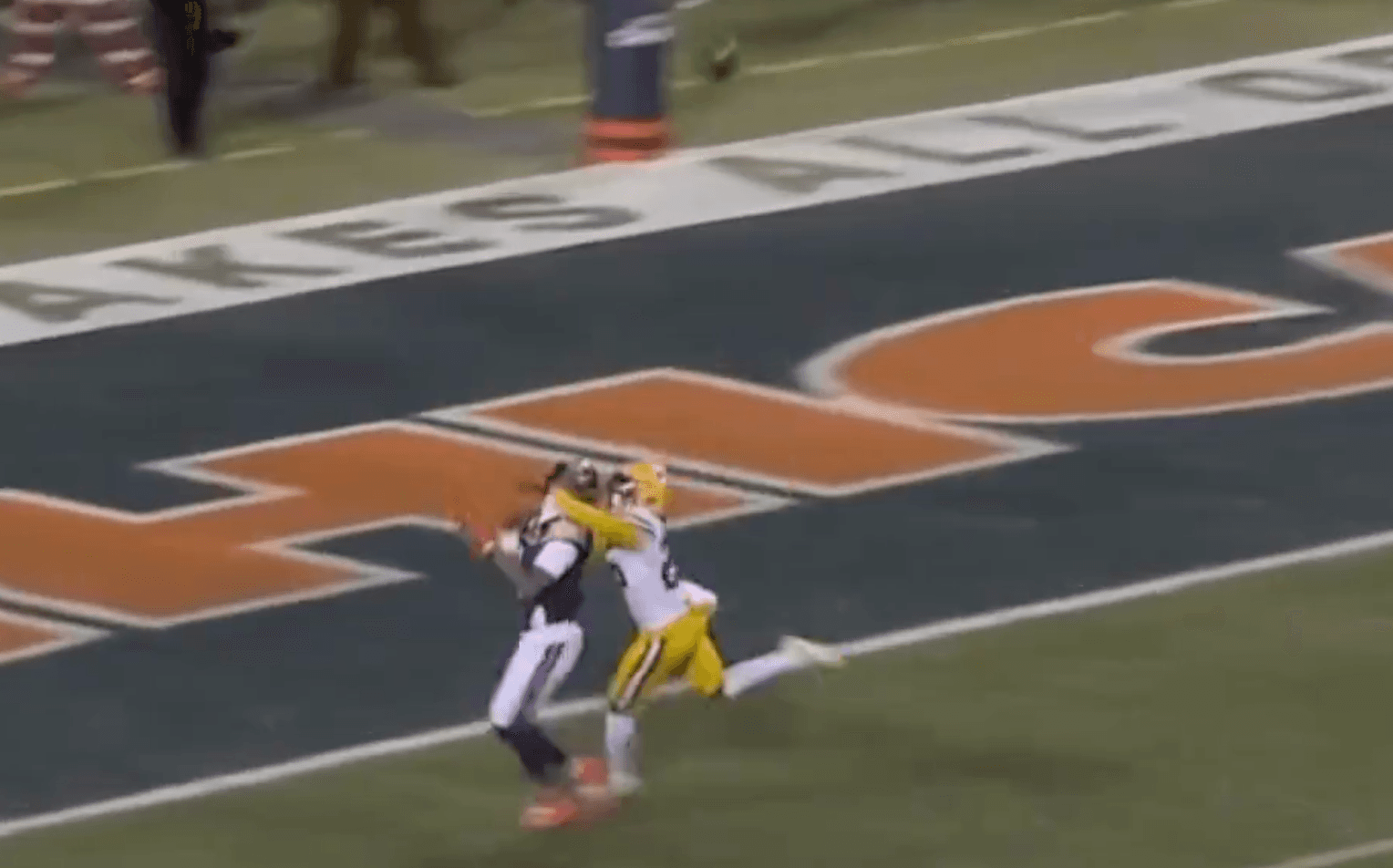
The game-tying touchdown was wide open, but it required more quarterbacking to pull off. Green Bay sent an all-out pressure, leaving its defensive backs in single coverage across the field. Chicago had Jahdae Walker and Olamide Zaccheaus stacked to the right side of the formation, which forced the Packers defenders to that side to play a combination coverage. Nate Hobbs was supposed to take the receiver who ended up inside, and Nixon should have taken the outside guy. But Walker and Zaccheaus crossed paths as they started running their routes, which caused enough confusion to spring Walker open in the back corner of the end zone.
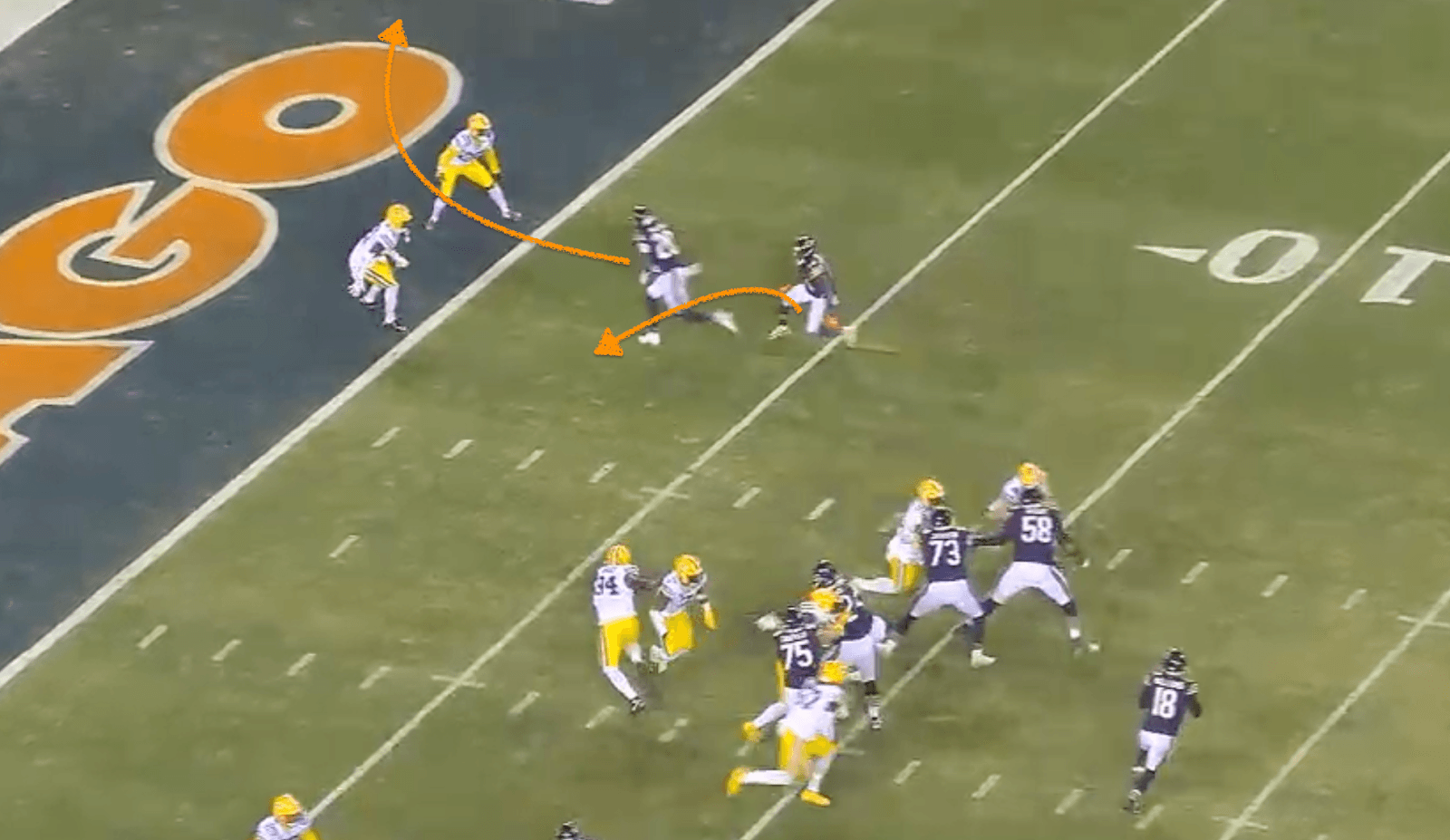
Had Chicago picked up the blitz, it would have been an easy throw for Williams. Instead, a free rusher got through, and Williams had no time to properly read out the play. He only had time to see Nixon take one small step toward Zaccheaus’s route underneath before triggering the throw—and then needed to fade away from the pressure to get the pass off.
Even with Williams going full superhero mode down the stretch, the Bears needed a tremendous amount of luck to force overtime. Chicago trailed by two scores with just over two minutes to go. Cairo Santos’s 43-yard field goal cut the lead to seven, and then his knuckling onside kick crossed up Romeo Doubs, who couldn’t corral the ball or recover his muff. The Bears came away from the pile with the ball, setting the stage for Williams to deal a shocking, but not unfamiliar, blow to Green Bay.
Winner: The New and Improved Justin Herbert
Great quarterbacks have a way of making their surroundings look a lot better than they are. If you watched Herbert cut up the Cowboys secondary in a 34-17 win on Sunday, you may not have realized he’s playing behind the league’s worst offensive line and throwing to a young, inconsistent receiving corps. Herbert tossed two touchdowns, averaged over 10 yards per attempt, and finished with a QBR of 92.8 (out of 100). He made things look simple, even on the few occasions when the Cowboys defense managed to make things difficult.
Dallas pressured Herbert 11 times on Sunday and didn’t sack him once. It can be difficult to tell when a quarterback mitigates pressure well—subtle movement in the pocket and quick processing aren’t always easy to identify during a live broadcast. But those things become apparent when you watch Herbert play behind a Chargers offensive line that has gone through multiple starting tackles and about two dozen lineup combinations this season. Coming into the week, L.A. had allowed the second-highest pressure rate of the Next Gen Stats era, which dates back to 2016. And that’s only gotten worse over the past month or so, as injuries have really cut into the team’s offensive line depth.
In past seasons, I’m not sure Herbert would have coped with the pressure as well as he has in 2025. The lack of creativity in his game has been a long-standing criticism, and a valid one prior to this season. I’m not sure what caused the shift—viable theories include playing behind a bad offensive line, dating a pop star, and growing tired of Greg Roman’s play calling—but this isn’t the same quarterback who’d dutifully get through his progressions and almost always settle for an ill-fated checkdown. He’s scrambling more often, throwing from different arm angles, finding creative ways to throw the football outside of the pocket, and even celebrating now. The Cowboys game would have played out differently with that old, robotic version of Herbert. He had 12 dropbacks end outside of the pocket on Sunday and averaged 0.47 EPA and 8.8 yards on those plays. It was the second time he generated at least 5.0 EPA on out-of-pocket dropbacks this season after going two full seasons without hitting that benchmark, per TruMedia.
Herbert is still on the outside of the MVP debate, but he’s got a chance at winning the award if he keeps this up. The Chargers are now just a game back of the Broncos in the AFC West race, with a Week 18 matchup in Denver still left on the schedule. If L.A. can beat the Texans next week, that matchup will double as the AFC West title game. Herbert doesn’t have the stats of a typical MVP, but if he can drag this offense to his first divisional crown, he’ll have an award-winning narrative and plenty of film nerds willing to make the case on his behalf.
Loser: Jaxson Dart
Thirteen net passing yards. That’s all Dart could manage on 19 dropbacks in Sunday’s 16-13 loss to the Vikings, an L that dropped the Giants to 2-13 on the season and into a tie with the Raiders for the league’s worst record. The rookie quarterback completed just seven of 13 passes for 33 yards and a pick. He gave 20 of those yards back on five sacks in what was the worst outing of his rookie campaign—one that might start to raise some questions about his status as New York vies for the top pick in next year’s draft.
That may seem harsh for a rookie who’s sporting a solid stat line through the first 10 starts of his NFL career. Dart leads his fellow first-year quarterbacks in EPA per dropback and ranks a respectable 18th in the league in QBR. But the concern is the amount of punishment he’s had to withstand to generate those numbers. Dart has shown some positive signs as a pocket passer, but that’s the weakest part of his game as it stands today. The rookie is at his best when he’s dashing through the open field and making defenders miss or just running them over. Unfortunately, that’s led to almost weekly visits to the blue medical tent—and Dart says he has no plans to alter his approach. The recklessness isn’t a bug; it’s a feature of Dart’s game, and a key one at that.
It’s hard to have faith in Dart as a pocket passer when the team that drafted him doesn’t seem to have any. Interim head coach Mike Kafka called plays on Sunday as if he were terrified of exposing his rookie to a Brian Flores defense. The Giants called runs on their first four plays of the game, and Dart took just one dropback in the first quarter. He didn’t attempt his first pass until the second quarter and finished the first half with 10 total dropbacks. He ended the game with just 19, and New York trailed for most of the second half.
There have been moments this season when Dart has looked the part of a future franchise quarterback, but we haven’t seen one of those moments in a while. And now Brian Daboll, the coach who pounded the table for him, is no longer around, and Joe Schoen, the general manager who made the pick, could be out of a job in a few weeks. If New York ends up with the first pick in the draft—a loss to the Raiders next week would give them a 65 percent chance of landing it, per The Athletic’s prediction model—the new regime will almost certainly be scouting quarterbacks. The Giants may have nothing to play for over the final two weeks, but Dart could be playing for job security.