The Slopification of Everything
In 2025, anything could be, and was, slop. Here are six foundational laws to identify slop going forward.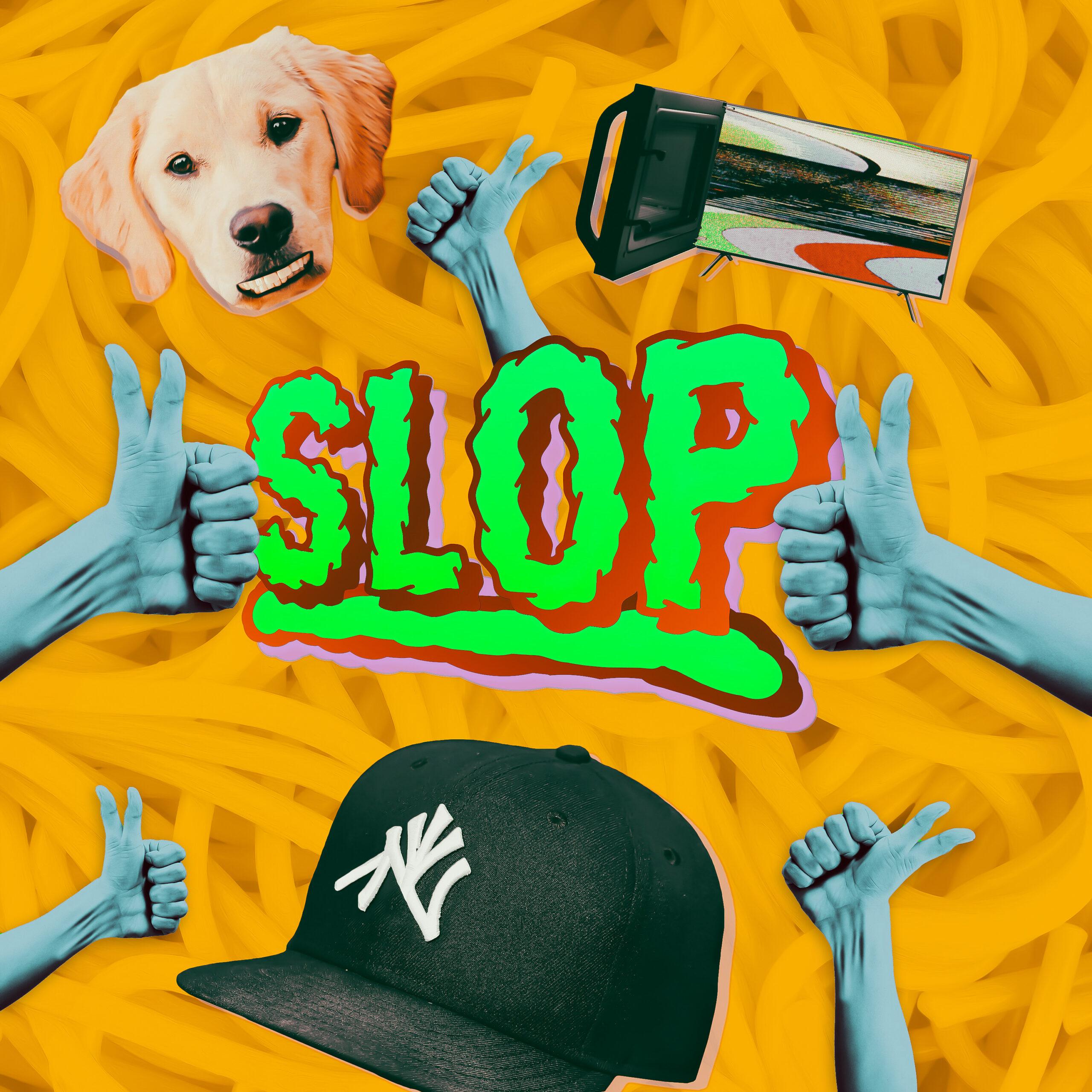

Earlier this month, the Oxford English Dictionary, in what I assume was a ceremony involving a red rose and a tearful, lingering kiss, announced that it had chosen “rage bait” as its Word of the Year for 2025. I know what you’re thinking: That’s two words. If you’re like me, however, you’re also thinking, “Wowww, what a terrible choice for Word of the Year,” because “rage bait,” with its quaint echoes of Obama-era message board culture, its air of having been a cutting-edge piece of online discourse in the year your aunts discovered Facebook, makes about as much sense as the word of the moment as “pwned” or “You’ve got mail,” or the dial-up modem tone.
No. The defining word of 2025, the true Word of the Year, is “slop.” This seems obvious. Merriam-Webster, the only dictionary in human history that could plausibly be called Too Online, got it right. 2025 was the year when most people realized that weird, ugly, and inaccurate AI-generated content—AI slop—was overrunning the internet. It was also, fascinatingly, the year when the AI-specific sense of “slop” started being applied more generally to non-AI products; suddenly there was architecture slop and fashion slop and carslop and wordslop. Anything could be, and was, slop; 2025 itself was open to allegations of being yearslop. “Slop” was such a useful concept for describing contemporary reality that the physical world appropriated it in reverse: First the offline sense of the word (sludge, waste, pig food, seepage) was borrowed as a metaphor for AI content, and then the AI sense was borrowed back as a metaphor for the many things in our environment that seem AI-ish, whether they were generated by AI or not.
This secondary use of “slop”—as a sort of pejorative suffix suggesting vibes of enshittification—has been a matter of feel rather than precise definition; Merriam-Webster doesn’t even acknowledge it when naming “slop” its Word of the Year. To my mind, though, it’s this usage that tells us the most about our moment. I’ve been trying to think about what makes slop slop, and so, to help us all say goodbye to 2025 and gird our loins for 2026, I’ve compiled a list of six essential attributes that collectively determine the slop quotient of any cultural product. Let’s take them in order, and then look at some test cases to see how they apply.
Note that something can be slop without having all six attributes; sometimes two or three are enough. Feel still matters here. Anything that does match all six, though, is probably such a phenomenal piece of slop that Sam Altman wants to buy it for his living room, if it isn’t already there.
But enough preamble. Let’s strap on our lexicographer safety goggles and dive into the Word of the Year.

More on the Year of Slop
1. Slop exists at scale.
Slop implies mass. There’s no artisanal, hand-crafted, or deeply personal slop. The existence of any slop suggests that an endless supply of other slop is nearby and readily available. The logic of slop is commercial and is tuned to both the attention economy and the money economy; slop’s premise is that a massive output of arbitrary products, if they can be produced cheaply enough or with little enough effort, will outperform a limited supply of more carefully designed products. The ultimate condition to which slop aspires is infinite quantity produced instantly and for free.
In the case of AI slop, this means a deluge of images of Jesus made out of spaghetti or videos of golden retrievers performing open-heart surgery on a patient with the head of Sabrina Carpenter and the body of Theodore Roosevelt. In the case of non-AI slop, it could mean the proliferation of niche music genres under increasingly specific TikTok keywords (alt-urban dank lucid WordPress bluegrass) or fast-fashion brands that churn out 100 new designs a week without any consideration or forethought. It could mean a particularly egregious slate of Netflix movies. “This is vitamin slop,” you could mutter to yourself, wandering through the miles of supplement aisles at your local health-food store.
2. Slop remixes culture without understanding it.
Slop doesn’t innovate. It welds together elements from existing narratives, design vocabularies, and iconographies but—crucially—without appearing to know why they exist or to have a considered reason for combining them. This can be subtle: a car that combines familiar design cues that don’t work together, or a mock-up of a new kitchen that mashes historical references in a subliminally grating way. (Why is my microwave enclosure neo-Gothic while my backsplash is Dutch Colonial?!) When unsubtle, it makes itself felt via a sort of floating “... for some reason!” that trails the description of the thing: a tuna, but it’s covered in pictures of Vin Diesel for some reason! A summary of Apocalypse Now, but it’s in the voice of Mr. Belding from Saved by the Bell for some reason!
Disney’s new deal with OpenAI will create bulk tons of this stuff online: Cinderella, but she’s dressed like a Viking and eating at IHOP for some reason! It’s fascinating that when AI people talk about the creative potential of their products, this is the kind of stuff they generally emphasize. Soon, a limitless future of customized entertainment will be at your command. If you’ve always wanted to see Marilyn Monroe in Judge Dredd, now you can. As if all art ultimately aspires to be Fortnite, an endless slog of reshuffled IP.
The result of the constant barrage of this stuff, I think, is a feeling that’s analogous to, but not quite the same as, the uncanny valley effect. Everything in the environment takes on a kind of repugnant quasi-familiarity; wherever you look, you encounter objects that seem designed to remind you of something rather than to be something. But because the reminders are so jumbled, their replication is so relentless, and their intentions are so illegible, they leave you with a sense of following endless threads that lead nowhere, of simultaneously knowing too much and missing something, of being inexplicably baffled by things you understand.
3. Slop has contempt for both creators and audiences.
The idea of integrity is antithetical to slop. So is the idea that purpose, need, or ambition can exist outside the realms of power and money. The worldview that produces slop is one in which only a sucker would make something for the love of making it. Only a weirdo would feel a need to experience art as the authentic response of a human mind to the conditions of its moment, design as an attempt to solve real problems, or communication as more than an information exchange. Quality, other than the baseline quality of photorealism in an image-generating app, is a dead end; no one will care or notice if movies look worse or if search results lie. Slop is a radical extension of both the corporate cost-cutting impulse and the impulse in media and entertainment to chase the lowest common denominator. It encodes the belief that no one needs more, no one wants better, speed and convenience are all that matter, truth and beauty are fake.
4. Slop hides producers from consumers, and vice versa.
Normally, when you consider a cultural object—a pair of sneakers, a pop song—you can tell roughly what the people who made it meant for it to do. The further you venture into the field of slop, the less likely that is to be true. Products seem to be made by no one, for no one, made by people with no conception of their audience, to be bought or liked or worn by people with no idea why the product exists. The Instagram algorithm wants to sell you a baseball cap with the Patagonia logo on it, only the word “Patagonia” has been replaced by “lessons”: What is it? Did AI make it? Is it a foreign knockoff using arbitrary language to evade copyright enforcement? Is it an intentionally created product designed to look like a foreign knockoff because somebody thought it was funny? Is a print-on-demand company auto-generating products for you based on a wildly inaccurate reading of your profile keywords? Is it—anything’s possible—an actual brand?
Slop makes the relationship between producers and consumers opaque. The more slop surrounds you, the more your cultural experience seems haunted by mistranslation. If you've been on AliExpress, you might know the feeling of looking at a roughly translated listing; it’s like that, but while with AliExpress you know you’d probably understand the listing if you could read the original Chinese, with slop you doubt there’s a language in which any of this would make sense.
5. Slop exploits parasocial identification with right-wing power.
Slop is the house style of both right-wing populism and tech oligarchy. The Trump White House is steeped in it; Silicon Valley has bet a chunk of its future on it. It’s no surprise, then, that slop has been most readily embraced by Elon Musk stans, crypto enthusiasts, far-right shitposters, and people in the political tractor beams of MAGA and big tech (if those are even separate entities these days). If you’ve ever used the word “libtard,” chances are you’ve also faved a great deal of slop. For people in these spaces, liking or pretending to like slop becomes another lib-owning vector for demonstrating ideological commitment. It’s a litmus test, a means of reinforcing identification with the regime, and a method of extending the MAGA fantasy world into the realm of aesthetics: In the same way that you believe the medbed conspiracy, you can believe that OpenAI’s Studio Ghibli–based slop is cool or moving. And as the slop aesthetic continues to move from the internet into the real world, as we’ve seen with the authoritarian kitsch of Trump’s White House ballroom design—more on that in a second—it will likely continue to define the era of tech-fueled, would-be authoritarianism in America.
6. Slop erodes your sense of the real.
Slop aspires to a condition of believable mimicry. If it’s a video of Donald Trump taking an inbounds pass from a bear and dunking over Anthony Fauci, it tries to look like a realistic sports clip. If it’s an email asking your professor for an extension, it tries to strike a recognizable tone of polite appeal. If it’s a picture of your goldfish as a character in Toy Story 3, it tries to look like a real Pixar movie. Even when slop isn’t trying to trick you into thinking a false event really happened, the cumulative effect of so much authentic-looking arbitrary content is to blur our mental distinction between true and false. The difference between something that happened and something that didn’t happen becomes less significant; the difference between a source and a copy becomes less stark. Real things seem a little bit fake. Fake things seem a little bit real.
Again, it’s not necessary for a thing to meet all six of these criteria to be slop; they all point in a slop-indicating direction, however, and the more of them the thing does meet, the more pure an instance of slop it’s likely to be. To put these into practice, here are a few quick test cases.
Test case no. 1: Is the White House ballroom actually slop? After all, it doesn’t exist at scale—it’s unique, thank God—and it doesn’t seem designed to be produced cheaply or quickly. It possesses all four of the other attributes in spades, however, to the point that even tech commentators were initially under the impression that the plans were AI-generated. It’s probably the single most significant real-world example of slop as a right-wing loyalty test. It is utter slop.
Test case no. 2: Are Hallmark movies slop? Hallmark movies should be slop. They’re produced in vast quantities, they remix familiar rom-com elements to the point of absurdity, they’re not interested in originality, and the aspirations they valorize—straight, conventional romance in small towns, mostly—are at least implicitly conservative if not actually MAGA-adjacent. But somehow, incredibly, they don’t feel like slop. There’s too much of a sense that the people making them care about them, and too much of a sense that their creators and their fans are in lockstep. Hallmark movies understand what they’re doing too well, and like doing it too much, to be slop.
Test case no. 3: Is the Cybertruck slop? Like the White House ballroom, the Cybertruck has been made in small numbers (lol), and it seems to be the product of an authentic, albeit incompetent, creative vision. However, the Cybertruck has become so singularly associated with Musk’s personality cult, is such a confused mash of bizarre car-like elements and influences, and conveys such contempt for beauty and function and human life itself that it’s at least slop-like in spirit. Not that it happens often, but every time I see one, I want to shout, “... for some reason!” as it thuds past.
Test case no. 4: Is Instagram shirtslop slop? I get served so many ads for graphic tees that don’t make sense to me on any level. A lot of them have words or images that seem algorithmically linkable to my interests; I saw one the other day that said “TIRED WHIPPET CLUB,” which caught my attention, as I am tired and live with whippets. The shirt had a picture of a sleeping whippet on it, and underneath the whippet, in the Live, Laugh, Love font, it said, “Life is letter with dancer dog.” (Not better, “letter.”) Sometimes they’ll have a line or two of Japanese characters and a line in English that seems comically inane: “Today, I choose to be two metal” or whatever. As with the Patagonia hat above, I genuinely don’t know which of these products are generated by AI on the fly, which ones are copies or parodies of oddly translated Asian shirts that I’m supposed to buy for their novelty value, which ones really are oddly translated Asian shirts, and which ones are something else. I think most of them are slop, but whenever I see one, I enter the cloud of slop unknowing; I gaze into the abyss of slop ambiguity.
Test case no. 5: Are McMansions slop? McMansions, to me, are fascinating evidence that products can be classified as slop even if they predate the rise of generative AI. McMansions don’t seem quite contemptuous enough to be hard slop, but they’re at least light slop. (An elegant slop for a more civilized age.) How far back does this phenomenon reach? Is there 19th-century slop? Is there slop from the Roman Empire? With McMansions, I do think there’s an important caveat: If you’re happy living in one, it’s not slop for as long as you live there.