The Year “6 7” Ate Parents’ Minds
The most obnoxiously catchy phrase of the year means … nothing, which is probably why it took over everything in 2025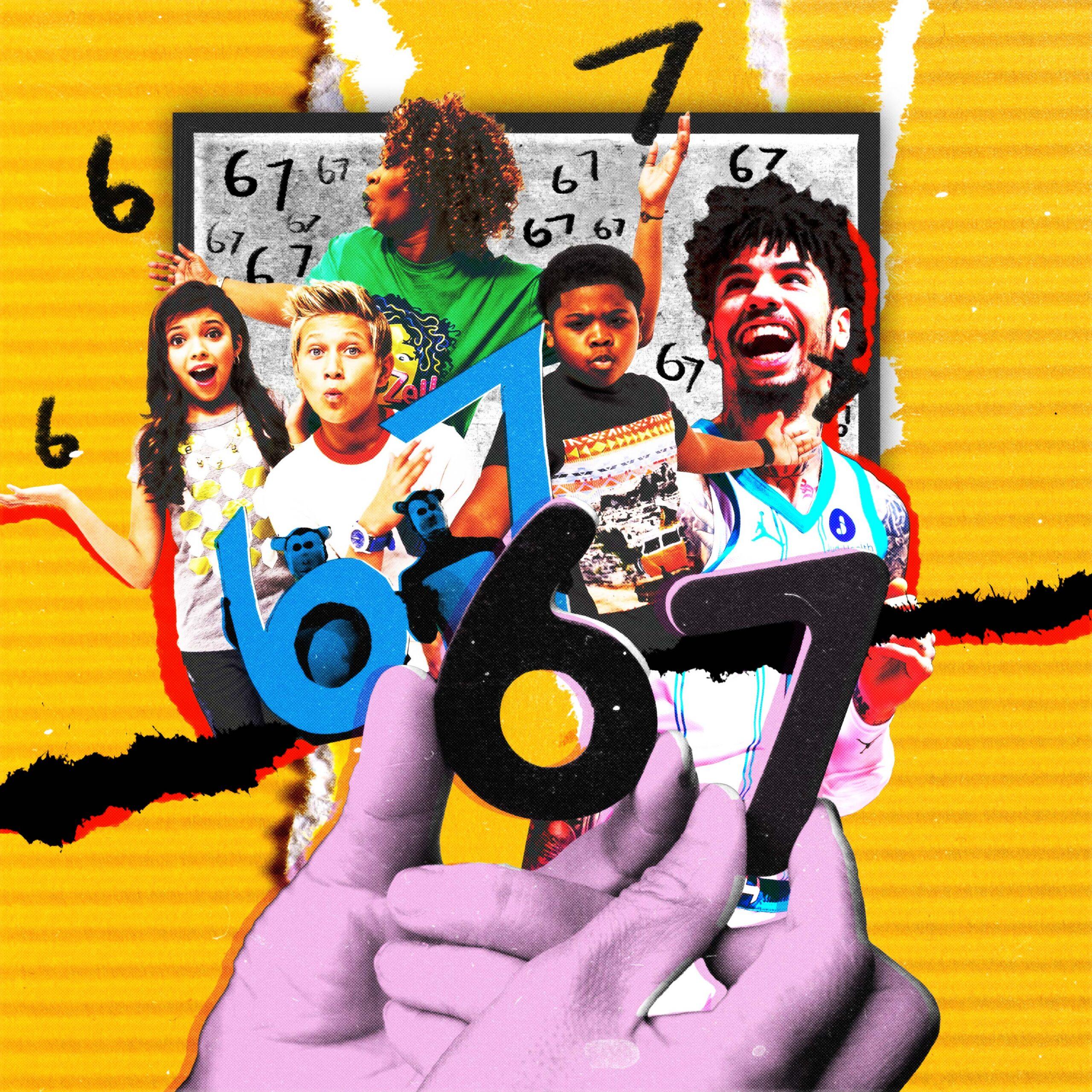

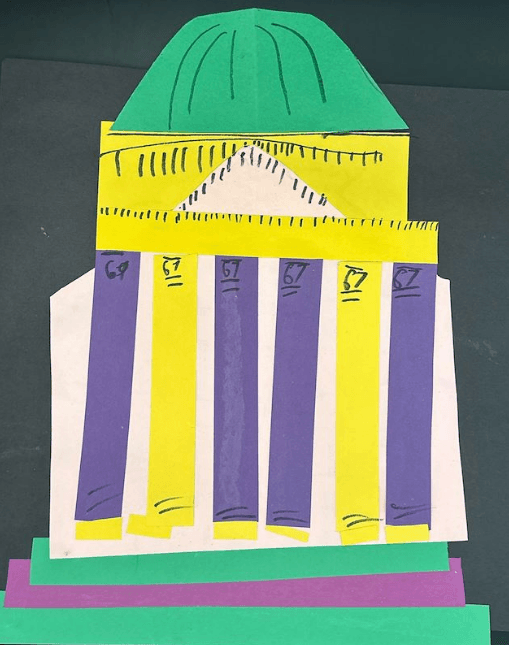
Every so often, nestled in my inbox amid the endless messages from MyChart and TeamSnap and SignUpGenius and the school principal, I’ll see an email from a third-party vendor called Artsonia telling me that a new creative work from one or both of my kids has dropped. When I click on the thumbnail image, I’m treated to a hi-res scan of their latest creation—a Starry Night rip-off, say, or a koala collage—and am gifted the opportunity to have it made into a golf towel/oven mitt/keychain with free shipping if I order right now! Earlier this fall, an email from the principal informed me that in my 7-year-old son Malcolm’s art class, “students will be studying ancient Roman architecture while they recreate the Pantheon out of cut paper shapes.” Not long after, I got the alert from Artsonia that this work was complete.
I smiled proudly when I saw the little thumbnail of the precious creation made by my brilliant, vibrant, beautiful boy. I imagined the concentration that must have been all over Malcolm’s sweet, freckled face as he constructed his Corinthian columns. Such attention to detail: He’d even included random decorative squiggles to denote the ornamental molding at the top of each one! Then I clicked to see the fuller image, and as I zoomed in, I realized that those decorative squiggles weren’t actually as random as I’d thought. In fact, every last one of them cohered into the same thing: the number pairing 6 7, written in Malcolm’s hand six different times.
“Son of a …” I said to myself, trailing off as I realized that whatever word I said next would, by definition, be about myself.
I hadn’t really seen this coming, even though I obviously should have. Fueled by the collective passion of a big-umbrella youth movement that welcomed everyone from little kids to sullen teens, the nonsensical, numeric 6 7 meme reached all corners of society in 2025, from pro sports to a Jimmy Fallon segment featuring Sydney Sweeney and Labubus all the way to the Congressional Record. My second grader’s Artsonia account was clearly no exception. Nor was my fourth grader Graham’s recent bowling alley birthday party, where the young celebrants, given free rein to choose their names for the scoring screen, inputted handles ranging from “I am so ligma” to, of course, “67676767676767.” As they bowled, I observed that these 9- and 10-year-olds were more focused on knocking down six or seven pins than they were on achieving strikes or spares.
Driving home afterward, I asked my younger son and one of his friends the very questions you may find yourself currently wondering: Where did 6 7 come from? And what does it mean?
“I first knew about it when I was watching this YouTube video, and it was this kid named Mason, and he told the cameraman to come over here, and he said 6 7 with a hand motion,” Malcolm’s friend explained. My son’s answer was slightly less confident, though equally specific: “Uh, so, I know about 6 7 ’cause my brother”—brudda—“uh, told me about it. And it’s a basketballer … it’s a basketball player’s height.”
In hopes of learning more, I polled Graham and the other young bros (sorry, young bruhs) congregating in my home on what felt like day 67 of their Thanksgiving school break. “It’s the height of LaMelo Ball,” one of his friends told me. “There’s a song,” another added, “but it has a lot of bad words in it.” Sounding almost wistful, one boy remarked: “The person who made up 6 7 had to be a cool dude.” It hurts me to recount this, but at one point I heard a child’s voice, maybe even belonging to my own flesh and blood, say the words “brain rot playlist,” and immediately wished I hadn’t. (In brighter news, my Gen Alpha representatives were all aware that seven ate nine. We haven’t lost every recipe.)
Finally, though, I asked the boys what it all meant—this inescapable meme that all year long has permeated what feels like everything. They responded quickly and in unison: “nothing.”


Looking Back on the Year in Culture
As far as I can tell, every one of the varied answers I got about 6 7 did contain some truth as to how it originated and spread—even if that truth isn’t necessarily any more illuminating. The song with a lot of bad words in it? That would be “Doot Doot,” by the Philly-based rapper Skrilla, the patient zero of this viral spread, as it were. “Doot Doot” contains the lyrics:
Shooter stay strapped, I don't need mine
Bro put belt right to they behind
The way that switch brrt, I know he dyin' (oh my, oh my God)
6-7, I just bipped right on the highway (bip, bip)
Skrrt, uh (bip, bip, bip)
I just bipped right on the highway
Trackhawk, mm, sittin' in the driveway (skrrt)
Uh, pull up, doot-doot, doo-doo-doo
Doot, doo-doo, doo-doo, doot
Dump truck, Baby Shark, doot, doo-doo-doo
I popped the Perc' and popped the blue
I geek-geek like the custys too
And so on, and so forth. (The “Baby Shark” reference is a genuinely nice touch!) As for the “basketballer”? That’d be Ball, who is indeed listed at 6-foot-7 on the NBA’s website. That was what originally prompted TikTok fancammers to post clips of him being nice with it, soundtracked by Skrilla’s laconic (and soon-to-be-iconic) verse.
That “kid named Mason” with “the hand motion”? That was actually a flopsy-haired boy named Maverick Trevillian, whose enthusiastic, full-body interpretation of the meme, filmed in the stands at a March AAU game by a guy named Cam Wilder, took off in just about every possible direction—some far more brain-rotted than others. My sons and their buds did leave out one vital vector in 6 7’s unstoppable spread: a video of a high school hooper named Taylen "TK" Kinney rating a Starbucks drink you-know-what on a scale of 1-10 and making a juggling motion with his hands.
And the meaning of 6 7? Well, I do think “nothing” rather elegantly sums it up. Even Skrilla himself, when asked to clarify the reference in his music—was it about any particular 67th Street or some law enforcement walkie-talkie shorthand?—kept things shrouded. “I never put an actual meaning on it, and I still would not want to,” he told The Wall Street Journal in October. “That’s why everybody keeps saying it.”
And how! Throughout 2025, the number pairing has proved surprisingly resilient, lasting far longer than I would have ever expected, thanks in part to some good old-fashioned back-to-school viral resurgence. (It’s definitely a type of hand, foot, and mouth disease.) Sporting events have started showing fans busting out their best 6 7 moves on the jumbotron, à la a kiss cam, or playing it up when, say, a bucket pushes one team’s score to 67. A recent South Park episode wove together 6 7, Peter Thiel, and Satan. Apparently, some In-N-Out Burger joints have tweaked their ordering system to skip over check no. 67 (like how tall buildings superstitiously omit labels for 13th floors) on account of the roving bands of teen streamers eager to capitalize on some frazzled worker in a white paper hat calling out the magic number.
Even some of the world’s most conspicuous leaders of men—NFL coaches—have seemed powerless in the face of this youthful uprising. “I think these kids these days, maybe they say 6 7,” Buffalo Bills head coach Sean McDermott, age 51, said in a press conference in early October (responding to a question about … James Cook’s usage?). “I’m not really sure what that means, either,” McDermott went on, “but I got teenage kids, so I try and talk in their language.” Da-ad! McDermott wasn’t the first NFL coach to bring up the figure unsolicited, either: In August, when now-former New York Giants coach Brian Daboll, 50, made a drawling “six sevvvvven” remark during a presser, the NFL’s official TikTok account posted the video with the caption “bro has to be clip farming” and the crying laughing emoji.
Dictionary.com—always a click farmer with these sorts of things—named 6 7 the Word of the Year. Brands and video games obviously got in on the whole deal, offering 6 7 discounts and emotes and such. “[Keir] Starmer says sorry for leading pupils in 6-7 dance,” announced a BBC headline after the British prime minister joined in with some kids doing 6 7, hand motions and all, unaware that the routine had been banned at the school. Not to be outdone, the vice president of these United States, JD Vance, tweeted just the other day that his child would not stop chanting 6 7 in church after being told to turn to pages 66-67 in the readings. (Vance’s attempt to be a relatable dad just had to involve an off-putting joke about rolling back Americans’ constitutional rights, didn’t it?)
At this point, 6 7 has been well and truly beaten into the ground. But as any parent knows, “beaten into the ground” tends to be the genre of humor that kids love most.
In theory, few things are sweeter than seeing children experience joy. Their little scrunched noses! Their silly-toothed mirth! As parents, we pray for moments like these: Please have a happy life, we whisper between lullabies when they’re babies. Whatever makes you happy, we tell ourselves as we write a check for some new extracurricular that was never budgeted for. Then, somewhere, the monkey’s paw curls, like: Oh, I’ll show you happy, all right …
I always bristle when I see people write Instagram captions about “making core memories,” because I know from personal experience that the real core memories are rarely the ones you’d expect. (All the beach vacations I went on as a kid blend together, but you better believe I have visceral, perfect-fidelity memories of messing around with the settings on the ball machine in the tennis center supply closet while my dad took a 90-minute lesson.) Similarly, happy kids aren’t all sunshine and rainbows. Oftentimes, happy kids present a lot more like real pains in the ass.
Earlier this week, Malcolm and I sat in the audience to watch his big brudda, Graham, perform in an end-of-the-year improv class showcase. Every time a new set of kids went up, the instructor invited someone in the peanut gallery to shout out a word or two to incorporate into the scene. You can see where this is going. After a few rounds of anodyne suggestions from various parents—winter! a jungle! Taylor Swift!—the child I still refer to as Baby Malcolm, all curled up in my lap, grew emboldened. “Six sevvvvvven!” he finally chirped.
Unfortunately, this brought the house down. In that Wall Street Journal article I mentioned earlier, a teacher had described the effect the numbers six and seven have on kids and teens as “like throwing catnip at cats.” Sitting in the elementary school gymnasium, I saw exactly what that looked like firsthand. Every person in the room under the age of 20 activated instantaneously, their eyes snapping wide open like dear little demons, their arms gyrating en masse. (Say what you will about this whole phenomenon: At least it demonstrates that the kids are actually listening!)
These children were about as happy as they could possibly get. Their improv teacher, however, was understandably not. According to my kids and their buddies, various authority figures at their school have developed their own ways of coping with the madness. Some purposely give the kids a sanctioned 30 seconds to blow off all that 6 7 steam when the number happens to arise during math lessons. Others take a more capitalist, incentive-based approach.
“We have the Dojo Store,” one of the fourth graders informed me. (It’s unclear if this operation is at all Artsonia adjacent. Really not my business!) “We have these Dojo Points, and they’re like points that we earn for being, like, good. And we use them and buy stuff like little toys. And, um, if you say 6 7, or 41, you can’t buy from the Dojo Store.” Tough, but fair.
But wait—back up a second. What the heck is 41?! According to the kids in my life, it’s basically a Temu version of 6 7. And I have also heard tell that the kiddos’ nonsense-number power rankings include 21 these days, too. I was all excited to mention these newfangled numbers in this space—reporting live from the cutting edge of Gen Alpha numerology, baby!—but it turns out that, as ever, I’m waaaay behind the trend. Parents magazine and The Today Show were on the 41 story months ago. And 21? Man, people have been explaining that one for nine years.
With kids, though, there will always be something. I was probably somewhere between Graham’s and Malcolm’s ages when the words “Don’t have a cow, man” were briefly the bane of educational workers nationwide. (I can’t remember whether my elementary school banned Simpsons T-shirts, but I do recall that slap bracelets got the kibosh.) And while the 6 7 thing is annoying, at least it’s relatively benign? (I do keep waiting to find out it got Milkshake Ducked, as all things inevitably will, given a long enough time horizon.) It’s waaay preferable to, and I apologize for what I’m about to remind you of here, the whole “Skibidi Toilet Ohio” season of life. And it’s more socially acceptable than when an overstimulated Malcolm chooses to diffuse a situation by blurting “chicken nugget!” as he has been doing for a number of years now.
Honestly, the dark moments when I feel like I’ve failed as a parent never stem from the boys convulsing and yelling “six sevvvvven.” It is always because, despite all my clarion guidance and my constant shining example, these two absolute gremlins won’t stop fucking saying the most insidious two-word phrase in the English language: “on accident.” What can ya do?
On a recent Sunday morning, I sneaked away from the chaos of my home to attend a “Sunday Soul Flow” yoga class. After nearly shattering my fibula on a Razor scooter on my way out the door—a fate somehow worse than stepping on Lego—I got in my car and noticed that the very same cherished GOAT USA–brand hoodie whose unexplained disappearance had caused a very grumpy stir between parent and child a couple of days prior was, in fact, right there in the back seat, strewn beside some 3D-printed toys of unknown provenance and a shriveling apple with a single chomp missing.
A confluence of relief and anger swirled through me, creating a fearsome eddy within. Welp, better go find my zen! I thought. When my class began and the teacher asked us to set an intention for our yoga practice, my inner soul screamed out: serenity.
We were in the midst of an uncomfortably long reverse warrior pose when the teacher encouraged us, in an entrancing, breathy monotone, to stay focused and strong just a little bit longer. “We’ll hold this for about six or seven more breath cycles,” she murmured, and suddenly it was like one spell lifted as another took hold. “Ha, my son would love that!” she exclaimed in her regular voice. “Six SEVVVVEN!” I laughed a little too loudly, so as to convey both understanding and mama-bear solidarity, and promptly lost my focus, and strength, and then my balance altogether.
Ultimately, in our own middle-aged lady way, the yoga teacher and I were doing the same thing with 6 7 that no less an expert than the Dr. Becky says that the kids are: joining in on the fun, signaling to one another that there’s something we both know about, even if it’s not something that we necessarily understand. One linguist who looked into the spread of 6 7 noted that it effectively functions as a “shibboleth”—a kind of password-y, in-group code word—and called the phenomenon an example of “semantic bleaching,” which is what happens when a phrase gets repeated so very often that it loses all meaning and just sounds like noise.
My trusty panel of children—I probably should have mentioned earlier that multiple of these guys sport some pretty sick mullets, just so you could better imagine the vibe—agreed that grown-ups trying to co-opt 6 7 were “uncool” but surprised me by scoffing at the notion that parents could perhaps overdo 6 7 and make the numbers uncool by association. “That is not true,” said one of Graham’s buddies. “That would never work.” Malcolm’s classmate, age 7, agreed. “It never gets old for kids,” he told me. Indeed, it’s us parents who went and got old.