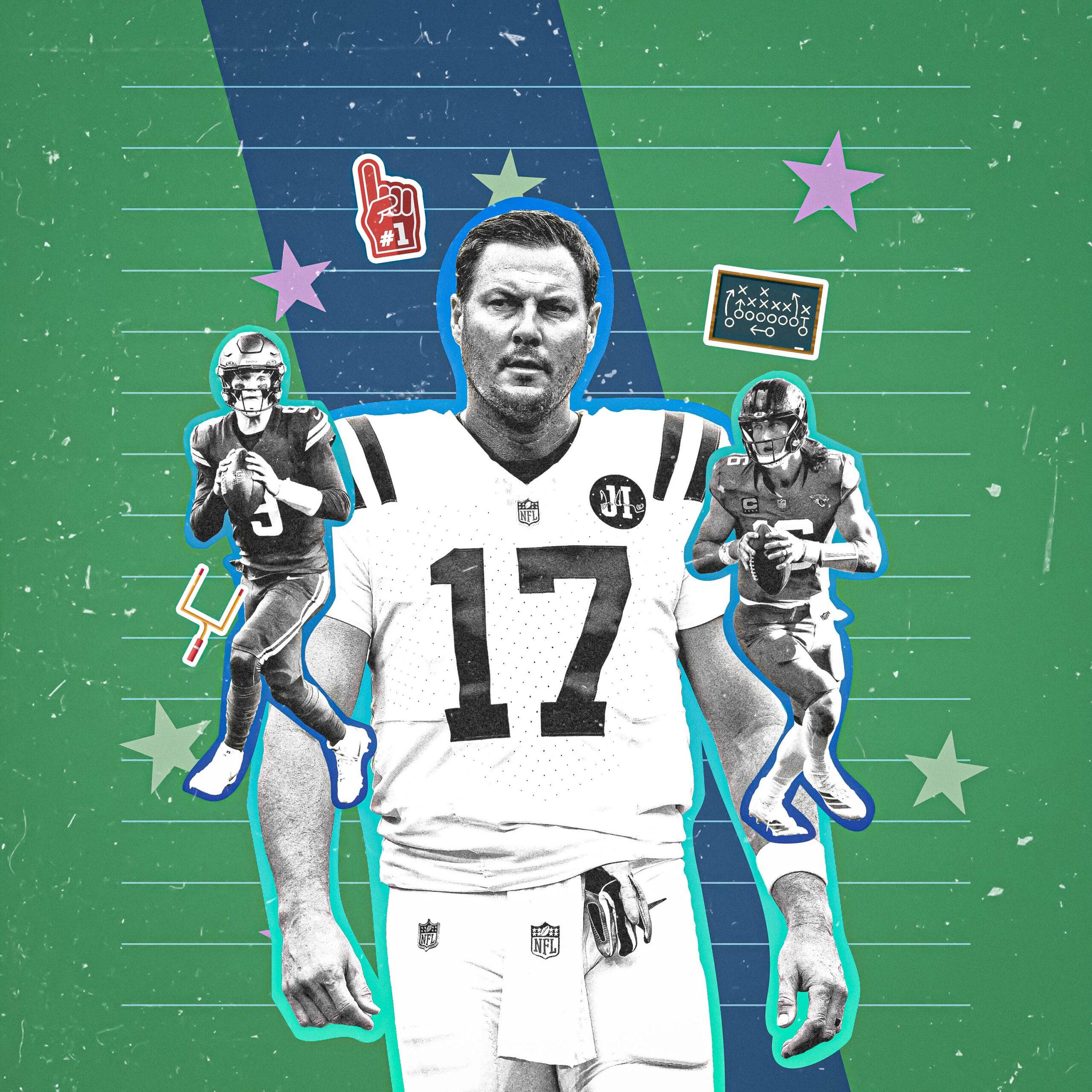

Welcome to The Ringer's quarterback notebook, where I’ll cover the past week in NFL quarterbacking—from the most interesting passers, plays, and story lines, to some other stuff that caught my eye when I was watching film. In this week’s notebook, we’ll be looking at the not-so-fun return of Philip Rivers, J.J. McCarthy’s improvement, Trevor Lawrence’s turnaround, and more. Let’s talk quarterbacks.
One Philip Rivers start was enough.
Now that the nostalgia of seeing Philip Rivers back on an NFL field has worn off and I’ve had time to watch the all-22 of his first game in five years, I think I’ve had enough of this comeback story. Look, I’m very impressed that Rivers was able to hop off the couch after all those years and put a scare into Seattle, one of the best teams in the NFL. But let’s not act like this was some virtuoso quarterbacking performance. It was slop, just with a familiar face serving it up. Rivers’s primary goal on every play seemed to be getting rid of the football as quickly as possible.
He probably knew where to attack Seattle’s defense, but he didn’t have it in him physically to get the ball to those spots with any consistency. The 44-year-old was straining just to throw the ball away at times. Passes to the perimeter hung in the air painfully long. And Rivers rarely targeted the middle of the field, where throws require the kind of velocity he no longer has.
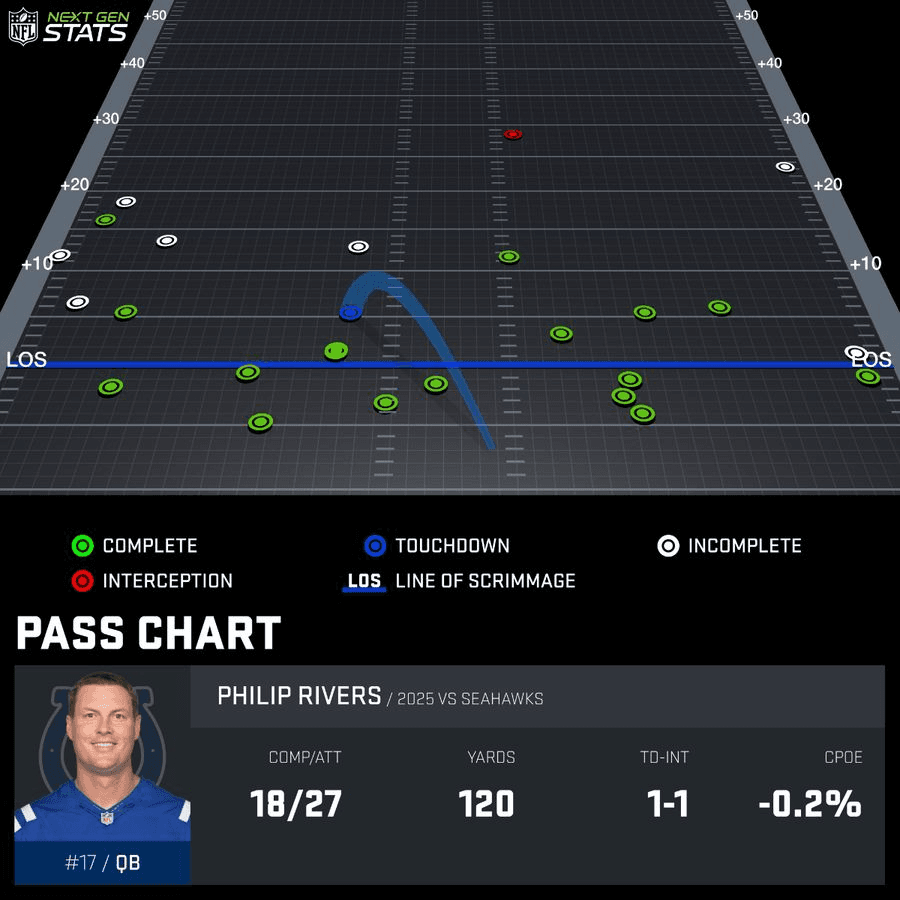
I am an appreciator of Rivers’s game. He’s a future Hall of Fame quarterback. That he can still dink and dunk his way to a 120-yard performance against a top defense is a testament to his football brilliance. His performance in Seattle was powered almost entirely by ball knowledge. But I don’t want to see him like this. I don’t need to watch Rivers chucking up bowling balls to Jonathan Taylor while Taylor’s running a clear out route and not even expecting the ball.
I don’t need to see him put Tyler Warren in danger with these hospital balls.
I don’t want to see this.
Or this.
Rivers can still throw a checkdown and make quick passes underneath against soft coverage. He can fix protection issues and get the offense in the right play. But after one game, his presence looks like a net negative. The Colts operated out of shotgun on all but one snap in Seattle, so Rivers didn’t have to take true dropbacks from under center. Colts coach Shane Steichen was calling the game with one arm tied behind his back.
I get the logic behind bringing Rivers in to be a veteran presence in the locker room or having him make an emergency start while third-stringer Riley Leonard is nursing a knee injury. But Leonard was active on Sunday and will practice this week, and Steichen is still sticking with Rivers for next week’s game against the 49ers. That means at least one more week of panicked checkdowns and self-sacks. If Rivers makes it through that, his reward the following week is a red-hot Jaguars team. And if he’s still standing after that, he’ll play against the Texans and DeMeco Ryans’s defense in the final game of the season. NFL fans will be watching that matchup like the spouse of a washed-up fighter in a boxing movie, cringing after every hit he takes from Will Anderson Jr. and that terrifying pass rush. Hopefully, Rivers and Steichen will come to their senses before then.
Has J.J. McCarthy played his way out of meme status?
How many good games does McCarthy need to string together to put an end to the Nine meme? How about two? Is that enough to get everyone to stop using this as the symbol of awful quarterback play?
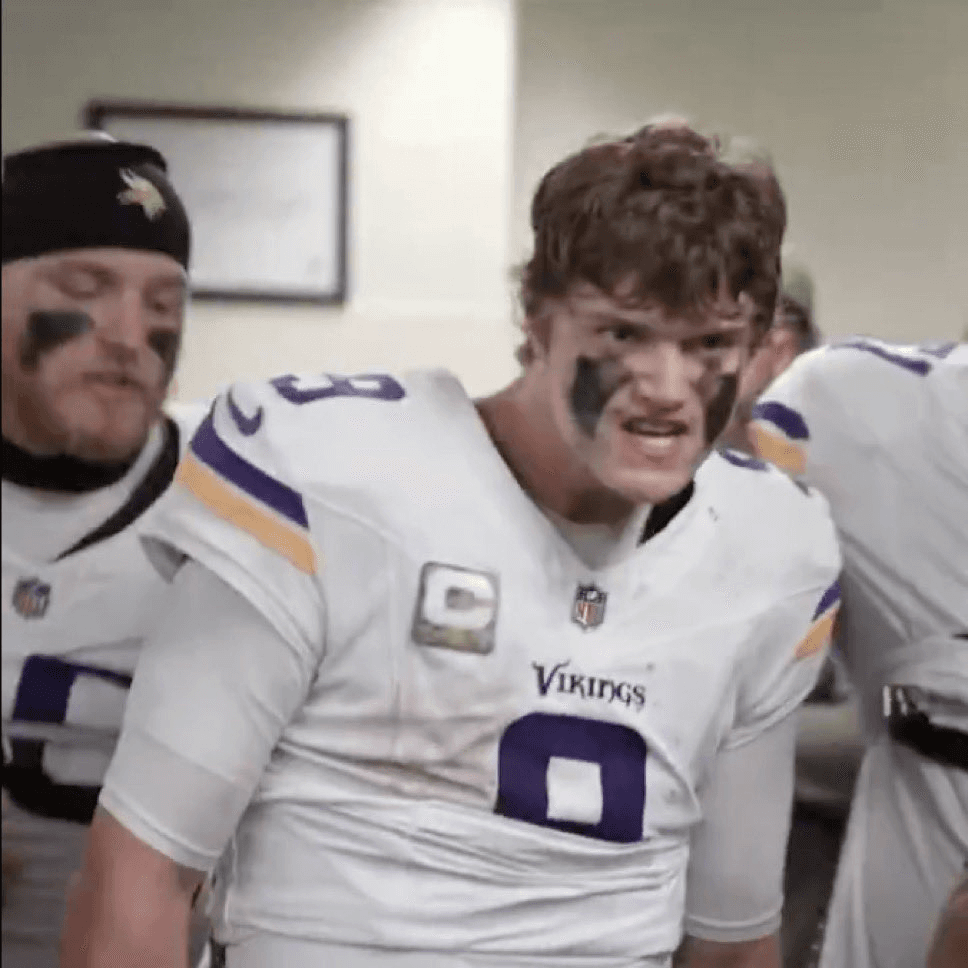
Any quarterback who’s played poorly has been in danger of getting Nined. They already got Rivers. Mahomes was Nined after the Chiefs were eliminated from the playoffs this week. I even saw Giants general manager Joe Schoen get Nined this past weekend.
But do you know who hasn’t been Nined in over two weeks? That’s right. Nine himself. McCarthy backed up a solid outing against Washington in Week 14 with the best performance of his career in Week 15. He threw for two touchdowns, ran for another, and averaged more than 10 yards per attempt in a road win over the Cowboys on Sunday Night Football. That’s two consecutive weeks of highly efficient football. These numbers probably oversell McCarthy’s performances over these past two games, but they’re impressive nonetheless and have to be considered signs of genuine improvement after the historically inefficient start to his career.

McCarthy no longer looks unplayable. His process in the pocket is smoother. He hasn’t rushed through his progressions nearly as often. He’s not forcing as many checkdowns or running himself into as many sacks. We’re starting to see him make the easy play more often. This modest third-down completion to T.J. Hockenson was a slick display of pocket management that showcased some of that improvement.
McCarthy climbs the pocket while keeping his eyes downfield and eventually hits his checkdown option in rhythm. This isn’t 400-level quarterbacking—or even 200-level, for that matter—but it’s an area where McCarthy had to improve to have any chance of remaining a viable starter for Minnesota.
McCarthy also showed off his arm strength on Sunday. His best throw of the night was this 29-yard fireball up the seam, which Vikings coach Kevin O’Connell highlighted on Monday morning.
That’s the kind of play McCarthy’s actually managed well this season, where he takes the snap, hits the back of his drop, and throws downfield—preferably to a receiver who’s running a vertical route. Even before this recent hot streak, that’s how many of his best throws have played out. And it’s a strength O’Connell and his offensive staff can start to build a passing game around.
But McCarthy’s inaccuracy on other throws is still a significant obstacle for his coaches. Even in Dallas, McCarthy was off target on 16.7 percent of his pass attempts, per TruMedia. That’s his highest rate of inaccurate passes in a month and his fourth-worst mark of the season.
And some of McCarthy’s bigger plays came on pretty mediocre throws. His first touchdown pass forced Jalen Nailor to work back to the ball and make a contested catch.
McCarthy wanted to throw the ball close to the back pylon but instead left it short and inside. Granted, it was a highly difficult throw with McCarthy moving to his left, but a better ball would have made his receiver’s job a lot easier—-and that’s a throw you’d expect a quarterback who’s been billed as a good athlete with a strong arm to make. The same is true on this play later in the game. McCarthy has Hockenson running toward the sideline with a safety working over the top. The throw is too far upfield, which turns an open pass into a contested catch situation.
McCarthy needed to place that pass closer to the sideline as Hockenson (correctly) decided to flatten out his route to avoid a confrontation with the safety. The tight end makes the play anyway, but it’s a bad ball from the quarterback.
Overall, the Commanders and Cowboys games were positive steps for McCarthy, but it’s fair to wonder how similar performances would have played out against better defenses. We may not get an answer next week, as the Vikings have the Giants up next on the schedule, but Minnesota finishes out the season against Detroit and Green Bay. McCarthy will get his chance to prove that he can do it against a proper defense, too. Maybe that will put an end to the memes.

The Jakobi Meyers trade has renewed my faith in Trevor Lawrence.
Or put another way: Since Meyers joined the Jaguars at the trade deadline, I have seen the error of my ways. I’ll admit, my faith in Lawrence was wavering after a mediocre first half to the season, but the 2021 first pick’s recent heater, which has coincided with Meyers’s arrival in Duval County, has pulled me all the way back in. I mean, come on.
Lawrence put up six touchdowns in Sunday’s blowout win over the Jets, continuing the tear he’s been on since Jacksonville swung the deadline deal for Meyers. Here are Lawrence’s passing splits with and without Meyers:

That’s just wild. Lawrence was posting bottom-five numbers before Meyers arrived. But with the 29-year-old receiver on the field, the Jags quarterback has played like the best passer in the league. His 0.25 EPA per dropback would lead the NFL this season. The same goes for a 54.9 percent success rate. And only Sam Darnold is averaging more than 8.0 yards per dropback this season. This is an MVP-level stretch of play we’re seeing from Lawrence.
His turnaround can’t be fully explained by the Meyers trade, of course. He’s presumably grown more comfortable with more reps in Liam Coen’s system. And the first-year coach has made a few tweaks to his scheme along the way. But Meyers has served a vital role, too. He was the adult in the room that this receiving corps desperately needed. A timing- and rhythm-based passing game doesn’t really work when receivers aren’t hitting the correct landmarks on their routes or are timing their breaks poorly. That can lead to bad throws (that aren’t really the quarterback’s fault) and cause hesitation in the passing game, as the QB can’t rely on the receiver to do the right thing. Meyers has almost single-handedly solved this problem for Lawrence, and you can see it when Lawrence targets his new go-to guy. Look how early Lawrence is letting these passes go, well before Meyers is getting out of his break. The accuracy stands out as well.
With Meyers on the field, Lawrence has cut his off-target throw rate in half (from 12.5 percent down to 6.3 percent) and cut down on his average time to throw while increasing his average depth of target. Issues with accuracy and timing—along with some good old-fashioned organizational incompetence—have prevented the leap we’ve all been waiting for from Lawrence since he led the Jaguars to the AFC divisional round in early 2023. This is starting to look like that leap—and it couldn’t have come at a better time for the 10-4 Jaguars. This week, Lawrence takes his team to Denver to face a nasty Broncos defense, and playoff positioning will be on the line.
I want to believe in Tyler Shough, but I have one hang-up.
The Saints might have something in Shough. I don’t know whether he's a franchise quarterback, but that’s within the range of outcomes for the 26-year-old rookie based on what he’s shown in six starts this season. I get Ryan Tannehill vibes when I watch him. He’s got prototypical size and moves well. He’s got enough arm strength and isn’t afraid to use it. And he’s not a stiff system-QB type, either. Shough can improvise and make creative plays in structure. This play he made to beat a Panthers pressure look in Sunday's win made me sit up in my seat.
Carolina has six men on the line of scrimmage showing blitz, with one of them, linebacker Christian Rozeboom, dropping into coverage after the snap.
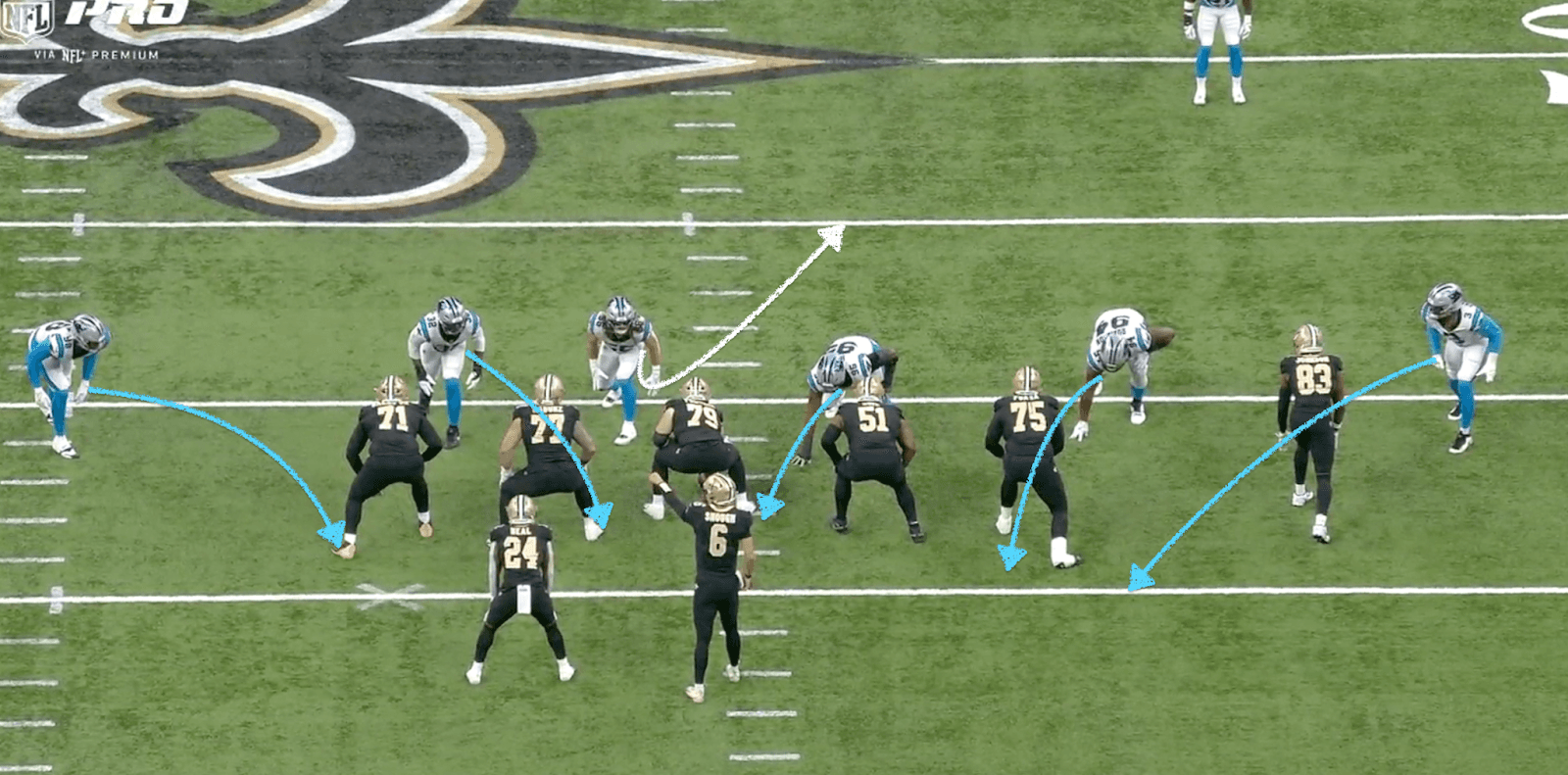
Shough notices Rozeboom lurking underneath the route he’s looking to target and uses his eyes to send the linebacker in the opposite direction of the throw.
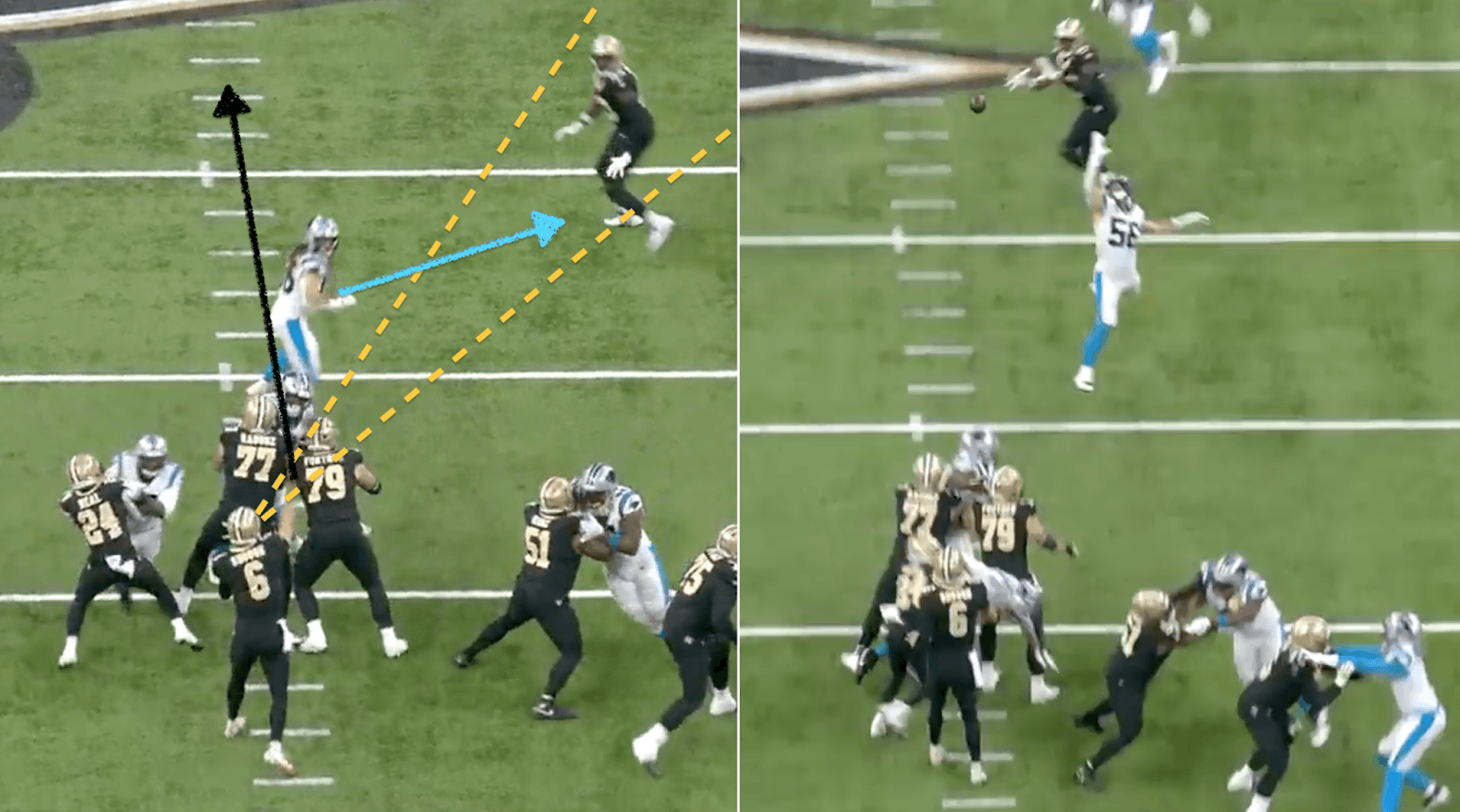
Shough isn’t afraid to work the middle of the field, and he has the chops to do it consistently. He peppered Carolina’s defense with intermediate throws down the stretch of the Saints’ come-from-behind win. New Orleans spammed the same high-low concept, with an in-breaker behind a short route underneath, and Shough hit the “high” option every time—even if he had to work to the backside of his progression to get there.
As you can see in those clips, Shough can really sling it. But my big concern with him is his lack of control on those line-drive throws. Even in a strong performance against Carolina, he had a number of wild misses. Shough has ticked plenty of boxes over these past two months, but “consistent accuracy” is not one of them. Of the 44 quarterbacks with at least 100 pass attempts this season, he ranks 43rd in accurate throw percentage, per Pro Football Focus. He has the highest rate of passes charted as “catchable inaccurate.” The ball doesn’t always go where Shough wants it to, which detracts from all that arm talent he possesses. He’s an impressive thrower, but he’s not a consistent one. Not yet, anyway.
This Next Gen Stats passing map made me look dumb.
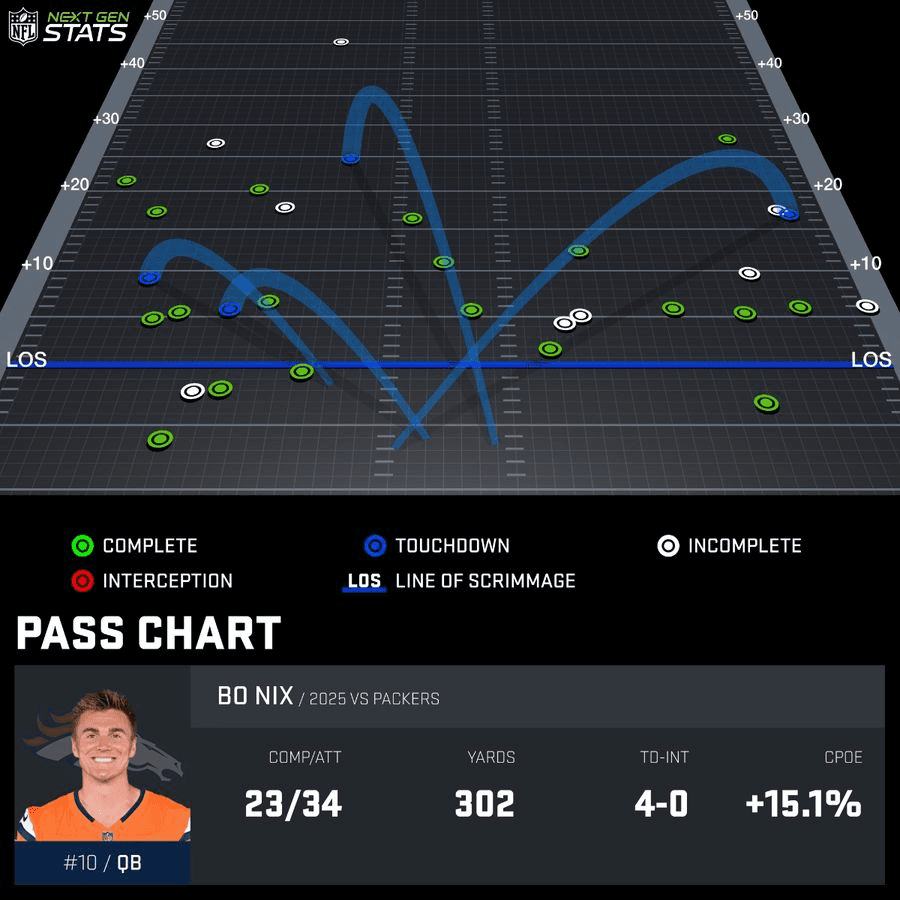
I picked a bad time to share my concerns about Bo Nix’s game. In last week’s QB Notebook, I broke down several plays that showed some of his issues with seeing the field. The common theme was Nix looking away from open receivers downfield to take inefficient throws underneath. That’s been a consistent flaw in his game going back to college, and Nix hadn’t shown much progress in that area in his NFL career. Then, though, he turned in the most complete performance of his career in an upset win over the Packers. You can see the stat in the graphic above: 302 yards, four touchdowns, and an absolute highlight reel of downfield throws.
This was the most ambitious I’ve ever seen Nix. We’ve seen him make plenty of impressive throws: Remember the 93-yard touchdown pass against the Browns last season? But we’ve never seen him stuff so many into one performance. If this becomes the baseline for Nix, my take on his limitations won’t age well.
The best throw I saw this week.
Take it away, Caleb Williams.
There’s some debate over whether Williams got away with a bad decision here. My answer: Who cares? If your first instinct is to question one of the coolest throws you’ll ever see, you’re doing football fandom wrong. My actual answer: It was a risky decision, but with the safety Grant Delpit playing so shallow when Williams let go of the pass, the ball placement and velocity made an interception highly unlikely. At worst, the ball would have been tipped out of the back of the end zone. That’s a bad decision for most quarterbacks, but Williams is one of the few who can get away with it—and he knows it.
The worst throw I saw this week.
There’s a fine line between anticipation and predetermination, and Tua Tagovailoa has been on the wrong side of it for the past two seasons. This is yet another example. Tagovailoa decides he’s going to throw this ball as soon as he finishes his drop. Does he see the cornerback entering the throwing window? Who knows, but he throws it anyway. When Miami’s offense was at its peak a couple of seasons ago, those throws were always open. Now they’re covered more often, and Tagovailoa keeps throwing them anyway. He leads the NFL with 15 interceptions.