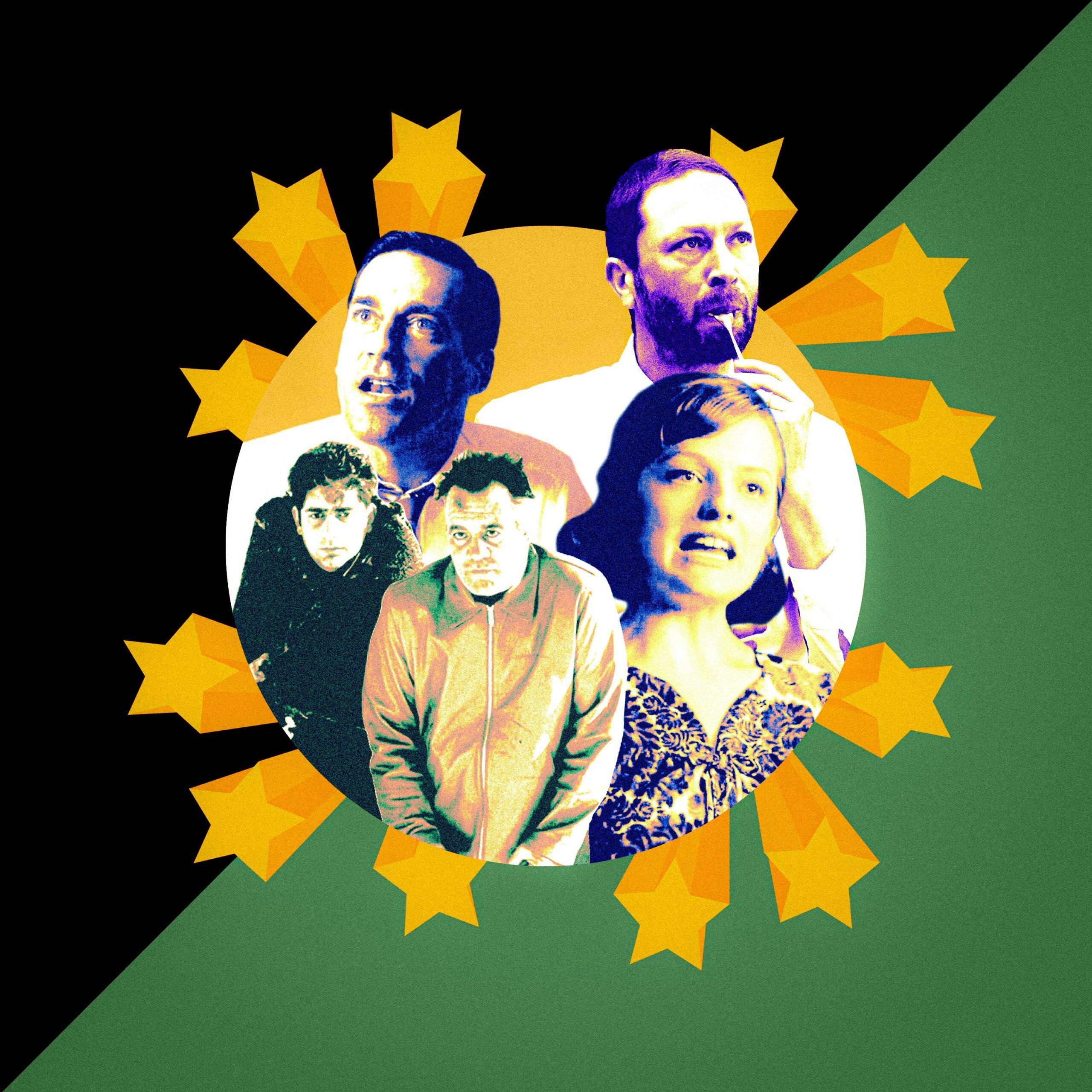

How important is plot to a TV show? I thought about this recently while looking at The Ringer’s updated list of the 100 best episodes of the century. Before, I probably would’ve said that for a scripted, narrative series, plot was the single most important element. OK, a sitcom might live or die by its jokes, but even the jokes need a story to contain them, and for every other type of show, I’d have supposed that plot—the source of conflict, mystery, and suspense—determined an episode’s success or failure, as well as the scale of its artistic ambitions.
Scanning the list, though, I noticed that many of the greatest episodes of the past quarter century don’t rely much on plot at all. Most do rely on it, of course; without its complex, intertwining, highly structured stories, Lost would really live up to its title. But on both the original list and the updated list, a striking number of entries are celebrated for plots that go nowhere (“Pine Barrens,” The Sopranos), plots that only loosely connect to the rest of the series (“Forks,” The Bear), plots with an almost dreamlike narrative flow (“The Suitcase,” Mad Men), or plots that spend most of their time exploring the edges of some monumental event (“Connor’s Wedding,” Succession). A striking number don’t follow conventional narrative structure or derive their grip on the viewer from the question of “What happens next?”
I started wondering whether these acclaimed low-plot episodes have anything in common. I think the answer is yes, and I think it has to do with the uniquely complex way in which TV shows interact with time.
Have you ever thought about this? Even more than movies, TV shows move through and manipulate time in a dizzying variety of ways. They occupy it (an episode lasts 48 minutes), they depict it (an episode covers three weeks’ worth of story), and they structure our experience of it (an episode seems to move faster or slower depending on the pacing and rhythm of its scenes). Moreover, because they’re spread across multiple installments, they punctuate our calendars in distinct ways: The regular drip of a weekly release schedule marks time differently, engages different patterns of anticipation and recollection, from the weekend-swallowing deluge of a binge-optimized full-season drop.
“This device isn’t a spaceship,” Don Draper tells his clients in “The Wheel,” the finale of Mad Men’s first season. “It’s a time machine.” He’s talking about a Kodak slide projector; he might as well be talking about television itself. Even a relatively straightforward series, one without multiple timelines à la Lost or baroque epoch hopping à la Dark, makes our minds process temporality in several ways at once. And while most of this processing happens at a level below conscious thought, the manner in which a show harnesses our perceptions of time inevitably becomes part of its style, whether in subtle ways (quick scenes, abrupt transitions, lots of plot condensed into a short space, as in 30 Rock) or in extremely overt ones (every episode’s plot is an extended flashback mediated by a voice-over from the future, as in How I Met Your Mother).




The Best TV Episodes of the Century
What the episodes on our list have in common, I think, is a particular approach to time, one that’s slower, more oblique, and more meditative than the typical installment in the series from which they’re drawn. I've started calling these “open-time” episodes, because they seem to open a space in the established rhythm of the show’s story, one where they’re free to explore characters, relationships, and environments in an unhurried way, without the pressure of a busy plot. Mood becomes more important than sequence, conversations extend past their usual length, scenes become fragmentary, narrative time condenses. A show whose episodes normally cover days or weeks might instead cover a few hours, or even be filmed in real time. There’s a feeling of patience, of lingering over details, of inhabiting an open-ended, present-tense experience rather than watching a story told in retrospect.
I’m not talking about bottle episodes here, though some bottle episodes also take place in open time. Bottle episodes are typically stripped down, with reduced casts and familiar locations. Open-time episodes can just as easily involve expanded casts and unusual locations (e.g., “Fishes,” from The Bear, with its massive corps of guest stars). What I find fascinating about open-time episodes is that they’re stylistic departures—no series is entirely presented in open time—that seem to work best in shows that have a strongly defined style. And even though these episodes step away from that style for all or part of their running time, they can, when they work, intensify the show’s identity rather than weaken it—they’re one-offs, but they can give us what feels like the purest version of what makes a show itself. How does that work?
Think, for instance, about “Pine Barrens.” For part of its running time, it’s a typical episode of The Sopranos. Silvio has the flu, Tony fights with Gloria; plots are advanced, scenes have their normal length and structure. But when the episode shifts to the woods, where Christopher and Paulie are stranded overnight, it slows down and enters open time. The plot crawls to a halt, even the specific subplot in which the two leads are marooned: Famously, the not-dead Russian whom they’ve taken to Pine Barrens to dump never returns after he runs off. Time drags, twigs crack, shadows lengthen. The loose, open-ended pacing—as a viewer, you have no sense of how long this situation is going to last—causes the whole focus to shift to the two characters and their relationship. How do they act in a crisis? How do they feel about each other? How adaptable is their gangster masculinity when their familiar environments are taken away?
Or think about “The Suitcase,” from Mad Men. It’s a bottle episode, yes, but what makes it so memorable is the way it plays with the show’s habitual rules of pacing and forward movement. Don and Peggy’s long, weird night takes place largely in open time, when the regular ticking of the workday wall clock temporarily drops away. Scenes slow down. Outcomes become unpredictable. The ambiguous temporal space makes absurd detours feel almost normal—when Duck Phillips shows up spoiling for a fight, the moment is no more surprising than Don and Peggy opening up about their fathers’ deaths over drinks. And as with “Pine Barrens,” the dynamic of the central relationship, the strange blend of love and resentment built on Don and Peggy’s years of dreaming up corporate slogans together, stands out in a new way.
The current series with the strongest attachment to open time is The Bear, a show so obsessed with time in all its forms (the countdown timers, the Groundhog Day callbacks, “Every Second Counts”) that it sometimes seems to be a show about clocks with a side interest in restaurants. The Bear is sometimes accused—at least by me, in my brain—of aping prestige TV aesthetics without possessing prestige TV depths, and if that’s true, the strongest sign is probably the sheer number of Bear episodes that venture into open time. When it’s clicking, the show does it brilliantly. In the magnificent “Forks,” Richie’s week of staging in a new restaurant is punctuated by abrupt shifts (the alarm suddenly goes off) and scenes that skim past normal exposition. The only narrative question is “Can Richie pull himself together?” and the answer emerges out of an experience that’s structured more like real life—a series of workplace confusions and uncertain relationships—than a TV show.
“Fishes,” the sixth episode of Season 2, isn’t on our list, but it’s probably The Bear’s most overt foray into open time. An extended flashback covering the events around a single Christmas Eve dinner, the episode advances the main plot of the season only in the sense of filling in gaps in its backstory. The absence of the restaurant business narrative liberates it to explore all the corners of the extended Berzatto family’s physical and emotional space, and it positively revels in the freedom, launching an elliptical voyage through the crowded family home. Scenes begin in the middle of seemingly random conversations and end with nothing resolved, as the camera simply wanders off; stray objects (a golden statue, a wooden spoon) are as likely to fill the frame as the face of whoever’s talking. In one sense, the episode is a pure tangent; in another sense, it’s the heart of the whole series. The inner world of the Berzattos—the complex mix of love, trauma, humor, loyalty, and rage that drives the characters’ decisions and defines the tone of the show—is viscerally real here as never before, to the extent that it changes the viewers’ relationship to the whole show.
Ultimately, I think The Bear ends up overdoing these effects; it sometimes seems so determined to experiment with time that it never finds a normal storytelling gear in which to advance its plots. (Which, in Season 3 in particular, barely seemed to advance.) The best series use open time sparingly for the same reason that no Terrence Malick movie has an action-packed plot: because it’s not a style that lends itself to straightforward narrative progress. The more conventional plot an open-time episode has to deal with, the less it tends to work. Great shows know to establish their rules before they break them; they create a style—including a style of rhythm, pacing, and chronology—so that when they vary that style, the viewer senses what they’re doing. We can follow them into new territory because they give us a home base to start from.
It isn’t, in other words, that plot is overrated as an element of great TV episodes. It’s that shows with a strong sense of plot can sometimes access a higher register of meaning by temporarily suspending their plot-first focus. We remember the open-time episodes of series like Mad Men and The Sopranos as some of their best because they bring the dramas’ other aspects—characters, relationships, motives—into high relief. But they're able to reach these heights because they spend the rest of their time building up their stories. They take us on a journey into the narrative’s open spaces; then, like the carousel in that Mad Men episode, they carry us back again.