
Welcome to The Ringer's quarterback notebook, where I’ll cover the past week in NFL quarterbacking—from the most interesting passers, plays, and story lines to some other stuff that caught my eye when watching film. In this week’s notebook, we’ll be looking at the return of the Joe Burrow–Ja’Marr Chase connection, the sad state of Aaron Rodgers’s game, how Daniel Jones is coping with a leg injury, and more. Let’s talk quarterbacks.
The Joe Burrow–Ja’Marr Chase connection is still the NFL’s best.
The Cincinnati Bengals welcomed Burrow back from his 11-week absence on Thursday by giving him 49 dropbacks against the Ravens. Only Marcus Mariota took more dropbacks this past week, and he needed an extra overtime period to get there. So, yeah, there was no easing Burrow back into the action. Bengals coach Zac Taylor immediately threw the offense onto his franchise quarterback’s shoulders and asked him to carry the load.
The statistical results were mixed—Burrow averaged just over 5.3 yards per dropback and had a 34.7 percent success rate, per TruMedia—but you could see on film why Taylor was so eager to call pass plays now that Cincinnati’s QB1 is back in the lineup. While Burrow missed a few throws early on as he shook off some rust, he didn’t make a mental mistake all night. Play after play, his eyes got to the right spot, and he found the right receiver to target.
More often than not, that receiver was Chase. Even when the Ravens doubled Chase, Burrow found a way to get him the ball. On this third-and-long play, Baltimore matches Nate Wiggins up with him and has safety help over the top. That allows Wiggins to sit on Chase’s in-breaking route.
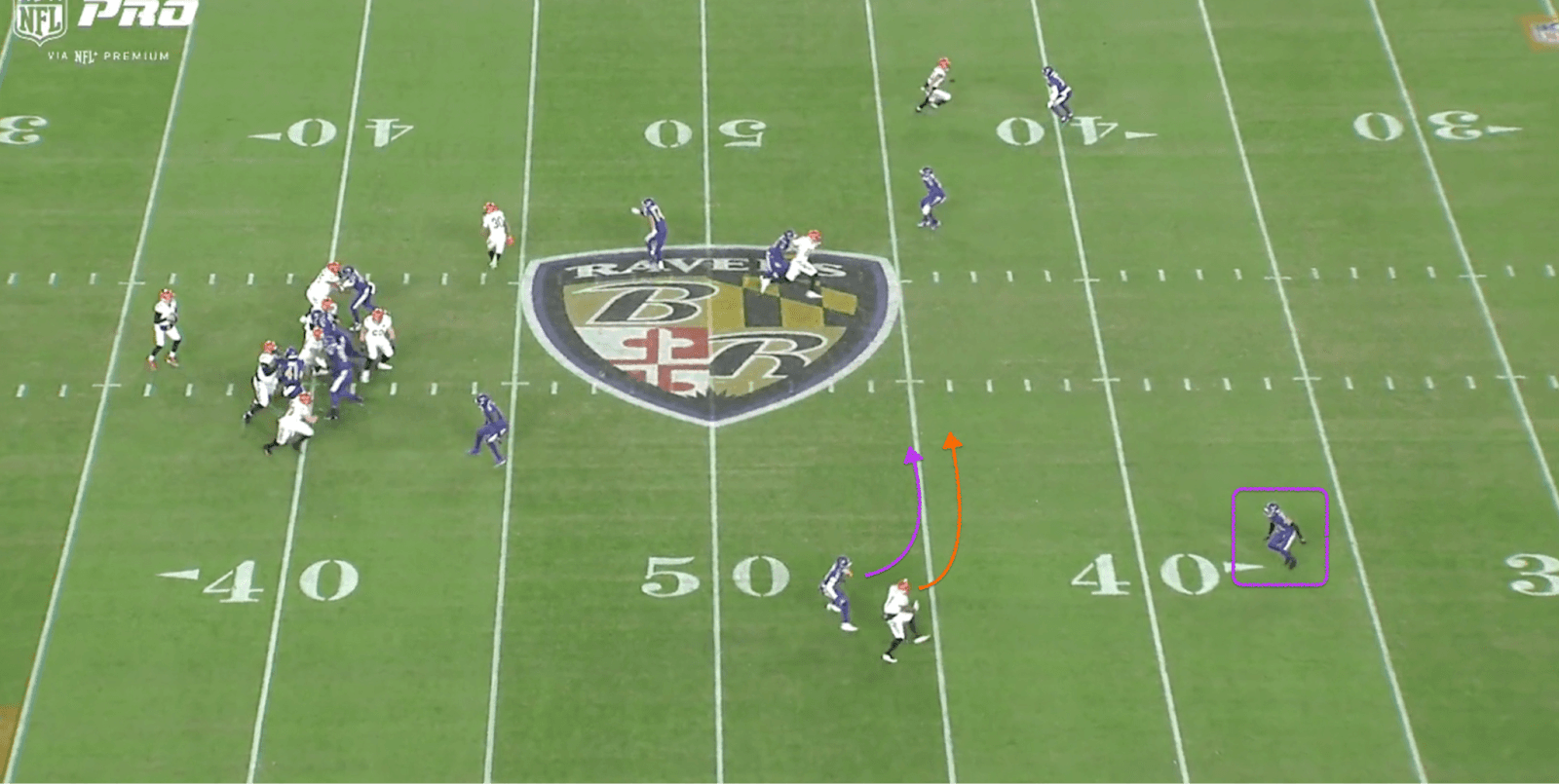
The Ravens also flood the top of the left side of the field with zone defenders, so everything is covered. The defense is in the perfect coverage, yet …
Chase sees Burrow getting flushed out of the pocket and immediately reverses field into open space for a pass that moves the chains.
This next play shows why Burrow and Chase form the NFL’s best offensive battery. The Bengals line up in a similar formation, with Chase isolated on the backside of a trips formation. The Ravens answer with a corner and safety doubling the star wideout, but Burrow and Chase are better prepared this time around. Watch how Chase bends the stem of his route inside to get the corner thinking that the in-breaker is coming again before he breaks out toward the sideline. Then notice how early Burrow lets go of the pass, knowing that his receiver will get to the proper landmark.
It looks like an easy pitch and catch, but that’s high-level ball from Cincinnati’s two stars. The Ravens had a quantitative advantage on the play, but not a qualitative one. There wasn’t much they could do against Burrow and Chase. Here they play over the top with Marlon Humphrey in a deep zone, but Chase turns him around, gets out in front, and then uses his body to shield Humphrey from the downfield throw.
That’s not a look you’d typically throw a vertical route into, but Burrow recognized the leverage advantage Chase created and trusted him to make a play. Both Burrow and Chase have an advanced understanding of defender leverage and how to beat it. And more importantly, they’re both on the same page about how to do so. Burrow’s comeback game showed just how strong that bond has become over their six seasons together.
Aaron Rodgers is one of the worst quarterbacks in football.
Rodgers looks terrible right now.
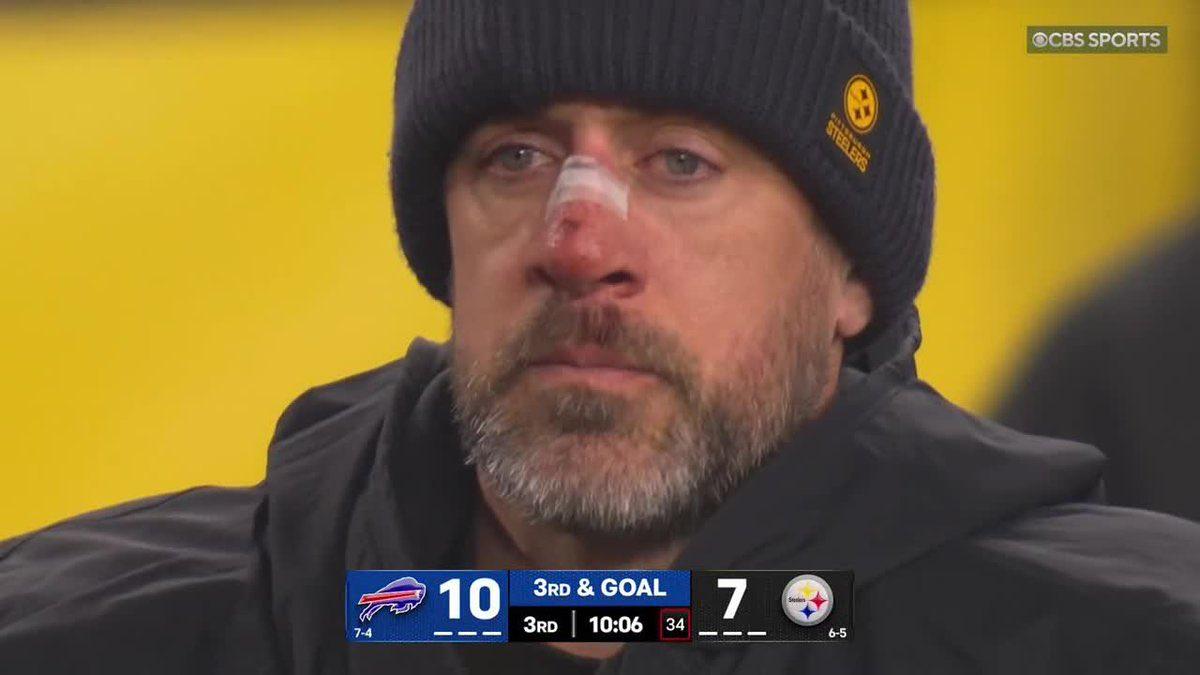
OK, that’s not what I meant, but the emotion of that image (or lack thereof) reflects where Rodgers’s game is as we head into the final month of the season. His season-long numbers don’t inspire much hope—but his production in recent games has been downright depressing. Since Week 10, Rodgers has ranked 32nd in the NFL in EPA per dropback, 30th in success rate, and 28th in yards per dropback. More concerning, it appears that Rodgers has given up on the idea of playing the position as it’s intended to be played. He’s not throwing downfield, and he’s rarely holding on to the ball for longer than a few seconds. Rodgers has just one completion over 15 air yards in the past month, per TruMedia. On dropbacks that last at least three seconds, he ranks dead last in EPA, success rate, and yards per dropback. He’s averaging just 1.9 yards per dropback on those extended snaps. His success rate is just 14.8 percent. Count to three in your head. That’s the amount of time after a snap that Rodgers remains a viable NFL quarterback.
You’re not going to believe this, but Rodgers has blamed some of Pittsburgh’s offensive struggles on his receivers, saying that they need to “show up to film sessions” and “run the right routes.” He’s not wrong. The team’s film is littered with poorly run routes, miscommunications, and drops. But Rodgers is making his own share of mistakes, too. And not just physical ones. He routinely turns down throws to the middle of the field and rushes through his progressions, which leads to suboptimal decision-making.
Here he decides to target DK Metcalf on a covered route instead of looking to Jonnu Smith, who’s running uncovered in the opposite direction. This is as clear a picture as you’re going to get as a quarterback, and Rodgers has plenty of time in the pocket to read the play.
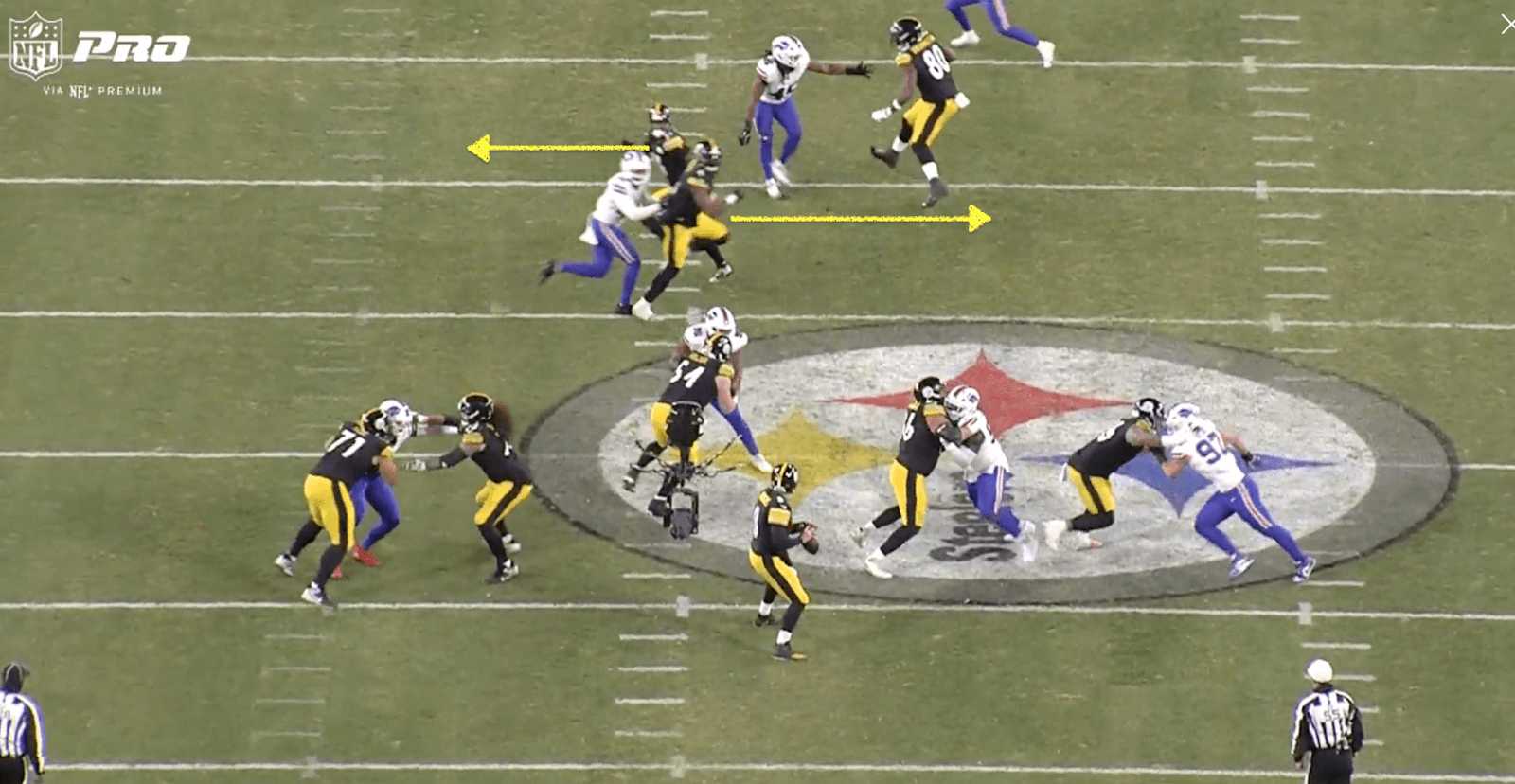
Rodgers tries to throw Metcalf away from the coverage but instead puts the ball out of reach.
If only there’d been a simpler option that didn’t require such a difficult throw. Watch Smith’s reaction after the play. He’s looking around at all the space he has, confused about how he didn’t end up with the target.
Here, Pittsburgh is running the same concept. Rodgers rushes a throw out to his running back, and the back would have gotten leveled by Bills linebacker Matt Milano if the pass weren’t batted out of the air.
This version of Rodgers adds no value to the Steelers offense. He’s essentially a one-read quarterback who can’t move and refuses to attack the middle of the field with regularity. His ideal dropback lasts around two seconds and ends with a quick, vertical throw to the perimeter, where there are no unruly zone defenders looking to add to his interception total. If Rodgers insists on playing like this going forward, Pittsburgh might be better off with Mason Rudolph.
OK, maybe not, but Rodgers is playing some god-awful football right now.
Daniel Jones is compromised.
Daniel Jones and the Colts aren’t confirming reports that the quarterback is playing through a fractured fibula, but any recent footage of him shows that he’s compromised by some sort of lower-body injury. Take this recent practice clip in which it looks like Jones can’t put much weight onto his left leg.
That’s how I imagine Terry Bradshaw would look if he took a dropback right now. As you can imagine, this created some issues for Jones against Houston’s terrifying pass rush on Sunday. All things considered, Jones played well in the 20-16 loss. He hit Alec Pierce in the back corner of the end zone for a deep touchdown pass.
He found Tyler Warren on the move for another score.
And I’m still not sure how he hit this pass to Josh Downs along the sideline without stepping into the throw.
On all three plays, you can see that Jones is favoring his left leg/ankle. He can’t really drive off his lead foot, which would make things difficult for any quarterback. And it’s more of a problem in a tight pocket, which the Texans seemed to pick up on as the game went along. DeMeco Ryans sent more pressure late in the game, and Jones couldn’t do much to avoid it other than speeding up his process and getting the ball out as quickly as possible. Ryans really turned up the heat on Indy’s final three offensive plays of the game. Watch how quickly Jones gets the ball out of his hand.
The Chiefs took a similar approach in the second half of their win over the Colts the previous week. This is where the injury is hurting Jones most. He can’t move in the pocket to buy himself time, so he’s not even bothering to try to get through his progressions. Per Pro Football Focus, Jones completed just one pass that wasn’t charted as his “first read” or a “checkdown” in that game. He didn’t have any of those attempts against Houston in Week 13. Jones’s average time to throw has dropped to 2.45 seconds over the past two weeks, per TruMedia. That ranks as the second fastest in the league, behind Davis Mills. Jones has had to make significant alterations to his approach in the pocket, and he’s playing more like the quarterback I described in the Rodgers section above.
I think that many of us were hesitant to buy into this Colts team even before Jones’s injury, but a physically limited version of the QB who isn’t capable of getting beyond his first read or moving out of the pocket is reason enough to sell your stock on them going forward.
(Sigh.) No, Kevin Stefanski is not sabotaging Shedeur Sanders.
Put your hazmat suits on; we’re diving back into the Shedeur Sanders discourse. I know that no rational football fans believe Browns coach Kevin Stefanski is actively working to sabotage Sanders, but this very online theory seems to have broken contain and is influencing the questions that both parties are receiving at press conferences.
It’s a silly idea, of course. Stefanski is coaching for his job—whether that’s his current job in Cleveland or his next one—and tearing down a young quarterback wouldn’t help his hirability. I also don’t think that this two-time Coach of the Year would put his reputation on the line just to humble a fifth-round pick. If anything, Stefanski’s play calls are propping up Sanders’s production. Even though he’s played only two full games so far this season, Sanders already ranks sixth in EPA on screen passes, which require very little effort from the quarterback. Take out the screens, and Sanders has been the NFL’s worst starting quarterback by the numbers. Of the 47 quarterbacks who have attempted at least 50 non-screen passes, Sanders ranks 47th in EPA per dropback, 47th in success rate, 47th in completion percentage, and 47th in yards per dropback. You can take issue with Stefanski’s use of wildcat or tight end sneaks, but without his screen plays, Sanders would be putting up some dreadful numbers.
Sanders’s 34-yard touchdown pass to Harold Fannin on Sunday featured some slick pocket movement and an accurate throw, but, again, Stefanski’s play design did a lot of heavy lifting. The deep post route clears out the deep zones, and Fannin starts as if he’s running a corner route before breaking up the field into those voids in the coverage.
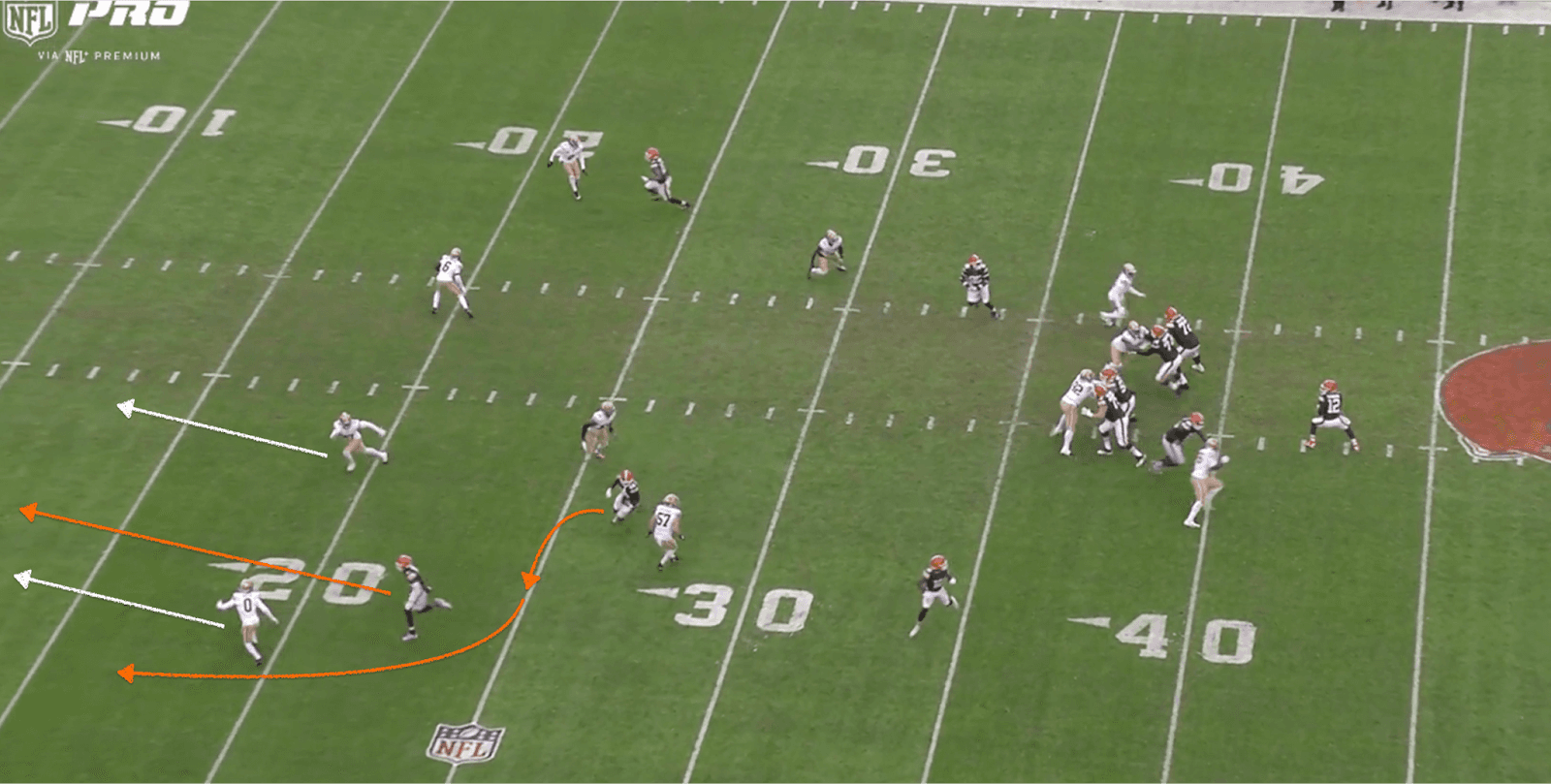
It’s difficult to get a receiver more open than this against an NFL defense.
Stefanski cooked up other downfield opportunities, too, but Sanders turned them down. On this second-and-long in the first quarter, Sanders has Jerry Jeudy open on the sail route and appears to stare it down but doesn’t make the throw.
Here’s another one from the fourth quarter. Jeudy’s deep dig route—which is the primary option on this play—breaks open over the middle of the field, but Sanders chooses to force a high pass to a covered David Njoku instead.
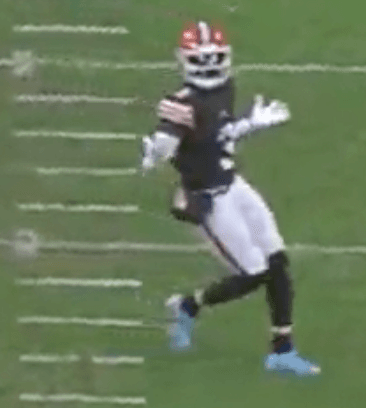
Jeudy is understandably confused by the decision.
The Browns haven’t provided Sanders (or his rookie teammate Dillon Gabriel) a nurturing offense by any means. But when the play calls are sound, the receivers get open, and the pass protection holds up, Sanders has to attempt the throws. Otherwise, he won’t need any help sabotaging his career.
Dak vs. Spags was a chess match for the ages.
Cowboys-Chiefs was for the football nerds. Dak Prescott, one of the league’s sharpest quarterback minds, went up against Steve Spagnuolo, the league’s most decorated (and deranged) defensive play caller, and on Thanksgiving Day no less. Spagnuolo said that the short week would make it harder for the Chiefs to go all out with new game-plan wrinkles, but the longtime coordinator had plenty of junk ready to throw at Prescott. His blitz on the third play of the game generated a free hit on Prescott and created an interception.
That was one of six unblocked pressures for the Chiefs in the game, per Pro Football Focus. Spagnuolo’s blitzes generated what Kansas City wanted early on—quick pressure—but after a few dodgy moments, Prescott locked in. Here’s a cut-up of the Chiefs’ blitzes in obvious passing situations. Watch all of the different ways Prescott manages to beat the free rushers.
Kansas City blitzed Prescott 19 times in the game, per Next Gen Stats. The blitzes generated seven pressures, but Prescott wasn’t sacked a single time and finished 15-of-19 for 190 yards when the Chiefs sent five or more rushers. Spags’s truncated game plan would have been enough to stop most quarterbacks, but not Prescott.


This Next Gen Stats passing map made me see ghosts.
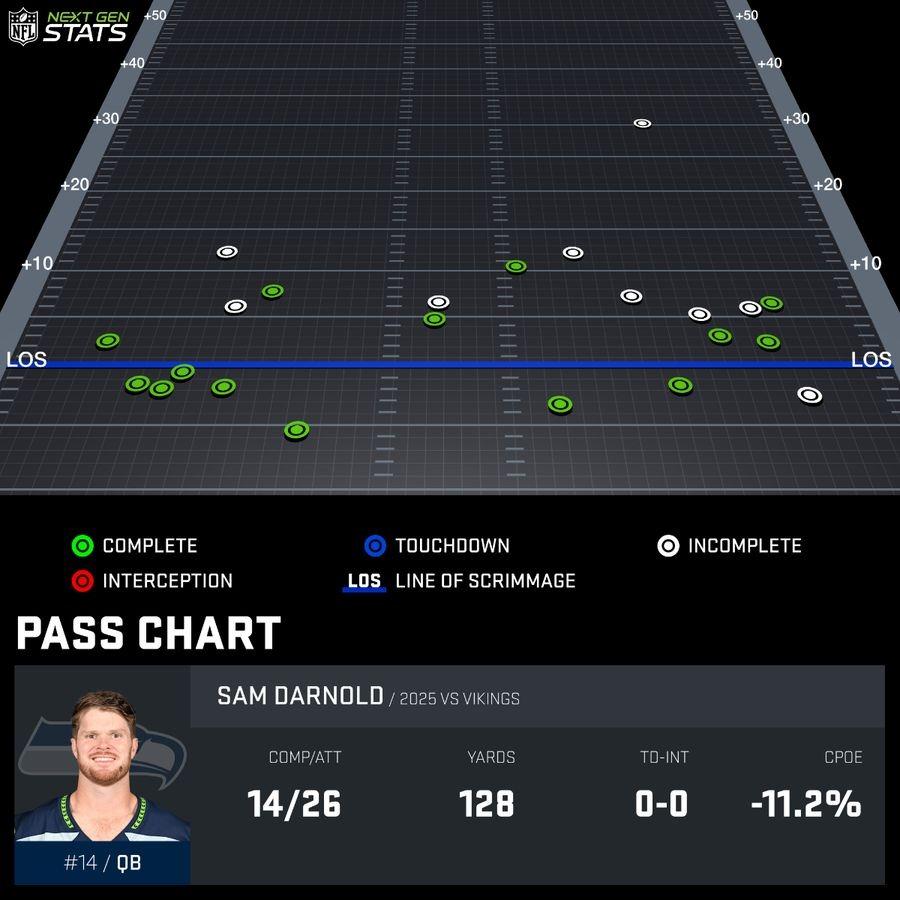
It’s been six years since Sam Darnold was “seeing ghosts” in a game against the Patriots, and the Seahawks quarterback saw them again against Brian Flores’s defense this weekend. The Vikings lit Darnold up with an array of blitzes similar to the ones the former Jets quarterback saw on that spooky night in 2019. Minnesota blitzed Darnold on 18 of his 30 dropbacks. It pressured him 11 times, and the ghosts returned. Darnold didn’t throw any interceptions, but he was sacked four times and averaged minus-2.1 yards per play when pressured.
Seattle won in a blowout thanks to Max Brosmer’s disaster class of a performance, but this was Darnold’s worst game of the season by both EPA and yards per dropback. On the bright side, it was an improvement over the original ghost game:

The best throw I saw this week.
Matthew Stafford had a crappy day against Carolina but gave us one of the best anticipatory throws of the season. Pause the video when Stafford starts his throwing motion and guess where he’s sending the ball:
The worst throw I saw this week.
Was there any question? I know I’m going to sound like a football nerd, but you really have to watch Brosmer’s pick-six from the all-22 angle to fully appreciate this atrocity of quarterbacking.