

Shooting is the most important skill in basketball, and NBA offenses are better at it than ever. As a whole, the league has continued to add shooting talent, while offenses have continued to adopt healthier shot diets. Add it all up, and you see historic shooting numbers all over.
So far in the 2025-26 season, the NBA is on pace to record its highest offensive efficiency rating of all time at 115.7, and three different squads are on pace to break team-level shooting records. Look at this:
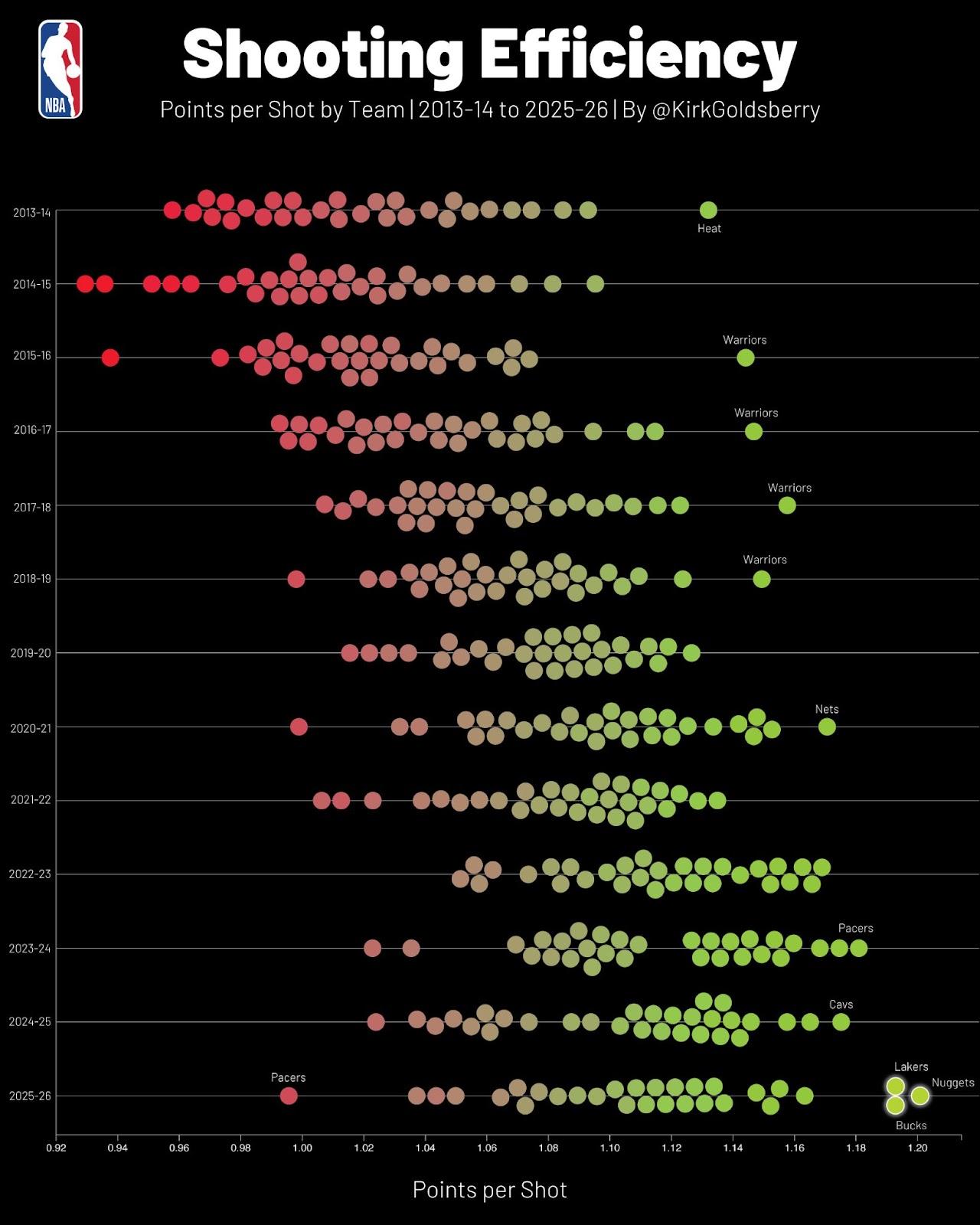
This chart shows the overall shooting efficiency of all 30 NBA teams for every season since 2013-14. It maps out the value of an average shot for each team in that time frame. The biggest takeaway is that the league at large keeps getting more and more efficient, and three teams this season are out here in uncharted waters, turning shots into points at record clips. It’s early, but the Nuggets, Lakers, and Bucks are each on pace to have the most efficient shooting season in NBA history! Even more interesting, each is doing it in its own way.
As a fun exercise, I put on my professor hat and graded every team’s shooting performance so far this season.
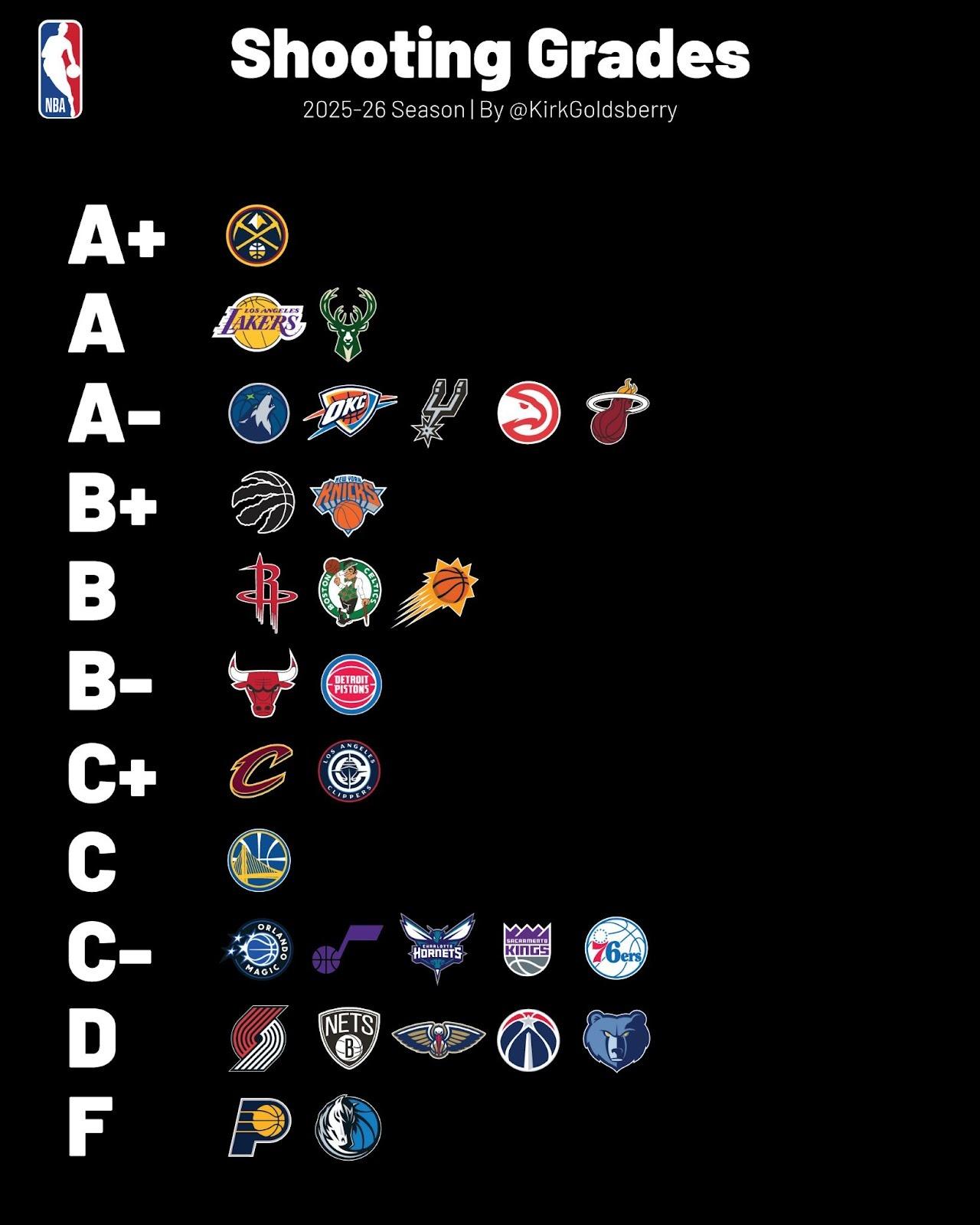
Let’s dive into a few of the most notable trends in team-level shooting this season, starting with the three A students at the head of the class.
The Denver Nuggets are in a class of their own.
Nikola Jokic and the do-it-all Nuggets are on pace to have the most efficient offense in league history because they are putting up staggering numbers on both sides of the 3-point line. We have tracked the detailed shooting efficiencies of 390 unique NBA teams in the player-tracking era (since 2013-14). Of that massive group, the 2025-26 Nuggets currently rank ninth in 3-point shooting efficiency and second in 2-point shooting efficiency.
It starts with Jokic, who is once again the most impactful offensive force in pro basketball; he is currently making 70 percent of his 2s and 44 percent of his 3s. But Jokic is not alone. Each of Denver’s five most active 3-point shooters is hitting over 39 percent of their attempts, which has helped the Nuggets go from the 28th-ranked team in 3-pointers made per game last season to the 16th-ranked team in that category this year. The red-hot starts of Jamal Murray and Tim Hardaway Jr. have been the biggest stories downtown, especially as injuries to Christian Braun and Aaron Gordon have chipped away at the team’s depth. But the wild part is that Denver is even better inside the arc, where its 1.22 points per shot is on pace to be the second-best 2-point efficiency mark we’ve seen in the tracking era, trailing only the next team on our list …


The Los Angeles Lakers get a gold star.
The Lakers have also earned high marks in the shooting department, but their formula is less diverse than Denver’s. As jump shooters, the Lakers don’t scare anybody. They rank 20th in 3-point percentage and 25th in made 3s, but those mediocre numbers are just a distraction. The purple and gold do their damage inside.
The chart below shows the 2-point scoring of those same 390 teams from the player-tracking era; that lone green dot up at the top belongs to this year’s Lakers. None of the other 389 teams in this group have even sniffed the 2-point conversion rate of this year’s Lakers, but why?
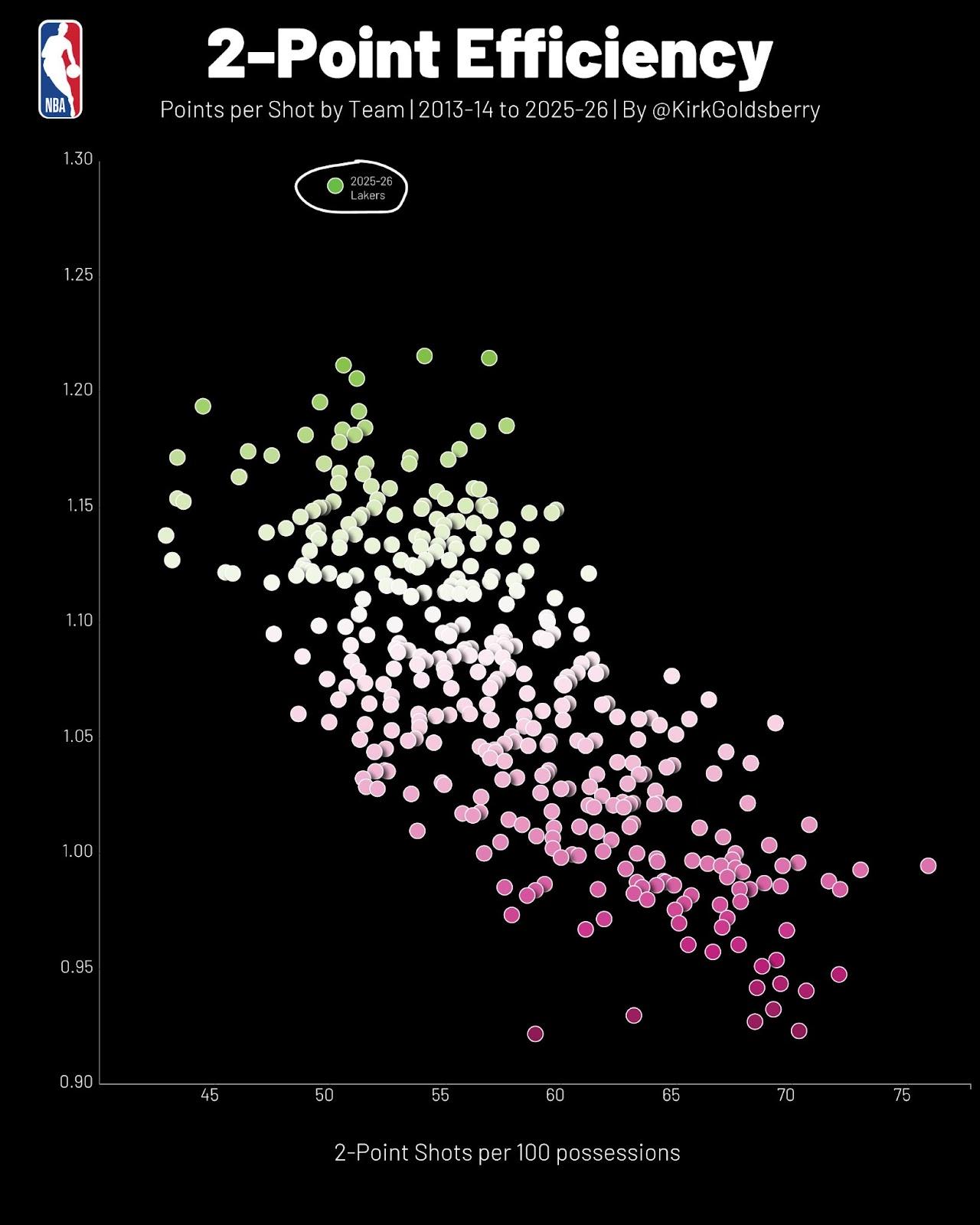
Simply put, Luka Doncic, Austin Reaves, and Deandre Ayton have coalesced into the most deadly 2-point scoring trio in the league. Ayton’s arrival has changed the math. As the Lakers’ favorite target on lobs and rolls, he has unlocked JJ Redick's offense. No player has converted more assisted 2-point field goals than Ayton, who has 101—a majority of which have been set up by Doncic and Reaves.
It doesn’t hurt that Doncic and Reaves are both on pace to log their most efficient 2-point seasons as well. But ultimately, this is an ecological story; Ayton, Doncic, and Reaves are making one another better. Oh, and the Lakers also have the most prolific paint scorer of the 21st century back in their rotation, too.


The Milwaukee Bucks are in danger of falling behind.
The Bucks are the most efficient jump-shooting team in the league this year, and no player in the NBA creates more clean looks from downtown than Giannis Antetokounmpo. Milwaukee’s MVP has never been a great 3-point shooter himself, but his passes seem to turn everyone else on his team into Kyle Korver.
Antetokounmpo’s passes are leading to 10.8 3-point attempts per game—the highest such figure in the league—and his teammates are knocking down over 45 percent of their 3s in these potential assist situations. All told, his dimes create almost five made 3s per game, which is a big reason why the team struggled so much when Giannis missed a few games with a groin injury.
Giannis is the straw that stirs the drink—we’ve known that for years. But his long-shot MVP case this season and the Bucks’ hopes for climbing back into the Eastern Conference playoff picture rest on his all-world talent for scoring in the paint (he once again ranks first in paint points by a country mile this season) and his best-in-class ability to punish collapsing defenses by setting up open shooters on the edges.
The on/off numbers are stunning. In his 461 minutes of action this season, the Bucks are scoring at a rate that would rank above the Nuggets for the top offensive rating in the NBA. When he rests, they score at a rate below the league’s least efficient overall team, Dallas.
The Bucks Offense Falls Apart Without Giannis
Any team that’s made 41 percent of its first 795 3s this season is getting an A on its report card. Some of the individual 3-point percentages are downright eye-popping. AJ Green is at 49 percent. Bobby Portis is shooting 47 percent. Ryan Rollins is at 40 percent.
Still, a closer look at the numbers suggests that this probably isn’t sustainable. The super-nerdy shotmaking metrics suggest that no team is outshooting expectations more than Milwaukee, which is impressive on one hand but cause for skepticism on the other. The potential “luck” factor is most exaggerated on its catch-and-shoot 3s. Milwaukee has made over 43 percent of 573 catch-and-shoot 3s, which leads the league; however, its shot quality in that same category ranks 27th. The Bucks rotation is loaded with knockdown shooters, but even by their lofty standards, some of these fellas have been unsustainably hot.

The Boston Celtics continue to fire away.
The Joe Mazzulla show is back. Sure, there are some understudies on the stage this season, but Boston’s commitment to raining down jumpers is as steadfast as ever. The Celtics hoist nearly 61 jumpers per 100 possessions, which leads the NBA; the Knicks rank second, at 54.7. Still, that figure disguises something interesting about the Celtics this year.
Midrange Mazzulla has a nice ring to it, but it used to be an oxymoron. Not anymore. Boston is suddenly taking a bunch of 2-point jumpers. Last season, it launched 9.5 2-point jumpers per contest; this year, that figure is up to 15.8, which trails only Kevin Durant’s Rockets and DeMar DeRozan’s Kings for the top mark in the whole league.
Most of this increase can be explained by Jaylen Brown taking a larger share of the offensive load. He’s taking more than twice as many 2-point jumpers this season compared to last, and he’s canning them at a career-best rate.
And the Celts still have the league’s highest 3-point rate by launching 45 triples per 100 trips down the floor. That’s a slight downtick by their standards but still a huge number.


The Indiana Pacers are on academic probation.
The Pacers are like the anti-Nuggets; no matter where they shoot from on the floor, they struggle to convert. They rank last in jump-shooting efficiency by yielding just 0.92 points per jumper, and they rank last in paint efficiency, too. That’s a brutal combination of bricks and the second-biggest reason (injuries being the biggest) why the defending Eastern Conference champs are 4-16. The chart below shows which teams are good and bad in the paint and as jump shooters. As you can see, the Pacers aren’t exactly dominating in either category.
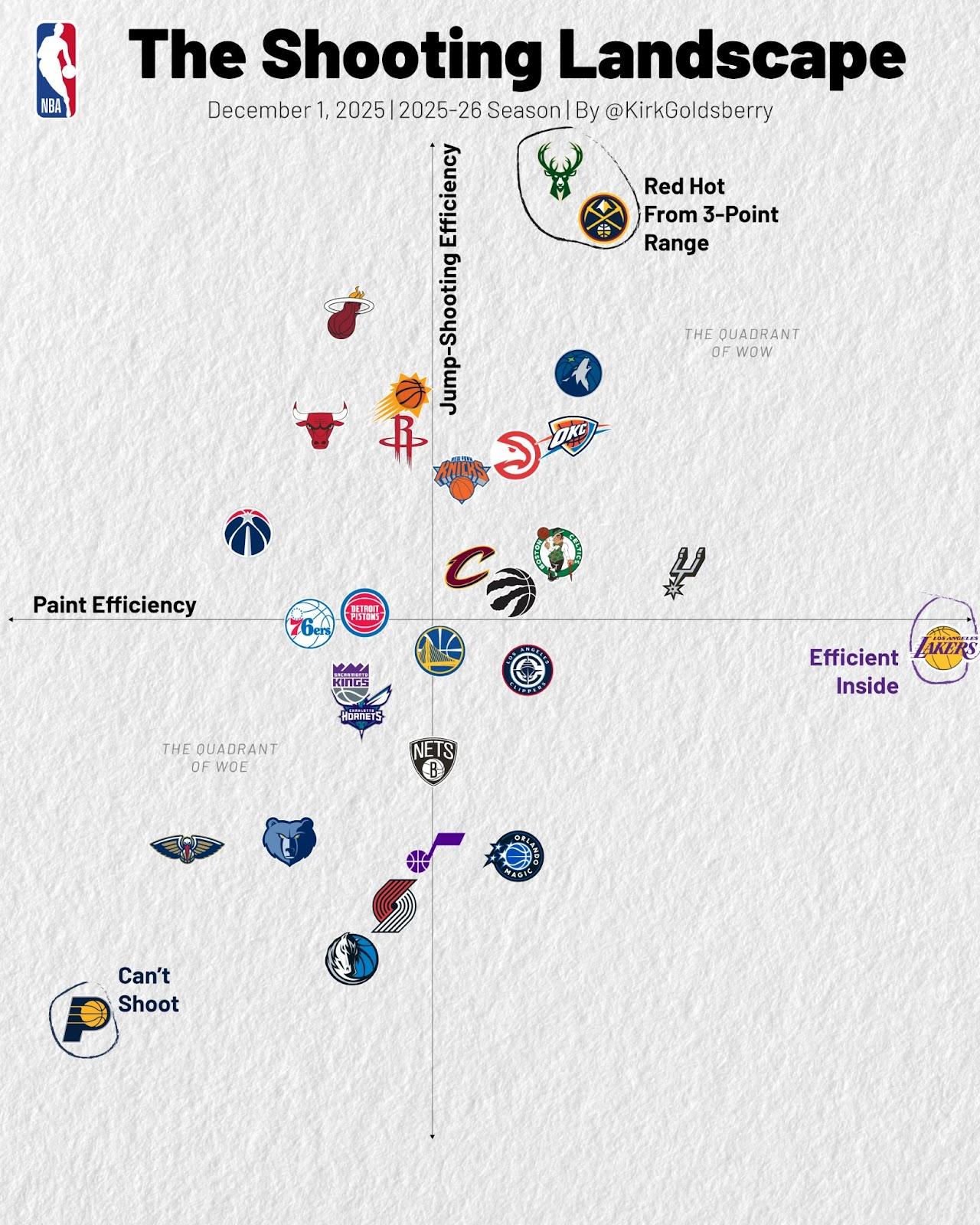
A few other observations about the shooting landscape: The only team scoring less efficiently than Indiana is Dallas, whose shooting numbers are only marginally better than the Pacers’, but the Mavs also turn the ball over a lot.
Shooting limitations continue to be the biggest thing separating the Orlando Magic from their hopes and dreams. Orlando has leveraged its interior offense, one of the league's best, to pull its offensive ranking up to ninth—even though it ranks 28th in jump-shooting activity and 26th in jump-shooting efficiency. Its overall offensive numbers are supported by its league-leading free throw production and top-five paint production. Still, imagine if the Magic had adequate shooting. Orlando is the only team scoring fewer than 40 points per game on jumpers, which means that opposing defenses are comfortable packing the paint and daring these guys to shoot it.
Stats through Sunday’s games.