We Still Don’t Know What Lane Kiffin Wants
Even after Kiffin’s move from Ole Miss to LSU, it’s not clear that he knows either

Every happy head coach is alike; every unhappy head coach is unhappy in his own way. This is true in every sport, but it’s especially true in college football, where the cult of the coach defined the landscape for generations and where that culture has recently eroded as seismic shifts in the sport—the introduction of NIL, the rise of the transfer portal, the debut of the 12-team playoff, the birth of megaconferences—have made coaches much richer but have stripped them of some elements of control. College football coaches, famously, do not respond well to losing control.
The latest case study is Lane Kiffin, the 50-year-old who announced Sunday that he’s leaving Ole Miss to become the next head coach at LSU. The short version is that Kiffin leveraged an ultra-successful six-year tenure in Oxford to springboard to a more prestigious program and become one of the highest-paid coaches in the country. The more accurate version is that he turned this decision into the defining saga of the season’s past month, apparently because he wanted to leave while still being allowed to stay on with Ole Miss through the end of the College Football Playoff. Kiffin wanted to flee for a brighter future while keeping one foot planted in the past. He wanted to break things off with his old flame while still trying to walk away with a ring.
For those who have not been following every absurd detail of this extended spectacle, here’s a rundown of how we got here:
- On October 26, LSU fired fourth-year head coach Brian Kelly after a disappointing 5-3 start. This, a week after Florida canned Billy Napier, and two weeks after Penn State axed James Franklin. With so many premier jobs available before Halloween, the coaching carousel kicked into high gear even earlier than it typically does.
- The candidates most commonly linked to the premier openings were Indiana’s Curt Cignetti, Texas A&M’s Mike Elko, Vanderbilt’s Clark Lea, and Kiffin. Cignetti agreed to a contract extension in October. Elko and Lea agreed to new contracts in November. Kiffin did not agree to any new contract with Ole Miss.
- On November 17, The Advocate and On3 reported that Florida had hosted Kiffin’s family for a visit to Gainesville and that LSU was flying them to Baton Rouge on a private jet. The Athletic subsequently reported that Ole Miss issued Kiffin “an ultimatum to decide his future before the Nov. 28 Egg Bowl against Mississippi State.”
- On November 18, Kiffin went on The Pat McAfee Show to dispute the existence of any such ultimatum. “Yeah, that’s absolutely not true,” he said. Somewhat relatedly, that same day, Kiffin began tweeting passages from a book called The Pivot Year by Brianna Wiest. One representative excerpt: “How do you figure out what you really want? You imagine a life that would be too good to be true, and then you take note of the elements, the themes.”
- On November 28, Ole Miss beat Mississippi State 38-19 in the Egg Bowl to finish the regular season 11-1, the best record in school history. Afterward, Kiffin confronted a local reporter who earlier in the week had called him out on a podcast, saying, “Can’t turn a hoe into a housewife.”
- On November 29, multiple outlets reported that Kiffin’s decision was “imminent.” Sources at Florida leaked that the Gators were out of the running, so the choice came down to LSU or Ole Miss. ESPN sent Marty Smith to the Rebels facility to report directly from the scene. A meeting was set for Kiffin and Ole Miss athletic director Keith Carter at the university chancellor’s home, after which an announcement, at long last, was expected to be made.
- The meeting lasted three-plus hours. Grainy, sideways photos of SUVs made the rounds on social media. No announcement was made. Saturday came and went without any further clarity about what Kiffin might decide. ESPN’s Smith, evidently stranded at the Ole Miss facility, texted Kiffin in desperation, “Will there be a resolution tonight? Please God in heaven tell me yes.”
- On November 30, a meeting was called for the Ole Miss players at 9 a.m. local time.
- The meeting was rescheduled to 1 p.m. local time.
- At 2:03 p.m. local time, Kiffin finally tweeted that he was bound for Baton Rouge. “I was hoping to complete a historic six season run with this year’s team by leading Ole Miss through the playoffs,” he wrote. “My request to do so was denied.”
So … yeah. It’s been a lot. And the drama didn’t end with the decision itself. Ole Miss fans flocked to the airport Sunday afternoon to give Kiffin the bird. Smith, never one to be deterred, landed an interview with Kiffin in a hilariously empty field just off the tarmac. According to a report from On3, Kiffin convinced most of his Ole Miss offensive assistants to accompany him to LSU and told them that “if they’re not on the plane to Baton Rouge today, they won’t have a spot on staff.”
We have gotten more updates on this story than would have ever seemed imaginable. But now that the dust has settled and we know where Kiffin is headed, do we have any real idea why he chose what he did?

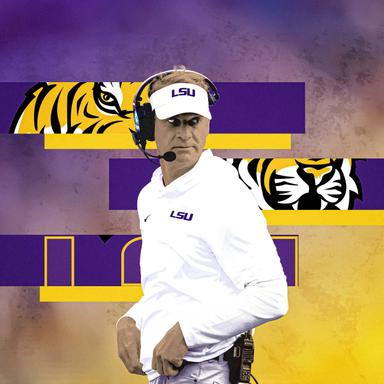
What is the ultimate goal for a college football coach? As with any meaningful question in life, the answer depends largely on what you value.
Is the goal to win a national championship? If so, then Ole Miss was the only program in Kiffin’s consideration set with a chance to win the national title this season. Prior to Friday’s game against Mississippi State, the Rebels were ranked seventh in the playoff committee’s latest rankings. They have a breakout quarterback in Trinidad Chambliss and a dominant running back in Kewan Lacy. LSU has a more storied tradition and a better chance at championships in the future; the Tigers count three national titles this century, while Ole Miss hasn’t claimed one since 1962. But the best-case scenario for Kiffin at LSU looks an awful lot like the current scenario at Ole Miss. He’ll be working to build his new program up to match the program he just left.
Is the goal to coach the best possible players? If so, then LSU decidedly has the edge. This is the program that produced Joe Burrow and Jayden Daniels, Ja’Marr Chase and Odell Beckham Jr., Tyrann Mathieu and Patrick Peterson, Justin Jefferson and Malik Nabers. Since 2021, LSU has signed recruiting classes that ranked third, 12th, fifth, seventh, and 10th, respectively, per 247Sports; Ole Miss—though it has cleaned up in the transfer portal—has brought in classes that ranked 17th, 27th, 23rd, 21st, and 16th, according to the same service. From the moment Kiffin accepted the LSU job, he was already recruiting: Video circulated of Kiffin meeting with Lamar Brown, a Tigers commit and the top-rated prospect in the class of 2026, almost immediately after he landed in Baton Rouge.
Is the goal to build a legacy that will endure far into the future? If so, then Ole Miss presented a rare opportunity. LSU has had several iconic coaches, from Paul Dietzel to Nick Saban to Les Miles. Ole Miss has had Johnny Vaught … and that’s pretty much it. From 1972 to 2020, the Rebels cracked double-digit wins in a season a total of two times. From 2021 until now under Kiffin, they’ve won at least 10 games in a season four times and beaten Georgia, Oklahoma, and [ahem] LSU along the way.
Is the goal to play in the most electric atmosphere in college football? If so, then LSU is unmatched. Is it to work for the most dysfunctional athletic department in college sports? If so, then, again, LSU is unmatched. Is it to coach at a school that provides the best environment for a coach’s family? To pay homage to the family members who came before? To go to the college town with the best hot yoga studio? To simply enjoy the ride and follow the road, wherever it may lead?
There are no right answers. How Kiffin answers these questions will differ from how Cignetti does, or how Kirby Smart does, or how Kalen DeBoer does. What matters to each person about a career is deeply personal. All that matters is that those answers exist. And it’s still not clear if they do for Kiffin.
In that interview Sunday just before Kiffin’s flight, Smith asked him what LSU offers that Ole Miss doesn’t. “I don’t know all that,” Kiffin said. “It just was something that I prayed on and made a family decision. Maybe it’s right, maybe it’s wrong. But I think a lot of times, you know, you just go prove things right. And that’s what we’re gonna do when we get there.”
During his introductory LSU press conference on Monday, Kiffin provided only slightly more in the way of specifics. “I felt like everybody that I talked to outside of the state that I was in all basically said the same thing,” Kiffin said. “They all said, ‘Man, you’re gonna regret it if you don’t take the shot and go to LSU. It’s the best job in America. It’s the best resources. And to win it.’”
Kiffin was seemingly driven more by avoiding regret than by pursuing what he wanted. The messiest part of this whole ordeal isn’t the what. It’s the why.


Tracking the Kiffin Saga
Lane Kiffin coaching breakup stories are a genre unto themselves. For as outrageous and consuming as the past few weeks have been, this doesn’t even represent the most ludicrous breakup in Kiffin’s oeuvre. In 2008, the Oakland Raiders dumped him, and Al Davis read a letter he sent to Kiffin while using an overhead projector in a press conference. In 2010, Kiffin dumped Tennessee for USC, setting off riots on campus and forcing Kiffin to remain barricaded in his office until about 4 in the morning. In 2013, USC dumped Kiffin on an airport tarmac. This was so embarrassing that it was long the thing Kiffin was known for—up until he resurrected his career by excelling as the offensive coordinator at Alabama, the head coach at Florida Atlantic, and then the head man at Ole Miss.
But what sets this latest breakup apart is the sticking point. Kiffin didn’t just leave Ole Miss for LSU. He left while trying to cling to a chance to win a national championship before packing his bags. Strip away the football context, and it’s clear how ridiculous this request was. Imagine a developer leaving a tech company for its biggest rival and asking to see a sensitive project through before his departure. Or a groom ditching his bride at the altar and still hoping to go on the honeymoon. This is not how things work, or have ever worked. As one agent told On3’s Brett McMurphy: “Only Lane Kiffin would burn a bridge while still trying to stand on it.”
Given the context, though, it’s worse than that. Had he stayed on, Kiffin not only could have taken several assistant coaches with him to LSU, which he did anyway. With the transfer portal in place, he also would have had the opportunity to recruit the Ole Miss roster while preparing it for the playoff. In 2016, when Kiffin was the offensive coordinator at Alabama, Saban forced him out before that season’s College Football Playoff because he didn’t think Kiffin could effectively handle two jobs at once. What he proposed at Ole Miss would have been magnitudes more problematic.
Multiple things are true here. Kiffin led Ole Miss to the most successful era that the school has experienced in more than 50 years. He transformed a program known for consistent mediocrity into a consistent winner, and he earned the opportunity to choose between multiple attractive job offers. That choice was difficult, and there were pros and cons to each option.
Still, he had to choose. And the choosing is where Kiffin has historically struggled.
In another one of her books, The Mountain Is You: Turning Self-Sabotage Into Self-Mastery, Brianna Wiest—Kiffin’s apparent muse—writes, “Your new life is going to cost you your old one. It’s going to cost you your comfort zone and your sense of direction. It’s going to cost you relationships and friends. It’s going to cost you being liked and understood.” Another acclaimed self-help author, Oliver Burkeman, writes, “Without noticing we’re doing it, we treat the future as intrinsically more valuable than the present. And yet the future never seems to arrive.”
These quotes encapsulate not only Kiffin’s move to LSU but his entire coaching career. The peaks, the valleys, and the relentless chaos in between. Lane Kiffin is starting over again, and maybe that suits him: He only likes the beginnings of things.